I’ve always found that Andrew Lloyd Webber’s interpretation
of The Phantom of the Opera presents the story all wrong. Webber romanticizes
what is an inherently horrific story. Webber’s music provides the opera aspect
of the title but it overlooks the ugliness of the story. The Phantom isn’t a
tragic figure; he’s a pathetic one.
Take the casting for the 2004 film adaption which horribly
miscasts the part with Gerard Butler, a romantic leading man (with a hilariously
misplaced Scottish brogue). He’s swooning and to die for, but it misunderstands
what makes the character so fascinating. He is uncomfortably obsessed with and
darkly possessive of Christine, the second-string opera singer he becomes
fixated on.
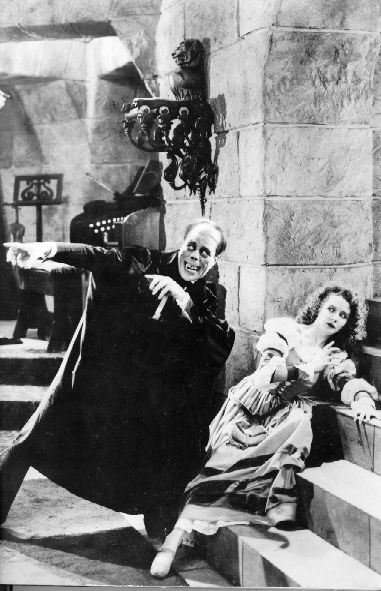
The original silent adaption understood far better the disturbing
nature of the narrative and it aims for creepy, unsettling horror. The film has
no shortage of melodrama but it also wishes to fuck with your head far more than your
heart (The non-horror bits are almost perfunctory). Lon Chaney, “the man of a
thousand faces,” easily slips into the role and the film doesn’t try to hide
the sinisterness of the figure and his actions. The make-up and costume design of
the Phantom are excellent, aimed for maximum ghoulishness.
And that’s what the Phantom is: a ghoul, a ghost, an individual
who is haunting and haunted (heck, it’s right there in his self-appropriated
title). For the first third of the film
the Phantom is spoken of in cautious whisper; his presence a suggestion and his
shadowy demeanor emphasized by sets and lighting of an exquisite Gothic design.
The film imbibes lessons learned from the art design of German Expressionism,
especially in the underground lairs and chambers underneath the Paris Opera
House.
The modern horror of shock value and excessive blood may
leave us numb and potentially incapable of being frightened by The Phantom of the
Opera. Its horror is psychological, of slowly building dread and gloomy, potent
imagery. The Phantom’s relationship with Christine is one of psychodrama. When
he lures her, hypnotizing her to come to the decaying underground world, she chillingly
calls him “Master”. The Phantom believes he can convince her to love him like
he loves her (though what he feels is not love, but a manic fixation).
On a smaller but crucial note: There’s something slightly
sexist in what takes place. Christine is not a fully realized character, and
she is torn between a mad man and a boring chivalric hero coming to her rescue.
Both men claim their goals from a place of male privilege; they’re figures of
patriarchy at its most self-serving and self-righteous. That might sound like
me picking too hard at the threads of something marked by its era, but it
matters: the Phantom does what he does because
he feels it is what society owes to him.
Webber’s version may have, in some ways, become the standard
version of the film, but so much of what Webber visually takes comes from the
silent original: the falling chandelier, the winding hidden corridors (In deed,
almost everything underground), the eerie mask (though later versions reduce the facial area covered), etc. It might seem ironic that
a film about opera can’t actually make us hear any opera music. But that music
might just be distracting. What carries over is all the heightened emotion of
opera, the grandeur of sentiments offered. Operas are larger than life and The
Phantom of the Opera paints on a similarly large canvas as well, turning
intimate terrors into grandiose nightmares.
Grade: A-

No comments:
Post a Comment