Tuesday, July 30, 2013

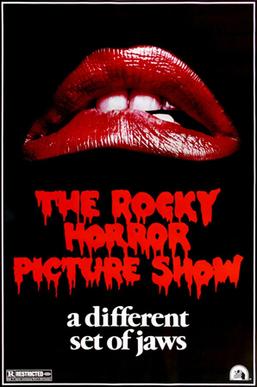
The Weird, Campy Cult Classic "The Rocky Horror Picture Show"

The Rocky Horror Picture Show has long been staple of off-the-beaten-path cinema for cinephiles. It was a cult movie before anyone was defining what a cult movie was. Overlooked in its own time but picking up attention through midnight movie screenings, the film began to take on a life of its own. You really don't watch the film so much as you experience it, and the experience today for the film has become infamous; featuring people performing the film in front of a screen that's simultaneously projecting the movie. The crowds at these screenings have seen the films dozens of time; there are ritualistic reactions assigned to viewing the film, and many prepare jokes to yell out at exactingly planned moments.

Now I didn't see the film in this manner as I've been told that its best to watch Rocky Horror on your own to get a sense of its casual ridiculousness before roping yourself into a screening. This isn't just due to the nature of these screenings but also because the film is fucking weird, and honestly pretty bad. It's one of those films that's so bad that it almost becomes kind of good. There's no point in grading it really (I think I'd give it a B-). It should be a D but there's so much endearing weirdness and headcase-like antics that it almost transcends its badness to become something that you have to see at least once.

To put this into a better context, Brad and Janet (Barry Bostwick and Susan Sarandon), a recently engaged couple that's squarely straight laced, stumbles upon a castle filled with transvestite aliens from Transexual, Transylvania. They're lead by their charismatic leader Dr. Fran-N-Furter (Tim Curry balls-to-the walls committing to the role with delightful results) who is doing experiments to create the perfect lover ... or something. It's kind of hard to follow, unfolding with the logic of a bad drug experience.

Oh, and there's music. All original music written for the film. Most well-remembered is the gloriously goofy "Time Warp Jump", which explains a dance to do to it! The music isn't bad but is so silly that it's hard to take seriously. Though it really is best to not take the film seriously as it never seems to take itself serious (Much of this is intended as parody of B-movies and sci-fi).

It's campy and fun but drags in lots of places. It's more interesting as the phenomena and experience its become than an actual movie. But there's still no denying that it's a certified cult classic no matter its shortcomings, and there's certainly never been anything quite like it before or since.

This Week in Film (7/30/13 - 8/3/13)

There's no theme for this week but I like the idea of a master post that collects all the posts for a given week and therefore I've decided to make up one for this week as well. Below are the various reviews and writings for this week. Perhaps a pattern will divulge itself! (Though I doubt it)

So sit back, grab yourself a tub of pop corn (and perhaps a cold one) and lets dish out on some movies.
 
Tally of Films:

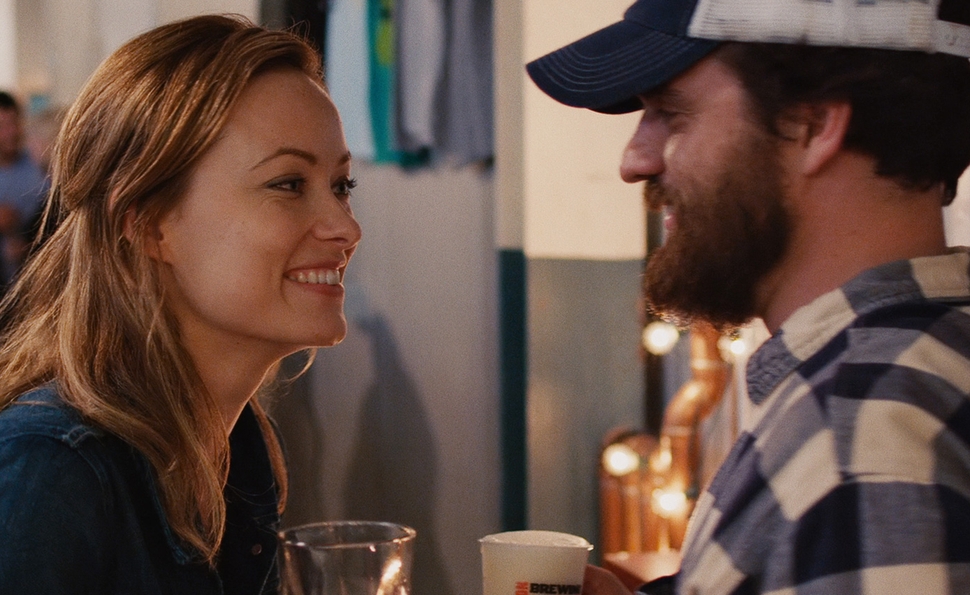
Drinking Buddies (2013) - Pour yourself a beer and consider watching this drama-comedy indie recently released simultaneously on demand and in theater at the same time. It's charming and easygoing and therefore probably nicely goes well with a drink.

Mama (2013) - The title is deceiving in that I would only watch it with your mother if she's into creepy and mildly scary movies. The devout horror fan will likely appreciate its old school horror storytelling even if it is overall a bit of a mess.

The Rocky Horror Picture Show (1975) - Time warp back to 1975 where rich, stick-in-the-mud white kids stumble upon some of cinema's most beloved weirdos (by certain niches at least anyway). This is leftover from when I intended to make this a week of cult movies. The enduring cult classic still has its moment even if it's incredibly uneven and insanely weird.

The Conjuring (2013) - The film gets bonus points for engrossing us so thoroughly in its creepy world. The Conjuring is a little film with small ambitions but, boy, does it ever deliver to us the scares we're looking for with maximum assurance.

Monday, July 29, 2013

"Mama" Provides Chilling Enviroments But Not Enough Story to Back It Up

Mama is a film that's more interesting than entertaining. For a horror movie, it's got the creepy, evocative, atmospheric visuals down cold but its storytelling is a bit more loose and uneven. There are some wonderfully textured and moody sequences that are equal parts unsettling and imaginative. The story though is less well put together and things feel disconnected from one scene to the next.

Two girls are taken to an abandoned cabin where their father (Nikolaj Coster-Waldau) is quickly picked off by some unknown entity. Five years later, the father's twin brother Chris (also Coster-Waldau) continues to spearhead a search to find his nieces, but when discovered they are found to be feral, as well as obsessed with a person they call "Mama". Chris adopts them but he and his girlfriend Annabel (Jessica Chastain) find it difficult to get through to the girls.

Twists and turns occur as they must in the horror genre. Things that go bump in the night do some bumping. Things pop up just at the corner of the frame to startle and frighten us. There are visuals that drip with eerie terror and darkness. Its very by the books, even as the mid stretch features an atypical exploration of mother-daughter relationships that is the most interesting, engaging, and emotionally rich part of the film.

Annabel is not on board with taking in the girls. This is put at odds when Chris is injured and incapacitated in the hospital. Soon Annabel is forced to bond with the two girls that she wanted nothing to do with before. Here the film takes advantage of Chastain's always great acting to really make the give and take between the girls and Annabel feel the emotional weight intended.

The film falls apart a bit at the end. It collapses under a muddled inability to determine how the film should go out (In overextended and baffling fashion apparently it decides). But before that there's enough well-executed horror setpieces and ambiance to carry Mama. It's good to see a horror movie attempt to scare us less through blood and carnage and more with straightforward storytelling; however Mama still could have been better executed.

Grade: C+

"Drinking Buddies" is More Ale Than Lager But It'll Still Give You A Mild Buzz

There's a shaggy dog quality to Drinking Buddies. The film feels like a couple people picked up a camera and just started filming stuff. This works to the films favor as it suits the subject matter; intimate, low stakes dramedy. Most of the film is about people talking and drinking (and drinking a considerable amount at that). The story isn't the strongest thing you're going to see out in theaters right now (and on demand as well). It largely plays out with rom com predictableness. Two couples find troubles in their relationships and yearn after partners in the other couple. Some consider it, some act on it, and relationships are tested and reevaluated. It really shouldn't work but the charm and likability of its performers (a sort of dream team featuring Olivia Wilde, Jake Johnson, Anna Kendrick and Ron Livingston) makes the material have an affability and a low-key pleasure to it. The four work off eachother really well and there's a sense of ease and familiarity that elevates scenes that could have been disastrous in the wrong hands.

It's indulgent and scatterbrained but there's enough chemistry and charisma from its four stars to salvage it from totally falling apart at the seams. 

Grade: B-

Post-Mortem on the Week of Films From the 2000's

The goal for this week was to watch films made between 2000 and 2013. This featured a good deal of rule bending. That began right with the very stated goal, which if I was being more honest should have been limited to 2000 through 2010. I changed that a little bit so I could cheat and fit in more recently released films and films that I'd seen in theaters. Then I broke it even more by including A Bug's Life which I had been dying to make an argument in favor of for a long time. On top of this, I chose to make the "week" end on Sunday in order for it to be a seven day running thing (not that it mattered as I missed two days altogether due to a lack of time).

Then there's the whole matter of how this set of films is not representative of the time period I set out to look into. There are several years that have absolutely no film whatsoever. And though I did my sincere best to include a wide range of films (for instance, Spirited Away is there so that animation got its fair due, Jiro Dreams of Sushi is there so at least one documentary was part of the conversation, and Spring, Summer, Fall, Winter ... And Spring is there both because its a foreign film and a film from what was then a rising film market), I haven't even scratched the surface of what made the 2000's such a great time period for movies.

This was all due to a combination of factors and there's not really any excuse other than that I chose movies I wanted to watch and then time caught up to me before I could level out the playing field. However, I'm very pleased by the movies I chose which turned out to all be great and I had been wanting to give them a chance for far too long.

This exercise was frustrating at times. The constraints on my options for films required me to not watch films that I really wanted to watch but didn't fit the billing (I hope to get to some this week). But it also made me remember that exceptional films are still getting made and that I've been neglecting them in favor of older movies. I hope that from now on I can have more of a balance between old and new.

Sunday, July 28, 2013

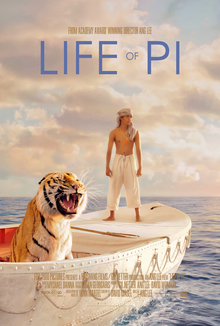
"Life of Pi" Has Gorgeous Visuals to Match Its Deep Spirituality

It's crazy that Life of Pi ever got made. The second biggest character is an adult Bengali tiger. The main character was an unknown actor. The story is based on a book deemed unadapatable. Almost the entirety of the film is spent out in the middle of an ocean on a shipwrecked raft. There's very little dialogue actually spoken in the film. And yet 20th Century Fox put millions of dollars into the production of director Ang Lee's visionary film, and I'm so glad they did because it was worth every penny. There's simply no way the film could have been made before recently; film technology never would have been able to properly capture the sweeping, exquisite vision that is the film's highlight. 

Life of Pi's fantastic centerpiece is about a young man named Pi (Suraj Sharma), the sole survivor of a shipwreck that takes the lives of his family, being stranded in the middle of the ocean on a raft. The time spent out on the ocean is technical wizardry at its finest. Watching Pi as he faces near death, the vicious tiger, boredom, exhaustion, and a spiritual crisis could very easily be plodding, boring and excruciating, but Lee turns this into an extended series of visually stunning scenes. Through green screens, a giant wave pool, and CGI the film creates grand, spectacular visuals that cue us into the vastness and beauty of the environment. The beauty of the film's look and feel fits with the underlying spirituality to it. Pi's only companions is a tiger named Richard Parker, a tiger his father once told him had no soul but who becomes both an obstacle and a saving grace. The central conflict of the film is less about Pi facing his impossible circumstances and more about Pi struggling to believe the tiger is worth saving and has a soul. And damn if the film doesn't make you identify with Richard every bit as much as Pi.

There's story that takes place before and after the the long sequence on the raft. We see an older Pi (Irrfan Khan) telling the story to an interested writer (Rafe Spall). He describes some of his life before the incident -- how he got his name, how he became the great swimmer that would aid in his survival, how he became deeply inquisitive about faith and religion, and shows us the zoo that Pi's father runs and where the animals come from -- and also poses an intriguing alternative to the story he's provided (one we're led to understand though less fantastical and more plausible is a far cry from the "truth"). These are great bookends to the story. The beginning is like an brief Amelie-esque set of bullet points that establish much of the tone (whimsical even at its darkest and most brutal), the visual style, and, of course, our reasons for caring about Pi, and also the tiger. And the ending is a wonderful restatement of the film' themes, its spirituality, its hopefulness, its sense of wonder.  

Life of Pi tells a fantastic, gorgeous fable. It's uplifting even at its most tragic. Most importantly though, Life of Pi has sense of awe about its subject matter and a desire to use the medium to properly convey it.

Grade: A

Friday, July 26, 2013

"The Shield" Ends Its Consistently Great Run With A Great Final Season

*Spoilers Below*:

The nature of the beast of  television requires that episode after episode after episode gets churned out. The end result is to have enough episodes to re-package for a syndication deal (the most profitable thing a television series can do, especially for the broadcast networks). In the mean time a show's job is to sell ad space. And this is in part the reason television has been looked down upon as a second rate cousin to film. Film's can tell neatly contained, well-wrapped up narratives. Television can reach highs but has to keep spewing out content even if its long ceased making sense from a quality perspective to keep a show on the air.

Serialization was something that was not really possible for the most part (outside of, say, a mini series). Some shows played with it, but attempting to draw in as many viewers as possible made that, for the most part, a toxic concept to the networks. Then The Sopranos became a sizable success, and though it wasn't a hugely serialized series, it had enough that that element was scooped up by shows born in its wake. Serialization is a a serpent eating its own head though. Yes, you can tell a long form story but the plot in turn becomes hugely important to how people perceive and enjoy the show. And when a finale or final season doesn't pay off fan's expectations or falls somewhat flat it recolors audiences' views of the show as a whole  (as was the case with the divisive finales of Lost and Battlestar Galactica or even The Sopranos - which frustrated people less because it was bad and more because it was just weird).

This a long-winded, roundabout way of saying that The Shield's final season has the massive burden of culminating in a satisfactory way because of how plot heavy it is. To end on a story note that was lackluster would make so much of the journey before feel just a tiny bit of a let down. The Shield had been a relentless plot machine for six seasons and that didn't end in its final season. The Shield was so consistently good though that expectations were weighing more heavily than with a show that's lost its way. The show's penultimate season is arguably its weakest season but its weak by standards of The Shield, which is to say it still damn good television. The sixth season acts like a giant bridge to the final season setting up storylines that payoff so well in the final season, however, that it almost feels worth it to spend that extra season getting to the last stretch.

Critic Alan Sepinwall once said that bad finales don't ruin a show but that good ones make a show. This has perhaps rarely been truer of The Shield. I don't want to overstate this, but simply put: the show ends about as perfectly as one could hope a show could end. This final season is so very, very good that it almost retroactively sweeps over whatever issues the show may have had (though to be fair, they were few).

I could discuss at length what happened over the course of the season but what makes the season as strong as it is is its culmination in the last few episodes. The season is almost more plot heavy in this last season then it was before, densely, intricately plotted, slowly building to a point of excruciating emotional devastation. And the payoff feels so thoroughly rewarding and plays off of so much of the history of the narrative and the characters that its equal parts gutwrenching and satisfying.

We knew the Strike Team would get their comeuppance at some point. The central conceit of the show had been about how the team barely survived one scrape after another. The question wasn't really if it would blow up in their faces but how. The direction the writers chose to go in was for maximum damage. The Strike Team's familial bonds implode and the members turn on eachother (after Shane believed he had no other choice but to murder Lem in a previous season). The conflict centers on Vic versus Shane, master versus protegee. As they attempt to outwit one another, they dig themselves further into a hole that becomes increasingly inescapable. Their myopia in trying to exact vengeance screws all of them (including Ronnie, the cleanest of the members. The character started out as a recurring character in early seasons before becoming a regular. The writers brilliantly built him up in later seasons, turning him into one of the most important characters -- the fate of Ronnie turns out to be every bit as a devastating as everyone else).

In the last few episodes, the plot slows down at times, something more intense and disturbing than the typical, pulp action. The show becomes quiet as if taking a breath after such unyielding plot machinations. Before revealing everything to gain immunity Vic pauses for forty seconds, a short amount of time but lengthy for television and it feels like forever. One of the final shots of the show is Vic sitting at his new desk job. He contemplates all he's done, the people he's screwed over in the process, the family he's lost due to it, and the fates he's resigned himself to. Waves of emotions slowly dawn on his face and Michael Chiklis makes his face crumple further and further inward to the point where you can't imagine there's another level of agonizing pain and weary self-realization that can be expressed, and yet there is. It's a beautiful piece of acting and it's a fantastic final shot (well, right before Vic grabs his gun and goes off into the night - where to? The right note of ambiguity to end on for a character who never could sit back and accept his fate).   

The Strike Team's story is excellent but the stuff around the edges is often every bit as good. The continuing tension between former partners Claudette and Dutch (Claudette now as captain of the Barn) is just as much of an emotional payoff, exploring their relationship and its meaning to both of them. Claudette's new position as captain and her frustration in the face of an increasingly difficult medical condition cause her to take out her anger out on Dutch. Dutch, knowing her too well though, suffers through it because he respects and admires Claudette too much and knows she's the best person possible to run the police department.

Not every character and story feels as though it gets a conclusion worthy of its longstanding nature. Acevada is left to be the self-serving, selfish political opportunist he's always been (though that's arguably the whole point of why it ends that way). Julian's crisis of identity between his faith and his homosexual feelings he doesn't agree with seemed to be dropped. However, everything else is so strong and so well-handled and executed that it doesn't matter. The Shield's final season justified the seven seasons we spent with it. I wouldn't trade those seasons as they were some accomplished programming, but this final season made it all the more worth it.
"The Man Who Wasn't There" Slyly Skewers Film Noir

The Man Who Wasn't There is a darkly funny, subversive noir. Though it is a noir, its a film that doesn't quite read like a noir. The film looks like a noir, even at times talks like a noir, but it's a whole other beast. In the hands of the Coen brothers the film zigs where we expect it to zag. There are the twist and turns of a noir but the film seems to be mocking our very enthusiasm for so much of the tricks of the trade. There are plots that suddenly, abruptly end when they very well could have been the story for the entirety of the film's length.

But the film treats the twists, much like everything else, with a casual indifference. This is because we see the film from the perspective of Ed Crane (Billy Bob Thornton doing wonders being affectless), a bland man who can barely be motivated to speak three words at a time. He's in a loveless marriage with Doris (Francis McNormand). Through the marriage he's entered the family business of barbering, a trade that's described as being about as dull as Ed is.

The film is filtered through the extensive narration of Ed. We hear more from Ed in the narration than we do anywhere else. He's a quiet, matter of fact guy who feels like he stepped out of Albert Camus' The Stranger. He takes things as they come rarely conveying much emotion or sentiment. The great irony here being that everyone else is the world's biggest chatter box.

Terrible things occur throughout the film, but it moves past them with a shit happens sort of mentality. The film begins with Ed being won over by a fly-by-night con man (Jon Polito) claiming he needs an investment for a great new invention (dry cleaning!). Ed decides to get the money by blackmailing his wife's boss Big Dave (James Gandolfini), who he suspects is having an affair with Doris. And then things continue to maddeningly spiral out from there.

The cinematography for the film is gorgeous. It simultaneously captures the atmosphere from the noir films of the 30's and 40's and the drab, square 1950's American suburbia. Ed's world is as paint drying interesting as his personality and curt responses. His blandness is contrasted with just how interesting and exciting the plot ought to be. The Coen's refuse to give us total thrills, in stead providing us with something darker, funnier (fittingly, hilariously deadpan), more cynical, and probably far more interesting.

Grade: A-

Wednesday, July 24, 2013

"Jiro Dreams of Sushi" Is a Contemplative, Elegant Character Study

Jiro Ono is the world's most famous sushi chef. He is 85, still running his three star Michelin rated restaurant in Tokyo. He lives, breathes, and, aptly enough, eats sushi. A stubborn perfectionist and dogged workaholic, Jiro has made sushi and the making of sushi his life.

Jiro takes the making of his sushi so seriously that it's almost become a form of art. In Jiro Dreams of Sushi, his process is described as a symphony or piece of music, and the stylistic form of the film is like a symphony. Classical music plays throughout and the film is shot with sheen-like, minimalistic elegance.

His restaurant is not a fancy place though. It's a tiny, tucked away place. But people must make reservations months in advance and one meal costs at minimal $300. Jiro has become a legend within the food industry and people go out of there way to eat his food and learn from him. He's a simple, serious man who loves his work and believes in doing it well.

Jiro is never satisfied, constantly seeking to improve his food and his technique; he's exceedingly hard on himself. He's also tough on his two sons who he insisted work for him rather than attending college. His sons resent him slightly (and they have a very strained bond with him, rarely seeing him when they were younger); it's never outright stated but they're frustrated with their father, who has continued working long past when anyone expected him to. Even a heart attack at the age of seventy has done little to setback his commitment to his work. His son now buys the fish but everything else is meticulously supervised by Jiro.

Jiro Dreams of Sushi functions as an fascinating character study and an intriguing glimpse into the sushi industry.

Grade: B+

Pixar's "A Bug's Life" Has Been Sadly Misaligned

Of all the Pixar films A Bug's Life feels a bit like the redheaded stepchild of the film studio. At least, that's the way everyone treats it; with disinterested apathy. Even more than the two Cars movies, people tend to treat it as a weird outlier by Pixar.

And for me, this perception never seemed to fit the film, which is just as exquisitely crafted as Toy Story (which was released three years earlier) or any of the films that came after it. But how we perceive the film is largely due to placement in Pixar's film canon. It's the second film produced by what was up to that point a scrappy little studio with only one hit on their hands. Toy Story had been a massive success both critically and commercially and this put a lot of pressure on Pixar to perform well again. If they put out something mediocre, well, we would just accept their first effort as a fluke.

Much of the discussion about A Bug's Life upon its release centered upon comparisons of it to Toy Story. The discourse inevitably shifted to saying, "Yea, it's good but not nearly as good as Toy Story". Agreed, A Bug's Life isn't as good as Toy Story but that's not entirely a fair or useful comparison. Taken on its own merits, A Bug's Life does what it's trying to achieve exceptionally well.

The animation is every bit as good as Toy Story. The characters are richly drawn and the story is told with such assurance and purpose. Pixar is as beloved as it is for these two reasons: its animation is excellent (and frequently boundary pushing) and its storytelling is thoughtful, engaging, and imaginative.

The opening sequence is brief but it quickly, entertainingly and confidently establishes everything we need to know. The character dynamics are laid out with an ease, complexity and breadth that would put many other films to shame. There's Flick, who's a bit of an oddball, misunderstood by the other ants. The queen ant is giving over duties to Princess Anna, who is nervous, and whom Flick has a crush on. Her little sis Dot looks up to Flick despite everyone else scoffing at her affection. The grasshoppers force the ants to collect a harvest for them, which goes awry when Flick's invention accidentally sabotages the collection. Flick decides to go out to find warriors to fight back the grasshoppers after they make the ants do the harvest all over again. The film drags a bit as it has to do another stretch of establishment for a group of circus performers who Flick will later mistake for fighters and ask to aid him. But once it gets past this, the film hums along and doesn't have to explain anything to us because we know who everyone is and where they stand.

Beyond its storytelling, the film is thematically rich. There's a great message in there about not judging people and the need for understanding people. This is a film that's often about misfits and wants us to root for them, whether it be Flick, the circus performers or Dot. Pixar films are frequently about outcasts, misfits and people who don't belong, and the films tend to argue about the need to be true to yourself.  

Of course, the animation is every bit as inventive and well-crafted as we might now expect from a Pixar film. Take the use of water droplets as drinks and the head of a telescope; it's a little detail but its one that provides texture to the environment and demonstrates a certain level of affection for this universe. There's a very good sense of the anatomy and movement of insects and the way in which they interact with the world around them. There's a realism underlying the antics that shows time, effort and a concern for attention to detail put into the film production.

Mostly why I think we overlook and misjudge A Bug's Life is that its subject matter about anthropomorphic insects doesn't seem as crafty or original as some of the other concepts Pixar has cooked up. Toys comes to life when you're not around. The monsters living in your closet are real. A man straps balloons to his house and floats off like a hot air balloon. It's nothing nearly as overwrought as these concepts, but what makes A Bug's Life more than its simple, cute story is the specificity that Pixar lends the film; this isn't a film about insects but a film about a quirky, misunderstood ant named Flick and his journey. That may sound obvious but so many films fail to give us characters that we feel for and identify with. Pixar does it in every movie and makes it feel easy.

Give A Bug's Life a second chance. It's a sophomore effort that's not nearly as sophomoric as we've led ourselves to believe.

Tuesday, July 23, 2013

Theme of the Week: The 2000's and On

This is shaping up to be a week where I explore films released in the 2000's and onward (2000 - 2013 that is). This was always a sort of a plan in my mind but I intend to stick with it (and hopefully by officially stating it, it will force me to actually toe the line). I've been so intent upon schooling myself on some film history that I neglected the film present (Which is very, very rich despite what you may have heard).

The manner in which I choose the films I watch is a mercurial process (I tend to have a couple films in mind but it's not a dead to rights thing. There are lots of films I was sure I was going to watch on a given day/week and still have yet to get around to) so I can't outright say what I'll be watching (or if they will remain in this previously mentioned era). But I'm open to suggestions (Spirited Away was chosen at someone's recommendation) and might consider making more "themed weeks" in the future.

A running tally of films so far:

Spirited Away (2001) 

Spring, Summer, Fall, Winter ... And Spring (2003)

Pacific Rim (2013) - Currently in theaters

25th Hour (2002) 

Despicable Me 2 (2013) - I previously reviewed the film but revisited writing about it after a second viewing.

A Bug's Life (1998) - I bend the rules a bit in order to try to change your opinion on this second, consistently misjudged effort by Pixar.

Jiro Dreams of Sushi (2012) -  Because it's only fair that at least one documentary get thrown into the mix.

The Man Who Wasn't There (2001) 

The Shield's Seventh Season (2008) - The 2000's were a great time for television as well as exemplified by the great final season of this fantastic antihero police drama.

Life of Pi (2012) 

Final Thoughts on This Week's Films

Odds 'n' Ends on "Despicable Me 2"

Re-watching Despicable Me 2, I found myself regretting my earlier opinions of it. No, it is not nearly as strong as the original Despicable Me, but it's also far more intelligent and deep than I initially gave it credit.

Amid a summer blockbuster landscape that has proven to be a bit of a wasteland, Despicable Me 2, even upon my first viewing of it, was refreshing for how colorful and uncynical it was. Now having seen a fair share of the summer movies (discluding indies and still having yet seen a handful of tentpole films), Despicable Me 2 ranks towards the top of the list. Too many films this summer have been abysmally bad (Man of Steel, Hangover 3, Grownups 2) that its a sight for sore eyes to see a film with a solid story that's often inventive and clever.

There's a consistently heartwarming story at the center of the second Despicable Me 2. While Gru is a more toothless character without his former villainy and one seemingly with little story left to explore, the parenting crash course that Gru is presented during the film is surprisingly earnest. Sub-plots I was previously dismissive of this time around I really took a shine to. Gru fretting over his teen daughter fawning over boys is not only very funny but spot-on in its accuracy. 

There are elements here that don't work. The villain "El Macho" borders perilously close to offensive. He's also a much less compelling and nuanced villain than the original's Vector. And the film simply doesn't spend enough time with him (It also does a poor job with the middle child Edith). The mall setting likewise never gets developed or built up satisfactorily. I would have liked to have met more shop owners; instead we're limited to two, one a not-so-red herring.

The minions remain the best part of the film. They're scene stealers, but the film thankfully never overuses them and they never overstay their welcome. Their adorableness is matched only by Agnes, the youngest daughter, who is an animation feat in her own right for her considerable cuteness. The cuteness though is part of the film's aesthetic which is bursting with dazzling color and memorable visuals. Take the journey of a spy car turned submarine plunging into the depths of the ocean. It is an astounding, gorgeous piece of animation. The animation is matched by an equally great voice cast. The cast has some wonderful comedic timing and it's only fitting we find great comedians such as Steve Coogan and Kristen Wigg added to the roster this time around.   

Despicable Me 2 is up there with Monsters University and Pacific Rim as the films of the summer that I've enjoyed the most. Monster University is another film I wish to revisit; I didn't give it enough credit the first time I saw it as well. It is another film brimming with a boisterous color palette and tons of fun ideas. Pacific Rim is also a film that's free of darkness. Perhaps what we need right now are films that don't try to be so serious or brooding or dark. We just need a fun time where we can laugh for an hour and a half, forgetting our worries. Despicable Me 2 does that without sacrificing creativity.

"25th Hour" Thoughtfully Takes on the Burden of Sin and Post-9/11 New York

The way a film carries itself is important. 25th Hour carries itself like a person whose seen and done too much and is simply weary of it all. Edward Norton's Monty Brogan looks like a dead man walking even before we learn what is weighing upon him. He gives off the appearance of man who wants to slouch and sag but has too much pride to let life completely crush him. We quickly discover that this is his last day before he has to go to prison for a drug charge.

25th Hour heavily carries itself like a film attempting to sort out some of the weight of living in New York after September 11th. There's a great monologue delivered by Norton early in the film where Monty stares into a bathroom mirror with "Fuck you!" scribbled in sharpy on the bottom left hand corner. He starts railing on everyone and everything: Fuck you he yells at various ethnic groups and demographics (show in a montage) that make New York City the rich and diverse place it is.

Eventually he lands on one final person to blame: himself. All he has to blame for the fate he's received is himself. He could have gotten out of selling drugs, gone into a more honest line of work like his childhood friends (Phillip Seymour Hoffman, Barry Pepper - though they're not entirely as straight and narrow as they seem or would like to believe), who he asks to send him off. He's grown apart from his two old friends, Jacob and Francis, having fallen into a less reputable crowd. Monty is a man sorting through some picadilos, confronting where life has led him and how culpable he is.

The one good act Monty believes he ever committed we witness pre-title sequence. Monty and his criminal partner Kostya (Tony Siragusa) stumble upon a severely wounded bulldog. Monty initially feels it deserves to be mercifully put down before changing his mind and rescuing the dog. The film cuts ahead five years later; the dog, Doyle, is all better but seems to be the only thing to have improved during the interval of time. There are a handful of flashbacks throughout the film, but the film primarily takes place over the course of the last day that remains for Monty and how he comes to terms with what he's done and the prison sentence that awaits him (There's only three options we learn: he runs, he kills himself or he accepts the seven year sentence. No matter how you slice it, it's not good).

There are subplots here but they're not nearly as interesting as the languorous dread that hangs over Monty's last day. Jacob, a teacher, has a crush on a seventeen year old student (Anna Paquin) who he runs into during the course of the farewell evening (It's very entertaining story played well by Hoffman and Paquin and provides a breath of air between the weightier material elsewhere).

Monty spends the day saying goodbye to his girlfriend Naturelle (Rosario Dawson), whom he fears ratted him out, his father (Brian Cox), who hopes to see him run away, Jacob, and Francis, who holds a grudge against Monty for getting into a criminal life. The discussion of issues that arose in the wake of September 11th never feel completely in synch with the rest of the film, but they also make sense for the first film that shot on location in New York after the attack. They also feel appropriate coming from director Spike Lee who has never shied away from such controversial subject matter and finds interesting ways for the weight of 9/11 to meld with the weight of Monty's incarceration.

Grade: A- 

Monday, July 22, 2013

"Pacific Rim" Is As Cool As It Is Entertaining

Pacific Rim is a film of exceptions amongst the big tentpole blockblusters released this summer. Where so many films featured big, dumb action that wasn't all that interesting or fun, Pacific Rim has plenty of action that is exciting and fun. Where so many films are dark and brooding, Pacific Rim is lighthearted.

Pacific Rim is a film that has a primary objective of giving us all the cool, awesome giant robots fighting giant monsters that our ten year old selves are clamoring for. And boy does it ever succeed! This action is sleek, cleanly shot and tremendously pleasing. It's easy to follow, brightly lit, clamoring with bright, eye popping colors. The monsters and robots are lovingly crafted and the action shines with great deal of affection.

The storytelling of the film harkens back to a simpler form of narrative. At times the story is archetypical; the characters largely fill certain roles: the rebellious hero, the vengeful romantic interest, the stern commander, the scatterbrained scientist. This is a simple tale of good versus evil. The alien monsters (called "kaiju" -- a reference to the genre of films that in part inspired the film) appear through a rift in the tectonic plates, a portal between worlds. A prologue quickly informs us of what's happened in the years since their arrival, and the film ensues almost entirely in the middle of a war where the appearance of the monsters is a matter-of-fact occurrence. The world has joined together to fund a program for giant robots (called "jaegers") to combat them, but the program is soon to be shut down. The commander (Idris Elba being stoically badass like few people can) attempts one last kamikazi run with the last four remaining jaegers to try to shut the portal for good.

The pleasure of the film stems mostly from how it finds so much nifty, merry, imaginative visual entertainment. While this feels like it ought not be an intelligent film, it's so lovingly and intelligently crafted that it rises above its cliches and its shortcomings. This is a film that revels in being fun and cool, and does it with such pride that you can't help but have a good time.

Grade: B+

"Spring, Summer, Fall, Winter ... And Spring" Is As Profound As It Is Visually Stunning

Spring, Summer, Fall, Winter ... And Spring is about a monk and his apprentice. They live on a floating Buddhist temple out on the middle of a lake. The film plays out like a series of vignettes connotating not just a change in season but significant passages of time; the titles represent the literal seasons we watch the story take place during but also the figurative time in the life of the protagonist, the apprentice. We watch him as a petulant child, a reckless teenager, an angry young man, a sobered middle aged man, and finally as the very master he had such a complicated and contentious relationship with.

The film is one of accumulation. The story gains heft and resonance the further it passes along. It asks us to witness the life of a person (At times the film is marking time; letting us really sense the passage of time). He's not always a good person but his master sees something in him. There's also a sense of aging and maturity that most people have as they grow up, forced to own up to the things they've done.

There's a sereneness to the film that often contrasts with its frequently painful and sad subject matter. The film takes advantage of its gorgeous scenery. The monastery is surrounded by beautiful, pristine landscapes. There's a lovely sense of the finiteness of man in the vastness of nature. The temple is a speck, and the people on it are less than a speck.

The film, as its title suggests, is concerned with the cyclicality of life, ending on a beautiful, poignant, and appropriately melancholy note. The film is a generally melancholy one; the master keeps trying to instill wisdom upon his tutelage and keeps failing. But he keeps persevering and the boy, later a man, eventually starts to embrace the teachings. But it's a slow process. The film's first segment finds the boy tying rocks to animals, torturing them. The master ties a rock to the boy while he's sleeping and has him untie the rocks while the large stone clings to his back. He tells the boy that if any of them are dead by the time he finds them he will have a stone forever weighing on his heart. This weight is continually felt throughout and it only gets heavier as the story progresses.

Quietly contemplative and repeatedly profound Spring, Summer, Fall, Winter ... And Spring is an elegant, elegiac film.

Grade: A

Sunday, July 21, 2013

The Beautiful Child-Like Whimsy of "Spirited Away"

Children are the protagonists in the films of Hayao Miyazaki. We see the world through their eyes. There's a a sense of wonder that pervades his films; it's a child-like wonder about the possibilities the world holds.

The films often start similarly. A family heads to a remote location, a new, unfamiliar place. They're moving into a new home. The distant place reveals itself to hold mysterious and fantastical things. It's the possibility of anything hiding, something awesome, just around the corner, just inside that forest or beyond that wall.

Kids are the heroes in these stories. It's childhood that is the unstated theme of the films. In Spirited Away, Chihiro is a ten year old girl; fearful of abandonment, worried no one will listen to her, that no one will understand her, that she'll lose those she cares most deeply about.

The animation of Studio Ghibli is unique. It's hand-drawn, lush, and soft. Simply drawn but filled with rich detail. The animation is infatuated with nature but also with spiritual, surreal and otherwordly things.

Chihiro and her parents stumble upon a fantastical other world filled with spirits and creatures. Her parents begin eating food randomly laid out, while Chihiro hesitates (Another Miyazaki trademark: children seeing the truth where adults cannot or will not). Her parents, eating like pigs, soon turn into giant pigs and mysterious, strange things start coming of the woodwork. 

Much of Spirited Away is storybook. Miyazaki is not really concerned with plot but with mood and atmosphere. The film is whimsical. The visions that the story comes up with are fanciful and splendid. The whimsy is also present in the story; Chihiro is befriended by a boy with magical powers, Haku, and turned into a work-slave by an evil witch. She's made to work at a bathhouse inhabited by anthromorphic animals, walking-talking vegetables, and other incredible sights (unlike those of any other film). Her love for her parents and Haku, and her faith in the goodness of those around her save the day.

Spirited Away is often considered to be Miyazaki's best film, his most representative (It's certainly one of his two or three best). It's a film with a lot of imagination and inventiveness. This is a film that's just a pleasure to spend time in its world; we enter following the tale of a child and leave feeling giddy like a kid again.

Grade: A

Tuesday, July 16, 2013

"Evil Dead" - Film Review

Being a remake, Evil Dead is likely to draw comparisons to the films that came before it. And it's important to say up front that while the film bears a passing resemblance to the original The Evil Dead, it's a very different film. The original was comedy in horror drag while this new film goes more for a horror vibe.

The film were given has call backs to the older series, the iconography and the famous scenes. But it's really not much more than an average horror film. Five people go to a cabin, creepy stuff starts happening and people get possessed.

There's still the original's penchant for raining down blood (at one point literally). But it's a more serious and moody film. This is at times to the film's detriment. Much of the excess needs to be played for laugh otherwise it feels unnecessary or glib.

There's also few actors in the film that have the charm and humor of Bruce Campbell. Jane Levy (being much darker than her work as Tessa Altman on Suburgatory might suggest) comes the closest but gets sidelined for an inordinate amount of time.

I appreciate the film's attempts to set itself apart from its source material, even if it doesn't entirely work. The film tells the story of a drug addict (Levy) heading to a cabin with friends and family to go cold turkey. The film, in a way, becomes an odd metaphor for overcoming addiction.

The drug angle allows the film to make excuses for the characters to initially keep avoiding the truth of the situation they're in. But it's also never really given enough room to breathe. The characters could have been there for any number of reasons and the film never entirely justifies this idea.

While the film has its problems, it's pacing and tonal shifts are pretty bad, it has an extraneous introduction, and it tries too hard to provide explanations to its horror, there's still a pretty good sense of atmosphere, a few decent horror setpieces (though never really all that scary - but with a couple good twists), and a final sequence (the film's best and scariest -  and also most absurd) that almost redeems the film. It's duller than it ought to be and less scary than it could potentially be, but it's not entirely a disservice to the far more inspired original.

Grade: C+

Monday, July 15, 2013

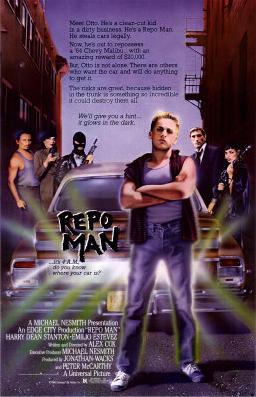
"Repo Man" - Film Review

Repo Man is tonally and structurally one of the most bizarre films I've seen. It never comfortably figures out what exactly it wants to be. It's funny, with a satirical bent at times (mocking consumerism and conformity), but it's also very dark, weird, and offputting. And It's constructed with such looseness and aimlessness that it's hard to know what we're supposed to take away from the film.

Emilo Estevez plays Otto, a would-be slacker who decides to start repossessing cars when his parents blow their money on donations to one of those television churches. Most of the film is watching him learn the ropes of the repo life, but there's a story playing out in the background about aliens whose remains have been smuggled out of Area 51. These extraterrestrial remains are in the trunk of a Chevy Malibu with a high repo bounty on it, and so in time Otto's path crosses with it.

It's as weird as it sounds and never compromises to be normal or predictable. It's also pulpy; mixing the seedy, the trashy, and the visually lucid. And for some its strange, punk, anarchic sensibility will surely ring true for them, but for myself, I'm still a little uncertain.

Grade: B-

Saturday, July 13, 2013

"As Tears Go By" - Film Review

As Tears Go By is an odd mishmash of deadpan humor, melodrama, romance, crime drama, and vivid imagery. And I'm not entirely sure it succeeds.

The film is about a criminal who attempts to help out a deadbeat criminal partner while wooing over a cousin he just discovered existed. 

There's plenty to like in the film. The meet-up between Wah (Andy Lau) and Ngor (Maggie Cheung) plays out like a more serious version of Stranger Than Paradise. These early scenes are simultaneously very funny and also tantalizing.  

The romantic elements are deeply erotic and even swooning. There's an epic sweeping scene set to Berlin's "Take My Breath Away" where the lovers run and embrace after having previously avoided acting on their feelings. This is every bit as affecting as the film intends it to be and exquisitely stylish to boot.

There's also a significant amount of brutal violence that at times is strangely elegant in how its shot by director Wong Kar Wai. The violence is twisted enough that though its entertaining its also almost never allows us to entirely be in the moment. Much of the romance is also dark and neurotic enough that it never becomes entirely cliched.

The film has sentimentality to it which is perhaps best seen in the relationship between Wah and Fly (Jacky Cheung) which is brotherly. Wah keeps bailing out Fly from his botched criminal activities and debts that increasingly put both in harms way. Wah would be better off without him but he can't escape the codependency.

But a lot of these elements while interesting on their own feel disconnected from one another, as if this is three or so different concepts for films pushed together. While Kar Wai certainly knows how to shoot things so their far more engaging and artistically interesting than the material might suggest, it still doesn't stop the film from feeling incomplete.

Grade: B

"Sansho the Bailiff" - Film Review

Lots and lots of miserable things happen across the course of Sansho the Bailiff's run-time. It's a sad, moving fable about doing the right thing in the face of the tragedies and difficulties of life. And yet despite the fact it puts us through the wringer with one devastating turn of events after another, the film is powerfully uplifting and hopeful.

The story it most reminds me of is Les Miserables. It has the same sort of scope and weight. In both narratives impossibly terrible things happen to people over the course of many years, but rather than feeling emotionally manipulative, it all feels totally earned. Both richly draw their characters and the situations they're put in, and then elevate the story to one of lofty but great themes about hope, redemption and loss.

On its face, Sansho the Bailiff appears simple, even in its direction by Kenji Mizoguchi which is continually reserved. But it slowly draws us into its story engrossing us as it moves along with a sense of patience and purpose. There's a seamlessness to the pacing and flow of the story.

The film is a period piece set in the Heian period of feudal Japan. It is about a family and their struggles. Their first misfortune occurs when the father, the official of a district, refuses to follow orders that would harm his people. Formerly aristocrats, their fates are left uncertain. As his wife and children travel to visit him in exile years later, they are kidnapped and made into slaves. The children are separated from their mother. The kids bide their time hoping that their parents are still alive and that they might one day escape. They are under the possession of the ruthless Sansho, who brands the face of anyone who falls out of line. Zushio grows bitter and loses faith in escaping or changing his life, while his sister Anju keeps hope.

The film has the fullness in its look at the lives of its character. We see Zushio and Anju as children and later as adults. We watch as the burdens and sacrifices that life forces upon us shape them. The film poses to us how we keep faith in the face of dire circumstances that should make us despair and crush us. Zushio breaks in the labor camp, becomes Sansho's trusted servant, hates himself for it, and then is forced to confront what he has done.

Its construction it is so carefully calculated. Its storytelling is something so profound and poetic that its hard to put it into words. And between its exceptional craft and deep story, it is a thing of beauty.

Grade: A

Friday, July 12, 2013

"My Darling Clementine" - Film Review

My Darling Clementine could very easily have been a revenge narrative or about two leading community figures butting heads, but instead it chooses to spend a lot of time just hanging around an Old Western town called Tombstone. Those first two storylines are pushed to the background of the film, and we get to see the lives of people living in this lawless, isolated Old West town.

There's a grit to the film. The town is filled with booze, prostitutes, gambling and individuals of questionable trustworthiness. Even our protagonist Wyatt Earp (Henry Fonda) is selfish and vindictive. The paragon of the community Doc Holliday (Vic Mature) is a controlling and bitter man. The kindest indvidual is the titular Clementine (Cathy Downs), a spurned lover of Holliday, whose a prim and proper middle class figure from back East. And she's hardly the focus of the film, despite the title's suggestion.

But the title is fitting because it's a film where no one gets what they want (She never gets to be anymore than a mere "darling"). Earp and his brothers are cow wranglers who go into Tombstone as a respite from their travels, only to return to find the brother they left behind has been murdered and their cattle is gone. He takes up the job offering as the town marshal, which puts him at odds with Holliday and a bunch of shady cow wranglers called the Clantons. Holliday rejects Clementine, who keeps loving him despite his treatment of her, and he's equally terrible towards prostitute Chihuahua (Linda Darnell) who he's promised to marry (and never does, nor seems to really be committed to it). Earp clearly has feelings for Clementine but finds it best not to act on them, thus never ending up with her. And the price of the justice for Earp's brother proves to be incredibly costly, leading to the death of many people from the town.

This is not the most romantic of Westerns. It's moody, especially in its shots of nighttime. There's a longing, loneliness and isolation about the film. The most exciting things that happen to the town are the appearance of a Shakespeare performer and the completion of a church. There is little in the way of civilizations for many, many miles (though it starts to make its appearance over the course of the film). Tombstone is just a speck on the horizon of Monument Valley, but there's a lot of life in there. There's a lot of hope bubbling underneath all that melancholy, and it's embodied in the glimpses the film gives us of the town and the people who inhabit it.

The film is technically about the infamous gunfight at the O.K. Corral, which we witness towards film's end. But it's one of the least important parts of the film. This isn't a film about Wyatt Earp, and Fonda plays him rather unassumingly. It's about the idea of the Old West, and director John Ford explored that from countless angles throughout his career, but few as effectively as this.  
 
Grade: A 

Thursday, July 11, 2013

The Scandalous Thing About "Scandal" Season 1 is That It Might Be Good

Our seemingly sensible selves tell us that Scandal is not something we should watch by choice other than begrudgingly and in hushed tones so no one is aware we're watching something with so many crazy twists and turns. Scandal, especially early on, feels like its going to be a guilty pleasure. It seemingly a series that is good at indulging in our baser instincts of what we expect from television in fast-talking, soapy fashion. Our sensible selves tell us: there's good stuff in there but its all so clouded over by its more, well, scandalous elements.

And certainly, there are ideas that feel half-baked on the show, and it definitely has a little more leg work to go in order to relieve itself of the label "guilty pleasure". But Scandal is a show that isn't half-bad at what it does, even if what it mostly does is lightly skewer the current political environment with potshots at both the Left and the Right and everyone in between (There's an episode where the case-of-the-week features a South American dictator, and it's every bit as "Um, okay then ..." as you might expect).

Tethered by the awesome central performance of Kerry Washington as super lawyer Olivia Pope who has gone from former White House adviser to political fixer, the series primarily focuses on procedural cases, gradually tying in a larger story connected to some illicit activities involving the President. Creator Shonda Rhimes makes the dialogue snap out of her characters like they're hopped up on five-hour energy, and the dialogue is the kind that often sounds cooler said at a whiplash pace than it might actually be delivered any other way. Some of it is a little too cute or neat (There's a running joke about "wearing a white hat" that borders on trite).

Pope runs an agency filled with lawyers that she's plucked out from the Island of Misfit Toys. The company takes on the cases of whomever walks in their door, fixing their client's problems without judging them. Slowly the supporting characters are revealed to be more than do-gooders and deliverers of exposition, and though the different cases vary in quality, what they slowly reveal about the operations of the company are suggestive of a really cool set-up that you'd only ever witness on television. Pope is steely and seemingly totally in control which means, of course, she's got her own baggage that slowly reveals itself.   

Scandal is a plot heavy series, which means a shortened seven episode season never really allows the show to find its footing. The pilot features a newbie being hired by the company and we begin to see the rest of the characters primarily through her eyes. But the series never even really gets to develop this angle, cliched as it is. Too many little plot threads are hinted at but never get to take form and that's what the problem is; Scandal is attempting too many things at once, and some of it is interesting but some (okay a lot) of it falls flat.

But between the performances of a cast that is at times more convincing than the material provided and an affection for giving its audience a delectably fun time (at times a little too predictably and plainly so), Scandal does exactly what you'd expect. And that's not a bad thing. The real scandal of Scandal is that this might just have the potential to grow into a very good drama. And it's doing it by giving us what we want; that's not a guilty pleasure, that's just a pleasure. I could see this show working out the kinks; developing the under-serviced supporting players more and turning the cases of the week into something with more teeth.

I'm not saying you should expect wonders from the first season, but it's okay to embrace the pleasure part of that guilty pleasure you're experiencing.         

"The Treasure of the Sierra Madre" - Film Review

The Treasure of the Sierra Madre is the tale of three men who go seeking gold in the mountains of Mexico and discover gold, yes, but something much bleaker as well. It's a story that becomes more compelling and darkly philosophical as it moves further along. Built on themes about greed, madness, and betrayal, Sierra Madre is a deliberately paced film that explores some of the darker elements about isolation and money-seeking.

The film has the quality of film's like Apocalypse Now. There's a journey that unfolds slowly, at times surreally. We have an idea of where this is going but the story keeps unfolding with a feverish intensity. There's a exceptional character study at the heart of the film, particularly of Humphrey Bogart's Fred C. Dobbs. Events conspire to pull at the frayed strands of Dobbs' psyche.  

The film is carried by the sharp dialogue of John Huston's script and the great performances of the three leads, including Tim Holt, Walter Huston (John Huston's father), and, most memorably, Bogart. Bogart as Dobbs, the most paranoid and desperate of the three, was born to speak this dialogue which crackles with his pronunciations, even as it also starts to sicken. Huston is also great as Howard, the old-time prospector whose seen it all, and acts as foil to Dobbs.

The film is fantastic at conveying the overwhelming sense of inevitability of the events that occur, which play out like a morbid Greek tragedy. Dobbs claims early on that he'd get a little bit of gold and get out before the desire for more overcame him, and in that moment we can foresee where this is all headed.

On one level, the whole film is a giant morality tale. A number of scenes are clearly staged on studio sets and there's a studio vibe to it at times (Much was filmed on location, though the night scenes weren't) - especially Howard's time spent in an Indian paradise. But it's also surprisingly dark for a studio film of this time.

Director John Huston does a phenomenal job of pacing and structuring this, and filling it with a keen attention to detail (The gold mining takes place a fair amount of time in after we've gotten to know the characters and see just how desperate they are). Blackly funny, adventurous, and wonderfully melancholy, The Treasure of the Sierra Madre is a classic.

Grade: A

Wednesday, July 10, 2013

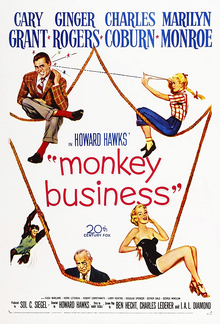
"Monkey Business" - Film Review

Monkey Business is a delightfully screwy comedy. A boring, absent minded scientist (Carey Grant) is working on a formula for a youth serum and testing it on monkeys. When one of the monkeys solves the formula before the scientist, he slips the mixture into the water cooler and soon has the scientist convinced he's figured out the answer to the fountain of youth. This in turns leads to lots and lots of shenanigans.

This is unquestionably a silly film but so much of it is pitch-perfectly zany that it doesn't matter how much of a stretch so much of it is or how ridiculous so many of the plot turns are. Grant and Ginger Rogers, as his wife, commit to the transformations caused by the serum and it leads to some predictable but hilarious scenes where they act first like they're in their twenties and then as if they're in pre-school. Grant gets a new hair cut, a new suit and a new car; crashes the car, and takes Marylin Monroe, the secretary of his boss - really just Monroe playing Monroe as she did in so many films and always pleasingly so - out on the town. Rogers pulls pranks on Grant's boss, before attempting to recreate their honeymoon night, which, of course, ends up disastrously. A fight gets out of hand, Rogers kicks out Grant, and calls up her lawyer to work on the divorce papers.

In the vein of screwball comedies (including director Howard Hawks' great Bringing Up Baby), this is a woozy escalation of events. The earlier comedy sequences seem quaint when compared to the ones towards the end (which really are testing credulity). Grant paints his face as an Indian and with the help of some neighborhood kids scalps the lawyer. Meanwhile, Rogers mistakes a baby for Grant, assuming the formula has gone terribly wrong and de-aged him too far.

There's no questioning this is a little dumb and a little goofy, but Hawks keeps the film humming along. The film never really takes a breather, continually pushing forward with one joke after another. And it's all so charming and funny that it doesn't matter that this is a little absurd. The film's enjoyment comes through its embracement of its absurdity.

The star power and the direction here turn what could very easily have been something bad into something with impeccable comedic timing. 

Grade: A-

Tuesday, July 9, 2013

"Bad Taste" - Film Review

Bad Taste is straight up with its aims; it's right there in the title. It's a trashy, schlocky film that revels in "bad tastiness".

The film is perhaps best known as the debut effort of director Peter Jackson. In the film we can see a lot of what would make up his later films, particularly those of his splatter film period. Though the story is dearly in need of more substance, the craft here is great. The special effects are inspired, and gloriously, often hilariously, over-the-top. Jackson is clearly working with a limited budget (he plays two different parts, along with writing, producing, making effects, doing make up, and directing the film) and out of that he comes up with some inventive ways for action, tension and humor (at some points disgustingly so).

Jackson keeps the story simple. A secret, small government agency is assigned to contain an extraterrestrial attack upon a small, isolated New Zealand town. The aliens have possessed the bodies of some of their victims and seek to eat any human that comes in their way. The aliens are harvesting human bodies to be used as part of a fast food franchise.

Jackson slowly builds up the story, starting out with smaller horror and action setpieces before building to a series of slightly indulgent, awesome and a bit tacky fight scenes where guns go a blazing.

Underlying all of this is a dry humor. There are a number of throwaway lines that are wonderfully biting and satirical without drawing attention to themselves. The film's humor is what drives it. The storytelling is constantly aware that this is a little trashy and has fun with its crazy, silly premise. 

Through the film such a high level of affection comes across that even at its low points, it's a little giddy. 

The storytelling is lacking a little too much, especially early on. But there's some good splatter effects and it's interesting to see where Jackson got his start.

Grade: B-

Monday, July 8, 2013

"The Queen of Versailles" - Film Review

Lauren Greenfield's Queen of Versailles finds a unique lens for exploring issues surrounding the economic state of the United States. The film tells the story of one of the nation's wealthiest families, the Siegels, pre and post 2008 economic collapse. And in the lavishness of their lifestyle and in the conflict it comes into when confronted with economic problems, the film finds a sad, darkly funny tale of excessive consumption and materialism with much greater implications for the larger U.S.

David Siegel made his fortune by founding the world's largest time share company, Westgate Resorts. So assured of his success and a workaholic, he put all his time and energy into the company. Nearly all of his family's money is tied up in the company. His wife Jackie dropped out from an engineering job at IBM to pursue a career as a model, which she was successful at for some time before marrying David. Now she lives out her days in their massive home with dozens of dogs and her seven kids. But this is not enough; she convinced her husband to build a full scale replica of France's Versailles Palace (the largest single family home in the U.S.), a house that remains incomplete.

In the miniature Versailles, Greenfield finds a near perfect unintentional symbol for her subject matter. The Versailles on the outside is near complete; it's luxurious, extravagant, and, to the right eye, gorgeous. But the inside is unfinished with scaffolding still in place. Greenfield started out the film before the 2008 and continues the story with a new direction in the face of the Siegel's new found struggles. The Siegels seem baffled in the face of their new economic challenges; they don't even speak the language of this downgraded lifestyle. The Siegels have to make sacrifices (sacrifices that Jackie never really takes to heart). Versailles has to go on the market (but who the hell is going to buy it?).

Greenfield is cynical about her subject matter. There are times where she's clearly taken aback by how ungrateful and ignorant the family so constantly is, particularly Jackie, a former Miss America contestant whose slowly becoming a plastically calcified version of her former self. Greenfield has an eye for images that consummately encapsulate everything that's happening and that she wants to get across. For example, at one point, there's a wonderful, hilarious shot of a stretch limo going through a McDonald's drive thru.

It would be all to easy to villainize the Siegels (and Greenfield's opinion seems to sit with more bemused discontent). But the film does a really great job of showing the fullness of the world its exploring by branching out to do interviews with the children and employees of the Siegels. In the employees, the film nicely demonstrates the extreme contrast between the Siegel's life and those living more typical and difficult American lives. The Siegels aren't completely terrible people; they're just people who've known too little of any other life for far too long. Both David and Jackie grew up in low income families, but though they mention this, it's hard to imagine it.

It's a surprisingly sympathetic portrait but it's also one that doesn't hold back its punches, allowing us to take a strange pleasure in the near demise of this frustrating and selfish family.  

Grade: A

Sunday, July 7, 2013

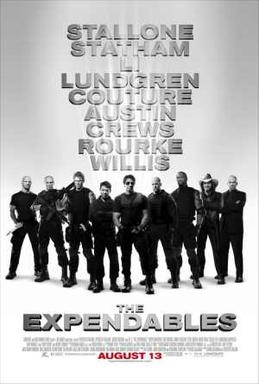
"The Expendables" - Film Review

The Expendables is a film all about massive wish-fulfillment. It seeks to answer what diehard action fans have surely pondered to themselves for ages: what would happen if you took the biggest action stars and put them all into one film?  You'd apparently get The Expendables which features a cast that includes Sylvester Stallone (who also directed), Jason Statham, Jet Li, Terry Crews, Mickey Rourke, Randy Couture, and Dolph Lundgren teaming up to do badass action-y things.

We get the loosest of plots about an extra-paramilitary force (called The Expendables) that runs covert missions for private gain. There's a mission about taking down a South American dictator and the American business man he's gotten into bed with, but it really doesn't matter. This is a film that isn't concerned all that much with a plot and is more concerned with hyper-masculine, over-the-top action. And in that regard it's rather successful.

The film's most obvious shortcoming is failing to take advantage of its cast. Arnold Schwarzenegger and Bruce Willis make cameos but it feels like a throwaway. Besides Stallone, Statham and Li, most of the other actors are sidelined.

Going into a film like this, you're aware you're not getting a film with a spectacular story or depth, but that's okay if you're interested in some well-choreographed, explosive fight scenes. The action is at times so excessive that it's hard not to laugh in the face of its extreme self-indulgence.   

This is a dumb film but it's never one that pretends to be smart. If you're willing to overlook some glaring storytelling problems, there's some high-octane entertainment to be found in The Expendables.

Grade: C

"Spring Breakers" - Film Review

Harmony Korine is a provocateur. He's a writer and director known for his films that try to shock us.

His first attempt to provoke us in Spring Breakers is in the casting. There's definitely an element of stunt-casting to having Selena Gomez and Vanessa Hudgens appear in Spring Breakers. The film is playing against their perceived family friendly, Disney personas. Of course these are personas that have been built up over many years, and the film is concerned with appearances, particularly manufactured ones. 

The story of Spring Breakers is a simple one. Four nubile college females (Gomez, Hudgens, Ashley Benson, Rachel Korine) are obsessed with going to Florida for spring break but don't have to money to do so. So three of them decide to rob a chicken joint to gain them the necessary funds to stay down in the Sunshine State. They seem almost unconcerned by the violence they've used to acquire the money; in fact, they almost revel in the rush of the experience. But this fits in with what much of the film argues. The film makes the case about the emptiness and vapidness that underlies so much of this partying-obsessed lifestyle.

The film's lighting is bright and its editing style is frequently filled with quick cuts. It's like the film is on ADHD. The vibe the film gave off to me was like a dance club, but it's more like coming down from a high and realizing the club is little seedier than you first realized. The color scheme for the film is a bright and super saturated; everything pops but it's lots of neon colors which almost becomes hard to visually take. The music choices similarly blare out; it's lots of techno, house and dance music.

The film is often one that's more concerned with its ideas than its story. The film ends abruptly and little actually happens in the course of getting there. We see the girls do lots of bad things, and be blind and ignorant to the damage their causing. This is at times property damage or physical harm, but there's also lots of psychological harm being wrought throughout.   

There's not much distinction between the four girls, but perhaps that's the point. They're stand-ins for all the people like this. Gomez plays the ostensibly "good girl" whose religious, and at one point super ironically comments on the spiritual awakening the trip has lent her. But besides that there's little done to give us a sense of what has led these people to this point in their life.

James Franco arguably gives the most memorable performance in the film. He plays a criminal who bails out the girls after they end up in jail midway through the film. The performance is ridiculously, almost unbelievably, hammy.

The film gets it message across at its best when its showing subtler contradictions. There are moments in the film that in the hands of another director would be erotic or sexy or tantalizing, but here are sad, pathetic, and even disgusting. There's plenty of nudity throughout and Korine lingers on the images of naked bodies. The objectification is magnified times ten to the point where it's not sexy or interesting, but just a matter of fact. What initially might have seemed like an exploitative film is much more contemplative and venemously indicative.

Grade: B+ 

Saturday, July 6, 2013

Bidding Farewell to "Happy Endings"

Not too long ago it was announced that Happy Endings was canceled. I only just recently finished up the last three episodes that had piled up in my queue (not that my watching in real time would have saved the series with the abysmal ratings it had), and so I now feel the need to share some thoughts on the series.

Initially Happy Endings held little promise in its midseason run first season, which felt too familiar and too uninspired to amount to much. But in time the show grew into something much better and much funnier. The show grew into a hyper-aware sitcom, skewering the very conventions it was playing around with. Happy Endings was a flopsweat of countless jokes, scripts brimmed with joke upon joke.

Happy Endings was a show that was hyper-literate and versed in pop culture. At nearly every turn it would throw in a spoof, homage, or just a sly joke puncturing genres. The characters on the show seemed to know, on some level, that they were sitcom characters, and the show played around with this to some fun results. This was a great cast filled with delightful performances. If nothing else, the show made us take notice of Adam Pally who I would say was the series' highlight if it weren't for the miraculous utilization of Elisha Cuthbert as Alex. 

Above all else the series was hilarious. If one joke didn't land, there would be a dozen immediately following it that would be sure to get you. The speed of delivery and the types of jokes Happy Endings was telling set it apart from so many shows, but it also made it a perpetually low-rated series. When ABC pulled it before clunking it down on the death-knell of Friday nights, burning off episodes two at a times, well, the end was spelled out.

The cancellation is a shame. Happy Ending was a messy show but often an ingenious one. It was a show best simply enjoyed for its wacky, glorious antics. And now we shall get no more of them. 

"Les Enfants Terribles" - Film Review

Les Enfants Terribles is about a sickly codependent brother-sister relationship. At first, it seems like any ordinary sibling contentious affection and rivalry, but it soon reveals itself to be something much more complicated (potentially incestuous).

Elisabeth takes care of her brother Paul after he becomes injured in a snowball fight. They soon become inseparable, spending all their time together. But the relationship becomes strained as both branch out.  

The film starts out as something more naturalistic and grows into something more theatrical and philosophical. The early naturalism is continually undercut by the voice over from an omniscient narrator who provides the events with a darkly whimsical and metaphysical quality (The narration is a bit excessive and gets into flights of fancy). The film is even playful in the early going, showing a loving but slightly self-destructive relationship between Elisabeth (Nicole Stephane) and Paul (Edouard Dermit). Stephane gives a fantastic performance, especially towards the film's end.

The film is a bit jumbled, filled more with vignettes than a complete throughline of a narrative. But the sibling relationship remains throughout and is fascinating. So much of the film contains such a sense of atmosphere that even minor scenes are interesting, and then this cinematography becomes ever more heightened in the film's third act. It becomes gloomy, dream-like, foreboding.

Not all of this works. Certain turns in the plot and character motivations/actions come out of nowhere. But the film at its best is wonderfully dreamy.        

Grade: B

"World War Z" - Film Review

World War Z is about a man doing everything he can to protect his family. Gerry Lane (Brad Pitt), a former U.N. employee, is called in to look into the cause of the viral spread that led to humanity’s crisis. The military will only allow his family to remain on an offshore naval base if he makes himself useful. And so despite how little interest he has in this, he sets out to try to find Patient Zero, the first person to have been infected. This takes him first to South Korea and then Israel and finally Wales. The film is a somewhat globetrotting one, but the film never overstays its welcome in any one location; it stays long enough for it to get in the story it needs without making us lose interest before moving on.

The film is somewhat uneven. The transitions from one part of the story to the next are poorly handled. As is, World War Z feels like a number of different stories mashed together. These different vignettes are all pretty fun in of themselves but they don't always add up to the most cohesive of films.

Not all of the action and horror in World War Z is successful. There’s a scene where zombies form a ladder and climb up over a defensive wall, and it not only stretches plausibility but isn’t all that interesting (it doesn’t help that the CGI here is pretty crappy). But much of it is rather effective and occasionally pleasingly inventive. There’s a great scene midway through upon an airplane that is one of the single best uses of zombies I’ve seen in a long time. There’s an even better scene at film’s end that is super intense and suspenseful where our hero has to grab medical supplies from a sealed off portion of a research facility. The film draws this out with engrossing and thrilling results.  

What I was most struck about World War Z was how effectively it found a story within what was at times huge zombie action taking place. The film focuses in on a few people and it makes the drama and our investment based in these handful of people, and it does this well. We start the film in the home of Gerry with his family. The story follows them out into traffic, where they get caught in the middle of a zombie invasion into Philadelphia. And we keep following these people, seeing the drama through their eyes. In this way the action never becomes all-consuming or distracting, like say in Man of Steel. Though a number of these characters never really get developed enough, Brad Pitt gives an assured performance as Lane. 

There are weaker and more questionable moments, and it's uneven in places, but World War Z is largely entertaining.  

Grade: B-

Friday, July 5, 2013

"Starship Troopers" - Film Review

Starship Troopers is a film that’s often hard to read. It’s intended as a satire but it’s satirical in a genre, sci-fi, that rubs up against this tone in strange ways. The film is so often peppy and upbeat in the face of its carnage and its macho action. This makes it sometimes hard to wonder whether you’re supposed to be simply be bemused or actually laugh at things. Enough content is played straight that it could be mistaken as serious. But it becomes clear from the strange interspersed “television clips” from the programs played in this far flung futuristic society (these are some of the film’s most hilarious moments).

Like other films by director Paul Verhoeven, such as Robocop, Starship Troopers is having fun at the expense of its excessive violence. The blood, guts and goo is played up for some delightful excess. The troopers find themselves fighting some villainous insect aliens. The film’s other excesses come in the form of society’s military complex which has come to engulf everything (fascistically so). Jingoism runs amok in the Starship Troopers universe. 

The film drags in spots, especially towards the end which repeats a number of earlier ideas to diminishing returns. But on the whole Starship Trooper’s satire is thoroughly unique and consistently funny. The production design is filled with intentionally chintzy and silly elements that add up to a sort of campy, lovable charm. Though because of how Verhoeven plays so much of the material, it’s often hard to know what to make of what we’re seeing, it’s at least never boring.   

Grade: B

"Beyond the Valley of the Dolls" - Film Review

Director Russ Meyer was the King of Sexploitation in the 60's and 70's. When he teamed up with Roger Ebert to make Beyond the Valley of the Dolls, he created one of his best remembered films.

Beyond the Valley of the Dolls is a weird, goofy, trashy film that went on to become a cult classic. Sexploitation, the genre of film-making Meyer's worked in, called for lots of violence and nudity, and there's plenty of both on display here. The film is sexy, displaying ample amounts of objectification (of both men and women - but mostly women). Much of the film is allowing attractive people to simply be attractive.

Despite how trashy and exploitative the film is, it's also smarter than that. Meyer and Ebert's script provides the film with a fair amount of satire and social commentary, and though some of it isn't entirely graciously handled, it gives even the sillier and limper moments a sense of purpose they otherwise might not have had. The film is very much of the time in which it was made. Made in 1970, the film is clothed in the vibe and style of the swinging 1960's that had just come to pass (at times laughably and awkwardly so), and much of the commentary looks forward to the conflicted 1970's America.

Though whatever greater messages about corruption, exploitation and understanding in the film might have devolved, especially in the surreal and silly ending, and are too frequently undercut by the film's sensibilities, the film is at times pretty fun. This is occasionally merely due to a camp factor. But there are still aspects that hold up. Plus there's splatter effects and hot bods.

The film's story of a girl rock group's rise to fame and the cost that comes at remains to be, in the words of the characters, groovy. Even if it is frequently for reasons not necessarily intended by the film. This a trashy, schlocky, at times pretty bad film, but it's also one where a lot of real affection shines through and it remains entertaining even if it's due to just how strange and poorly handled it so often is.   

Grade: B-