The field appears to stretch on forever, like a cartoon
background endlessly on loop. It seems to have no beginning and no end; it
feels more like a metaphor than a location the characters of A Field in England pass through. It
could be any field and yet it is also an ideal. A place between what has come
before us and what lies ahead.
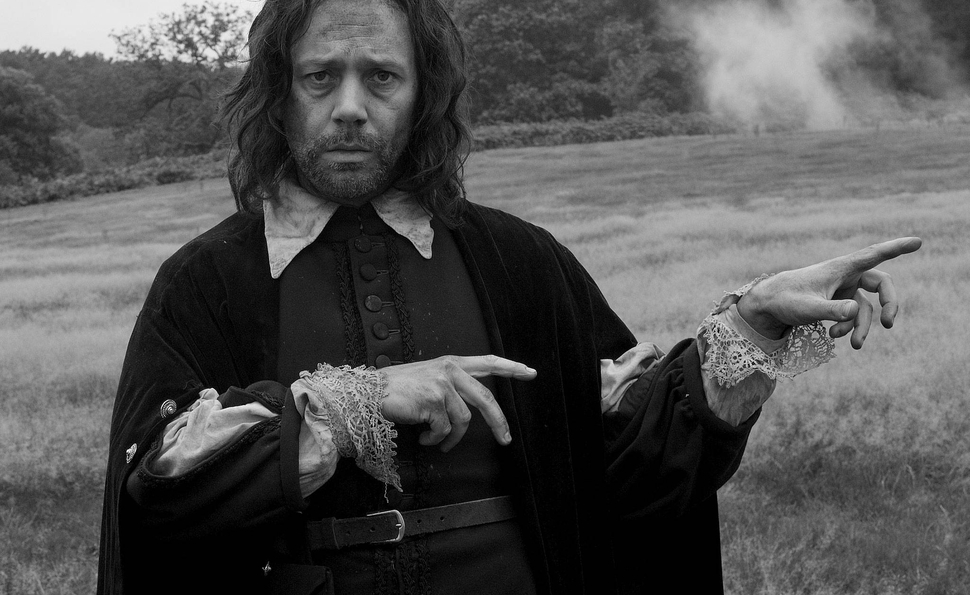
The film is set during the English Civil War. The characters
dress in ragged, dirty period-appropriate 17th century garb and
their hair is loose and in need of washing. Their appearances make them feel
like they’ve been situated outside of time itself when they wander through the
field. We never see the five main characters interact with anyone else; it’s
like they’re part of a droll, avant-garde short play.
Most of them have deserted the army after a nasty skirmish. One
claims there’s a nearby alehouse, though it never appears; it’s a mirage or a
desperate hope for relief that will never come. Whitehead (Reece Shearsmith) is
an apprentice of an alchemist. He seeks out O’Neill (Michael Smiley), a man who
has robbed his master; this task has been made difficult by the death of Trower
(Julian Barratt), a mercenary hired to help take in O’Neill.
Whitehead keeps pontificating in florid language about God
and faith, and his digressions suggest that the situation the men find themselves
in is one foisted upon them by God. Much of the situation feels like an existential
nightmare made real. Director Ben
Wheatley and director of photography Laurie Rose shoot the film in lush black
and white that serve to accentuate the dry, philosophical quality of the film (hints of Jim Jarmusch).
This contemplative side is not A Field in England’s only mode though. Amy Jump’s pithy script is filled
with hilarious, witty lines as it observes characters from a distance, pointing
to their obliviously overlooked flaws and shortcomings. Whitehead wants to see
himself as better than his lowly, uneducated traveling companions, but he
proves himself just as incompetent and uncertain.
The film is also often just interested in experience. The
journey itself is about inevitability and watching to see the details of human
shortsightedness unfold. But Wheatley also takes time out for bizarre, overwhelming
experimental sequences, notably a late film sequence where hallucinogenic drugs
are consumed.
That final sequence suggests that there’s a stoner-based
cult audience just waiting to embrace A
Field in England, much like, say, El
Topo. The point of watching it isn’t necessarily to understand what it all
means but rather to tune in, drop out, and embrace the strange, fascinating
ride.
Grade: B-

No comments:
Post a Comment