Thursday, October 31, 2013

"I Walked with a Zombie" (1943)

Tens Items or Less

A new writing segment, "Ten Items or Less" is an attempt to consciously cutback and restrict how much I write. I get ten sentences or less to discuss a movie. That's it. Let's see if some genius comes out of working around my self-made obstacle.  

Producer Val Lewton's low-budget horror movies thrive on suggestion and what's not shown as much as, if not more so than, what we do, and I Walked With a Zombie is no exception. The film's tension derives from making us sit on the question of whether Paul Holland's (Tom Conway) wife Jessica (Christine Gordon) is or isn't a zombie; well, technically she's zombie either way, but just a sleepwalking vegetable in the less exciting of the possibilities. The film is Jane Eyre thrown into the West Indies and given a heavy dose of voodoo and a moody atmosphere provided by director Jacques Tourneur to match the Victorian Gothic story. So it's no George A. Romero or 28 Days Later, but Tourneur gives the story a strong bite by telling the melodrama about the Holland brothers, their never-ending, bitter sibling rivalry, the lingering damage of the past that won't go away, and how they're doomed to repeat the past. New plantation nurse Betsy Connell (Frances Dee), tasked with caring for Jessica, becomes torn between Paul and Wesley (James Ellison), who also previously pined for Jessica and still stews about it, descending further and further into alcoholism. The film never settles its central tension over whether Jessica is a supernatural undead being, and that's all for the better, leaving it to our imagination and making it far more creepy and strange.

Grade: ★★★

Wednesday, October 30, 2013

"Poltergeist (1982)

Tens Items or Less

A new writing segment, "Ten Items or Less" is an attempt to consciously cutback and restrict how much I write. I get ten sentences or less to discuss a movie. That's it. Let's see if some genius comes out of working around my self-made obstacle.  

"They're here," Carole Anne Freeling (a perfectly cast Heather O'Rourke) informs us in Poltergeist's most famous line. The moment rightfully deserves all the parody and recognition it has since garnered; it's a truly chilling moment, perhaps the film's most terrifying one, and it plays bluntly but primaly on our fears of not being able to protect our children. Poltergeist taps into real Reagan Era fears over the breakdown of the nuclear family and the home, putting a loving family to the test against outside forces that would tear them apart. Though this is essentially a horror movie, producer Steven Spielberg marks it with his signature brand of sentimental melodrama and cinematic wonder. The eventual explanations of the paranormal activity feel schmaltzy, but it does little to damper the film's final act which turns the film's slow burn into an explosion. Poltergeist is leavened with humor and good character moments, but it's also still properly freaky and unsettling: the face peeling, the static television sets, and all the wonderful craziness in its final moments that I wouldn't dare to spoil.

Grade: ★★★

Monday, October 28, 2013

My "Gravity" Film Review

Once again the Arts section of my school's newspaper, The Lafayette, let me write a film review for them. I'm really pleased with how my review for Gravity turned out with me giving a lot of, rightfully deserved, glowing praise. As always I'd like to profusely thank the editors for letting me publish my review, and to edit it so it's a little less laconic and rambly yet still stays true to my original intentions.

"Gangster Squad" (2013)

Tens Items or Less

A new writing segment, "Ten Items or Less" is an attempt to consciously cutback and restrict how much I write. I get ten sentences or less to discuss a movie. That's it. Let's see if some genius comes out of working around my self-made obstacle.  

Gangster Squad was a movie designed to make a pretty great movie trailer, but everything in between those trailer-worthy moments is some carelessly thought out padding. The film feels under-written. The characters are all uninteresting and have spelled-out-in-bold-letters clear, but far too often contradictory, motivations, and the story seems as though it's missing a few key scenes. I could go on about the missing story beats or how those story beats it does have are woefully bland -- seriously, for a movie attempting to appropriate the supposed sexiness of the Roaring Twenties, Gangster Squad is a surprisingly dull and tedious film -- or how its characters are handled by its actors pretty terribly -- Ryan Gosling and Sean Penn have some atrocious, overstated affected accents that are laughably unnecessary -- but lets get to the more, um, subtle problems to the film. The film is top-to-bottom filled with gender politics that at best overly simplified and at worst slightly offensive. Gangster Squad has a terrible representation of women, and that's when it's representing them at all; Emma Stone, in a miserably one note role, is one of two female characters. Though it has a diverser cast than most films, it still has racial stereotypes and biases -- the film has some embarrassing moments in its treatment of its sole Hispanic character. If you can make it through its plodding plot, Gangster Squad has a handful of somewhat entertaining action scenes, but you can watch the trailer and get that experience in a fraction of the time and pain.

Grade: 1.5/4 ★

Sunday, October 27, 2013

"Ferris Bueller's Day Off" (1986)

Tens Items or Less

A new writing segment, "Ten Items or Less" is an attempt to consciously cutback and restrict how much I write. I get ten sentences or less to discuss a movie. That's it. Let's see if some genius comes out of working around my self-made obstacle.  

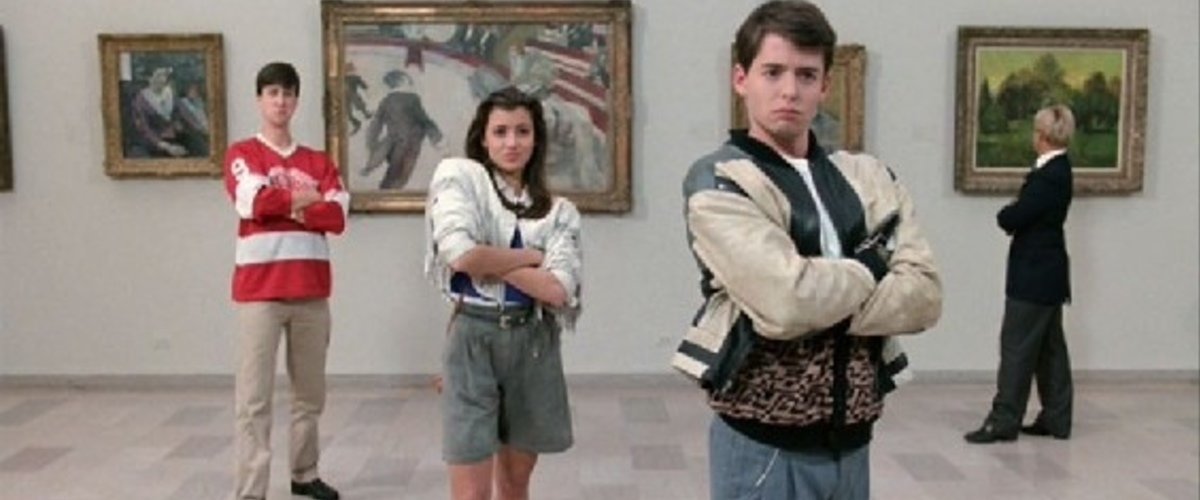
Ferris Bueller's Day Off is one of the best teen comedies and one of writer-director John Hughes' strongest movies. It's firstly a very funny movie and it benefits from a number of spot-on casting decisions, starting with Matthew Broderick as Ferris, as well as Hughes' lighthearted but sharply focused script. Hughes' script and direction keep things moving, wasting little time with fat; Rooney (Jeffrey Jones) and Jeanie's (Jennifer Grey) screentime is brief but it gives us all we need to know about them. Beyond it's humorous moments, something not commented upon enough, is a story of three teens having one last hurrah before the end of an era. There's a dark heart at the center of Ferris Bueller hidden by its playful, occasionally silly tone and episodic gags. Ferris notes himself that he's uncertain of where he stands with Cameron (Alan Ruck) and Sloane (Mia Sara) and where they go from here once the school year is over. Ferris plays it cool because, yes, that's who he is, but also because as he tells us "life moves pretty fast" and he wants to look around for awhile while there's still a chance to. Ferris and Cameron's relationship is the heart of the story, and Cameron's journey is equally as important as Ferris'. Cameron's catharsis -- in part, a story arc about him overcoming depression -- allows Ferris to be more prepared to move on from this stage in his life. Or you can just take the film as smooth operator Ferris having an impossibly great day of hooky, either way, the film is very funny and very fun.

Grade: 3.5/4 ★★★

Friday, October 25, 2013

10 Items or Less: "The Long Goodbye" (1973)

A new writing segment, "Ten Items or Less" is an attempt to consciously cutback and restrict how much I write. I get ten sentences or less to discuss a movie. That's it. Let's see if some genius comes out of working around my self-made obstacle.  

Director Robert Altman's shaggy update to the noir genre The Long Goodbye dives headlong into the byzantine narratives, hardboiled personalities -- well, one of them anyway, in its protagonist -- and sharp dialogue that made the genre a classic staple of cinema. But he also gives it an unmistakable modern sensibility, more fitting for the 1970's. Elliott Gould as Phillip Marlowe is certainly a continuation of a long tradition of cynical detectives investigating an increasingly intricate and seedy case, but he's also a little less classically cut and a little more rough around the edges. Really this is another way to describe the film in general, which features a lot of Altman's roving camera -- including some zooms that occasionally get distracting -- and a narrative that's interested in weird quirks and digression. The Long Goodbye above all though is a really fun film with a great sense of character and dialogue and an engaging and surprising genre-bending story. There's a terrible and shocking scene that ends with the line: “Now that’s someone I love. Think what could happen to you.” And there's another unexpected moment at film's end that's a great, surprising capper. Altman wants to take what we know about this genre and shake it up.

Grade: 3.5/4★★★

Wednesday, October 23, 2013

The Walking Dead: "Infected"

In its finest moments, The Walking Dead is a show with a stark, brutal grace. The action, intensity, atmosphere and narrative come together to produce something that has a cold, morbid logic to it. Too often -- okay most of time -- the show doesn't earn this and that's why it, in part, can seem like the show is dragging its heels. But, for the most part, "Infected" was an hour of television that shows The Walking Dead at it's most clear-sighted -- give or take a few moments that dragged. It's somewhat exciting to have some action take place -- especially when it's frequently as inventive and propulsive as this -- but the further the show considers the consequences of what occurred the more disturbing it becomes.

That subplot with Carole and the two kids is not always well-executed -- it's not entirely clear what the point is and the child actors aren't always up to snuff -- but it gets to the heart of what makes the show so appealing. There is a constant sense of foreboding hanging over the show. Awful things seem to happen on this show just to remind us that, yep, this is an awful world. It's been argued that death is its own character in the show and perhaps Death is what haunts the show constantly and gives it dark, haunted quality. But it's also something more -- something, at times, the show is too glib about. The title of the first chapter of the comic book series that the show is based on -- as well as the name given to the pilot -- is "Days Gone By". And I kept considering that as I watched "Infected". The episode begins with Tyreese telling Karen about how he misses what life was like before the zombie apocalypse, and he's essentially saying what's got to be at the back of every character's mind constantly in this universe.

When characters aren't mourning life as it was when civilization was still around, they must be mourning the terrible, dreadful things they have had to struggle through in their time as survivors of a zombie world. Rick's actions so far this season -- whether we buy them or not -- are informed by the many awful things he experienced last season, which have since driven him to be a mild-mannered farmer.

A minor point I noticed that bugged me, and was well-stated by Alan Sepinwall last season, is how the show treats Rick as a character. Sepinwall noted, "'The Walking Dead' operates from the default that Rick is and always should be the one everyone else takes their cues from. And, certainly, he has a good track record, especially with the way they cleared out and claimed the prison. But other than Andrew Lincoln having top billing, there's nothing magical about Rick. He's a good man with good tactical ideas, but he has flaws ... I think it would be interesting to get a stretch of episodes where Glen really was in charge - or Carol (who's much more up to the job than we would have imagined even last season) or Maggie or Daryl". And Sepinwall was discussing this back when Rick had completely gone bonkers and was seeing weird visions of Laurie, and when it might have made logical sense for someone to be taken seriously as a new candidate for running things. The show keeps trying to force Rick back into a leadership position as if it both makes sense and is an interesting narrative direction, which I don't think in either cases it is.

What the show does get right are the moments where it embraces the brutality of this world. The girls watching their father die is heartbreaking and difficult to sit through. The moment where Rick cuts the legs of the pigs to give them up as zombie chow, and the camera briefly lingers on Rick's deeply pained face, is one of the better scenes the show has done in recent memory as well as a perfect encapsulation of how this world takes and takes until there's nothing left. Rick's expression is one of him having to give up one more damn thing -- and right after he thought things were actually looking up. The sacrifices of the world of The Walking Dead are excruciating, whether it's giving up piglets you were just giving names to yesterday or suspiciously burning bodies.

This brutality isn't enough to carry the show, but it'll do for now.

Grade: B

10 Items or Less: "The Purple Rose of Cairo" (1985)

A new writing segment, "Ten Items or Less" is an attempt to consciously cutback and restrict how much I write. I get ten sentences or less to discuss a movie. That's it. Let's see if some genius comes out of working around my self-made obstacle. 

Woody Allen's fantastical and hilarious The Purple Rose of Cairo has a charming, warm premise with a sneakily profound and thoughtful things to say about fiction and films. When mild-mannered film character Tom Baxter pops out from the titular Depression era film to court mild mannered film lover Cecilia (Mia Farrow), it creates havoc for the characters still stuck in the film, the film studio, and the real life actor who plays Tom, Gil Shepherd. The film really picks up when Jeff Daniels starts playing both Gil and Tom with Allen considering the odd implications of what's taking place to farcical and self-effacing effect, while also questioning the gap between the fiction films sell us and the harsh realities they ignore. Gordon Willis' cinematography really recaptures the Great Depression look and feel with a gloomy, color-drained design. Cecilia's life is all kinds of miserable, even for someone living during this time and place. She's a battered wife, to the obnoxious Monk (Danny Aiello), and works a terrible, minimum-wage waitress job. She gets no respect, affection or happiness anywhere she goes except when she goes to the movie theater. The film is in some ways a homage to the films of the 1930's, especially screwball comedies and the many feel good films of the era that depicted a world far, far removed from the poverty and struggles of reality.

Grade: 4/4 ★★★★

Tuesday, October 22, 2013

A Temporary Cut-Back in Writing

Unfortunately, it has officially become that time in the semester where I can no longer in good conscience continue to write about movies, at least not daily and, even more likely, not at the, already shortened, lengths that I have. I'm not sure who out there reads my reviews, even just partially, but I'm deeply appreciative all the same. I know my little blog here is very hit or miss in terms of quality -- and at times even grammar and syntax (That's what you get when you're your own editor and attempt to squeeze reviews out in between real life obligations). Writing is a time consuming process and, although I ultimately enjoy it a great deal, I just don't have time for it anymore. Watching films has been and will continue to be a very fun and very personal hobby, whether I'm writing about them or not. Hopefully I'll get the ball rolling again when I don't have to worry about other forms of writing that involve getting a grade.

How I Met Your Mother: "Knight Vision"

"Knight Vision" was possibly the worst episode so far this season (although there are other contenders, particularly "Last Time in New York"), and one of the worst episodes of recent memory in How I Met Your Mother's run. The episode really demonstrates the limitations of the story being confined to Farhamption. There's only so many stories you can tell in this location and in this time frame. And the writers can try to sugarcoat the story of Ted's ill-advised attempts with Cassie as setting up the eventual meet-up with the Mother, but it's a band-aide on flesh wound. It's a last minute story beat to salvage one of the most unmemorable, unfunny and simply bad stories this season. The story never clicks and always feels like filler. But it's the A-story, right? It's hard to tell what story is meant to be the most prominent here, but it really doesn't matters as they all felt limp.

Barney and Robin aren't an interesting or believable couple any longer and they're only together out of narrative necessity rather than plausible or satisfying reasons. The series acknowledging the strangeness of how they became a couple only serves to highlight just how weird and poorly handled their pairing has been and continues to be. When Robin and Barney get all cutesy and talk about how they love the messiness of the story, it rang very, very false. To have the reverend die immediately after only pointed out how awful this couple is and how unlikable they've increasingly become. This was an episode that tried to examine the problems inherent to this pairing and only served to make the pairing feel all the more desperate and destructive.

The episode isn't devoid of amusing moments but they're few and far between, and they almost always seem to trump the story and characters. Hearing Sherri Shepherd dub Lily's voice is initially quite funny (although it wears its welcome quickly) as is having characters pretend to be other characters in flashbacks (particularly Marshall as Barney re-enacting Ted meeting Robin), but these fleeting moments aren't enough to save an episode that feels scattered and uninspired.

Give us more of the Mother. The brightest part of the season thus far has been the welcome entrance of Cristen Milioti, and yet she has only appeared in one episode, despite having been elevated to the status of series regular. Nothing has felt quite as funny or emotionally satisfying as Milioti's screentime.

Grade: C

Monday, October 21, 2013

"An American Werewolf in London" (1981)

 
Horror and comedy sit oddly side by side in An American Werewolf in London. It's a delicate balancing act between both, at times hilarious and at others scary -- thanks in part to makeup artist Rick Bakers' great special effects.  The film is framed by its cynicism of human nature. American hitchhikers David (David Naughton) and Jack (Griffin Dunne), backpacking through rural Norther England, stumble upon a small quaint village. The village is the home to a dark conspiratorial secret, that it's safe you probably already guessed is a werewolf problem. The villagers briskly and brusquely send the two young men on their way. However, they soon have a crisis of conscience and attempt to save the Americans from the werewolf, managing only to stop David from dying, but still badly wounded. The town covers up the incident and blames it on a "mad man", which doctors and the police buy with a strange matter of fact ease that almost could only exist in a horror film -- the film at times is parodying the genre it situates itself in. From there the film uses a dark and dry comedy that recognizes the bleakness that inevitably would be part of becoming a werewolf. There is a perverse quirkiness to the film, especially in its treatment of its horror designs. The surviving American David begins having haunting visions, including witnessing the rotting corpse of his dead friend Jack who informs him that until David dies Jack will remain in limbo between life and death, giving David's new lycanthrope form even more troubling consequences than the potential eviscerating of unsuspecting Londoners. This inevitable preying upon innocents happens with total devastation; the werewolf scenes are filled with tons of gore that's simultaneously dismal and rather funny. The film has a visually laidback and deadpan style, fitting for the sarcastic humor underlying the more conventional narrative at hand. But even the cheerier, familiar elements feel like more of the same cynicism -- such as the romance with a British nurse (Jenny Agutter), which, surprisingly for a film about a werewolf, is its most implausible aspect.

Grade: 3/4 ★★★

Sunday, October 20, 2013

"Pierrot Le Fou" (1965)

The criminals in Jean-Luc Godard's Pierrot Le Fou feel as though they've seen a few too many gangster movies, and they're self-consciously adopting the posturing of the wisecracking and hardboiled personalities that inhabit so much of the crime genre. Pierrot Le Fou is not always the playful movie that it's so often described as; it's heavily intellectualized and Godard is sorting through some weird, nagging obsessions that only feel like half-formed ideas. Interspersed between its more typical genre based moments are cuts to, among other things, classical artwork, snippets of incomprehensible journal entries, and fragmentary voice-overs. But even the genre elements are reflexively attempting to undermine our expectations. Jean Paul Belmondo's Ferdinand leaves his stifling marriage and goes on the run with his intriguing and mysterious mistress (Anna Karina). The criminal couple quickly demonstrate an inability to truly function as criminals. They literally burn through their money in a car explosion, trying to fake their death. Their efforts to be inconspicuous only make them all the more visible criminals on the lam. When they go into hiding at a beach cottage, they soon become bored. They're attempting to make their lives match the Hollywood movies and novels that they hold so dear. But there's a slice of life quality to much of their escapades with Godard showing all the tiny details of what actual gangsters on the run would be like. They inevitably are at each other's throats as two people who are only in it for the thrill of it and who miscalculate attraction as true connection. But Godard turns much of this into a piece of comical absurdity (The ending feels like live-action Looney Toons). Stylistically cinematographer Raoul Coutard puts a strong emphasis on making the film brightly stand out like a piece of pop art. And the film is in some ways a piece of pop art in its own right, commenting on society, culture and consumerism with sardonic wit and morbid cynicism. The social and political commentary is strong right out of the gate with Ferdinand getting bored at party where the guest can only find interest in talking about consumer products. And it's possibly even more memorably and bizarrely depicted when the couple dress up like an American soldier and a Vietnamese civilian in a bit of play acting for actual American military personnel. Pierrot Le Fou has an anarchic and sketch-like nature. It comes in fits and starts, and there are just as many moments that ring as weird and questionable -- even highly unnecessary and indulgent -- as there are ones that are hilarious and whimsical.

Roger Ebert wrote about the film back in 1966, "So let this be a warning: You probably won't like 'Pierrot le Fou.' One of Godard's films, seen by itself, can be a frustrating and puzzling experience. But when you begin to get into his universe, when you've seen a lot of Godard, you find yourself liking him more and more. One day something clicks, and Godard comes together. And then, perhaps, you decide that if he is not the greatest living director he is certainly the most audacious, the most experimental, the one who understands best how movies work." Much of this remains true of Godard. His films don't seem nearly as iconoclastic because he, and so many others of the French New Wave, made iconoclasm a more appropriate form of filmmaking and because his iconoclasm feels less fresh in some of his films than it did upon its release. Now that postmodern awareness seems more stilted and at times too temperamental. Pierrot Le Fou tosses around a lot of, sometimes interesting, ideas from an ideologue and now they can feel like the random, caustic mutterings of someone who wasn't entirely certain how to bring together the ideas overflowing from his twisted mind.

Grade: 3/4 ★★★

"Plan 9 From Outer Space" (1959)

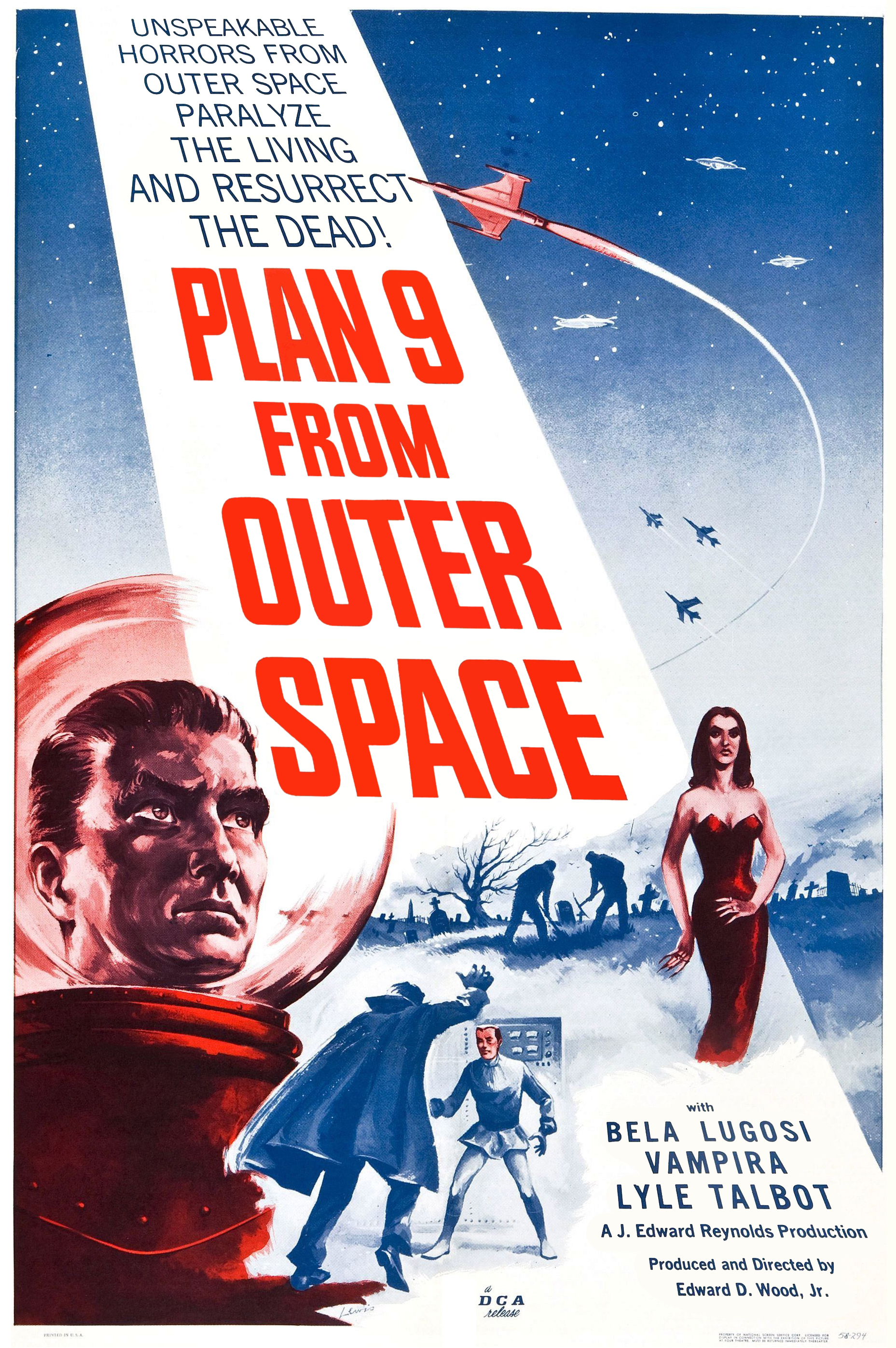
There are likely much more disastrous and ill-conceived films than Plan 9 From Outer Space, but in the conversation about the "worst movie ever made" -- an honestly arbitrary label -- Plan 9 is often claimed to be the worst of the worst; sometimes even getting regarded as the "Citizen Kane of Bad Movies" (heck, the DVD back-cover proudly declares it). And to be sure, Plan 9 is a very, very, very bad movies, but we only talk about it being bad because it's since become a staple of classic cult cinema. We watch it because it's bad; because its bad elements ultimately make for a movie that is weirdly entertaining to watch. Plan 9 is one of those movies that helped define the idea of "so bad its good" cinema. This is ineptitude at its endearingly finest. I take a cue from critic Scott Tobias here in his own discussion of bad cinema, "The real 'worst film ever made' isn't anything you would ever want to watch". Film obsessives often actively seek out works like Ed Wood's stunningly incompetent Plan 9 because they actually have a weird, perverse value to them that a film that was just purely bad would not. Plan 9 is certainly bad but if it were merely just bad and had no, um, redeeming qualities, well, then there would be little reason to partake in watching it. Tobias notes that the film has a sense of narrative ambition. There's clearly a story and, even with its Swiss cheese plot holes, gaps in story beats, and the general questionableness of the narrative, it's not entirely hard to follow. There's definitely times where you'll have to ask yourself, "Wait, what just happened?" But it's more due to poor execution and Wood's terrible script than for wont of a story, even if the story is absolutely wanting. The execution is a huge part of the problem; there's a major gap between Wood's vision and the presentation of that vision. He doesn't have that large of a budget and he doesn't do a great job to work around his budgetary constraints or to hide them. UFO's are very apparently hanging from strings, gravestones get knocked over by actors, it's daytime in one shot and night in the next, boom mics appear in frame, actors are obviously reading from scripts, and stock footage, and footage in general, is reused over and over again. Because of this the story's premise seems even more laughable and ludicrous than it already is. Simply put, aliens are raising an army of zombies to kill humanity. There's more weird, and very unnecessary, quirks and specifics to it but they largely don't matter and discovering them only adds to the fun of the film, watching it struggle to tell a bizarre story that only gets more muddled and self-serving as it goes along. The funniest part to me though is the countless clunky lines of the film, which are equally poorly delivered to hilarious effect. When you open on a line such as, "Greetings, my friend. We are all interested in the future, for that is where you and I are going to spend the rest of our lives. And remember my friend, future events such as these will affect you in the future," and the line is provided with total seriousness and gravitas, well, you know you're in for something. That something is a well-worn contender for the title of the worst movie ever, but whether it is or isn't doesn't matter. There's a lot of amusement to be found in the poorly handled and conceived science fiction turkey.

Saturday, October 19, 2013

"Apollo 18" (2011)

Apollo 18 is as conceptually ill-thought out as it is poorly executed. The film is a found footage film about a conspiratorial cover up of a botched, secret NASA lunar space launch. Not only is the found footage genre ill-equipped for advancing such a story, but the found footage concept is awfully handled and utilized at nearly every turn. The film is filled with distortions and impossible filmed moments that only pile onto the questionable nature of a story that is already highly implausible to begin with. When the film isn't being utterly ridiculous, it's being surprisingly boring. For a film with a lurid, crazy premise, Apollo 18 is all sorts of not fun. Unevenly paced, and even more problematically plotted, with characters that have no other discernible character traits besides macho and ruggedly heroic, the screenplay is full of gems on not what to do to tell a story. The simplicity of the characters isn't even effectively used for baiting them as victims of the strange extraterrestrial phenomenon occurring on the moon and that provides the film its horror elements. The horror elements are the film's most interesting moments but they're few and far between, ill-timed and haphazardly executed. Apollo 18 is more of a science fiction premise with an underlying horrific suggestion, but the true horror comes from how the astronauts' superior officers back on Earth respond to these inquiries and troubles, signing their death sentences with bureaucratic and covert self-preservation. It's truly the film's most unsettling moment but the film has already long since given up on any semblance of depth so it hardly matters.

Grade: .5/4 

Thursday, October 17, 2013

"Martin" (1977)

Martin is writer-director George A. Romero's modern re-imagination of the vampire story. Romero's first decision to move away from the romanticism and myth is to strip the vampirism down to its most basic components: blood lust and agelessness. What remains is a self-loathing, awkward loner -- potentially literally as Romero leaves it ambiguous as to whether Martin is actually a vampire or if it's all in his head. Troubled teen Martin (John Amplas) says he's 84 years old but his urges are familiar for anyone just on the cusp of adulthood -- his sexual confusion is both pubescent and psychotic. Romero takes the underlying sexuality always inherent to vampires and emphasizes it to its extreme. Martin's desire for blood is highly sexualized, even eroticized. The first scene of the film gives us a good sense of both Martin's tactics and his lust. Martin hasn't entirely accepted drawing blood from people or the cost of human life it entails. He injects his victims with a drug that knocks them unconscious so they don't feel any pain. It's a humane act but everything else about the scene uncomfortably reads as an act of sexual violence. There's a date rape connotation underneath giving the drug -- an idea that gains greater plausibility when you factor in the fact that Martin only pursues female victims. As if the sexual undercurrents weren't already strong enough, Martin outright acknowledges his weird associations of his vampiric acts with his sexual uncertainty and impotence. He has trouble having actual sex and so drawing blood stands in for actual sexual gratification. Romero goes further to establish Martin as a film indebted to vampire lore while also reinterpreting it. Black and white flashbacks to Martin's first vampiric attack re-call older vampire cinema, especially Dracula (a disc-jockey mockingly calls Martin "Count" on a late night horror-fest program), and the juxtaposition with the present shows how distant from those types of narratives Martin is. Romero wants to complicate what the realities of being an immortal being with such desires would be like, as well as to update them to a modern setting, in this case the decaying city of Pittsburgh (As to be expected from Romero, there's some minor social commentary about the 1970's going on here). In a painful scene, Martin botches a job, failing to account for the appearance of other people, and the scene turns into a drawn-out, protracted home invasion where Martin has to violate his own skewed moral code to survive. Romero pulls us back and forth on our sympathies; Martin is well-meaning and naive even as he's violent and sociopathic. But what else would you expect from a guy who's been living as a teen for nearly a century?

Grade: 3.5/4 ★★★

Wednesday, October 16, 2013

"Meatballs" (1979)

There's an argument to be made that Meatballs is the quintessential camp movie. When you watch it now, it feels like you've seen all this before. Kids stuck at a woodsy, summer sleepaway camp with minimal supervision; it's a familiar premise that flourished in the 1980's and Meatballs was one of the first to do it, and competently under the steadied guidance of writer Harold Ramis and director Ivan Reitman -- in the first of what would prove to be a series of comedic team ups with star Bill Murray. Much of the plot is lumpy and loose, but Reitman keeps the story humming along so you never have a chance to really pull it apart. It's simple and contrived but it's also fun and charming if not a little too lightweight. These characters feel like archetypes, and, true enough, they never get fleshed out, but they serve their necessary purpose; the nerd; the chubby kid; the hot chick; the jock; the misunderstood kid. There are multiple stories that get played out but most of them are forgettable, entertaining in the moment but not especially memorable. There's a number of romances and courtships that we keep popping in on. A number of pranks are played, largely on the camp director Morty. There's an underdog competition with the pompous upscale Camp Mohawk just on the opposite side of the lake which, of course, ends with a win being rallied for. The best part of the film is Murray, in his first starring role, as goofball counselor Tripper. It's a great meeting of material and performance; Murray's personality and mannerisms are so well-suited for the role that it's hard to imagine anyone else in it. He's clearly improvising dialogue here and it makes for the right dose of anarchy added into the mix of the routine story. Tripper has a really sweet relationship with a camper (Chris Makepeace) who he takes under his wing and helps comes out of his shell. Meatballs has an odd sincerity though. There's a nostalgia for this environment and this time in people's lives, and it gets the summer camp vibe down just about perfectly.

Grade: 2.5/4 ★★

Tuesday, October 15, 2013

How I Met Your Mother: "The Poker Game"

Well, that was more like it. This wasn't a perfect episode but the B-plot of "The Poker Game" about Ted forgetting a wedding gift for Marshall and Lily was classic How I Met Your Mother. The show has always been good at one particular joke: time jumping, telling a story once before re-telling that story from a different perspective to see the story in a different context. When Ted recounts his side of the story and we revisit events, it felt like the kind of jokes the series was managing at its peak capacity.

The main plot about Barney, his family and Robin was more problematic. If you're still invested in Barney and Robin perhaps this story would be meaningful to you, but otherwise this felt like more of the same we've already seen from them without actually learning anything new or worthwhile. It's not an entirely dead story. In fact, the episode's funniest moment comes due to it when the many poker players pop out from various corners of the hotel room after Barney leaves. That was the goofy side of HIMYM at its finest, turning farcical theatricality into its advantage. Even the reappearance of Frances Conroy as Barney's mother Loretta was a welcome sight and she got in some wicked jokes.

HIMYM has so much history to draw upon at this point and I want it to use what we know about its characters and their lives, and by the same token what we don't know, to make both meaningful commentary, poignant juxtapositions and humorous callbacks and jokes (Note the little wonderful details in the flashbacks such as Lily's changing hairstyles or the appearance of the Slutty Pumpkin in the background. Continuity nerds should be very pleased). HIMYM has that power at its disposal. It has always done the previously stated things since its very beginning and it should be able to do it with even stronger emotional meaning and acuity. That it hasn't recently is one of the show's biggest shortcomings. Here was the an example of that opportunity. It's not even necessarily a matter of time jumping. Having Ranjit, William Zabka and Loretta be present and signifiers of the little world the show has built up over its eight plus seasons is a nice way to really make the weight of the show's history be felt. And HIMYM as a show about history, storytelling and growing up should be making those acknowledgements of its history; and it doesn't all have to be serious as the hilarity of "The Poker Game" demonstrated.

Grade: B+

The Walking Dead: "30 Days Without Accident"

Critic A.A. Dowd recently said, "I get that it's not exactly the best show on TV, but I'm happy THE WALKING DEAD is back." And that pretty much sums up my feelings about the series; I have a strong love-hate relationship that fluctuates constantly, much as the series fluctuates from promising and addicting to muddled and unsatisfying. Still there's something oddly comforting about The Walking Dead that makes me keep returning to it. Part of it is certainly a desire to see new and innovative ways that zombie scares and kills can be doled out but there's also something about this world and this atmosphere that sucks you in time and again.

Initially I found the decision to stay at the prison a poor decision that went against what the third season had been about (much in the same way that keeping the Governor alive felt contradictory to the season's aims), but now it feels like a more appropriate decision. The Walking Dead is a television show and television shows need some level of stasis both more budgetary and narrative reasons. Eventually the show needed to settle into a comfortable rhythm and this appears to be it -- for now at least, as the cliffhanger at episode end suggests. On the other hand, the last time the show went into deadlock focus on one location was season two at the farm and that produced a dreadfully uneven, and far too often boring, stretch of episodes. The prison is a more interesting central location and the show is further along so that hopefully we see less of that.

And yet still not much of anything happens in this premiere. Things are far too cheery for their own good, which of course means things are going to go south quickly soon. But not much is done to advance the story. Little amusing details are thrown at us about what's happened in the interim -- including an adorable kid's story time/knife lesson (Good on you Carole!) -- but really: what's actually happened? Rick meets a woman in the woods who turns out be crazy and kills herself. A run for supplies ends up going, not all that unexpectedly, really badly (which, admittedly, was pretty entertaining). If the show weren't serialized may be it could get away with little weird side stories but think about it: what's the story for this season? The third season had some major problems but it was obvious that the central story was the Governor and Woodbury versus Rick and the prison. And before it was that it was: oh, here's a prison that needs to be made habitable.

Or put it another way. It's sort of nice just to hang out and kick back with this group of people who we've come to know and, in some instances, like. But it's also the essential antithesis of what makes The Walking Dead work and dramatically satisfying. The best stretch of episodes the show had was the first half of season three in which there was a relentlessly paced series of action sequences that were intense and exciting. The Walking Dead is at its best when something, anything happens. The moment it slows down it gets stuck. It gets stuck because this is miserable fucking world. There is nothing to look forward to or be happy for. Even bringing life into this world -- as Glen and Maggie discuss -- is kind of pointless and heartbreaking because you're sentencing new human life to a shitty existence. Any time the show takes a breather is a time where it forces us the viewer to consider we're just watching shitty things happen to people for our own enjoyment. And when it's not something thrilling such as zombie killing, it's just people mourning the loss of civilization, and most, if not all of, their friends and family, and coming to terms with living in a post-apocalyptic world. When you actually stop to consider that's what you're watching, it's kind of depressing and empty.

But, hey, look on the brightside, some nonentity character just turned into a zombie inside the prison. That should make for a fun time, right?

Grade: B+ 

"House of 1000 Corpses" (2003)

House of a 1000 Corpses is almost a challenge of bad taste. There's nothing especially entertaining about it. Even its perverse sense of humor wears its welcome rather early on; the film's black humor is never entirely reconciled with its violent excesses. The plot becomes increasingly convoluted and the story eventually becomes less scary than numbing. And yet I found myself fascinated by the film even as I was sickened by it. Director Rob Zombie has an uncanny ability to create images that are striking even as they're deeply disturbing.

But perhaps no one has stated Rob Zombie's film visions more succinctly than critic Keith Phipps, "Let’s float a notion: Rob Zombie is the greatest horror-movie director never to make a great movie. Zombie has a gift for horrifically beautiful compositions and a feel for atmosphere and character, letting quirks and background details suggest history and depth. He speaks the language of classic horror films, but his taste for the extreme puts him at home in an era in which Saw sequels have become institutions."

And yet Zombie's work is more startling, unsettling and interesting than any Saw sequel or knockoff. Phipps is right. The atmosphere in 1000 Corpses is beautiful in a get-under-your-skin gruesome and fuck-with-your-mind sort of way. The characters -- a disgusting, sadistic backwoods family murdering off personality-less teens -- are well-realized even as they're insane and intolerable.

Still 1000 Corpses is not really all that good. Even as I can recognize its merits -- where many still would dismiss it as pure, undignified torture porn -- I still don't think it's a good movie; interesting and unique but ultimately a little hollow.

Grade: 2/4 ★★

"Ain't Them Bodies Saints" (2013)

If Bonnie and Clyde weren't a romanticized vision of outlaws, it might look something like Ain't Them Bodies Saints. The writers and director (Both David Lowery) aren't the ones doing the romanticizing here, it's the characters themselves who keep telling themselves stories about the greatness of their crimes and their status. Bob (Casey Affleck) is constantly telling Ruth (Rooney Mara) about their future; he's mythologizing before there's anything to be mythologized about and he's draws her into a life of reckless criminality. Ruth hasn't completely bought into Bob's way with words or his swagger. We first see her stubborn and strong-willed, trying to walk away from the whole relationship. She's pregnant though and so she gets drawn into the outlaw lifestyle. The film moves past this quickly. Their outlaw career goes south fast and Bob convinces Ruth to feign taking part in the robbery under duress. Bob gets a five year to life sentence and though he writes letters to Ruth touting how wonderful their life will be once he's freed, we can tell things have changed. The beauty of Ain't Them Bodies Saints is its sly reinterpretation of so many crime movies. "This happened in Texas," the film dryly informs us at the start of the film. The film is mocking the taglines of so many movies claiming they're based on a true story. This isn't a trumped up tale; matter of factly things happen -- told in a clipped, elliptical style -- and they happen realistically, tragically and painfully. Bradford Young's cinematography acknowledges the disconnect between Bob's perception of events and reality. Gorgeous, naturalistic imagery -- reminiscent of Terrence Malick -- with an understated pastel design is used throughout the film. The film looks romantic even as its story is romantic only to the couple yearning for things to be as easy and simple as they imagined when they made a pact to start a new life with each other.

Grade: 3.5/4★★★

Monday, October 14, 2013

"The Blair Witch Project" (1999)

It's hard to appreciate how fresh and unaffected The Blair Witch Project was upon its release. The film and its ideas have been so heavily parodied, re-purposed and remade that it can be difficult to recognize how not only influential the film was but also how good it continues to be. The film didn't invent the found footage genre but it certainly popularized it with an unexpectedly hugely successful turn at the box office catalyzed by a viral Internet marketing campaign that was one of the first of its kind. While recent found footage concepts such as the Paranormal Activity series have aped its ideas, few of the films since feel as inspired or as legitimately scary as Blair Witch. Its not just its shoddy, shaky cam VHS-look that Blair Witch gets right but utilizing that stylistic choice not for gimmick but for verisimilitude. The film is psychologically nuanced. The scares aren't from being startled but from watching the three Gen-X, would-be film students (Heather Donahue, Joshua Leonard, and Michael C. Williams) slowly unravel. Blair Witch also has an initial concept that nicely determines how the film plays out. The three characters are investigating a local legend, one they don't actually buy into. It's a simple framing device but its highly effective; the characters start out as skeptics but as they get lost in the woods and strange things happen they realize that they've tempted fate by failing to tread lightly. The film is also exemplary for how to stretch a shoestring budget. Blair Witch is convincing because it focuses on its characters and their fraying relationship, and it does this because it has so little else to rely on. The film goes for big scares once, in its final moments, and that painfully demonstrates the limitations of the budget to the point where it can feel disappointing. The most frightening moments are when the frailty of human nature is on full display -- perhaps seen best in the film's most remarkable moment where Donahue makes a chilling confession straight to the camera. For a long time there's simply the possibility that there's nothing supernatural afoot just madness sinking in as they get more deeply, irrevocably lost in the woods.

Grade: 3.5/4 ★★★

Sunday, October 13, 2013

"Escape From Tomorrow" (2013)

For many, going to Disney World is the ultimate dream. Escape From Tomorrow turns that dream into a nightmare. Shot DIY, under the radar of Disney's restriction of filming at the theme park, the film plays off Disney's sunny, innocent facade by suggesting something more sinister and evil lies underneath the surface of the amusements and rides. A family goes to the park and the father Jim White (Roy Abramsohn) starts slowly losing his grip on reality. In one sense, the film is about a father whose frustrated by losing the life he had now that he's married and has children (Writer-director Randy Moore claims the film is based on his own experiences with his father when his parents were getting divorced). He stops caring about his children and his spouse, predatorily stalks two nubile French teens, and begins seeing inexplicable, disturbing things creeping into the background. The faces of the people in It's a Small World start looking like demons hiding in plain sight. A single mother becomes an enchantress who bends reality. In short, nothing is quite what it appears to be and that works well for playing against expectations of what the happiest place on Earth ought to be like. The black and white look of the film feeds into this; there's a trippy, darkly alluring quality to the film. It slowly draws you in by being both highly mundane and yet uncannily surreal. The film really is only able to manage this feat for so long. The last third of the film gets a little too bonkers for its own good and the film loses some of its dark seductive appeal in the process. This last third wholly embraces the craziness that has only been suggested up to that point (for much of the first two thirds, there's hints that this might all be inside the head of the father). Still, Escape From Tomorrow largely succeeds at being unsettling and entrancing by taking something familiar and flipping it on its head in ways that feel a little too close to reality for comfort, even as it seems otherworldly.

Grade: 3/4 ★★★

"The Innkeepers" (2011)

The Innkeepers is a movie that buys into the potential virtue of seemingly nothing happening. It's a horror movie that doesn't obsess with getting right to the scares, and in the process it becomes a well-crafted piece of dread inducing cinema. The longer nothing happens, nothing even remotely frightening, the more we wonder when something might happen. Director Ti West used this same notion to even better effect in his terrific House of the Devil. In some ways, the film is indebted to horror movies such as The Shining where the story and imagery get to us in our gut by being unsettling and surreal rather than from startling us. Set in a creepy old hotel on its last weekend in business, the film largely focuses on the two employees overseeing the building in its last days. They split time between dealing with their residents -- utilized primarily for comic effect -- and investigating the paranormal phenomenon allegedly haunting the place. Luke (Pat Healy) clearly has a crush on Claire (Sara Paxton) and he's using the ghost talk as a chance to woo her. She's completely oblivious to this even as it's obvious to us, taking the talk about spirits as a welcome distraction from the humdrum minimum wage job. However, in time, Claire becomes more invested in the ghost hunting than Luke and the film focuses on her. The Innerkeepers has many virtues, chief among them is its sharp characterization. Claire is one of the better female character horror has written in recent memory; strong and curious yet unmistakably nervous and doubtful. The interplay between Luke and Claire is also especially strong and speaks to the film's small doses of humor and playfulness. West is great at composition. He uses the early going of the film to establish the lay out of the hotel and its winding corridors, and to develop characters. The Innkeepers is a throwback to older horror movies where the story rather than the scares was the top priority. The film weaves a simple but deliberately told story that isn't worried about being a little slower going in the early proceedings, building a creeping sense of paranoia. Although it ultimately isn't able to stick the landing, with an ending that feels like an unintentional anticlimax, everything that comes before is a confidently told with visual panache.

Grade: 3/4 ★★★

Saturday, October 12, 2013

New Grading Policy

I've always found the letter grading system slightly problematic for grading movies. The significance between grades becomes somewhat arbitrary in some instances. What's the real difference between a "B" and a "B-"? I couldn't really tell you in all honesty. Grading comes from the gut and it becomes even more instinctive and guess-work based the more flow within the grading system there is. That's why I've decided to move to a more solid and dependable grading system: the four star system.

Yes, in actuality, grading altogether is pretty arbitrary but it's in some ways a necessary evil. The letter grading will likely remain for television reviews I do but the star system is going to be applied to film reviews, at least for a little while on a experimental basis.

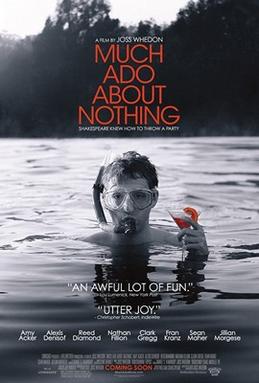
"Much Ado About Nothing" (2013)

Much Ado About Nothing is a curiosity. A swanky, chic, wine-drenched (seriously, alcohol seems to be getting consumed in nearly every scene) black & white adaptation of Shakespeare's play transposed to the present day by writer-director Joss Whedon. The film features a host of Whedon regulars from past film and television work, including Amy Ackler and Alexis Denisoff in the lead roles as quarreling, barbed witted sparring partners Beatrice and Benedick, who are tricked by their friends into falling in love with one another. Much has been noted about the circumstances under which Whedon filmed the movie; filmed entirely at his Santa Monica, Californian home, a Tuscan villa styled house, over the course of 12 days, the movie at times feels like a bunch of friends casually putting on a home-theater production of the bard's work. At other times it feels like we're getting a glimpse into a very private and well-acquainted group of friends putting together a movie for their own amusement. The juxtaposition of Shakespeare's dialogue and the present day setting is at times jarring -- although it eventually settles into a pleasing rhythm -- and setting it all in one location at times noticeably limits the options for the ways the story can be told. (Locations keep getting re-used over and over and the low budget becomes painfully obvious in certain instances). Jay Hunter's cinematography is gorgeous and intoxicating; it's dazzling and energetic at points. These performers clearly have a lot of chemistry and there is, perhaps not surprisingly being based on a Shakespearean comedy, plenty of funny moments, particularly parallel moments of dedicated slapstick from Ackler and Denisoff and the winning appearance of Nathan Fillion as bumbling police officer Dogbert. However, Much Ado feels far too indulgent. Too often there's the sense we're on the outside of some joke that only those involved in the production quite get. Still this is good, charming performers wonderfully reciting Shakespeare's impeccable writing and having a great deal of fun doing it.

Grade: 3/4 ★★★

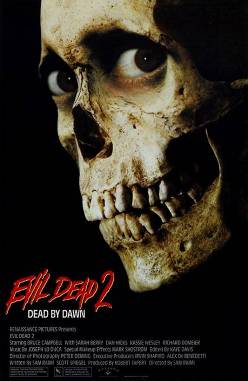
"Evil Dead 2: Dead By Dawn" (1987)

Evil Dead 2 is one of the most purely fun films. This is a film brimming with ideas, imagination, ambition and style to spare. By the time our ever faithful protagonist Ash lands himself back in medieval Europe we have gone through an exhausting amount of plot, furiously burned through with savage delight. That ending is unimaginable when initially Ash appears with his girlfriend in a beaten down old yellow sports car. But writer-director Sam Raimi and co-writer Scott Spiegel go for broke testing out every last weird, interesting and wonderful idea they can come up with. Evil Dead 2 isn't so much a story so much as it's a series of stolen moments. The first third especially is fragmentary moments that only loosely connect to one another. Let me foolhardily attempt to describe it briefly: Ash arrives at the abandoned cabin, his girlfriend is taken over by evil spirits, beheaded and buried, Ash is possessed, saved by the break of daylight, drives away only to find the bridge home destroyed, chased by spirits, and goes raving mad, his possessed girlfriend rises from the grave and he kills her with a chainsaw, and finally he fends off his turned-demonic hand. Mind you that the film is only an hour and twenty-four minutes long, but it moves along with a measured clip and packs so many inventive and fun things into that brief time. The film is ostensibly a sequel to the original Evil Dead and in another sense a remake. The film borrows the basic horror premise of the original but it only uses it as a jumping off point. Evil Dead 2 diverges tremendously from its predecessor; make no mistake: Evil Dead 2 is not a horror movie. It's a comedy. For much of its runtime, it's essentially a one man show for Bruce Campbell. Campbell is a huge part of the film's appeal. He does some fantastic Three Stooges slapstick. But it's also in the expressions and microemotions that Campbell conveys that really sell the film. There are moments that are so funny and endearing merely because the chiseled face of Campbell pauses to give a goofy grin or shoot off a one-liner. Then there's the glorious amounts of blood spewed out from the walls and evil spirits; it's so over-the-top and so clearly not real blood that its excesses become hilarious. The special effects are some excellent designs. Some superb low-budget technical craftsmanship is on display; a homage to old B-horror movies and Ray Harryhausen.

Grade: A-

Friday, October 11, 2013

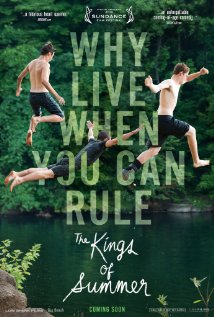
"The Kings of Summer" (2013)

The Kings of Summer is one of those light coming of age stories that keeps getting made in recent years, particularly on the indie scene. I say light because it too often glosses over the real pains of the time, place and age that it deals with. Like The Way, Way Back, there's a charm and wit about The Kings of Summer that makes it entertaining and fleet -- although it drags in the last third. Also like Way Back, it has a lot of good performers elevating material that is a bit too familiar and, at times, simple. Nick Offerman as one of the fathers gives nuance to the part by just the ways he delivers his lines in unexpected and bitingly funny ways. All the young performers are charismatic if not especially memorable; Moises Arias as the kooky member of the trio of boys Biaggio gives a quirky and committed performance that stands out, and it's a nice meeting of writing and acting that really works well. The other two boys Joe and Patrick (Nick Robinson and Gabriel Basso) are resentful of their parents and longing to get out from under their thumb. In the course of events they inevitably learn to grudgingly respect and even love their parents. They go out deep in the woods, build a make shift home, and suddenly believe themselves to finally be "real men" (adults!). The cinematography is at points rather lovely; there's a beautiful naturalistic feel that highlights the forested locales and contrasts the drab suburban settings the guys are escaping from with the their new nature-hideaway. One unfortunate story point involves a girl that Joe pines for; she dates a douchey guy for a brief stint and Joe then thinks he has a chance with her. He invites her to the forest retreat where she falls for Patrick thus leading to the inevitable falling out between the two friends. The Kings of Summer never rises above its cliches or its simplicity; there's something more painful and bitter under the surface but it always seems to avoid it whenever it comes too close.

Grade: B-

"Child's Play" (1988)

There is an absurdity inherent to the premise of Child's Play that in its most entertaining moments the film embraces whole-heartedly. The notion of a serial killer transferring his soul into a child's doll has a built in level of incredulity to it. At first the film tries to take its premise seriously and be a more straightforward horror movie but the closer the film gets to inevitable reveal, the more it seems to recognize that there is a comedic goldmine to be had in a cute little cherub-faced toy doing things that clash with that cute, innocent sensibility. So when Chucky stops pretending to be just a child's plaything and begins spitting out offensive epitaphs, it's more funny than scary; the moment is made all the more hilarious by the fact that the actress, Catherine Hicks, is clearly at points acting with a doll that she's shaking around for effect. The film's action sequences increasingly accept this campy, comic tone. Initially they're shot from the point-of-view of the doll but once they cease to and we just get a Chucky outright attacking his victims with a knife these moments are simultaneously thrilling, creepy and rather funny. This isn't to say Child's Play isn't scary; there's a menacing quality to the film but it's always mixed with or undercut by a humorous tinge. Whether this is intentional or not, it makes for a fun time all the same.

Grade: B

Wednesday, October 9, 2013

"Three Colors: Blue" (1993)

I'm not entirely sure I understand what I saw in Three Colors: Blue but I'm also certain that I wasn't supposed to, and I'm okay with that. The film is about a woman Julie (Juliette Binoche, in a beautifully understated performance) who survives a car accident but loses her husband and daughter in the incident. It's a film that feels impenetrable and abstract at times because the story is exploring Julie's fractured psyche in the aftermath of the incident. She grows erratic, closed off and disconnected. She sells her home and hides away from all people she formally knew. Tiny things happen to her that are never made clear. At one point she befriends a prostitute; she listens to a flute player whose music she finds intoxicating; she goes swimming -- perhaps to feel something; anything. Julie was married to a great composer. It's suggested at one point that she actually wrote his music. It's never revealed whether this is true but she does seem to have knack for music. She hears her husband's old music at every turn; it haunts her mind like old ghosts, coming at her like micro-flashes of lightning. Director Krzystzof Kieslowski shoots the film is a gloomy, mysterious and alluring style -- and, perhaps to be expected, it's bathed in blue tones of every shade and variety. The film doesn't make a fine point about what certain imagery means but some images are so haunting and transcendent that it really doesn't matter; they're hypnotic and seductive and can be appreciated for their own sake. The story has the quality of a symphony; sumptuous, lavish; high emotions and somber low-points. At once, deeply felt and yet distant and hard to pin down. It's an elegant, gorgeous and challenging mood piece.

Grade: A-

Tuesday, October 8, 2013

"Trans" (2012)

Trans is an important documentary with a good message. The film is about what it means to be transgender and the struggles and lives of transgendered individuals. But even more so it's about getting people who aren't aware or feel uneasy about the issue to come to accept transgendered people. It's a worthwhile, considerate message; one presented through compassionate and sensitive interviews with individuals who are transgender. It shows how they're just like anyone else.

I'm not quite sure how it conveys that message is always one that works though. Trans forgoes recounting the history and terminology of its subject in order to dive us in head first into an emotional identification with the individuals who live with being transgendered. At times it feels emotionally manipulative -- and I say this as someone who agrees with and supports the message of the film. But ultimately the film's message is strong enough and presented with such humanity and warmth that it doesn't matter.

Grade: B

Monday, October 7, 2013

How I Met Your Mother: "The Broken Code"

Unlike last week's episode, "Last Time in New York", this week's episode, "The Broken Code" felt like it actually had a story that was worth telling and that needed to be told. There's nothing wrong with sitcom antics and it's expected that they'll have diminishing returns in later seasons, but How I Met Your Mother's central conceit forces it to give the burden of proof in order to feel truly well and satisfying. I don't find Barney and Robin that interesting of a couple and so my opinions of their storyline avoiding their elderly relatives -- on top of the fact that that joke about old people felt very one-note and uninspired -- was bound to be meh.

Here though the main story about Barney being uncomfortable about Ted's still lingering feelings and Ted attempting to deny them felt like it had some weight to it that the last episode didn't really have. Most importantly there felt like there were actual stakes; Barney and Ted' friendship very well could have been seriously compromised and no doubt will be on an uncertain footing going forward -- and that's all for the better. This season needs to throw out complications to make it have a sense of purpose, conviction and, most importantly, energy. Weddings tend to be fraught with complications and thus far the complications have been too light and disposable (Thankfully we got that old people joke out early and lets hope there's nothing quite as bland as it going forward). 

But even the less meaty subplot between Lily and Robin felt as though as it wasn't completely a throwaway story. The story ultimately moved past the weird tics and insecurities of Robin in regards to her inability to make female friends and onto reaffirming the relationship she has with Lily. HIMYM has always been a show grounded in relationships and character dynamics and in recent seasons it has been at its best when it examines those relationships and assesses what they mean to these characters. Inevitably the commentary is thin here but it elevates a story that while amusing felt needless.

Like I said, a tv show doesn't have to make such purposeful statements all the time; if it's funny and energetic enough then we can roll with it even if it's not suggesting something meaningful (although inevitably they'll be some statement no matter what). But the central conceit of the series and the show's general emphasis on its relationships has unfortunately played against the stories it can meaningfully tell and that are actually satisfying.

Final seasons are statements of what the writers believed the show was about. To me it has always been about these characters, but I'm just a viewer not the author of this work and therefore what I felt this show was about and what it actually will end up being could be very different. I doubt the gap between those two perceptions will be that far apart, but it's still frustrating nonetheless when it loses track of these characters.

This was a good episode that made me feel as though the wedding weekend structure could actually work (and oddly enough it had little to actually to do with the wedding). We could do with more of this and less of what we got last week.

Grade: B

"Go West" (1925)

Buster Keaton is often praised for being the Great Stone Face. True enough Keaton's dead pan expression at all the increasingly crazy antics in Go West is one of its most notable aspects. The humor stems from the disconnect between Keaton and the slapstick he performs with dutiful commitment. But it also comes from Keaton playing characters that are totally serious and dedicated. Keaton isn't emotionless; he's a Charlie Brown-esque figure sighing a wearing, aware sigh at the lot life has dealt him. This makes it much easier to accept the plot of Go West, which is essentially about Keaton (credited as "Friendless") befriending a cow, Brown Eyes. Sure it's a silly plot but it's not one Keaton entirely wants us to take seriously. Keaton's character takes it so damn seriously that we're meant to rightfully laugh in the face of the absurdity of it. Keaton spends the back-half of the film trying to save the cow from going to the slaughterhouse while getting the rest of the herd to their destination -- the second task he takes upon himself because he's simply too darn earnest not to help out his boss. The train the cattle is on gets put off course by a group of bandits and Keaton is forced to take an alternative route. In the film's most memorable sequence, he lets loose the hundreds of cattle upon an unsuspecting city where they upset traffic and at one point make good on the expression "bull in a china-shop". Then the film's best moment is its final joke; "I want her," says Keaton pointing, presumably to the boss's daughter. Nope, to the cow. It should be cheesy but the expression on Keaton's face sells the moment home. He means it and because he believes it so do we, and thus we can't help but laugh.

Grade: A-

Sunday, October 6, 2013

Left on the Cutting Room Floor: Films I Watched But Didn't Review This Year

For various reasons I occasionally don't review films that I watch and though it's a rarity it sometimes makes me feel as though there's a lack of completism to the blog. So I decided to dig up the films that for one reason or another I didn't feel like or didn't have time to write about.

Breathless (1959) - The deeply influential French New Wave film about a petty criminal fleeing to Paris from cops after he kills a police officer is filled with then groundbreaking technical innovations, but what stands out about Jean-Luc Godard's debut film is its attitude. It still feels lively and bursting with energy and ideas despite how long it's been since its release. 

Twilight: Breaking Dawn Part 2 (2013) - It's not as though it's the worst film I've seen (I've seen lots of less watchable films than Twilight just in this year alone) but I was feeling unmotivated to write about a movie where there doesn't feel as though there's much to say beyond how lazy and uninspired it is. And as it seems so patently obvious and widely acknowledged that came across as redundant to me.

Jaws (1975) - Steven Spielberg's horror classic helped establish the summer blockbuster but it feels so far removed from the blockbusters it helped inspired that it almost feels quaint to describe it as a blockbuster. Spielberg was a New Hollywood brat and he fills the film with little, artsy touches that make it more than just a horror film. Although he does provide plenty of exciting horror in spades. The mechanical difficulties with the shark forced Spielberg to be more creative and show it less which helps make the film into something so thrilling: the biggest fear we have is that of the unknown.

Life Aquatic with Steve Zissou (2004) - Wes Anderson has always had a droll visual flare that makes him the dictionary definition of quirky. He supplies plenty of melancholy underneath his well-manicured, highly stylized fantastical visions, but some of the human element gets lost in Life Aquatic (possibly the worst of Anderson's oeuvre). It's humorous and whimsical but the tale of an Jacques Cousteau-like oceanographer, documentary maker feels a little too hollow for its own good.

North by Northwest (1959) - Alfred Hitchcock had made and would continue to make some of the best suspenseful thrillers anyone ever has but few were quite as purely fun as North by Northwest. The crop-duster and Mt. Rushmore scenes are two of the most expertly crafted action sequences in cinema and otherwise the film is a cracker-jacking good time of mistaken identity, wordplay, and espionage.

Run Lola Run (1998) - The kinetic and highly stylish film about a young woman tasked with getting 100,000 dollars in twenty minutes or her boyfriend will die comes at you like a jolt of lightning. The film is shot with a frenetic and pulsating style that makes it utterly cool and exciting to watch.

Citizen Kane (1942) - What can I say about Citizen Kane that hasn't already been said. Widely regarded as one of the greatest films ever made -- if not the greatest -- and rightfully so. Orson Welles' modernist masterpiece broke new grounds by synthesizing film techniques into a brilliant examination of power, perception and loss.

Touch of Evil (1958) - Yet another fantastic film by Orson Welles about a seedy American-Mexican border town at the peak of the noir tradition. It's shot in a fabulously moody lighting scheme and features one of the most iconic opening sequences in all of cinema, an amazing unbroken long take.

Double Indemnity (1944) - Billy Wilder's masterful, picthblack noir about a femme fatale who ensnares and conspires with an insurance salesman to kill her husband and walk away with the insurance money. Wilder's brilliant screenplay features sparkling, immaculate dialogue that is beautifully recited by Fred MacMurray, Barbara Stanwyck, and Edward G. Robinson.

Dancer in the Dark (2000) -  Lars Von Trier provokes and emotionally manipulates at every turn in this wrenching human tale of a slowly going blind factory worker saving money to stop her son from suffering the same physical fate. In order to escape the misery of her existence (a misery that grows to disturbing limitations of tolerability), Selma (singer Bjork) imagines herself in musical numbers that grow organically out of the noise of the environments around her and save her from confronting the tragedy of the life surrounding her. 

This Week in Film (9/29/13 - 10/5/13)

In recent days I have been both bogged down with school work and coming down with a cold. That's unfortunately detracted from my ability to both watch and write about movies. Though my output has declined a bit (and I can't necessarily say that will change as next week is in some even more hectic), I'm strong in my resolve to keep at it as best that I can. This previous bit of polite statement likely sounds a little strange since I did still manage a number of reviews during this time. Movies (and to be fair television shows as well) are my comfort and my escape, and to give up on them in the face of the ups and downs of life, well, that just seems silly.

Let's tally it up:

Breaking Bad: "Felina" - The finale of Breaking Bad hasn't detracted from its well-earned place in the pantheon of great television dramas but it's been somewhat divisive critically with some feeling it wrapped up a bit too neatly. I agree but I also enjoyed and appreciated what took place in the finale too much to let that entirely dissuade me.

The Rules of the Game (1939) - Jean Renoir's masterpiece comedy of manners that sneaks in some sly -- and then extremely controversial -- class critique. It's hilarious even as it's deeply humanistic. 

The Great Dictator (1940) - Charlie Chaplin's transition into sound film isn't the most concise effort but even in its shakiness there's still a lot of brilliant comedy that could have only come from the great comic director's imagination.

Cat People (1942) - The first of the Val Lewton horror films that displays the low budget scares of implying the supernatural forces just offscreen and in turn creating something far more frightening than anything that could actually be shown to us. 

Seven Up (1964) - I provide some thoughts on the first film in this renowned documentary series that stops in on a group of individuals every seven years starting at the age of seven.

My Man Godfrey (1936) - A classic screwball comedy about a homeless man turned butler for a nutty aristocratic family.

Saturday, October 5, 2013

"My Man Godfrey" (1936)

The plot of My Man Godfrey is one of those narratives that if you blink twice it all falls apart. The film takes place in one of those heightened realities that's more live action cartoon than anything in real life. This is part of the film's charm. People talk fast and do silly things, and it all comes across with a loose, off-the-cuff style (much of the film was improvised). And in this way it's in that fine tradition of screwball comedies from the 1930's and 1940's. Godfrey (William Powell) is a homeless man living in the city dump until by a string of circumstances far too intricate and wacky to describe -- it's best to see it for all it's delightful absurdity and hilarity -- he becomes the butler for an aristocratic family the Bullocks (who have such a fitting name). The family proves to be, put politely, kooky; they have exceedingly ridiculous demands and whims. They're selfish and reckless, especially in their expenses and their lavish lifestyle. The eldest daughter (Gail Patrick) tries to get Godfrey fired over a petty slight. The youngest daughter (Carole Lombard) obsessively, stalkerishly pines for him. The matriarch (Alice Brady) seems to be constantly in a state of flight of fancy inebriation. The only level-headed one is the father (Eugene Pallette) who is henpecked and ignored to the point of uselessness. They bicker and talk over one another and Godfrey keeps a level head through all their increasingly absurd antics. In a bit of Great Depression era social commentary, Godfrey, who we learn once came from wealth and now understands the pettiness of the wealthy, is grateful for the opportunity given to him even as he's bemused and turned off by the Bullocks. Yes, it's implausible but sometimes implausibility doesn't really matter when it's this deliriously fun. 

Grade: A-

Friday, October 4, 2013

Thoughts on "Seven Up" (1964)

It's not entirely fair to review Paul Almond and Michael Apted's Seven Up on it's own so take this more as some brief thoughts on the film. I say that it's not fair as the film gains a weight and poignancy when taken in concert with the other films of the "Up" documentary series (fair warning that I haven't seen any of the others ones yet). The film series stops in every seven years with the same group of people, starting from the age of seven. The first film was never made with the intention of following up with these participants. The goal was to see what the lives of children across the socioeconomic spectrum of Britain were like. While the first film isn't bad, it often times feels far too lightweight and frivolous. There's great humor and irony spun out from the questions asked about race, gender and class but it never feels as though the film really gives us a sense of who these different children are. Some are referred to by name but the film sketches in broad strokes and never really gets at the pressing question at its heart about how social class standing affects the lives of individuals. I give Seven Up the benefit of the doubt though because it is an entertaining and interesting thought experiment in action and because I can tell from just this first film how -- if done right -- the later installments will really make this film carry much more meaning and weight in hindsight.

"Cat People" (1942)

Cat People is all about those untamed, repressed passions people have lingering deep down inside of themselves. Cat People's id comes in the form of Erena's (Simone Simon) black panther, her outward representation of her inner jealousy and raucous sexual appetite -- the kind well-to-do gentlemen, especially in the 1940's, fear to find their wives have. When her husband (Kent Smith) starts drifting away from her as Erena grows jealous and distrustful, she snaps and is lured in by that primal -- and supernatural -- desire to exact vengeance on those who've wronged her. Unlike that untamed feline rage though, Cat People is very collected in terms of its storytelling; it's not until late in its run time that we actually get any real action but in that time it builds a creeping sense of paranoia. The cat is playing with that ball of yarn and slowly unspooling the thread. The horror is almost entirely suggestion and director Jacques Tourneur turns those moments of  horror into scenes palpable with tension; in the tradition of the best horror, it's all shadowy lighting, eerie sound design and the implied presence of dark things just outside the frame. The lesson of classic horror such as Cat People is that fear of the unknown is the most powerful and potent fear of all. The film's own brand of mysterious sexual danger only makes it that much more unnerving.

Grade: A-

Thursday, October 3, 2013

"The Great Dictator" (1940)

The most infamous moment in The Great Dictator -- and the one that has since inspired countless Charlie Chaplin kind of looks like Adolf Hitler jokes -- doesn't occur until the last ten or so minutes in the film. It seems so strange that this moments plays out for such a short length of time; the film goes back and forth between the story of a Jewish barber and a fictional dictator so clearly standing in for Hitler (both played by Chaplin) that we're constantly anticipating the moment when their two stories will collide -- though the moment itself is actually a bit tedious and dull sadly enough. Though the dictator is not Hitler but the tyrant of fictional Tomainia, Chaplin's mocking jabs are so specific in their aim at Hitler that it's hard to think of anything else. Back upon its release in 1940, more Americans would have been familiar with Chaplin than Hitler. Today the opposite is probably true. But you don't need to be familiar with Hitler or Nazi Germany to get in on Chaplin's joke; The Great Dictator is many things (a critique of tyrannical governments and megalomaniac personalities, a scathing satire of the Third Reich, a sweet, sentimental romance) but above all else it's pretty darn funny. Chaplin mixes social commentary with his ever committed slapstick. But there's also just a lot of really inspired silliness; his clearly fake use of German (politically incorrect but damn if it isn't funny all the same) or the dictator dancing with a giant balloon shaped like the globe. Though some of this wears its welcome out, much of it is simply too clever to ignore. Chaplin was ahead of his time with the political message; the U.S. had yet to enter the war, the government was neutral on their position towards Hitler, and he was making a bold statement. Though that statement sometimes seems quaint today, it still doesn't take away from the film's frequently winning humor.

Grade: A