Friday, May 31, 2013

"Face/Off" - Film Review

Inimitable genre director John Woo doesn’t make movies so much as thinly veiled excuses for action. Face/Off is a great example of this. I could fault the film several times over if its action sequences weren’t so damn entertaining. The film, in general, is very entertaining (sometimes unintentionally so) because it’s so frequently loud, excessive and over-the-top.

So much of your ability to enjoy the film will depend on your ability to just role with it. The film seems to accept everything that takes place at face value. This is perhaps most true of the titular “face-off” wherein the two protagonists FBI agent Sean Archer (John Travolta) and terrorist Castor Troy (Nicholas Cage) have a surgical procedure to switch faces and change their identity. It’s absurd certainly, but the film just keeps pushing forward as if this is completely logical. 

The film takes pleasure in its twisted take on the body swapping. Castor sleeps with John’s wife and creepily flirts with his daughter. Meanwhile John as Castor rots away in a prison where everyone, including the corrupt prison guards, is out to get him. The most fun found in this is how the turn of events allows for both Cage and Travolta to be completely, delightfully hammy. But this excessiveness is in line with the film’s sensibilities.

This excessiveness is best seen in the film’s many elaborate action sequences. They’re so operatic and ostentatious that sometimes you wouldn’t be remissed to be laughing at the brashness. Indeed the film’s exaggerated manner can make it feel like it falls into the realm of self-parody; this is perhaps best exemplified by the film’s final action sequence which has such an intricate Mexican standoff occur that it almost becomes a commentary on the lengths action movies will go to entertain us.  

At times, this excess seems to be at odds with how self-serious the film is. There’s a weird sentimentality to the film that feels like it belongs in a different movie. The emotional undercurrents are obviously there to keep the whole affair thinly strung together. But you never really get invested in the family drama on John’s end of this ordeal. Oh sure, you get unnerved about Castor stepping in and taking advantage of John's daughter and wife, but that’s more likely just because you’re a decent human being than because these are fully formed characters worth caring about. 

Throughout Face/Off I kept thinking to myself how for a film with such an uncliched premise, it’s a pretty clichéd film. Much of this is due to how heavily it relies on the body swapping premise, which plays out fairly predictably. In fact, so much of it plays out in a sort of aw shucks hijinks-y manner that you could potentially see this as a dark, masculine, action-filled spiritual successor to Freaky Friday without all the gooiness and messages about mother-daughter relationships. The moment both characters get to be the other person they go right ahead and take advantage of the new body in ways we could all but have guessed the moment the film began leading us down this rabbit hole. That’s not to suggest the body swapping, in all its predictableness, isn’t fun. There’s actually a surprising amount of entertainment to be gained from Travolta essentially playing an unhinged Nicholas Cage and Travolta seems to delight in his ability to play up every possible moment.  So in essence we get two people playing two different Nicholas Cages. As Film Crit Hulk (who you should all read) pointed out, Nicholas Cage can instantly make any film watchable, not necessarily better but at least interesting and potentially entertaining, and that’s definitely the case here. 

The simple truth of the matter is that parts of this film I liked while others parts I really disliked (at times in equal measure), but at the end of the day I really enjoyed it. I’m a sucker for a film that attempts to get a reaction out of me (not in an exploitative way, of course); film’s that use the spectacle of cinema in such a way where you can’t help but get on its wavelength and go along for the weird, goofy ride. 

It's beautiful to behold, exhilarating in its action and hilarious in its characterization. Its imagery, thrills and humor (sometimes unintentional) are enough to gloss over the absurdities inherent to its premise. 

Grade: B-

How Doctor Who Became So Addicting and Emotionally Resonant

Doctor Who has largely always been an inconsistent series in its revival form. Even in stronger seasons the show has had episodes that are absolute clunkers. Take a stronger season such as the second season, which has such forgettable efforts as “The Idiot’s Lantern” and “Fear Her”. Fan favorite pegged as series best “Blink” is in one of the most erratic seasons of the series (I would argue that Martha isn’t a bad companion but rather she gets stuck in some of the most middling efforts of the series). The first season really should have been an indicator of the patience required of any potential fan of the series. There’s lots of promise in the first season but there’s plenty that makes even the most stouthearted of Doctor Who fans cringe (the less said about the Slitheen the better). There’s some really solid efforts from the series that demonstrate just how adventurous and fun the series could be given time (particularly from future showrunner Steven Moffat in the two-parter “The Empty Child”/“The Doctor Dances”), but you’d be forgiven if you just didn’t have the patience to get through the first season. The show didn’t really figure out the type of show it wanted to be in full until the season one finale which hints at a lot of the type of storytelling that the show would play around with more in later seasons with varying degrees of success. I would argue the only season that is completely consistent is the fifth season which has the most well-thought out and clear vision for the season long narrative while doing plenty of great stand-alone stories that nicely service the characters. But even that season has episodes that I wouldn’t say are memorable (“The Beast Below”, “Vampires of Venice”) so much as the quality never dipped below a certain respectable level.

I bring this up because there’s something devoted fans of the show dare not admit: Doctor Who is a frustrating series (even as it remains one of the most entertaining). When the show is firing on all cylinders it packs a punch that few series can manage. Even when it’s disappointing (which is another thing more often than not fans wouldn't care to admit), it still has an undeniable charm; one that a show so procedurally heavy really ought not to have in such abundance. Amongst its less well-realized outings, the show still sneaks in enough moments that are so indelibly specific to its mythology and its general philosophy that it’s hard not to want to stop in at its worse just for these slivers. 

Some have argued that Doctor Who is a religion. While this may seem like an overstatement, it gets to the heart of the series’ powerful hold over its fanbase. The show certainly creates a religious like fervor in people who follow it. Many people watch the show to be part of something larger than themselves, the engrossing fandom, which turns the show into much more than a television series but a live-in experience shared with other people. 

Even as the show has me wondering if it’s simply run out of steam, I cannot shake my affection for the series. What I began to realize is that Doctor Who uses motif better than just about any other series, and it calculatingly uses it to form some powerful emotional connections between its audience and the show.

The more obvious aspects of this are the symbols the show has encoded from early on. That big blue box the TARDIS is an image we’re taught to recognize very early on and whenever it reappears we’re immediately cued in. Even the outfits of the Doctor are carefully chosen and timeless in that they rarely ever change from episode to episode. Certain villains take on this symbolic function as well, notably the Daleks and the Cybermen. 

The reoccurring imagery doesn’t stop there though. Tumblr gif sets love to juxtapose images from different episodes and while it’s rather amusing it’s actually an incredibly interesting exercise. For example, note how the divide between Rose and Ten in “Doomsday” eerily parallels the divide between Rory and Amy in “The Girl Who Waited”. The show knows when and where to draw its connections and it does it often enough that it seeps into our subconscious. It helps that these connections are typically made during emotionally fraught moments.  

Look to the way the show treats its characters. The introduction of companions almost always takes the same path. An episode takes place where the characters is introduced and peaks the interest of the Doctor. The Doctor invites them along for an adventure and the following episodes, their first adventure, is set in the future, usually on some alien planet. The second adventure is generally more historically based and set on Earth. The series has taught us to expect these things of the characters in their growing relationship with our favorite Time Lord. It’s also taught us to anticipate fairly emotionally devastating exits for companions as they leave the Doctor. 

This reoccurrence structurally, visually, and symbolically emotionally ties us to the series but perhaps most important of all are the themes and philosophy of Doctor Who. The Doctor is a godlike, paternal figure who takes along someone who sees themselves as ordinary and the Doctor, through many misadventures, proves their extraordinary. The Doctor is an altruistic figure who feels the need to right wrongs and save worlds wherever he may go. Though he’s well-intentioned, the Doctor is flawed and frequently making things up as he goes along; this makes victory that much sweeter and noble. The Doctor faces many evils and aliens, but he ultimately believes that people are really good at heart and has a deep abiding love for humanity (Earth has become his second home after he lost his own home planet Gallifrey in the Time Wars). Essentially the Doctor is a god but a very human one. His knowledge and his agelessness make him superior to others but though others look up to him, he squarely places his own faith in us. This is crucial as the companion is almost always a surrogate for the audience. The Doctor isn’t just suggesting that his companions are capable of being “fantastic”, “brilliant”, and “cool”, but that in fact we are too.    

If anything all this adds up to a world view that has religious qualities but is more overtly based in secular humanism than anything else. The Doctor believes in people and doing the right thing, and though he’s often wrong on both accounts, his faith steers him to be better and better those around him. That’s a very hopeful and life-affirming philosophy and the way the show uses it shape our vision of the characters and the narrative makes for a truly unique experience. Not much may happen (and what may happen may just be plain bad – *cough* “The Unicorn and the Wasp” *cough*) but there’s a certain distinct pleasure to watching this worldview in action, not just because it’s very life-affirming but because it feels like a philosophy that’s worth living by (which sounds wishy-washy but the romantic inside me wants to just say, “get off me!”). Not only that, but the series shows that it’s a philosophy with limitations which makes the Doctor’s faith in it and the victories achieved through it that much more palpable and important.  

The variety of ways the show utilizes its motifs bonds its viewers to the show. Though on an intellectual level I know there are better series out there, on an emotional level Doctor Who trumps plenty of other series out there. That emotional bond was a slow, long con that has progressed over the course of seven seasons and has been achieved largely through motifs.  

Thursday, May 30, 2013

"Close-Up" - Film Review

Reality and fiction are blurred throughout Close-Up. Nearly everyone in the film is playing themselves; some parts are re-enactments, others are actual documentary footage. But the real kicker is that it's about a man, Hossain Sabzian, who cons a family into believing that he's a famous film director, Mohsen Makhmalbaf, and that he wants them to star in his latest movie.

The film moves back and forth between the past where he's arrested and dupes the family, and his current trial for fraud. The man claims that he had no intention to harm or steal from the family; he was just merely playing a part. The young film buff never could afford to make his own movies and so he's performing a strangely vicarious form of gaining the experience life never afforded him.

But here's the truly bizarre thing; there's genuinely times where it appears as though the guy actually never meant for the whole ordeal to be taken as fraud. He just liked the experience of it; the attention, people listening to him, and the chance to make a movie. And the film wants us to accept that this is absolutely a potential truth. In fact, the real takeaway is that we'll probably never know the truth of the matter; it's probably much messier than that (and cracks definitely show in the argument  Sabzian puts across).

The really odd thing about the film though is how it treats itself like it's a documentary (mind you, at times it is one). There are moments where obviously this isn't the case. But for the most part, it's like a self-serious mockumentary. But it really works at times; there are totally times where you forget it's not real and become immersed in the fascinating story at hand. Part of this effect is because it is real; there are moments that are actual documentary footage and there are moments that are staged, but even the staged moments come unnervingly close to reality. But even during the documentary footage, it still feels more like a fictional tale than a documentary. Which is to say, one can't help but feel as though director Abbas Kiarostami isn't so much concerned with this story but the nature of it. He's letting the inherent strangeness of this story be the real centerpiece of what we should take away. 

Stray Thoughts:
-In the end the real Makhmalbaf meets with Sabzian to reconcile with the family, which is to say the conflict smooths itself over in an even more unreal fashion.
-The reporter, Hossain Farazmand, is very colorful in the opening scene. I wish we'd seen more of him.
-So apparently directors are pretty much God-like figures over in Iran.
-I think I like the idea of this story more than the story itself.  The transitions between scenes felt kind of clunky, while the individual scenes were largely pretty great.
-The scenes of Sabzian speaking at the trial are thoroughly captivating. 

Consensus: The story is a fascinating and sympathetic look at identity and the fine line between fiction and reality.

Grade: A-

Wednesday, May 29, 2013

"Drunken Angel" - Film Review

Drunken Angel is a film that's all about change, or rather the inability to do so. Matsunaga (Toshiro Mifune) can't escape being a member of the yakuza, and neither he nor Doctor Sanada (Takashi Shimura) can escape their drunken ways. Sanada sees a lot of himself in Matsunaga, which is why he goes so out of his way to try to heal him of his tuberculosis. But Matsunaga keeps refusing his help and his advice and this only makes his illness worse. By the time he wises up and starts cleaning up his act in order to get better, he gets dragged back into the underworld of the yakuza; a yakuza member, Okada (Reisaburo Yamamoto), is released from prison and Matsunaga gets caught up in the welcome home celebration. It's like the scorpion tells the frog, "It's in my nature".

It's also a film about lamenting the past. Sanada blew his chance at having a successful private practice, squandering his youth getting drunk and partying. In Matsunaga, he sees himself at that age. Deep down he's not a half-bad guy, but he's done in by his own violent and drunken ways. We also see this in the local shop-owner who pines for Matsunaga. She long ago came to the city and got stuck there in a rut; she yearns to leave the city, and it's only after Matsunaga is done in by film's end that she can convince herself to get out.

The city is constantly referred to as a corrupting force. It's seen as dirty place that's gone to hell, dragging people down with it. There's a pull and tug between Sanada and the yakuza for the soul of Matsunaga with the yakuza acting as a similarly corrupting influence. For the longest time, it seems like Sanada might just win out. The early going of the film appears to tailor a story where Sanada fixes up Matsunaga and in the process wins a spiritual victory to redeem his woebegone past. The film, however, lands on a more bittersweet ending. Matsunaga learns that the yakuza are using him as a pawn to be given up to a rival gang. At this point Matsunaga confronts Okada and it leads to his demise.

Sanada does get a victory but it's in a more unexpected way. A younger patient with TB tells him that she's been cured of the illness. Perhaps after a certain point in your life, you can't change, but that girl has a chance. And, well, Sanada is going to revel in that at least. There's hope even if it's just a silver lining.

Stray Thoughts:
-Director Akira Kurasawa knows how to set a mood. Those opening night shots are wonderfully evocative. The dancehall scene is another nice, but different, example of this.
-I really like the way the fight between Okada and Matsunaga becomes incredibly messy. The end of it slipping around in paint really gives a darkly comic tinge and adds to the sense of chaos and exhaustion.
-The ending with the girl could have been saccharine but it somehow really works. I think the film just needed some sort of victory at that point.
-Some really fabulous acting from both Takashi Shimura Toshiro Mifune (who would go on to star in many other Kurasawa films).
-Those hairdos man! I know this was 1948, but this has a very 60's feel to it at times.
-The poisonous bog is a great metaphor. It could have been too blunt, but the film never feels the need to underline its meaning and so it works really well.

Consensus: A great, thematically rich film filled with lovely imagery and carried by the impeccable craftsmanship of director Akira Kurasawa and the performances of the two leads.

Grade: A 

Tuesday, May 28, 2013

"Aguirre, The Wrath of God" - Film Review

I have to imagine that being part of the production on Aguirre, Wrath of God must not have been a fun experience. Set in the forests of the Amazon and on the river itself; the actors often seemed exhausted because the shooting was itself very exhausting. The film is short in length, at just a little over an hour and thirty minutes; but the film feels so much longer than that. It's languorous and sprawling. Often times it feels like very little in the way of plot is occurring; writer-director Werner Herzog wants to create an atmosphere to the story, and it is not the most inviting of tones he strikes. It's morbid and cynical and sad. Herzog drags his characters through the wringer, and it's clear from very early on that there's no way there's a happy ending to all of this. But a happy ending would be like a cop-out. This is not a happy or pleasant story. It's a story of the corruption of power and the obsession with fame and fortune.

Spanish conquistador Pizarro's journey through the Andes to discover the mythical city of El Dorado hits a roadblock. The tedious, difficult journey winding through the mountains has exhausted them and they've still yet to get any closer to their goal. Pizarro sends out a scouting party to get them resources and figure out their location. The scouting parties efforts quickly go south; they run into rapids and one of the rafts is caught in a whirlpool and all the people on it die. Aguirre seizes the opportunity here, playing off the frustration of the men to stage a mutiny. Another man, Guzman, is voted in as "emperor" but it's clear that the real power resides in Aguirre. But Aguirre's leadership skills prove to be bold, brash and self-destructive.

Everything from this point on goes downhill. The natives constantly attack and kill many; they run out of supplies. They eventually catch fever which only heightens their sense of despair and madness. The film slowly builds up a sinking sense of madness, and exponentially becomes more cerebral and surreal.

The film that bears the most resemblance to Aguirre is Apocalypse Now, which this film would influence and which tells a similar extended story about men heading downstream further and further into untamed, wild territory and continually finding themselves forced to confront their inner demons. They also both lavish in excess, turning their setting into a crucial piece for the mood and the tone of the film, and ultimately the film's power.    

This intention by Herzog is all well and good, but it often makes Aguirre a painful film to sit through. Large stretches feel like they're unnecessary and self-indulgent. The moments that are most effective are the moments where Herzog has the characters take action, and there's a real disturbing beauty to these moments, especially as they so clearly telegraph the growing madness of these people. Of course, these moments only get their teeth because they cut across the deliriously slower, languid stretches.

Stray Thoughts:
-Klaus Kinski is phenomenal in the role of Aguierre, giving the character an intense feral ferocity.
-The religious subtext (well, it's so incredibly overt that it really doesn't even qualify as subtext) is pretty hauntingly beautiful.
-There's some interesting use of minimalism in the film. It's historically based but also seems to be disinterested by this aspect of its story. The minimalism is contrasted with the lushness of the setting.
-That's one doozy of an ending. Whatever my problems with the movie were sort of retroactively sweeped over by that near-perfect end shot with Aguirre on the sinking raft, all his crew dead, and monkeys dancing around. It's chaos; it's death; and it's very fitting for what the rest of the film was attempting.   

Consensus: Aguirre, The Wrath of God is a methodical, sumptuous, dark film that's often powerful, but also slow to reveal itself which plays against its ability to really impact us.

Grade: B+ 

Mad Men - "The Better Half" - Review

Peggy is in a rock and a hard place, as she’s torn between two mentors. One she’s grown disillusioned with, and one who’s not interested in her. The opening scene telegraphs this conflict. Don calls in Peggy to settle an argument between him and Ted, but Peggy refuses to get involved. She’s fed up with Don. This is unfortunate for her current circumstances. She wants to have an affair with Ted, but Ted simply isn’t game for this. On the other hand, if she were to choose Don, he’d more likely be willing to give it a go (he does in fact have an affair this episode). This split between these two men (individuals said to be all but the same people) takes place in an episode filled with duality.

By episode’s end, Peggy finds herself shut out by both her mentors and her boyfriend Abe (though stabbing him might have had something to do with that). Though the episode ends on this excellent moment, all but bound to occur at some point, this isn’t really Peggy’s episode. The big storyline, and the one with the biggest, most memorable turn of events, is Don’s. Well, rather Don’s and Betty’s. Betty gets solicited for an affair by a strange man and while she denies his advance she seems to do it more out of fear of her husband’s wrath than because she’s not taken by the idea. Betty has grown discontent in her marriage to Henry Francis, but she’s too stuck in her old ways to leave the marriage (especially not now that Henry’s political ambitions are on the rise).

Don and Betty happen to coincidentally simultaneously visited little nonentity Bobby Draper. While spending an unexpectedly nice day together where they don’t snipe at eachother, the sexual tensions mount until it becomes clear they’re going to sleep together. And then, yep, they do, and it’s one of those very Mad Men-y twists that feels like it was inevitable even as it comes completely out of nowhere. I like this direction for the series moving forward; it feels like a fresh move for the series to get out of old habits, and an affair with Betty seems like the perfect type of affair to ultimately wreck Don’s marriage to Meghan. Although this affair may never be rekindled again, for all I know (In fact, it's more likely just wishful thinking that it will). 

It helps that the two of them are such different people at this point in their life.  They reminisce about the past, and ponder who Sally is more like. And in that moment, you can see why these two got married in the first place. There was definitely something there at some point, even if it’s all but disappeared by now.  

There’s some nice paralleling here between Meghan and Betty. Meghan is playing twins in the soap opera program she stars in. “I told him I didn’t want to be a cliché,” Meghan says, not realizing the massive irony behind that statement. Meghan is a cliché; she’s Betty 2.0. Alright, personalitywise she’s different, but she’s merely another marriage for Don to fill the hole inside himself that is ultimately unfillable. She’s a twin, a cliché, a repeat. And she’s starting to pick up on this. “I don’t know where you’ve gone. But I’m here,” she tells Don. Unlike Old Betty she admits to her unhappiness in marriage, and Don appears to have accepted the fact that he needs to change something about this arrangement as all he can muster up to say is “I know”. Does he want to try harder? In the moment the answer appears to be yes, but this is Don Draper and so I doubt we’ll see much change on his part. 

While the Don, Betty, and Peggy stories in this episode are great, Roger and Pete’s storylines feel like one plot too many. Pete is considering leaving the company, but it has less to bear on this episode than potentially episodes down the line (although social climber Bob Benson does get him a nurse for his mother, at the suggestion of Joan, no less, who he looks to be cozying up nicely to). Roger continues to be a terrible father figure, failing to babysit his grandson, taking him to the frightening of all frightfests: Planet of the Apes. 

There was moments in this episode that were Mad Men at its best, and especially for this season. But there was also a lot of story that just didn’t feel like it went anywhere. It just seems as though the show could have gotten so much more out of the Betty-Don storyline. Even when we go back to Peggy for the final scene, it takes a moment to snap back into that different mindset of Peggy being torn between Ted and Don. Peggy’s plot has little happen, other than watching her relationship with Abe further deteriorate and having her open up her feelings to Ted (which in part leads to the demise of her relationship with Abe). 

In the end, this episode is very much an episode about the titular "Better Half". It's about relationships and it's about the damage we inflict on those better parts of ourselves. This is most obvious in Don and Betty's stories, which find them cheating on their spouses, but it's also in nearly every storyline. Peggy is frustrated with Abe because she wants to be with Ted, who won't be with her because he himself is married. It's even in Roger's story as he visits Joan, the woman he formerly thought to be his better half and for whom he still occasionally pines for; there's been too much damage done there for him to fix that, and so Joan won't even let him see his son. It doesn't even have to be taken literally; it can be seen as referring to Don and Peggy's relationship, which is a big part of this episode and continues to break down. Don is unfulfilled in his home life and so he trying to get comfort in his work life and he can't get any of the acceptance he needs from the one person, Peggy, who has always seen things similarly to him.    

All and all, a very good episode of Mad Men. It could have been a little less messy, but it nailed things where it needed to and so I was fine with it.

Grade: A-

'Awkward.''s First Season Takes on High School Drama with a Keen and Charming Eye

For the longest time I couldn't even begin to put into words why I liked Awkward.. It's such an unassuming teen comedy that it really is at times hard just to put your finger on why it's so effective. The series is incredibly charming and sweet, that was certainly part of its appeal. But as I get further and further away from high school, I find it somewhat strange how continually drawn I am to narratives about the subject matter. I'm a big defender of Easy A, and a lot of the wiles and tropes that Easy A played around in are front and center in Awkward.. There's a voiceover prompted through a blog that gives us insight into the protagonist's thoughts and the series primarily deals with the protagonist navigating high school, especially relationships, sexuality, and the drama that can come about from both of these things. While these are the types of stories that are so well-worn and played out that it would be hard to imagine some piece of pop culture making them fresh, Awkward. largely succeeds by being incredibly earnest about these topics and making them specific to its characters and the situations they find themselves in.

The show is trafficking in tropes, but it's the way the series so often provides nuance or emotional resonance to a trope it's using that so consistently makes them work. Take queen "bee-atch" (show's word choice, not mine) Sadie, played with delightful despicableness by Molly Tarlov. The series gives just the slightest glimpses to orient us to the reasons for her mean girl sadism that it doesn't fly off into space and become totally unbearable or utterly unrealistic. While the series never feels the need to constantly reiterate what makes Sadie, or any other character for that matter, tick, it's the nudging reminders that nicely relate that there's more to these characters than the wacky antics belies.

The show is often at odds with its broader sitcom-like structuring and its deeply felt emotional authenticity that comes out in smaller doses. The sincerity of the series underlies nearly everything the show attempts, and its undercurrents are sensed in the more goofy, more directly funny moments. But the show still can pull out the stops and stick a solidly emotional moment that feels satisfying, well-earned, and honest.  

So much of what makes Awkward. work is Ashley Rickards' performance as protagonist Jenna Hamilton. The performers in general are really fun, but Rickards command of the central performance is what sells so much of the show. All the hesitation, frustration and longing that comes with being in high school are brought out in Rickards who plays between daring-do moments of lacerating confidence and self-deprecating anxiety as Jenna constantly reinvents herself and accepts her place in the spot-light. It helps that Jenna is never allowed to be a completely sympathetic figure; she's our protagonist and most of the show is seen through her eyes, but Jenna frequently fails to understand where other people are coming from, whether it be her friends, her love interests, or her mother. By allowing the dynamic between characters and within the plot be a bit messier than say a John Hughes movie (which the series even makes reference to at one point), the show becomes a bit more practically relatable. Yes, the kids of The Breakfast Club are relatable, but that's because they're types; they could be anybody. Jenna could be us but she's also very uniquely herself in a way that she's her own fully formed character.    

While much of the show can be much too broad, at times too much so in its characterization, the show at its best moves beyond its tropes. It provides a lovely little lens on the politics of everyday life in high school. This is most clearly apparent in the show's handling of the love triangle that drives much of the season, but it also plays out nicely in the ways in which Jenna is forced to confront the attention thrown at her at many different turns.

The series has this great ability to be rather dirty and yet lose none of its sincerity in a way only a handful of other series can pull of (may be New Girl and Bob's Burgers are as up to the task). Few series would consider taking pinkeye and turning it into an storyline that restates major character tenets in sweet and hilarious fashion. The show is very open about sex, alcohol, etc. and demonstrates the heightened, charged overemphasis these things have in people's lives at this age.

But therein lies the thing to most take home about Awkward.. The series captures that wonderfully delicate state of being so peculiar to being in high school. The sense of self where you imagine that every bit of drama will be the end of the world, but where you could "disappear and no one would even notice". The twinfold burden of believing everything is the end-all be-all that will send the world crashing in on itself, but deep down knowing that not much will probably come of any of this drama. The series never looks down upon this outlook or the behaviors that stem from it, but accepts it as the norm of being in high school.

Awkward. doesn't reinvent the wheel, but it's a fun, smart, and emotionally resonant series with a lot of charm and heart.

Monday, May 27, 2013

"Arrested Development" Returns for a Mixed, Puzzle-Like But Fun 4th Season

There are spoilers in this review. Also it's very rambly and digressive. You have been warned.

Few series have been more well-loved in death than in life as Arrested Development has been. I got hooked into the series when its second season was airing on Fox in the fall of 2004. Back then the show needed fans desperately. It was bleeding viewers like crazy, and the network had so little faith in the show's success that they cut the series from a full 22 episode season to an 18 episode season (a fact that gets joked upon within the actual series itself as the show was so wont to slyly, self-awarely do). Now, however, people would kill to have more Arrested Development, standing on the carnage of hackneyed, watered down sitcoms to look upon a few precious glimpses of what eventually blossomed into a cult phenomenon. Now we stand here (or more likely sitting back in a La-Z Boy) witnessing the return of the show for a fourth season, laid out before us all at once on Netflix.

But before we look forward, let's look back at what made Arrested Development so good that it would even warrant such a fervent desire for more episodes. Contrary to popular belief, Arrested Development wasn't wholly original. Like many great series before and after it, the greatness of Arrested Development was in synthesizing many elements into something distinctively its own. The mockumentary style had been done by the British version of The Office, as well as by the many Christopher Guest films. The look and feel recalls Wes Anderson movies. The pace and type of joke-telling owes a great debt to earlier series such as Seinfeld and Scrubs (even as they seem glacial by comparison). The self-referentiality that became the show's trademark and the choice to continually expand further and further outward are lessons learned from The Simpsons. And this is just the tip of the iceberg. What made Arrested Development special though was taking these many elements, combining them, and ramping up the pace, breathlessly testing the limits of the amounts of jokes the writers could fit into a given episode.

Arrested Development is that rare tv comedy with a good, representative pilot. Where most series fuss around and take time to figure out what they want to be, Arrested Development seemed to come fully formed right from the get go. This sense of knowing what it wanted to be carried over into the second episode "Top Bananna", which loses none of the frantic pace or the rate and variety of jokes, and demonstrated that the show was, as is probably quite apparent for fans, going to be heavily serialized. Part of the delight of Arrested Development is its serialization; the show is like an upside-down pyramid, constantly building outward, constantly looking back to its history to make a joke. And boy did the show ever love a reoccurring joke.

Really it's hard to separate the two qualities that make the show so enjoyable, memorable, influential and great: how damn funny it was and how damn audacious it was. There's rarely a moment that Arrested Development isn't trying to get a reaction out of you, and the guffaws-per-minute are astounding. Certainly the amount of jokes (and the variety - the show leaned on callback and self-referentiality, but it could do a pun, a sight gag, a parody, physical comedy, farcical moments, a character driven or narrative driven joke, among many others, and often simultaneously). But the other pleasure of Arrested Development is how unlike anything else it is. It was post-modern chic before anyone really realized that that was a cool thing. And that sensibility would carry on to influence show's like Community. The style and rate of joke delivery would influence shows like Happy Endings and 30 Rock, who learned at the feet of AD that without a live audience to wait up for you could fit in more jokes than you can shake a stick at into any given episode.

But now for why we're really here ... How is the fourth season of this revived series?

Um, interesting might be the most apt word for it. The show out of necessity took an unique approach to its storytelling. This was partially due to the conflicting schedules of a large ensemble cast. Good on them for rightfully becoming busily successful post-AD but it means that the writers have had to work around their schedules, minimizing the amount of series regulars in any given scene, patting out the edges with guest stars and cameos (some of which work better than others).

In the process, the series has lost one of its strongest qualities, it's ensemble nature. The show can no longer pop in on every character and the zany energy of the original series is somewhat lost in the process. Of course, this changes from episode to episode, with some ultimately being stronger than others. Part of the problem is that without studio oversight, the writers have no reason to shorten any episode which proves to play against them. 22 minutes actually feels like a totally reasonable time for this show once you've sat through some of these episodes which range from 28-37 minutes. Many of them need to be tightened up, as some characters simply can't justify the extended screen time. On the other hand, some characters can and the extra time feels like nothing at all. It inevitably likely comes down to your preference for a given character.

Now time has not softened any of Mitch Hurtwitz and the writers' ability to create intricate, dense story and joke telling. In fact, what's so often the surprising is how little the show relies on the old series. The writers create a number of new running jokes that become pretty funny in their own right (the use of text-as-inner thoughts gag annoyed me but eventually had me laughing when it switched from the guest star to George Senior; while I was more partial to the tipping black people joke and the recurrence of The Sounds of Silence). The callbacks are still there but the whole thing doesn't devolve into a complete nostalgia-fest, which is a blessing (even if the damn return itself is in of and itself a nostalgia-fest). The writers find ways to build upon what came before while establishing new scenarios that sometimes feel overlong but largely are pretty fun in their own right.

One of the interesting choices (alright: perhaps the most interesting choice) for the series is the decision to make each episode like a chapter. Each episode focuses on a particular character. When it's on a character that can justify the screen time, like Michael, this works incredibly well. But when it's someone like George Senior or Tobias, characters always best in small doses, the episode drags just a little bit as it tries to find ways to keep itself pushing forward. The season proves that Tobias was always sort of a bit character, and it takes awhile for his story to get going. Some of the episodes work better than others, and some will likely please you more depending on your preference for certain characters. But the structure demonstrates just how much the series was an ensemble piece; the show wouldn't be the series it was without every dysfunctional piece of the dysfunctional puzzle. A puzzle is what the season ultimately is, teasing out little things to reveal them down the road. Who's in the seat behind Lindsey? What's Maeby doing in George Michael's dorm? Why is Lucille at Tobias' musical? It's something to keep us distractedly binging along even when things are falling flat or there's not necessarily very funny things taking place. And it largely works. This episodic design is a way for the writers to break up what's essentially one giant episode. Sometimes it's cool how its used in order to create new meanings through different perspectives, but other times I'd much rather have had all the characters together. The fact we have to wait to get to standalones for characters like Maeby and Buster until near the end of the run is frustrating (but then again, the wait for these episodes might have made them seem better then they actually were).

Besides the structuring, there's the simple necessity to bridge the seven year gap that's taken place since the show ended. This often requires the show to gloss over large amounts of information and paint out storylines in broadstrokes, at least initially. Rather than the many little mini arcs we'd get if this time were parsed out across a few more seasons, the show treats, largely again out of necessity, the course of each character's life leading up to now as one giant plot, one big story arc. The broadstroke nature does leave a bit to be desired but the show at times turns this to its advantage putting characters into dire straights that the episode by episode time witnessing seven years passed would never have allowed for (for example, Michael and George Senior's debts would never have been this pressing otherwise. And I doubt Maeby would have gotten stuck in high school in perpetuity).

There's an obscene amount of plot to even get around to talking about but, in essence, the central thrust of the season revolves around Michael, who is sunken into debt after leaving the company and finishing the model home community (a business plan that goes bust when the housing market tanks). His $700,000 dollar debt to Lucille Two (aka Lucilla Austero, the neighbor to Lucille One) convinces him to get on board for the film adaptation of his family's life (a project originally spearheaded, unbeknownst to Michael, by his niece Maeby). There's a number of throughlines to the episodes (Cinco de Quatro, Austerity, Herbert Love, the Mexican border wall), but the one the show wants us to take notice of is Michael's attempts to get all of his family members to sign waivers in order to get the rights to make the film.

Yes, there's plenty, plenty elsewhere going on, and in a way the suggestion that Michael's story is the biggest is an oversimplification. Let me give you a the briefest level of summary I can muster for the rest of the season's plot:

-George Senior: moves down to Mexico, duping executives with a bunch of spiritual mumbo jumbo; his brother Oscar convinces him to buy the land, but his confidence in purchasing this land proves foolhardy and he spends the fallout attempting to build a wall along the Mexican border that Lucille convinced him to build in order to get out of debt.

George's first episode ("Borderline Personalities") is pretty good for the most part, but his second one ("Double Crossers") drags so very much that it becomes somewhat painful.

-Lindsey: has a artificial reawakening when she visits a "shaman" in India; she decides to try to make it work with Tobias only to hook up with an activist at a rehab clinic. Lindsey fails to help her activist boyfriend protest a politician, Herbert Love, who she ends up sleeping with and later takes the candidacy from when he falls into a coma.

Lindsey can carry a story much stronger than I ever thought possible. The first ("Indian Takers") is the stronger of the two though, just because the second one ("Red Hairing") is an obscene 37 minutes long.  

-Tobias: has a similarly parallel experience in India, to the cluelessness of Lindsey, that further inspires his passion for an acting career (the series also broaches the many "gay" jokes at Tobias' expense, allowing part of his plot to be about him confronting his family's perception of him). Tobias, accidentally getting himself registered as a sex offender, to get out of prison, takes a job at Lucille Two's rehab center, Austerity, where he stages a Fantastic Four musical in order to be with Maria Bamford.

Tobias' plots feel the most like they're B-plots, especially in the second episode ("Smashed"). Because of this, despite how funny the character is, he just can't carry the narrative for this long.

-GOB: goes along with an accidental marriage to Ann (Her?), but inevitably screws up the whole ordeal when he stages and fails to pull off a Christian-themed magic trick (illusions!); in his spiral downward he befriends a famous entourage, only to be despised by the group and take on a "roofie cycle" where he gets addicted to and forgets about getting addicted to roofies. He gets hired out by Michael to sell the rest of the model homes, while he attempts to get revenge on his archnemesis Tony Wonder by proving he's not gay, only to discover he might potentially have a tinge of homosexuality to himself.

GOB has two of the stronger episodes; I can't say exactly why but they're two of the more consistent, funny, and cohesive episodes. The first episode ("Colony Collapse") has real stakes for the character as he loses his family and his sense of stability. There's no real sense of stakes in a lot of these other episodes and it's strange that some of the strongest grounding is in his episodes.  

-Lucille: goes to a country resort-like prison after attempting to evade the FCC, where she befriends the Chinese triad to gain funding for the Mexican border wall. To get out prison she takes therapy sessions with Tobias and stars in his play as the villain.

Jessica Walters gets weirdly short shrifted. It's a very light, amusing episode ("Queen B"), but it also feels somewhat unnecessary. So much of her story had already been filled in by other episodes that it seems besides the point. It's still a nice showcase for Walters though.  

-Maeby: Kept repeating her senior year to make her parents notice her. When she realized her career in the entertainment industry wasn't going anywhere, she attempts to turn George Michael's  program FaceBlock into a major internet startup. Her fear of not graduating causes her to try to blackmail a student who she assumes is an undercover cop, but turns out to just be a minor, leading her to become arrested as a sex offender.

Do I think they could have thought of a better story for Maeby? Probably, but it's also pretty fitting for a character who just never really cared all that much, until she was forced to. It's interesting who got more screen time than others. Maeby's episodes is one of the better episodes. It says something worthwhile about the character while also being funny and breezy.

-George Michael: is off at college at UC Irvine. He seizes upon an opportunity to potentially rekindle things with Maeby by making FakeBlock seem like some innovative privacy protector when it's really just a woodblock ap. GM unwittingly finds himself dating the same woman as his father, Rebel Allie, the daughter of Ron Howard (narrator of the series and producer of Michael's film project).

George Michael has two good episodes that I really don't have much to say anything about. I like the notion of him embracing his inner liar. Plus him going after Maeby is a long established character trait. But I'm also weary of the open-ended cliffhanger that the last episode lands on.

-Buster: is coping with his mother being away, first by getting all Psycho-y, then by hooking up with Lucille Two, and finally by joining the army (again). After being discharged for getting injured in combat (for 47 straight hours of remote drone missile strikes - which he mistakes for video games), he's taken in by the wife, Ophelia Love, of the politician Herbert Love.

We get so very little of Buster up until his episode ("Off The Hook") that it's pleasant just to get extended time with him. The whole episode is kind of loopy but it's fun.

Do all these stories work? No. Some try too hard to reclaim the sensibility of the original series, and others head down cul-de-sacs that simply don't bear fruit. I was pleased at times, bored at others, frustrated at still yet others. I totally laughed at things, that's for sure. Some episodes were excellent and others were mediocre. Yes, the age has shown on this series. In of itself, there's an audacity in the intricacy of this narrative which takes time to pay off jokes and plots several episodes down the line. While a number of these are more clever (or occasionally self-indulgent) than funny, at times the plot becomes so dense that it's hard to get your head around (that above description - which is already massive - is only the baseline of the many stories). This ultimately left me more impressed than disappointed. Here's the thing about ambition, it can cover for the sins of a show. If a show is trying something really bold and cool, even if it misses the mark, you can't really leave totally dissatisfied. Back when it was the on air this was very true of Arrested Development. The show had its weaker moments (though not everyone cares to admit it), particularly in its third season, but it was always trying something that was unlike anything else out there that it was hard to fault the show.     

But it's also hard to unpack the structuring because the episodes feel so much like pieces of a whole. You can't really separate one from the other, as they fit together so precisely to tell a larger story. That story is essentially one big episode parsed out over 15. There are stories here that don't merit the screentime they receive. There's also the issue of the timeline which became hard to keep track of as the show danced around it so much. I still don't think I have it completely figured out.

The structuring is perhaps questionable, but I think it ultimately feels like an attempt to make this fresh again and to not lean so heavily on the original series. It's as if the writers know this is never going to live up to the old series, so why even bother; why not in stead try something completely different that still has undercurrents of the DNA of the original show. The downside though is that the series doesn't have the opportunity to bounce around from plot to plot and character and character. The pacing at times is hurt due to this. There's certainly times where spending so much time with any given character is somewhat outputting or less than satisfying. The extra amount of episodic time is perhaps also responsible for how the episodes are built. Episodes take much more time to get where they want to go and the pacing is less snappy due to this.   

The way Netflix released the episodes is also interesting. Putting all the episodes up at once all but encourages us to binge watch the series. This has created a problematic nature for discourse about the show, as we're all watching it at different times, at different paces, and thus are experiencing the show differently. At the same time, watching them all at once (which is doubtless what most people will do) allows us to gloss over some of the problems of the series and formatting. Don't like a Lindsey episode, well, keep pushing on through til you get to a character more on your wavelength. It also will likely allow us to glance over the fact that so much is being crammed into every episode. They may each be focused on a singular character, but the show packs in tons and tons of story material into each episode. On top of this, a number of characters have multiple episodes, suggesting that the writers had to figure out some way to make each "episode" feel like an isolated narrative, while also serving as a part of the bigger picture.    

Look, this season is likely to be divisive (and not just due to the odd structuring). Do I think it's good? Yes. It's good (not great), but it's also different. The problem with trying to recapture what made a show so special is that you're never going to be able to fully please fans who have obsessed over and adored a series for so long. What the great tv critic Todd VanDerWerff said about the revival of Futurama is very fitting here: "My feelings about new Futurama effectively explain why I have absolutely no interest in the Veronica Mars movie. A great TV show is alchemy, and you can’t reassemble alchemy years later, just a rough representation of what it felt like at the time." Arrested Development should have lay dead when it went off the air, but it didn't and so, yes, this isn't the same show. It's a resemblance of that old show, and it's different, but in its own way it's a fun time. It's like finding a few extra fries at the bottom of the bag. You didn't ask for more, you didn't need more, but heck if you aren't going to eat them. And if it leaves a bad taste in your mouth, well, you can live with that because you likely would have killed for more episodes of this show and so you can't really totally complain now that you've gotten them.

Season four of Arrested Development wasn't the same show, but it was smart enough to recognize it could never be that same show. Was this format the best way to achieve that distance? I'm not sure, but it told a story, and at times that story overtook the rate of jokes, but it was a clever, intelligent, and unique story that could only have been spawned from these writers, this world and these characters. There were parts of it that fell flat and there were episodes that just didn't all that work. But I had a good time, just a different time.

And as I was trying to think of a nice way to sum up all my feelings I cam across this from tv critic Mike Ryan: "I have finished all 15 episodes of Arrested Development. Mixed feelings, but, who cares -- it was nice to see everyone again." I ended up dreading it much less than I expected. It turned out as good as I could have anticipated and it stopped leaving me anxious early on. I laughed, I smiled, I chuckled. There were things that had me laughing as hard as anything the old series managed. Some of my affection leaned on nostalgia and love for this cast, but, hey, lots and lots of very good series do that late in their runs. Things frustrated me, but on the whole I was pleased.

Stray Thoughts:
-Thanks for sifting through that rambly nonsense above. But I have just a few more thoughts.
-I appreciate Mitch Hurtwitz's decision not to make this just a bunch of normal episodes. It was much more interesting and engaging this way. Giving us more of the same would have been disappointing in different, potentially worse ways.
-You don't realize how important some characters are to the series (Maeby, George Michael, Buster) until you have to wait a dozen or more episodes to really get to spend time with them.
-The thematic links/parallels here are very basic but I appreciate how they reinforce how similar the members of the family are. Michael and his father are both seriously in debt. Maeby and Lucille both trapped themselves in different sorts of prison, at their own hands. Lindsey, Tobias, and Maeby all go to India for similar reasons. Maeby and Tobias both accidentally end up sex offenders. George Michael and Michael date the same woman. I'm a sucker for that kind of thing. I also like the way the series treats each installment as ___'s "Arrested Development", as we find, unsurprisingly, they've all entrenched in their old, unbreakable ways.
-The shift between the flashback and non-flashback episodes made for a weird experience (really jumping around temporally in general made for a strange experience). But the non-flashback episodes told more straightforward stories which made for less jumping through hoops.
-Buster probably couldn't have justified anymore than one episode, but it turns out Maeby in all likelihood could have. On the other hand, George Senior and Tobias totally could not.
-Lucille's revelation (she's not the villain, but the invisible woman) was far more touching than it had any right to be.
-Some of the cameos were unnecessary or even distracting. On the other hand, some of the new ones worked for me (Kristen Wiig as young Lucille was awesome). However, the only ones that really truly worked were the staple cameo players, particularly Mae Whitman returning as Ann. Henry Winkler as Barry Zuckercorn was also a welcome sight. Ron Howards appearance started out good and then got overplayed.
-May be I'm just easy or may be I just like puzzles, but lots of reveals worked really well. George Michael as the other guy dating Rebel; almost all the reveals related to Maeby were great.
- The most pleasing thing of all was how the characters remained as spot-on as ever, and the actors quickly re-inhabited them as if it's good to be back in the saddle.
-I don't know if we can entirely call these episodes as some of these really don't function well as an episode of television but these weird 30 minute things.
-I'm with critic Tim Goodman here: "The beauty about the Netflix version of Arrested Development is that, given the laws of time and hype, it should not have succeeded. If you were on Twitter in the early light of Sunday, when it launched, you would have read some discouraging comments ... and perhaps felt the twinge yourself of over-anticipation, when jokes seemed to fall flat or scenarios made no sense. But the series quickly found its pacing; the elaborate Rashomon structure revealed its glorious ambition and the combination of absurdity and intelligence meshed as well or better than you may have remembered from the original three seasons." That seems like a good place to end this.
-Oh and I would recommend exceptional tv critic Myles McNutt's thoughts on each episode. They're very brief, but vital, thoughtful reactions that informed this piece.

Saturday, May 25, 2013

"Jules and Jim" - Film Review

Well, that was depressing. That opening, up beat score and the generally uplifting and fun first act of the film are incredibly deceptive. They soon fade away in favor of something far more contemplative and complicated. Not that I'm complaining; the first act of the film at times is somewhat self-indulgent, and the film becomes far more interesting to watch after Jules (Oskar Werner) and Jim (Henri Serre) return from fighting in World War I.

At its heart Jules and Jim is about a love triangle, but it's often an antidote to the oft used trope. Katherine (Jeanne Moreau) isn't someone to be won; if anything she's poisonous. While making the female paramour a destructive entity is somewhat reductive, it at times seems meant to be a counterpoint to the frivolousness of so many love triangles. The film looks at the pairings from many different angles and shows why they're, yes, plausible, but also far too flawed in their own right to be stable. While there's also a fair amount of idealizing on the part of Jules and Jim, there's also a certain amount of stepping back and acknowledging that what attracts both of them to Katherine is how messy of an indvidual she is; she's a "real woman". But there's also enough manic-pixie-dream-girl envisionment that we should take this with a grain of salt, especially initially.

But as the film carries on, the story manages to the demonstrate why Katherine is no good for either of them, and why they're no good for her either. Katherine, if anything, has got some undiagnosed form of clinical depression going on that she's trying to consume with love affairs. When she becomes tied down by getting married and having a kid, it wrecks her.

A lesser film might put Jim and Katherine together and that be an easy solution to the complications. Jules and her had their time, but Jim was always meant to be the one. But they're equally ill-suited in their own way. Jim takes a backseat for a long time, too concerned about his friend, who was with Katherine first, and his feelings. But his own feelings linger, and he's unable to shake his desire to be with Katherine. Jules eventually realizes he can't please her and gives Jim a chance with her (mind you, while he's still married to her). Jim and Katherine plan to get married, but their inability to have a child dampens their whole affability towards the arrangement. Katherine thought if she had a child with Jim that her mind wouldn't stray towards looking towards other men.

So the film progresses towards a point where no one is happy (and, well, eventually two-thirds of this geometric, ill-fated romance are dead). The only time there's a glimpse of this is when the three come to an odd arrangement where they're living together, acting as a pseudo-family unit with Jim and Katherine together and Jules as a hanger on looking after their child Sabine.

Jim gets out and rekindles things with a former lover. He's prepared to get married to her, while Jules continues to get dragged down by Katherine. The only sense of relief from all this only comes when Katherine drives a car into a river with Jim unfortunately in the passenger seat. Jules gets freed of the burden of Katherine but has also lost his best friend.

Jules and Jim's real greatness comes in showing the all-consuming nature of this love affair. The film allows the wear and tear of this entanglement to be deeply felt. We watch as two best friends are torn apart by a fascinating, passionate woman. It's all a bit familiar, but Truffaut keeps it chugging along with energy and enthusiasm.

Stray Thoughts:
-Georges Delerue's score is rightfully well-beloved and provides the films with its duel sense of whimsey and tragedy. I'm particularly partial to "Retrouvailles à l'auberge de le Bécasse"
-I understand the purpose of the WWI portion of the film, and it pays off beautifully down the road, but the actual sequence itself just didn't work for me. 
-The scene where they run on the bridge has since become iconic and I think deservedly so. It's an excellent tracking shot and it represents a lot of the film's sensibilities. 
-The best stretch of the film is the time spent at the countryside house in Germany. The film starts opening wounds and playing out some emotional moments that are really sincerely put across. It's also got a number of very fun moments, particularly those involving the young daughter Sabine. 
-The film might be called Jules and Jim, but it's Katherine who steals the show. Jeanne Moreau makes Katherine at once impossible and yet completely recognizable. She's contradictory and enigmatic, and she draws both men into her web.
-I defer to the late, great Roger Ebert to sum up the style and sensibility of the film: "There is joy in the filmmaking that feels fresh today and felt audacious at the time... the energy pulsing from the screen"

Consensus: A lovely example of the French New Wave, and a great, tragic, poignant tale of love and loss.

Grade: A-

Friday, May 24, 2013

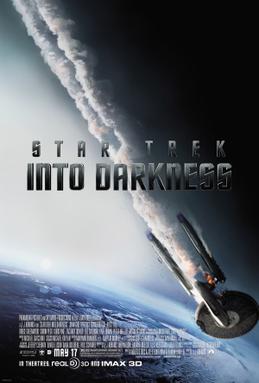
Odds n' Ends on "Star Trek: Into Darkness"

Much and more ink will be spelt over Star Trek: Into Darkness, so it almost feels besides the point writing anymore about the film which will be doubtless seen by plenty of people, and already has.

But having seen the film a second, as it is the summer, and as youngin' that's what I'm wont to do during this time of the year, I thought I'd share some additional thoughts.

Seeing the film a second time, I enjoyed it much more. The film is a fun, action-packed film. And while it doesn't reach the memorable heights of the first film, it does leave you entertained. I had expectations going into this film since its predecessor was such a wonderful reinvention of the franchise. Into Darkness doesn't expand the series further or reinvent it anymore, and that's a good place to start for considering why it doesn't come off as strongly as the original.

The film as is could shed the elements that make it uniquely "star trek-y" and it could still stand largely on its own as a solid big budget action, sci-fi adventure. That's partly a strike against it. It's nice to see a well put together summer blockbuster that's a fun distraction, but I'd rather, in the case of this film, that it be unique and specific to this franchise.  While some of this is well-realized, including especially the relationship between Kirk and Spock, much elsewhere just doesn't give you that sense. I would love to see the affection for the old series shine through; to see people who geek out about the older series getting to play around in this sandbox. And that well-worn love doesn't always comes across as strongly as it did in the original.

Many of the characters feel incredibly poorly utilized. Pavel Chekhov has practically no screen time whatsoever. Uhura is stuck in a plot that is at times embarrassingly reductive, relating agency solely to her relationship to Spock. The conflict between the two characters also comes off as rather forced and is resolved much too easily.

This speaks to a larger problem that the film has with gender. It's not all bad; the undercutting of Kirk's masculinity, at turns, is a nice sight. But the female character are token at best and objectified at worst. This is particularly true of Carole Wallace. Carole often times seems to be in the movie for the purpose of looking good, and while I can dig a pretty face, this has male gaze written all over it. 

However, the film is on the whole a very good time. There are very few sequences I would point to as being bad or distracting (although the fight on Chronos is kind of a mess and my least favorite). This is popcorn spectacle at its most refined, even if I think it could have been honed just a tiny bit more to raise it up to the tier of its predecessor.

Stray Thoughts:
-John Cho doesn't get as much to do this time around as Sulu, but that steely eyed speech to the Admiral is an excellent monologue and Cho revels in every second of it.
-Simon Pegg once again goes home MVP as he has an absolute blast playing Scotty. Also Scotty's sidekick is adorable and awesome.
-Khan crushing the Admiral's skull feels like it's from an absolutely different film. It's almost over the top for a film like this.
-Khan crashing the ship into enterprise headquarters at films end comes off as far too destructive for the conflict to feel truly victorious, like the film wants it too appear.
-I enjoyed the intro more the second time around, but having so much character development and plot take place off screen is just bad storytelling.
-The film could have done a better job explaining the situation with the Klingons for non-Trekkies.
-Kirk's death is very effective, although I think Spock saying the reverse-engineered version of the infamous line from Wrath of Khan feels a bit forced, even if it's kind of necessary for fan service.

"Texas Chainsaw" - Film Review


Texas Chainsaw is a by the book the horror film that defies the books it’s following and in the process becomes a convoluted mess.

Prior to this the film is mediocre but solidly crafted big budget horror film. There are attractive but forgettable people heading to a destination all but tailored to be their demise. There’s a general atmosphere of darkness. There are little callbacks to the original franchise that are needless but nice. There’s even a mid-portion to the film that’s genuinely rather scary and thrilling. I wish the film had stuck with this tone and these thrills because they're well-staged and a lot of fun. If the film had gone this route, it might have redeemed itself.

But then the film goes for something so bizarre that it’s simply baffling. It attempts to turn the villain into the protagonist, in part by largely ignoring the fact he’s just killed a bunch of people. And I think it worked, but I also think it may have been the stupidest and most confusing decision a film could have done. It’s an incredibly offputting turn of events that comes so out of left field and is given so little time to develop that it makes very little sense. It also undermines what little momentum the film had going for it and in turn its ability to scare us, as pseudo-villains take up the role of killing our main characters (which adds further to the convolution of this). 

Texas Chainsaw has its moments, but it descends into hackneyed, convoluted, uninteresting storytelling. 

Grade: D

Thursday, May 23, 2013

"Sex, Lies, and Videotape" - Film Review

Why are we so uncomfortable to talk about anything related to sex? Americans get particularly squeamish when the subject matter is broached. And we have unstatedly decided that violence is a-okay in films but anything sexual is taboo. In fact, the more intimate the subject matter becomes, the more likely me are to feel uncomfortable and unnerved.

Writer-director Steven Soderbergh takes that feeling of intimacy and makes it one of the key assets of sex, lies, and videotape. This is a story about four fucked up, broken people and their intertwining lives. We find these characters in minimal locations, talking and continually hurting one another. As the story unfolds, the film digs deeper and goes more personal. 

When John (Peter Gllagher)'s old friend Graham (James Spader), who he hasn’t seen for years, moves into town, John  invites him to dinner. Graham has a fucked up personal history, and he’s no longer the same person who John was friends with nine years earlier. He’s a bit off, unusual.  John is sleeping with his wife’s sister Cynthia (Laura San Giacomo). This is in part due to his wife Ann(Andie MacDowell)'s lack of desire for sex, and the two haven't had sex in a long time. 

Graham is coping with his troubled past and his impotence by filming woman while asking them about their sexuality and sexual history. Graham's greater openness leads to John, Ann, and Cynthia confronting their own troubled lives, secrets, and sexual frustration.

As the film progresses the dark hidden truths behind these people and their actions become revealed. In turn, these individuals become able to admit what they really want and break from the baggage that’s dragging them down.

The cast is all-around phenomenal, and the film does a wonderful job of fleshing out the characters. The script crafts some exceptional dialogue and asks some mature, thoughtful questions about sexuality, desire, and psychosis. 

sex, lies, and videotape is a great character study and a wonderful mood piece. 

Grade: A-

Wednesday, May 22, 2013

"Dead Alive (Braindead)" - Film Review

Before he became known to a wider audience through The Lord of the Rings movies, Peter Jackson directed a number of films that were all but destined to become cult films. Dead Alive is a prime example of this. For anyone who came into the movie solely based on their familiarity with Jackson’s blockbuster works later in his career, they might be a bit baffled.

Dead Alive is a horror comedy. Well, actually, if we’re to be honest with ourselves, it’s really just a comedy. The horror aspects are just an excuse to be gutbustingly hilariously excessive. It’s a film that takes gleeful pleasure in trying to one up every setpiece and gory showcase that it’s managed. There’s tremendous pleasure to be taken from the buckets of blood and guts as they reach almost transcendental heights of parodic, rhapsodic over-the-topness. 

The film quickly dispenses with the explanations for the Sumatran rat monkey whose vicious bite turns people into decaying zombies, and instead gets right to its real purpose: blood galore! If this at all sounds crazy and absurd, it’s because it’s meant to be, and it’s totally in line with the sensibilities of the storytelling. As a friend described the film, it’s “glorious schlock”; a film that’s self-aware of its trashy, low-budget, campy nature and embraces it super hardcore.  

There’s enough underlying, very basic storyline at it center to prevent the film from completely going haywire as it gets involved in the horror bloodfest. There’s a romantic plot between our protagonist Lionel Cosgrove (Timothy Balmy) and a comely working class girl Paquita (Diana Penalver) who’s convinced of the supernatural. There’s also a mother-son relationship that might just put Psycho’s to shame. It’s this last element that has Lionel keeping those infected alive and locked up in his basement. He just can’t let go of his mother, even if in this state she’s not really his mother. 

Dead Alive wants to get a reaction out of us. It wants us to be shocked by its manic desire to be insanely bloody and weird, and in its best moments it succeeds. It’s truly hysterical.

Grade: B+

Doctor Who - "The Name of the Doctor" - Review

Well, you certainly can’t fault Doctor Who in the Steve Moffat era for lack of ambition. That’s for sure. In fact, I would say that the series’ greatest problem under Moffat has been too much ambition. And while I really appreciate ambition, even ambition that falls short of the mark, Moffat is simply trying to cram too many ideas into any given episode, and this has become an increasingly bigger problem as the time under his tenure has gone on. They’re frequently very wonderful ideas but rarely are any of them given enough time to breathe.

“The Name of the Doctor” has a lot to like. But it feels like an episode that’s trying to tell a story that ought to have parsed out over a couple of episodes. For example, did we really even need the appearance of River (whose appearance itself is a mystery related to her being trapped in a database after “Forest of the Dead”)?

I like the explanation for Clara’s multiple lives. And somehow it’s both totally crazy and somehow kind of sound in that way that really only Moffat is capable of pulling off. But when the show tries to achieve these complex narratives with the pizazz and coolness so typical of Moffat occasionally the storytelling gets a little too convoluted. 

Another problem is that we haven’t spent enough time with Clara. While I really enjoy Jenna-Louise Coleman’s performance, we haven’t been given enough time to really understand this character and her relationship to the Doctor (her going into the time vortex without doubts doesn’t entirely add up with what we know about the character even as it attempts to be a powerful moment, which it is, but it also feels a tad forced).

The series has tried to cram a season long story into half a season, and that came partially out of the need to service the story of Amy and Rory. But I just don’t know if creating this over the top mystery for the show to solve was the best path to enter as the show entered ostensibly a new chapter. This becomes somewhat apparent in how the show never fully explains the problem at hand, leaving the episode on an ellipsis with the reveal of another version of the Doctor played by William Hurt. Another mystery.

I say all this because the mysteries have somewhat usurped the narrative. And Doctor Who has never been about mysteries. There’s been wibbly-wobbly-timey-wimey content here and there, but at its core it’s been about a mad men with a box getting caught up in to situations where he tries to help out and potentially save the day. Even his love for humanity was something that grew, begrudgingly, over time. 

Now let’s fanboy here for a moment because the above probably comes off as totally despairing and cynical. The scenes of Clara placed into stock footage are a real treat, even as they stretch the limits of the budget to a point where they don’t totally work. The idea of the Doctor facing up to his future death by heading to his tomb is emotionally rife and honestly the episode doesn’t get enough time spent with the Doctor confronting this.     

There’s plenty of the expected fun in “The Name of the Doctor”, but it tries much too hard to get across what it wants to convey. 

Grade: B

Mad Men - "The Crash" - Review

“The Crash” is a busy episode, and at times it’s a confusing episode. But it’s an episode that’s meant to be busy and confusing. The moment Don and the members of our now nameless ad agency take some doctor prescribed drugs the whole episode goes into a bizarre overdrive. The episode has the quality of a drug trip; it’s dream-like, fast paced, filled with unexplained jumps forward in time, and many elements seem arbitrary but potentially loaded with hidden meaning. But often, honestly, come off more arbitrary. Like what the heck is up with the creative team throwing exacto-knifes at Stan beyond adding to the already abundant sense of chaos and unproductiveness at the office?

After being dumped by Sylvie, Don becomes a wreck. He’s scheming of ways to win her back, and standing outside her apartment door, creepily hovering. The whole time Don has everyone convinced he’s working on the ad campaign for Chevy, but instead it turns out he’s crafting the perfect sales pitch to win back to Sylvie. If Don has been out of sorts before, he rarely has stooped to such maddening lows. When he collapses towards episode end, it feels like the only logical response to how much Don has been failing to tackle reality and the many things in his personal life (it also feels like the only logical response to the absolute craziness of this episode). For so long this season Don has been doing a terrible job at work and he’s been avoiding responsibility, in his marriage, at work, and with his children. 

There’s a general offness to this episode (well, there's an understatement if there ever was one). Everyone is talking in a highly mannered and fastpaced way that’s sometimes comical but mainly very strange and offputting. Even outside the office, the Sally B-plot is totally weird. A strange black woman breaks into the apartment and starts robbing the Drapers. Sally immediately recognizes that something isn’t right but she’s put into a fix by her age, her lack of knowledge of her father, and her general justifiable fear and confusion. 

Sally has been a character that’s been overlooked this season. After spending more and more time with her each season, it’s been disappointing to not see more screentime from the always great Kiernan Shipka. Shipka continues to nail the growing independence and rebelliousness of her character while still managing to undercut this with a youthful uncertainty. But Sally's storyline is part and parcel of the larger peculiarity of this episode and also has less to say about her than Don.

For this is an episode all about Don. We get more flashbacks to Don’s time living in a brothel, a formative experience. While these flashbacks don’t interest me nearly as much as some of the flashbacks in the past, they continue to fill out the backstory of Don and they set up the wonderful (if very on the nose) closing scene of the episode where Don equates the agency with a whorehouse (great resonance of “The Other Woman” here). We could have guessed that the prostitute introduced in "Collaborators" would deflower Don and it comes to fruition here. While the flashbacks aren’t the most interesting, they play off the episodes theme stated by soothsayer and daughter of the late Frank Gleason, “Does someone love me?” Don doesn’t want Sylvia; so much as he’s so damn lonely that he doesn’t want to lose the one thing keeping his mind at ease.   

“You have to let yourself feel it,” Peggy tells Stan in regards to his cousin dying in Vietnam. Don isn’t letting himself feel things though; he never has. He thinks he can just always reinvent himself and that will keep him one step ahead of the pain of his past. “The Crash” might literally refer to Ken’s car accident, forcing him to walk around with a cane. But it figuratively refers to Don, who has been all but destined to collapse in some form or another. It wouldn’t be all that surprising if the series ended with Don having to own up to everything he’s been avoiding for five plus seasons, and when he does it will be messy and self-destructive no doubt.

Our other "Don", Peggy, not be getting exactly what she wants (she clearly wants to hook up with Stan, and she even more obviously wants to sleep with Ted). But Peggy can control her urge; she, for now, is going to stay true to her boyfriend. As we know from our other “Don”, Pete, that it’s best to stay on the straight and narrow. No matter how good you are at assuming some part of the identity of Don Draper, it almost always comes at a cost.  

Take Sally for instance. This episode wants to parallel Sally and Don, to an extent. Sally is acting like she believes her father would have and how she expects her father would have wanted her to. But this ultimately leaves her doubtful. She apologizes for screwing up. But, of course, Sally handled this as well as we’d hope a fourteen year old to. And more importantly still, as Sally herself states, she doesn’t really know her father (but then again: no one truly does).  Don is still that child at the whorehouse and he's that way because he never got the affection of a real mother. Hence trying to hold onto Sylvia.

The themes of prostitution have been abundant this season. And Don’s closing statement makes this blatant. Actual sex, in deed, takes place in the office. The people that get hurt the most when things are run on this sort of business model are people like kids (Don in the flashbacks or Sally and Bobby in the present) or people who mean well (the kindly prostitute, Ken). 

“The Crash” has a lot of ambition, and, while this ambition doesn’t always succeed, I really appreciate its ambition. At times this season, Mad Men has felt like it’s retreading a lot of territory we’ve seen so much of with not much new to say. It’s also felt like it has so much it wants to get in that it’s not necessarily being as substantive as it potentially could be. While this episode is often more style than substance, it's always nice to see the episodes of Mad Men that are structurally more adventurous, even if here it comes off as too frantic and hectic.

Grade: B+

Tuesday, May 21, 2013

"Star Trek: Into Darkness" - Film Review

There are a handful of reactions that you are pretty much guaranteed to have when you go to see a summer blockbuster. The big three are pleasantly surprised, mildly disappointed, and outright desiring your money back. There are summer blockbusters that are a rip roaring good time, that earn their spectacle through interesting situations and great characters. There are films that amuse you but leave you slightly dissatisfied. And then there’s those other ones you totally regret seeing it.

JJ Abram’s Star Trek fell squarely into the pleasantly surprised category. It was not the summer blockbuster that was most on my radar, but it was one that stuck with me after I’d watched the film. The film took something familiar and elevated it above the well-worn tropes that had made the series a cultural hallmark.

Star Trek: Into Darkness doesn’t stick with you the way its predecessor did. It’s what we might describe as mildly disappointing. 

Into Darkness reminds me of another recent summer blockbuster: Iron Man 3. Both are sequels to major successful franchises. Both fail to live up to the merits of a sequel. There’s more spectacle at times, but the spectacle never feels completely well-earned. The plotting is inelegant and the stories try much too hard to provide a gravitas that simply just isn’t there.

And this, mind you, is me talking about two films that I largely enjoyed. Into Darkness has some moments that are popcorn action at its most engrossing, but the plot is also frustratingly scattered. So much so that the film is often a collection of mostly good scenes that are somewhat disjointed. It takes a third of the movie to really get cooking, and even then the film has suffered from an opening sequence that’s uninteresting and perfunctory. There are also a number of twists piled on top of eachother that start to become tedious. 

There are many moments in the film that feel like they’re in this movie merely because the studio expects it’s the type of stuff we want in there. Scotty makes an off-handed quip. Kirk and Spock have disagreements over commanding the ship. McCoy amusingly suggests an alternative action to Kirk. Leonard Nimoy makes an appearance! But after a while a number of these moments come off as if they don’t service the narrative but rather are in place just to try to get a reaction out of the audience, to carelessly make us laugh or thrill us. And too much of it is leaning on our affection for these characters and this universe (granted, many of these previously mentioned expected moments really are a treat and arguably would have detracted from the film had they not been there). But as appealing as they may be, on their own a solid film they do not make. 

Don't get me wrong. The action of Into Darkness is wonderfully staged and addicting. This action is made all the more pleasurable by the tremendous performance of Benedict Cumberbatch in the role of the villain who vexes our heroes with his delightful scheming.  

There’s a lot of fun to be found in the film, but it just doesn’t step its game up the way a big budget sequel ought to. 

Grade: B