Thursday, February 27, 2014

"Rock ‘n’ Roll High School" (1979)

Rock ‘n’ Roll High School is a musical built around The Ramones, but the musical aspects aren’t really what make the film so entertaining. If you enjoy the music of The Ramones it will be enjoyable, but, though the musical moments are well-shot, The Ramones are an uncharismatic screen presence. Instead, what makes the film work is the simple fact that anyone can get behind the film for its embracement of the punk ethos The Ramones represented (and the band could easily be swapped out for any other late 70’s punk band and this would still work). Like Freaks, the film that inspired one of The Ramones’ best songs, the film has an abiding affection for weirdos and misfits, and it gives them, led by the band’s self-proclaimed biggest fan (PJ Soles), an opportunity to fight for control of their school, through music and an anarchic spirit, against the dictatorial control of the new principal (Mary Woronov). For most of its runtime though, the film is simply a very self-aware teen film. Rock ‘n’ Roll High School functions off of a lovable cartoon logic. There’s a Looney Toons appeal to the film, which functions less on plot than on a grab bag of high jinks and tomfoolery. This is a film where one of the best running gags involves taking a joke about a lab experiment on mice to its logical conclusion, having the mice become human sized; no one bats an eye at this. But it makes sense within the rationale of the film’s world: anything goes, as long as you’re not keeping anyone down.

Grade: B+

Wednesday, February 26, 2014

"Woyzeck" (1979)

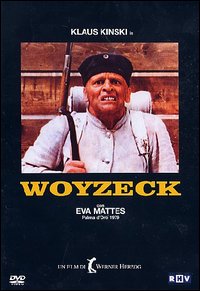
Until the 19th century the treatment of those with mental illness was horrendous, and even the reforms from that century were inadequate. At present, we still have a long way to go but there are now opportunities to help those who need it. But if you lived at any time before the last century: you were fucked. You’d be looked down upon at best, but you were even more likely to be taken advantage of or seen as a problem. Werner Herzog’s Woyzeck is about a German soldier Johann Franz Woyzeck (Klaus Kinski) who is very clearly a ticking time bomb. He is paranoid and hears voices. This is exacerbated by everyone around him, who only see how pathetic and nervous he is. Kinski was an intense method actor and director Werner Herzog brought out some of his best performances by bringing out the ferocious intensity Kinski could convey like few others. Kinski allows his face to sink in further and further as he suffers indignity upon indignity and his madness sets in. At any given point, Kinski’s posture is rigid but his eyes constantly suggest the depths of his emotional turmoil. Woyzeck is in a loveless marriage with Marie (Eva Mattes), who’s bored and looking to have affairs. Woyzeck seeks the help of doctor and the doctor begins using Woyzeck as a subject of experiment. The doctor makes him eat only peas for a year, which only serves to worsen Woyzeck’s instability. The doctor takes the madness as a joke and laughs about Woyzeck as if he were an amusing oddity. Herzog plays this all out with a sense of forgone conclusion; madness is inevitable once it sets in. 

Grade: B+

Tuesday, February 25, 2014

"There’s Always Tomorrow" (1956)

“There’s always tomorrow,” is the type of phrase loaded with double meaning. It can be accepted as a statement of youth, where possibility and time feel endless. But it can also act as something sour and bitter, referring to missed opportunities and faded dreams, as it does in Douglas Sirks’ film There’s Always Tomorrow. Sirks made melodramas about how Eisenhower era conformity was, as James Dean might say, tearing everyone apart. "There's always tomorrow" is the kind of deceptively hyper-optimistic phrase we might expect from a time of Leave It to Beaver deluded hopefulness and self-conception. On the surface, Sirks was dealing with stories of heart-stringingly intense emotion, but underneath Sirks examines people trapped and overwhelmed by doing what society expected of them. There’s Always Tomorrow could be taken as a fascinating study of constricted masculinity; Fred MacMurray’s Clifford Groves is a man who’s tired of the daily grind of his job as the owner of a toy company and he feels as if his family doesn’t appreciate him. When old friend Norma (Barbara Stanwyck) returns into his life, old memories and feelings are stirred up; reminding him of how much life has gotten away from him. His children believe their father is having an affair with this old friend, which they’re mostly wrong about. Clifford deep down knows he’s only fooling himself and that his stodgy old life is going to keep consuming him, no matter how overwhelming his sense of ennui might be. Sometimes there’s no tomorrow, just a lousy today. 

Grade: A-

"Ziegfeld Follies" (1946)

Broadway producer Florenz Ziegfeld Jr. was famous for his extravagant theater performances known as the “Ziegfeld Follies”. The Ziegfeld Follies rolled out the red carpet for every big name performer the producer could rope in for the show. They featured dancing, singing, comedy and everything in between. Ziegfeld Follies attempts to recapture the “let’s put on a show”-spectacle of the producer’s shows, touting itself on the DVD cover as the “Greatest Production Since the Birth of Motion Pictures”. It’s exactly the sort of hyper-overstatement you’d expect from something overflowing with this many top-billable performers, including Fred Astaire, Lucille Ball, Gene Kelly, and Judy Garland. Though Ziegfeld Follies has certainly dated, it’s more for lack of cultural relevance than for lack of entertainment value. There’s an admirable go-for-broke quality to the film that creates a not entirely unexpected lack of consistency; some sketches or bits are still really fun, but others feel more like filler than well-thought out acts. It doesn’t help that some of these performances aren’t the most memorable work by the players that are doing them. Ziegfeld Follies is more of a cultural artifact of its time, a time capsule from when an excessive Broadway revue could easily draw in a crowd. 

Grade: B-

Monday, February 24, 2014

"Abbott and Costello Meet Frankenstein" (1948)

There seems like few things quite as antithetical as the comedy routines of Budd Abbott and Lou Costello and the frights of the Universal horror monsters. The value of both of these film properties Universal had its hands on were fading, and in a desperate effort they threw them together. The result in Abbott and Costello Meet Frankenstein was something that benefited from the mismatched elements of horror and comedy. The funny business is far funnier because it feels bizarrely out of place and yet uncannily appropriate. The Universal monsters, Frankenstein’s Monster (Glenn Strange), Dracula (Bela Lugosi) and the Wolfman (Lon Chaney Jr.), were always a little campy and recognizing that exaggerated nature and placing it against the cartoonish charms of the comic duo makes it appropriately amusing. Yet director Charles Barton doesn’t sacrifice scares in the name of comedy; some good moments of horror are provided for all the monsters and this became a fitting swan song for them. 

Grade: B+

"A Story of Floating Weeds" (1934)

Yasujiro Ozu’s sound films have the quality of a silent film. They rely on the strength of their imagery and the depths of emotions Ozu plumbs from them. Ozu told simple stories, typically family dramas, with increasingly radical compositions (in most of his films he breaks the 180 degree rule). A Story of Floating Weeds, one of Ozu’s earliest films, is a silent film about the leader of a traveling theater company who returns to visit a former lover and his grown-up illegitimate son, unaware of their biological relationship. The man’s mistress, another member of the troupe, discovers the identity of the son, and grows jealous. She asks a friend to seduce the son, as a way of getting back at her lover and in hopes of breaking apart the family. This becomes further complicated as the woman actually falls for the son as she courts him. The genius of Ozu though is how all of this grows out of recognizable human emotions, and the ways he keeps layering the story with situations that deepen this emotion. Ozu displays what might be called a “formal objectivity”; though it doesn’t have the same rigor of formal discontinuity and distance of his later works, Floating Weeds allows feeling to arise from our observations of these characters and their story. Ozu’s sense of distance only serves to increase our empathy, as we feel more deeply because the film chooses to avoid directing our emotional response.     

Grade: A-

Sunday, February 23, 2014

"Kind Hearts and Coronets" (1949)

Kind Hearts and Coronets postures itself like an English gentleman, literate and dry, but with a lacerating, understated wit. The film was one of Ealing Studio’s famous droll comedies, and it tells its story with an ironic sense of detachment, contrasting its dark story with how matter-of-factly it’s recounted. Louis Mazzini (Dennis Price) has recently become the duke of the a’Asocyne family and he recounts his story in voiceover from prison, where he will be soon be hung to death. Mazzini’s mother married beneath her social standing to an Italian tenor, was disowned by the family, and instilled hatred into her son for the aristocrats who’ve taken away everything from them. When his mother dies, Mazzini plots the murders of his family members standing in line to his ascendency to the dukedom. All eight of these heirs are played by Alec Guinness, but you never notice that he’s playing all these roles. Make up, costuming, and choices in posturing and voice transform all these characters into wholly original figures. Mazzini might be a remorseless psychopath, but much like the film he’s in, he’s a sophisticated and well-spoken one, and ultimately that’s all that really matters. 

Grade: A

"Big Doll House" (1971)

The women’s prison movie had a pretty simple formula: shower scenes, threats of rape, a sadistic warden, etc. These films were never going be great works of art, but within this premise a director could do whatever they wanted, so long as they hit the necessary exploitation marks. The best of these films demonstrated surprising craft being snuck through very trashy, extremely lurid plots. Jack Hill’s Big Doll House is one of the best examples of this weird little sub-genre. The film is about a prison break at a corrupt Philippines prison, which for some odd reason has a lot of attractive American women locked away in it. Hill doesn’t hold back on the titillation; he’s not above lingering on a body or aestheticizing violence, almost to an unhealthy extent. And even Hill’s assured directing can’t make up for a number of lukewarm performances (Granted, many of these actors were not chosen for acting chops, but their good looks and willingness to expose themselves). The exception here is Pam Grier playing a prisoner who essentially amounts to a variation on her real life persona. Grier had charisma and a magnetic screen presence that makes even the most inadequate dialogue acceptable. But underneath the sensationalism Hill creates lively power dynamics that give a sense of weight and tension to the narrative. Hill knows this is all in good, tantalizing fun, and he never pretends it’s anything else; he’s light and playful here, embracing the sordid charms that a film like this entails. 

Grade: B-

Saturday, February 22, 2014

"Post Tenebras Lux" (2013)

The thing about the nature of evil is that in real life evil is far more insidious than we often give it credit. Real evil isn’t Anton Chigurh, evil incarnate practically walking around with a sign saying “Hey, I’m evil!” No, real evil is tiny acts of pettiness, selfishness and disregard that add up to slowly eat away at ourselves and the people around us. Carlos Reygadas’ Post Tenebras Lux attempts to get at this idea, or something (I could be totally wrong with a film this evasive), in tremendously impenetrable and highly personal ways. The film is a deeply introspective look at a family living in rural Mexico. The film doesn’t abide by any sense of conventional storytelling, underplaying moments that would be climactic moments or major setpieces in another film, and jumping around in time. Instead, Reygadas opts to soak up the breathtaking natural environment and observe as people precisely do awful things to one another. The notion of primordial evil lurking in nature and awakening malevolent forces in humans is definitely at play here. But really Reygadas is telling things in a state of almost abstraction; what’s interesting isn’t what’s being shown so much as how it’s being shown. Most of the film is filtered through claustrophobic, fish eye lens-like perspectives that make everything feel like it’s off its axis. Reygadas seems to have little concern with audience reaction though; this is a film that isn’t really understood so much as experienced with bafflement and wonder. The film’s most stunning, dream-like moments come in the film’s disorienting opening moments before settling into an exhaustingly elusive and uneventful series of nonstarter developments, of varying compellingness. 

Grade: B

"The Stranger" (1946)

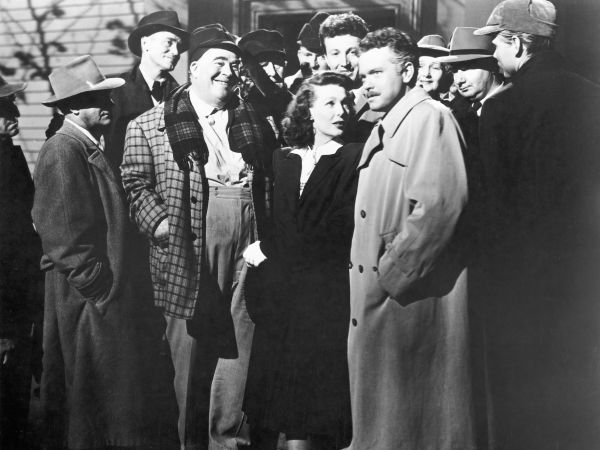
Orson Welles’ films wanted you to know you were watching a film. Welles was an ostentatious director, and he wanted his audience to marvel at his showmanship. Even not especially unconventional stories stand out when put under his flair for style. The Stranger is an exciting noir thriller about a government agent (Edward G. Robinson) tracking down an elusive Nazi Franz Kindler (Welles), hiding away under an assumed name in a small Connecticut town. The plot is fairly barebones, but within it Welles ratchets up the tension through atmosphere and deliberate pacing. As Kindler’s identity slowly becomes revealed, he tries to stay apace of the detective. His new wife (Loretta Young) becomes a pawn in the game of chess – or perhaps checkers would be more apt – between Kindler and the detective with Kindler feeding her convincing lies as the evidence mounts insurmountably against him and the walls close in on him, turning everything more claustrophobic. Welles contrasts the homey small town life against the deadly cat and mouse games, which only serves to turn everything all the more foreboding. He also gets a lot of mileage out of playing up the evils of Nazism, at the time still fresh in the public's mind. Welles may underplay just how terrible the actions of the Nazis were, but it’s all for an intended effect. Like its terrific Welles' noir counterpart Touch of Evil, The Stranger’s greatest trick is surrounding us in a moody ambience that suggests that there’s no good in this world, just varying shades of black and grey.   

Grade: A-

"Stella Dallas" (1937)

It’s become a cliché to say “It shouldn’t work, but it does”, but that description is surprisingly applicable to Stella Dallas. One of those weepie “women’s picture’s” from the 1930’s, the film features the expected near-histrionics plotting, but it’s anchored by a remarkable performance by Barbara Stanwyck, who makes this all more plausible and devastating than it sounds on paper. Stanwyck plays the titular Stella, a status obsessed working class woman who marries a down on his luck former millionaire playboy, foreseeing the potential wealth in store. That makes her sound heartless, but she’s more vain and self-deceiving than ruthless. Stella’s obsession with social climbing is complicated by her hard-nosed, scrappy upbringing. She can’t shake the habits or behaviors that mark her as an upstart. This leads her and her husband to grow distant and later become separated; taking turns to care for their daughter Laurel. Stella invests her whole life into her daughter, aspiring for her daughter the status and privilege that she herself is incapable of achieving. She vicariously lives through her daughter to an unhealthy fault, selflessly – for slightly selfish reasons – sacrificing herself and her happiness for the good of her daughter’s future. And Stanwyck sells all of this; the inflections in her voice, her posturing and mannerisms build a fully realized human being. Stella is deluded beyond all help, but her actions come from a troublingly recognizable place. 

Grade: B+

"The Letter" (1940)

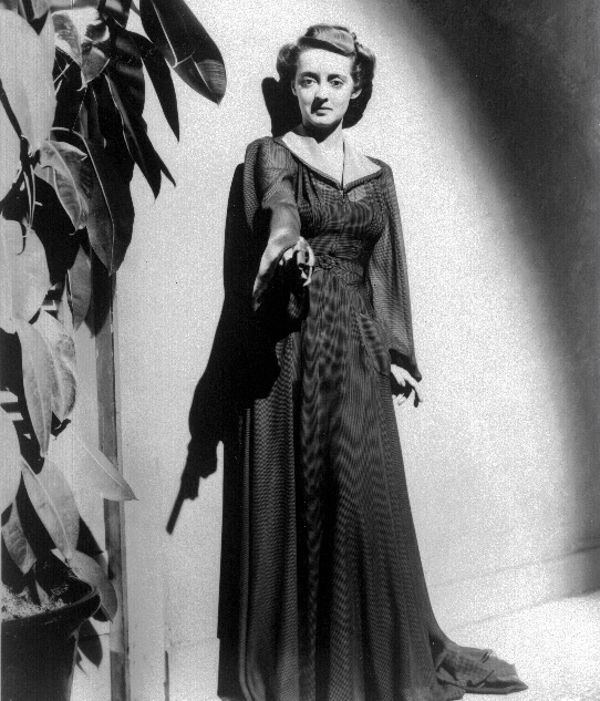
The Letter has a noir hard outer shell and a soft melodrama center. Tony Gaudio’s cinematography is languidly moody, dripping with the play of shadows that defined the noir. But the dialogue, the story and the performances are stylized in a manner more befitting the high emotions and ludicrous plots of the melodrama. Bette Davis’ Leslie Crosbie, the wife of a wealthy plantation owner in Malaya, is first seen killing a man. The look on her face demonstrates little remorse, and she fires off every single round in the revolver even as the man clearly lies dead on the ground. Leslie tells her husband, her lawyer, and the investigator a story about how a family friend attempted to rape her and how she killed him in self-defense. Director William Wyler makes it obvious from the get-go, however, that something is fishy here. This becomes corroborated when the lawyer’s assistant informs him that he’s come across a letter written by Leslie on the day of the murder inviting the deceased man over. Leslie is scheming at every turn but she never appears to fully think through her actions, scurrying to cover up one consequence after another. The Letter has some seriously outdated racial depictions regarding its Asian characters. The deceased man’s Asian wife is treated as a sinister figure almost entirely for her race and her nerve to be in an interracial marriage. Wyler’s direction suggests she’s a more deadly and less sympathetic figure than Leslie who is a manipulative, murderous adulterous. The Letter is elevated above its shortcomings through its performances and its atmosphere, and it still has the ability to strike a chord with the lubricious desire in all of us. 

Grade: B

"My Little Chickadee" (1940)

In every single movie Mae West was in she invariably played herself. The same was true for her My Little Chickadee co-star W.C. Fields. You could slap a character name onto them but no one was actually buying it. You went to see a Mae West film or a W.C. Fields film for their personalities. In hindsight, West and Fields were oddly well-suited. Each was liked for the delivery of their lines and the connotation of what they were saying. Their best dialogue functioned on double meanings and suggestion. West, with her swaggering, bawdy sex appeal, crooned out naughty lines about her extensive off-screen sexual conquests. Fields was a drunken buffoon as much off-screen as he was on, and his lines read like they were coming from someone trying convince you he was brilliant and put-together, when in reality nobody was really convinced. Fields spoke his lines in soft, muttering tones, trailing off into incomprehensibility. My Little Chickadee isn’t an especially good film, but it features these two distinctive performers and that redeems it. The film is a simple, almost redundant, western, with West as a woman whose purity is thrown into question when she has amorous relations with a masked bandit. She pretends to get married to the drunken conman Fields to set to rest any doubts about her maidenhood. Around this plot, the film allows for opportunities for West and Fields to play up their established personas. Much of the film separates them and switches back and forth between vignettes where they get in a few pithy pieces of dialogue. Besides the film’s ragged charm and humor, there is its sexual politics. Society questions West’s behavior but the film never does. West takes pride in her sexuality, and she simply shrugs off expectations and flirts with every guy around her. My Little Chickadee is often more advanced in its gender politics than many modern films: West remains single at film’s end and looks forward to more sexual adventures in her future. But really, who could contain Mae West?

Grade: B

Wednesday, February 19, 2014

"Letter From an Unknown Woman" (1948)

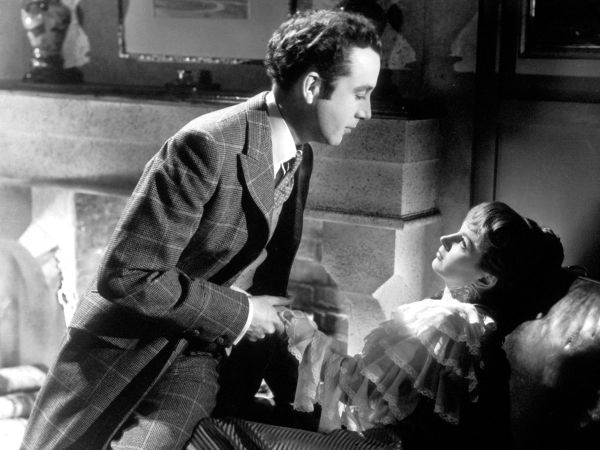
Unrequited love can be recovered from, but formerly requited love lingers with even the most hardened of individuals. Still yet, liking someone from afar, only to have your feelings confirmed and reciprocated, can breed an intensity of devotion and passion that can be unhealthy. Letter From an Unknown Woman by description sounds like a tawdry melodrama: a man, Stefan Brand (Louis Jourdan), receives a letter from a nameless, soon to be dead woman, Lisa (Joan Fontaine), recounting how she pined for him from afar, before having a glorious but brief affair that left her, unbeknownst to him, pregnant with his child. She kept the child secret because she didn’t want to ask anything of him – and probably because she thought it would temper the idyll of their time together. In the hands of director Max Ophuls though, the film rises above melodrama to become capital-d Drama. The film is aiming for high emotion, but Ophuls has deeper thematic interests about romance and love in mind, and he observes Lisa’s motivations and actions with sympathy while also understanding that they’re volatile and questionable. Ophuls treats the film like the opera music that plays a crucial role in the story, letting the camera glide along as if constantly set to an orchestral piece. Ophuls uses light and camera movement for expressive ends, emphasizing the progressively heightened emotions of Lisa. Notice the slow growth in high contrast of light and shadow; it’s subtle but crucial to our response. Lisa is a hopeless romantic who treats life with a corrosive dreaminess, all but predestined to blow up in her face. Even when Lisa gets exactly what she wants -- as she does on more than one occasion -- she finds excuses to induce things to fail because reality is never quite as satisfying as the unstable fantasy she’s built in her mind. 

Grade: A

Tuesday, February 18, 2014

"L’age D’or" (1930)

Luis Buñuel was fascinated by human nature. He was also quite cynical about it, and he thought of the human race as a depraved bunch, hiding behind a mask of politeness and civility. His second film L’age D’or caused something of a scandal for its candid depictions of and views on sex, and it was heavily censored for decades. The film begins with a seemingly non-sequitur scene describing the nature of scorpions, but Bunuel is really referring to humans, and he intends it, as almost everything he does, as a bizarre, derisive joke. The film’s main story is about a man and woman trying to have sex, but how social forces keep getting in the way of this. When they do get into the act, they look as if they’re in a parody of what sex is. They’re clumsy, and they all but ravage eachother. And that’s just the foreplay that never actually goes anywhere. Besides this central story though, the film is almost without plot, capturing moments of human weakness and selfishness with a twisted sense of humor. Bunuel fills the film with odd jokes that feel like they are there simply because they amuse him. The man attacks almost every living thing he comes in contact with, including a blind person wandering by. The man does it out of sexual frustration and self-entitlement, or may be for no reason at all. In one surreal moment, we discover that the woman has a pet cow, and see it lying in her bed. The film also features Bunuel’s indifference to religion and the Catholic church. In the film’s final moments, Bunuel ties up Christian iconography with sexual debauchery, and he does it for the sheer perversity of the joke. Today Bunuel's messages and ideas don't affect us like they did upon the film's release. In stead, what remains surprising is Bunuel's forcefulness in presenting his vision. No would mistake a Bunuel film for anything other than a Bunuel film; the audacity still shines through.

Grade: B+

Monday, February 17, 2014

"Lovely & Amazing" (2002)

Nicole Holofcener’s Lovely & Amazing is deceptively frivolous and lightweight. Holofcener isn’t concerned with traditional storytelling. There’s drama and there are moments played for laughs, but Holofcener often underplays a fair amount of what takes place. The low-key nature is in service of a story that feels true to life. The film looks at the lives of a family of four women, matriarch Jane (Brenda Blethyn), her two biological thirty-something daughters Michelle (Katherine Keener) and Elizabeth (Emily Mortimer), and her recently adopted eight year old African American daughter Annie. Michelle and Elizabeth deal with distant, inattentive partners. Elizabeth is an unsuccessful actress who lacks the confidence to make it big, while Michelle takes a job as a one hour photo job to get her husband off her back about her failing career/hobby as an artist. Meanwhile, Jane gets liposuction to take away what she sees as excess fat and tries hopelessly to flirt with her doctor, and Annie confronts issues of her racial identity and body image, complicated by Jane’s mixed messages about ethnic pride and self-image. Holofcener is interested in the lives of her women: their relationships, their work, their sense of self-worth. She isn’t afraid to have her characters come off as vicious, petty or lacking in self-awareness – or, by the same token, having too much self-awareness. The film is perceptive, observing the, often neurotic, behavior of these characters. In its best moments, especially its infamous, incisive nude scene, Holofcener places these women within the context of larger social and cultural forces. These women are as much products of gender norms as the screwed up family that’s, for better and for worse, bred them. 

Grade: B+

"Au Revoir Les Enfants" (1987)

Morality isn’t something we’re innately born with. We learn it. Partly from family and teachers, but morality is most strongly discovered through experience. Au Revoir Les Enfants is a film about a friendship between two young boys at a Catholic monastic school in Nazi-occupied France. One of the boys Jean Bonnet (Raphael Fejto) is a Jew being hidden away under a fake identity by the priests of the monastery. The other boy Julien Quentin (Gaspard Manesse) slowly puts one and two together about Jean’s real identity; Julien first hounds Jean for answers before easing into a friendship after realizing how petty his actions have been. Julien is at a point in his life where he is still coming into his own, and he hides his uncertainty behind false bravado. Behind his demeanor is the personality of a sensitive soul, and his character has much more in common with Jean than he’d like to admit. But Jean is a bullied figure of ridicule due to his social awkwardness and intellectual rigor. Julien even participates in this outcasting, before it begins to dawn on him what he is colluding in. The film subtly suggests how the cruelty of humans begins at a young age in small practices of indignity and chauvinism, and it contrasts this with the small acts of kindness and connection between Julien and Jean. Director Louis Malle based the story on his own childhood experiences, and he aims for total immersion, both in the period itself and the school setting. The authenticity of Malle’s careful observation only serves to heighten the film's chilling outcomes. Julien, Malle's stand-in, will carry these lessons with him for the rest of his life; how could he not? How could we not?

Grade: A-

Sunday, February 16, 2014

"The Last Seduction" (1994)

Imagine a noir told from the perspective of the femme fatale. In this situation, we’re not meant to see her egotistical, deadly manipulation as evil or wicked but as brilliant and delightful. Femme fatale literally translates to fatal female, both for the fatalism the character instills in the character she meets but for her own inevitable downfall. But noir fans have long known that this moralizing – largely due to the Hays Code – couldn’t detract from the fact that the femme fatale was a vital part of the genre's appeal. We understand that she’s a sly seductress and con-artist with ulterior motives, and we love her all the more for it. The Last Seduction is an excellent neo-noir about Bridget Gregory (a terrific performance by Linda Fiorentino); a woman who runs off with ill-gotten gains from a drug deal she strings her husband along into. Bridget’s witless husband Clay (Bill Pullman) isn’t just going to let her get away the hundreds of thousands of dollars, and attempts to find where she's hiding out in the rural up-state New York town of Bretton, just outside of Buffalo. Bridget settles down and starts plotting how she can extricate herself from the problem of her husband, while still keeping all of the cash for herself. She proceeds to set a trap upon a small town man (Peter Berg) looking to escape his humdrum existence. Part of the pleasure of watching the film derives from how much you know about noir, and how the film undercuts expectations about how this all should play out. But it also comes from the wonderfully ornate dialogue, sensuous atmosphere, and seeing how the thoroughly clever and awful Bridget outsmarts everyone around her, and the slow reveal of her well-thought out, two-steps-ahead-of-everyone scheme. When it comes down to it, Bridget is monstrous, but she lives in a world where everyone feels the people around them owe them something. She’s just better at taking advantage of this fact.  

Grade: A-

"Star Trek: Into Darkness", "Forbidden Planet", and Sci-Fi's Gender Problems

One of the many things Star Trek: Into Darkness did really poorly was gender politics. The film’s conception of gender seemed to be stuck back in the 1950’s. This might feel like an overstatement, until you actually go back and watch a piece of science fiction from the 1950’s, such as Forbidden Planet.

Forbidden Planet has one female character, Anne Francis’ Alta, whose entire role is essentially to stand around and look pretty. She’s even dressed in outfits designed solely for how revealing they are (outfits that actually aren’t that different from those of the female crew members of Into Darkness). And if that weren’t bad enough, in the film, she’s all but called a slut for the way she dresses. Oh, dear lord, there is an embarrassing amount of victim blaming and slut shaming in Forbidden Planet. The truly terrible thing is that the character has been isolated from all humans, except for her father, for her entire life and so she has no clue about social convention or propriety. But, despite this fact, the characters judge her based on cultural values that are beyond her. In one scene, a shipmate takes advantage of the fact that she doesn’t know anything about kissing, and it gets highly predatory and creepy – and if that weren’t bad enough she gets blamed for the incident, not the shipmate. When Alta isn’t around for the sake of looking attractive or being wooed, she exists to be saved in damsel in distress fashion. 

Now consider Into Darkness’ Dr. Carol Marcus (Alice Eve). She’s supposedly a brilliant doctor and a proficient fighter, and yet we rarely see her doing either. The one time she goes off to use her scientific knowledge to investigate the suspicious torpedoes, we never actually see her in action. Instead, we witness her strip down into her underwear, and for no better reason than to tantalize us. Dr. Marcus is reduced from a complex, smart fighter and a valuable asset to the Enterprise crew to a body. Similarly, the only other major female character, Zoe Saldana’s Nyoto Uhura, is diminished to the importance of a subplot where she has romantic squabbles with her boyfriend Spock (Zach Quintos). Uhura only matters as far as she can serve the story of Spock, the male character.

But these depictions of gender grow out a larger valutative shortcomings in these films. Forbidden Planet’s space crew is part of an intergalactic peacekeeping organization quite similar to the one of Star Trek (not entirely surprising since Gene Roddenberry cites the film as an influence), and yet the crews in both violate primary directives. The amount of cultural judgment placed upon the people of another planet by Forbidden Planet’s crew throws into question their ability to be arbitrators of justice. In Into Darkness, the Enterprise's crew ends up causes more damage than good. They wreck large parts of Earth in their efforts to defend it and the galaxy at large. They’ve ethically compromised themselves, and if anything, all members of the Enterprise should be put under a hearing for their misconduct, no matter how good their intentions were.

Forbidden Planet, however, is redeemed due to its thematic intentions and its groundbreaking special effects. Forbidden Planet could have worked as an episode of the original series of Star Trek if its runtime were trimmed. The film is about people with different beliefs and values at odds, and how the good intentions of characters end up causing more harm than they ever planned to. But unlike Into Darkness, Forbidden Planet’s tighter plotting actually allows it to sit on ideas and mull them over. When the revelation about what Walter Pidgeon’s Dr. Morbius has done comes through, it not only makes sense and rewards us, but it puts the film into some surprisingly dark thematic territory. This is a film about obsession and the refusal to recognize humanity's limitations. The damage wrought in Forbidden Planet is actually more wide-scale than Into Darkness but it grows from an understandable and far more intimate place, and that makes all the difference.  

Forbidden Planet had highly questionable gender depictions but they were a product of its time. What’s Into Darkness’ excuse?  

Saturday, February 15, 2014

"Morvern Callar" (2003)

Some people don’t live linearly, with all the constant forward momentum that suggests. They live from moment to moment. They “live in the moment”, attempting to get a contact high from the rush of their devil may care ways. I imagine many people who live like this must have a difficult time processing guilt, grief and loss. They live to avoid these harsh realities, and if they were ever given a moment’s pause, they’d be force to confront whatever it is they’re running from. In Movern Callar, Morvern Callar (Samantha Morton) is such a person. We first see her discovering her boyfriend has committed suicide. Her response is telling. She doesn’t report his death, and proceeds to attend a party with a friend. Her escalating response -- or, rather, lack of response -- to this terrible incident, and likely deeper strains of angst from a discernibly troubled life, feel callous and opportunistic. They are, but they’re just as much reckless and self-destructive. Morvern discovers her boyfriend wrote a novel, and she steals authorship of it, sending it out to publishers. She then disposes of the body and claims he’s moved away. Morvern, as you might tell, comes off a bit like a sociopath – but director Lynne Ramsey keeps suggesting the ways that Morvern does this both out of a need to survive and a desire to forget. She seems to do it out of a need for money, which she then blows on a meandering trip to Spain, but she also does it so she doesn’t actually have to deal with the death of someone she cared about. It’s a character study of a troubled but highly narcissistic person, who’s all but destined to never change. Where an event like a death would be a moment to catalyze change in most people, it simply causes Morvern to double down and increase her impetuous nature.   

Grade: B+

"Leviathan" (2013)

It might be a very bad pun to say this, but Leviathan throws you into the deep end of the water and hopes you can swim. Technically it’s a documentary film, but directors Lucien Castaing-Taylor and Véréna Paravel free up the film of all documentary, and even narrative, conventions. There’s no talking heads, no interviews and no voiceovers to guide us. It often plays more like a piece of abstract or avant-garde art than a documentary, and there’s certainly an argument to be made that it is abstract art. The film is about life on an offshore fishing vessel, much like we might think of from an episode of Deadliest Catch (which the film even references at one point in a deeply self-aware and bitterly ironic moment), but it doesn’t so much tell us how they survive but shows us. The camera is allowed to simply run and capture startling, inexplicable moments -- birds flying and guts tossed overboard become more strangely mesmerizing than is possibly imaginable. The camera is rigged to the side of the boat and allowed to capture whatever it can during this time. The result is imagery that’s riveting and powerful, but it's hard to really to put into words the startling effect. It’s an overwhelmingly experiential film, where you learn things through letting the film wash over you. But it’s not all completely surreal; much of the more dazzling imagery is contrasted with long stretches of mundane downtime or excruciatingly difficult and tedious work. Eventually this admittedly gets slightly repetitive, as it feels as though the film is making the same few points over and over. Freed from narrative constraints the film takes some daring, thrilling risks to get us to understand what life for these seamen entails, but the lack of conventions also causes the film to feel the need to drive home points more than is really necessary.

Grade: A-

Friday, February 14, 2014

"Tampopo" (1987)

We typically consider eating a very impersonal, uninteresting act. We eat when we get hungry and we do it because otherwise we would perish. But eating is much more than a simple act. It has various qualities - erotic, sensual, comforting - and it’s an act defined by the cultural context in which we eat. Tampopo is about the pleasures of eating, and it’s about the food culture of Japan. At its center, the film tells the story of a man, Goro (Tsutomo Yamazaki), who helps a woman, Tampopo (Nobuko Miyamoto), achieve her dreams of owning a great noodle restaurant. But the film jumps around to other vignettes reflecting the modern state of eating and cuisine in Japan, most memorably in a subplot about a fatalistic gangster finding deep connections with his moll through food. Some of the subplots are heavily sexual, finding the erotic attributes to eating. Others are about the divides in consumptive experiences, across class lines or generational gaps. But more often than not the film is concerned with the ways food connects and brings together people. Like in a scene where Goro introduces Tampopo to a group of homeless men, who she’s initially wary of before they prepare food that makes any differences between them matter little. In some ways, the film is like a western with a stoic, stetson-wearing man, coming to town, fixing some problems and walking away into the sunset, but Tampopo defies easy categorization, assuredly shifting between genres in order to examine the fullness of the consumptive experience of modern Japan. Tampopo is an inviting film; it’s involving and draws us into its world and its community, one built through a love of food and a passion for making it well. 

Grade: A

Thursday, February 13, 2014

"Taste of Cherry" (1998)

Taste of Cherry often plays more like a philosophical or theological thesis than a film. The film’s simple, Sartrean premise deals with man contemplating suicide and attempting to convince various individuals to bury his soon to be deceased body. He’s hoping to take sleeping pills and lay down in a shallow grave, believing if God still wants him to live than he’ll still be alive by the time the next morning arrives. Director Abbas Kiarostami uses this concept for a deeply meditative, contemplative film. There’s a tragicomic quality to the story, borne of its existential brooding, which creates a gorgeous, haunting inevitability to what’s taking place. Taste of Cherry is largely a film about individuals at ideological impasses, stemming from the man’s unwillingness to reconsider his suicide. But the film isn’t solely interested in oblique, weighty themes. Kiarostami takes time to observe the beauty of life, human nature, and the rural landscape of Iran. The film is about a man who’s world-weary and tired of life, but it's also attempting to capture a particular slice of Iran at a given time by observing the views of different classes, ethnicities, and generations. Kiarostami watches extended conversations carried on in long car rides. He finds horror and confusion here, and divides amongst people of different backgrounds and persuasions. But he also discovers a shared sense of humanity, where individuals don’t wish to be involved in this morally and ethically questionable job -- even potentially the suicidal man himself -- no matter how high the price being paid is.

Grade: A-

Tuesday, February 11, 2014

"Fast & Furious 6" (2013)

The Fast and Furious films function heavily on suspension of disbelief, in some ways more than other franchise films. This has become increasingly true as the films have embraced their cartoon-y, dumb-fun nature. Fast Five marked a new era for the franchise, which has extended into Fast & Furious 6, establishing a byzantine mythology and crafting action setpieces that defy logic. The film’s new ace in the hole was behind the camera; director Justin Lin stream-lined the meathead lunacy. Action films have the good fortune of not necessarily needing exceptional content. All they require is good formal considerations for how that content is shot. Lin does just this, pulling off the action sequences with coherence, clarity and proficiency. But Lin’s efficiency extends beyond this as well. The backstory has become exceedingly complicated and the film is juggling a large ensemble, but Lin brings economy and balance to how this is dealt with. He moves past set-up, admittedly wanting, in order to get to good-natured banter and no-nonsense action. Though Fast & Furious 6 at times wears it bloat on its sleeves, even more than the already unwieldy Fast Five, that typically has more to do with the series crushing under the ridiculous, dense, dedicated continuity. But simply praising the series for its action, which is tune-in, drop-out, gloriously unhinged technical spectacle at its most effective, sells its short. Fast & Furious 6 is successful for the diversity of its cast and its interest in giving its female characters, though only supporting roles, more to do than to simply look pretty and be saved. Its characters don’t have exceptionally deep characterizations but they’re well-written enough to remain recognizable and believable no matter how absurd the plot around them becomes. Also, not to overstate things, but it’s a very American film in its values, reaffirming family and marriage, and sacrifice and subsuming yourself to a greater cause. While none of this is especially nuanced, when there’s a car chase involving a tank, does it really matter?

Grade: B

"The Red Shoes" (1948)

Ambition is roughly equal parts possessiveness and obsession; it’s a desire that grows out of trying to grasp something just out of reach. But it’s also formed out of a feeling that whatever we’re trying to claim could end up as not ours, and no one, no matter how modest their ambitions might be, wants that. The Red Shoes is about ambitious individuals driven by their passions and their aching aspirations towards greatness and memorialization. It’s a film about a ballet company, and the compromises and questionable behavior taken in the name of success and artistry. The film uses the Hans Christen Anderson fairy tale of the same name, turned into a ballet performance, and utilizes it as mirror for the story of the theater company. Anderson’s dark fable told the story of a girl who bought a pair of red shoes and couldn’t stop dancing once she had put them on. Like many fairy tales in their original forms, it ends rather dark, with the girl dead. The upstart dancer Vicky Page (Moira Shearer) tells us that she values dancing above life; she wishes to be a famous dancer above all else. The manager of the company Boris Lermontov (Anton Walbrook) takes a shine to her; he is unsettlingly possessive of her, for reasons that are never entirely clear, possibly sexual or paternal. These feelings of possession severely deepen when the dancer falls madly in love with the company’s young composer Julian Craster (Marius Goring), who has written the score for The Red Shoes opera. Jack Cardiff's beautiful cinematography is saturated in bright colors. It envelops us, particularly during the film’s dance sequence, featuring surreal, dream-like imagery. The characters’ passions seem to seep out into reality, turning the even more solidly built traditional storytelling aspects into something that feels sinister. When the events of the play start displaying themselves in reality, we can tell where it’s all heading, but it’s still shocking and electrifying. 

Grade: A

Sunday, February 9, 2014

"My Night at Maud's" (1969)

Conversation, especially really good conversation, has a way of contorting and bending in on itself; it rambles, meanders and digresses. Above all it has the ability to take on a life of its own, to engross us thoroughly in its peculiarities. Writer-director Eric Rohmer’s script for My Night at Maud’s has lovely dialogue. The film is predicated on us listening to the conversation of a handful of characters, and these conversations are witty, sophisticated, involving and often surprisingly true to the rhythms of casual conversation, where the profound and profane sit comfortably side by side. Rohmer is interested in using the conversations and diverging perspectives of the characters to examine morality (this was one of his “Six Moral Tales” series), relationships, romance and love. Devoted, principled Catholic Jean-Louis (Jean-Louise Trintignant) has given up his frivolous bachelor ways for a more pious, simple life. His views are thrown into question when he runs into an old school friend, a professor who questions Jean-Louise’s rigorous religious principles, particularly on marriage. The friend introduces Jean-Louise to areligious divorcee Maud (Francoise Fabian), and Jean-Louise’s convictions in his beliefs in Catholic-based love and romance are put to the test. Maud is intrigued by Jean-Louise, whose opposing views and frankness fascinate her. They’re clearly attracted to one another, and the night unfolds with the unspoken question of an affair as the subtext. However, Jean-Louise’s ideal woman is a young blonde churchgoer he has pined for from afar and intends to befriend. He’s torn between what his principles tell him he needs versus what his base instincts tell him he wants – framed as moral choice for him and an amusing character fault by his compatriots. While Rohmer certainly has some thematic concerns he’s working over, he also simply likes his characters, and subtly examines them in depth through the dialogue. The dialogue is worth appreciating for its own sake though: how often is dialogue this good still written?  

Grade: A

"Nausicaa: Of the Valley of the Wind" (1984)

Post-apocalyptic worlds often work best when they feel fully inhabited, as if, no matter how implausible, this strange world is only a few steps out of sync with the one we’re familiar with. To create that lived-in quality requires careful world building, and that makes director Hayao Miyazaki with Nausicaa: Valley of the Wind a well-suited match for crafting a world that bears almost no resemblance to our own yet eerily feels like the remnants of some formerly great civilization. In all of his films, Miyazaki cares an awful lot about attention to detail, and he often seems more concerned with world building than actually telling a story – it’s as much about texture, tone and atmosphere as plot and narrative. Nausicaa is an anti-war film and a conservationist tale, but it’s foremost about stepping into a fully formed world and being dazzled by the wonders that exist in it. This world feels something like a cross between Game of Thrones and Mad Max, but despite the violence and power politics the film’s world is filtered through far too much of a whimsical, bittersweet perspective to completely bare resemblance to anything else. This is partially due to seeing much of this world through the eyes of the protagonist Nausicaa, a free-spirited princess who is carefully attuned to the beauty of the natural environment. Nausicaa’s world is set in a time after the industrialized world has imploded in on its own destructive tendencies. Much of the environment bares this mark, bereft of vegetation or signs of human life. The few places where forests still exist are inhabited by super-evolved bugs and toxic atmospheres. Nausicaa gets caught in the middle of in-fighting between various feudal-like states vying for global domination. While the film often seems like an epic medieval struggle, it has a lot more of the qualities of a Japanese fable, drawing out deep emotion and themes from a seemingly simple narrative about human nature.  

Grade: A

Friday, February 7, 2014

This Years Oscars and 2013 in Film

The editor of my school's newspaper altered a fair bit of the language of my article on the Oscars and 2013 in film, making some of it a bit questionably hyperbolic ("golden era" is really oversimplified wording that I don't really stand by, and didn't write) and cutting out some of the things I had to say about The Bling Ring and Spring Breakers. But on the whole, this sticks to what I wanted to say; 2013 was a very good year for film, and the Oscars don't acknowledge that fact in all its totality.

Tuesday, February 4, 2014

My Review of "Dallas Buyers Club"

I've been really fortunate in the opportunities I've been given over at my school's newspaper, The Lafayette, where I have a lot of freedom to write about essentially whatever I please on the subject of film, so long as its fit to print. I'm excited about the article coming out this week related to the Oscars and 2013 in film, and I hope if you're interested you'll look out for it, but in the meantime here is my review of Dallas Buyers Club. I had previously discussed it in far less detail on the blog, but this new review goes more extensively in-detail on my thoughts on the film, as well as my broader feelings on films like Buyers Club.

Monday, February 3, 2014

"Byzantium" (2013)

Vampires have to be one of the most miserable fictional creations. The world changes, people die, but they remain the same, infinitely stuck at the point they were sired. Vampires, of the modern Anne Rice conception, don’t experience things so intensely because they have heightened senses, but because after 200 years of loss and regret they have to live life with an intense passion or else they might as well feel numb. Vampires are nothing less than manic depressives with a blood addiction. Byzantium is about how isolating this type of existence must be -- constantly moving, barely making connections, and debasing oneself to survive in a world that would hunt you down if it knew your secrets. Byzantium may be romanticized, but it’s far from romantic; this is brutal, unforgiving world that occasionally is sexy in that way moping loners can sometimes be. Director Neil Jordan (Interview with the Vampire) and cinematographer Sean Bobbit create a film that tonally aches with unbearable, unrequited yearning. It’s the film’s exquisite longing that make it feel worth inhabiting even when its plotting and pacing feel a little out of sorts. The film is mired, particularly in the middle, in a series of clumsily handled flashbacks depicting the terrible life events that have made the film’s two characters, mother and daughter vampire duo Clara and Eleanor (Gemma Arterton, proudly using her looks as a potent asset and weapon, and Saoirse Ronan), such passionate brooders. What sets apart Byzantium from most vampire tales though is its emphasis on the desires and troubles of female vampires first and foremost. The story uses its vampire trappings to hone in on the exploitation and mistreatment of women across the centuries. While that might sound too broad or under thought, and it occasionally is, the film finds way to show the complicity, as well as the empowerment, of its characters in the systems that limit them. But before I get too serious and overwrought: Byzantium is primarily a moody, sensuous vampire story. It's a high melodrama about characters with passions and temperaments that are volatile and intoxicating in equal measure. And that is an under-appreciated pleasure all its own.

Grade: ★★★