Computer Chess is a relentlessly droll and dour film. Writer-director Andrew Bujalski tells the film at an almost clinical remove; he's detachedly observing a group of computer programmers competing in a computer chess competition in the early 1980's. But he's not really judging them. Though there's some humor to be found in their behavior, and it is a funny film, Bujalski seems more concerned with noting the peculiar daily beats and idiosyncrasies of this kind of event and these sorts of people. In deed, the film does a wonderful job of recreating the 1980's time and place its set in, keenly observing period detail. At times the film is a mockumentary with individuals filming the competition. The film is shot in grainy Sony tube vintage black and white video as if it's found footage, but it slowly becomes clear that some of what we see could not possibly have been filmed by anyone. And that's before Bujalski really starts taking liberties with the limitations of his stylistic convention.
For Computer Chess starts out in abstraction and then turns its thematic interests into weirdly cerebral realities (like the hard sci-fi these geeks are likely fond of). Whether it be connection and loneliness, or the shrinking gap between humanity and technology, or power and knowledge and their purpose, the film takes ideas to their logical (or, sometimes, illogical) extremes. A film like The Social Network had similar themes but explored them through procedural. Chess, however, is purposely misshapen. It doesn't rise to a high emotional point, but plummets stuttering to an anticlimax fitting for its isolated, frustrating introverts and outsiders.
If its ending feels like its of little consequence, that's likely because the events of the film were equally of little consequence. The chess players realize that beyond a handful of obsessive techies, no one will care much about the slow trudge of technological advancement or the potential denigrating effects it might have on humans in the long run. We see the members of the competition slowly fall victim to their own worse peccadilloes, missing opportunities or going after the wrong gains. Though they may have done plenty for the greater good of society and the scientific community, they also consistently seem to do it at unconscious, or, at least, suppressedly self-aware, personal loss and suffering.
Grade: ★★★
Saturday, November 30, 2013
Friday, November 29, 2013
"Resident Evil" (2002)
Resident Evil for better and (mostly) worse abides my no standard film logic. It's not a horror, action or sci-fi film (though it has elements of all those). The plot hurdles forward without batting an eye at logic or motivation. Characters are there to be framed by the camera, fight off threats, or die at the hands of zombies and computer programs. In short, it is a glorified video game (perhaps not entirely surprising considering it's actually based on a video game). Writer-director Paul W.S. Anderson is a competent director who knows how to get a desired effect. The film looks and acts like video game, but it also mostly never looks cheap (except for some poor CGI towards film's end).
However, as much as I love zombie dogs getting kicked in the face by a kickass woman, no amount of technical or visual competency can make up for how empty and hollow Anderson's story is. Anderson's characters are convenient and disposable props for the film's action setpieces. The setting, an underground, high tech research facility, is unreal and undefined, serving only to look elegantly, technocratically cool. Anderson seems to have no real interest in exploring the bare-bones themes that underlie the film. The Umbrella Corporation is an overwhelming corporate, scientific and military evil, but the company is impossibly shadowy and all consuming. There's a potential critique of the military-industrial complex and corporate capitalism run a muck, but they are way, way down on the low end of the totem pole of the film's concerns.
The film revels in its superficiality, the object-ness of the environment and its characters. It pauses in moments of self-aware satisfaction at the glorious bombast on display. As if: Yea, did you see what just happened; wasn't that neat? If nothing else, my inner ten year old certainly got a kick out of it -- I don't mean that entirely as a dismissal or insult, but I don't intend it entirely as a plaudit either.
Thursday, November 28, 2013
"The Devil's Rejects" (2005) and the Complications of Character Identification
Who are we meant to identify with in The Devil's Rejects? If you look at your options, it's either the corrupt police sheriff John Quincy Wydell (William Forsythe) who abuses his institutional authority to get revenge or the sadistic psychopathic mass murderers known as the Devil's Rejects (Sid Haig, Bill Moseley, Sheri Moon Zombie, Leslie Easterbrook). And neither of those options look at all pleasing or satisfying. But Rejects doesn't seem all that keen on allowing pleasure to be had at any turn. Characters are colorful and interesting but never entirely lovably so, and the actions they take are disturbing at best and uncomfortably atrocious and excessive at worst. It's a highly sleazy and grisly film where torturous death and pain are the only certainty.
Initially the film seems poised to have us see the protagonist as the police. They're a bit douchily hyper-masculine but they have the goal of righteous justice on their side. They want to stop the reign of terror of the Rejects who are completely irredeemable. The Rejects, by contrast, are inbred hillbillies who have taken pleasure in gruesomely murdering countless people. They're horror movie villains shown plain as day for what they are: morally bankrupt maniacs. They know this is what they are and revel in every opportunity to be exactly what people see them as.
And yet, they are our protagonists, not the police. We spend the majority of screen-time with them as they struggle to stay ahead of the police and brutally kill people. But as the body count rises and viscera increases, it becomes harder and harder to sympathize with the characters. They're antiheroes, emphasis on the anti. It's a film shown largely from the perspective of the horror villain rather than the person who would normally be the hero.
But on the other hand, the sheriff's quest for justice doesn't contrast him as any better than the people he seeks to stop. The sheriff takes his task as a personal one; he hopes to avenge his brother, who died at the hands of the Rejects. Justice, however, quickly morphs into vengeance, where any gratifying retribution is lost. The sheriff's mission slowly drags him down to the level of the Rejects.
He's no better than them, and that's why Rejects reads so bizarrely as a viewing experience. Beyond the victims of the Rejects, there's no one who's clearly a decent person and didn't deserve their fate. The heroes have become just as bad as the villains, and the hero is okay with that as long as justice is served, no matter the cost. But it leaves the world feeling a bit more off-kilter, like the ground has been cut out from under our feet.
"The Bling Ring" (2013), Celebrity Obsession, and Cultural and Personal Vacuity
After watching the young burglars in The Bling Ring rob the houses of celebrities, party, drink and do drugs, and attempt to emulate the very people they steal from, writer-director Sophia Coppola does something bold. She denies us the opportunity to see their trial. The film shows the courtroom doors close only to cut to the same set of doors re-opening and the young criminals exiting. We hear their sentences read by the judge in a voiceover set to their slow motion departure. They are punished but we are unable to be given pleasure in watching them be punished.
The narrative choice matters because the film really isn't an indictment of the vapidness and emptiness of the lifestyle of its characters. It's a critique of the larger culture that breeds this kind of behavior in the first place. The young celebrity obsessed teens rob celebrities' homes in order to appropriate some of the celebrity's status and wealth. And yet, it never brings them any more contentment; they can't stop stealing from the homes, and using their gains in order to party and look like the celebrities they steal from.
When they're caught, they never seem to be upset with their actions, but rather upset with being unable to get away with their crimes. Yet the brilliant irony of the film is that they end up getting exactly what they want by being arrested. They are turned into celebrities in their own right, chased after by the paparazzi and news reporters and thrown into the scrutinizing public spotlight they always yearned for. Sure, we're infuriated and baffled by their behavior, but we're also infatuated by it. Why else would anyone desire to be like Paris Hilton and Lindsey Lohan? We create a strange dichotomy: criticizing them for their excessive and naughty behavior, but encouraging it through tabloids and fashion mags.
While too much of The Bling Ring reads as obvious, and even a bit on the nose, that might just be, in part, due to its protagonists being loud and brash. They yell out for attention, much like their flashy jewelry and outfits. The character of Marc (Israel Broussard) is where Coppola attempts to make it most explicit how this lifestyle isn't just empty but rather the people living it are aware, on some level, of its emptiness -- even if Coppola doesn't seem to go far enough in explaining or rounding out the character (But then again, with the help of the late cinematographer Harris Savides, Coppola's style is highly impersonal and detached). Marc gets caught up in the lifestyle because he finally, for once in his life, has the attention he's never felt he had, or deserved, in the form of his friendship with the other teens (Interestingly enough, Marc is the only male member of the Bling Ring outfit, and the only one who seem to show genuine guilt). These characters are crying out for attention, any attention at all, and at any cost.
Perhaps this is best seen in the character of Nicki (a scene-stealing performance by Emma Watson). Watson's performance is delightfully hammy, but somehow it never reads as too over-the-top. It rings true for this kind of fame fixated persona. Of all the characters, she most closely looks and acts like the vacuous celebs she imitates. She's a total ditz, but she's also, surprisingly and insidiously intelligent, utilizing her good looks and angelic baby face to get away with bad behavior. And the film, ends on her, looking out at us, while on a talk show, and building up an actual celebrity status from her time as a criminal. It's a darkly cynical end-note which implicates us as just as responsible for the Bling Ring's behavior as they are.
"All That Heaven Allows" (1955), and Social Propriety and Conformity
Late in All That Heaven Allows, the widow Cary Scott (Jane Wyman) takes her new fiance Ron Kirby (Rock Hudson) out to a party to prove to herself and society at large that the age and social class differences between the couple don't matter. Ron is a much younger, much less wealthy man, and Cary initially fights her very real feelings due to a weary understanding of the consequences she will face if they date. When the town begins gossiping and rumors start spreading, it's not just an idle threat but a personal and real one which, rightfully, makes Carry feel as though she might not be able to liver her life unaffected.
Amongst the many striking and frustrating hypocrisies the film presents, perhaps the one which stands out strongest of all occurs when a much younger woman at the gathering, set to marry a man more than twice her age, quietly passes judgement on the couple. The film subtly draws attention to the twisted double standard for men and women. Cary is expected to marry again right away, and yet when a man her age, Harvey (Conrad Nagel), believes he's coming to her rescue by offering a marriage proposal, she gingerly rejects. Harvey offers her companionship but not romance or love, but romance and love are exactly what Cary desires. Yet everyone is too pigheaded, stubborn and stuck in their ways to understand why she would ever want to date a man like Ron.
Even Cary's two grown children angrily reject the possibility or legitimacy of the engagement. They have much greater reason to be upset and concerned than others who take the relationship as a personal insult. Not only is it a personal and honorary humiliation, but her son and daughter feel the burden of the public scrutiny and worry about the strain on their personal and social image. However, no one is considering Cary's feelings or emotions. They can't see past the age difference or the social class gap. Cary is transgressing boundaries, but she keeps running into people who've made it their job to police those borders.
In short, the film discovers the despairing, complicated intersection of gender, class, and social and familial expectations and obligations of the socially loaded relationship. The setting is important for this intersection, heightening the level of indignant scrutiny; by placing it in the kind of small town where everyone knows everyone else, the film makes the social ties seem more important and exceptional than they might necessarily be otherwise (1950's audiences didn't necessarily always pick up on the barbed jabs at conformity in mainstream society, but they seem patently obvious today).
Director Douglas Sirk sticking a happy ending on feels a little dishonest. There's was a more poignant and more satisfying (perversely satisfying admittedly) potential conclusion to be had, which would have crushed the hopes of this relationship and taken the examination of the film's social problem to its logical conclusion. Before this though, the film finds a painfully realistic consideration of how society, family and social bonds restrict us whether we realize it or not and how we conform to the expectations of society even against our best interests. Cary confronting her social peers, her family and their expectations about class and age is as strong as it is due to how it rings true to the unfortunate social realities it speaks to. The melodrama might seem a bit more obvious today, but its message still remains strong and its complications are still potently frustrating and absorbing.
Wednesday, November 27, 2013
What Today's Action Films Could Learn From "The Adventures of Robin Hood" (1938)
The Adventures of Robin Hood is a classic Hollywood, swashbuckling adventure, which shamelessly embraces notions of honor and loyalty; it's unabashedly escapist cinema done right. Unfolding on a beautiful, eye-popping Technicolor canvas and filled with some wonderful set and costume design, the film is essentially an old fashioned tale of good and evil. However, Robin Hood surpasses many of today's action and adventure films by using its action in service of the narrative, and not the other way around.
Every fight sequence in the film is not only fantastically choreographed and staged, but always has clear conflicts and stakes. We understand the motivations of Sir John (Claude Rains), and we understand those of Robin (Errol Flynn) and his followers. Sir John wants to shut out Richard the Lionheart from the throne and take power; Robin wants to protect the poor and defenseless against Sir John's reign of terror. It's nothing fancy or complicated, but sometimes good drama doesn't need to be overly complex. This is not intended as a complex story; it aims to please, and its conflict is established quickly and then utilized to tell a fun story about heroics, bravery and loyalty. Unlike, say, Man of Steel the film doesn't claim its concerned with what it means to be a hero; it proves it to us. Man of Steel wants to get straight to the action and fighting without giving us a reason to care for Superman and his fight (Heck, General Zod's plan doesn't make a lick of sense). Worse still, if Supe had never come to Earth, the planet would never have been in trouble in the first place. How are we supposed to root for a hero who causes more harm than good? We can't.
The action in Robin Hood is entertaining, but it's also inseparable from the story it's trying to tell. Robin fights to tests new recruits, and this shows his growing group of loyal followers. Otherwise, he fights against Sir John to set things right. In so many films recently, I'm simply waiting for the action to pass so we can get back to characters talking, but in Robin Hood the spectacle is great to look at; it's lush eye-candy. The action is uncluttered both visually and narratively. One of my favorite shots comes during the final fight sequence, a huge, sprawling battle taking place inside the king's castle. To give us a sense of the chaos of the battle, the camera gives us an extreme long shot which shows us the battle in its entirety. There are no quick cuts to create tension or make things seem more chaotic than they are. It's chaotic because we see that this is a two-fisted free-for-all taking up every inch of the castle's inner court.
There's also a sense of wit and excitement to everything taking place. The dialogue crackles with sharp-tongued wise cracking. The action has playfulness to it as well. Robin and his followers appreciate the merits and qualities of fighters. We see this in a number of one-on-one fights where Robin recruits new members of his merry men. Everyone involved seems to be enjoying the thrill of the fight and so it's hard not to enjoy it yourself. Even Sir John appears pleased to finally have a worthy adversary.
Robin Hood's fights are never overlong, but they also never feel perfunctory. They're to the point, never unnecessarily lingering. There's no excess. There's no belaboring. There is no complicated methods to attempt to excite us. What's exciting is right before our eyes. There's no outrageous twists. There's no overdone plotting. If Star Trek: Into the Darkness had half as coherent a plot as Robin Hood, the film would be far more entertaining. There are fun elements to Star Trek but they are lost in the midst of a overwrought narrative so convoluted and careless that it's insulting to the viewer. Robin Hood never insults; it entertains. It doesn't need some cheap gimmick or crazy twist to hold our attention.
The Adventures of Robin Hood helped inspire some of the myths surrounding the the legendary figure of Robin Hood, and I think that speaks a lot to the quality of the story. Whether they realize it or not, people have likely been influenced by the film. Into the Darkness, Man of Steel, Iron Man 3, and many other top box office earners aren't creating myth; they are sequels or re-adaptations, but they do little to set a new bar for the types of stories that can be told about their characters. They are also dark and brooding; there's no spark of life to them. Robin Hood is feel-good and innocent, but never to a fault; it believes its own values. I'm not sure today's blockbusters do. They want to please us, but they don't seem to know how to; there's no sense of enjoyment in pulling off a well put together piece of showmanship. The summer of 2013, on the blockbuster side of films, was one of the most widely panned summers of recent memory for films; people were frustrated with their film selections. May be we should look more to our film history and what worked and why it worked. Perhaps then we could get films which are more than fleetingly entertaining, but eternally memorable as well.
"Au Hasard Balthazar" (1966)
Au Hasard Balthazar begins with a highly sentimental montage about the childhood of of a handful of its prominent characters. Everything after these early scenes, however, is brutally unsentimental. Writer-director Robert Bresson goes extensively out of his way to show how innocent and naive his characters were at this age, and how much has changed since then.
Bresson uses the framing device of the life of the donkey Balthazar to weave the the various stories throughout together. Balthazar witnesses events but since he's only a donkey he takes everything in stride as a beast of burden. And this is important because he sees and experiences awful things throughout his short life; yet he never passes judgement. In deed, the film is often shot from lower angles, from the height level of Balthazar, and turns the perspective of the donkey into an objective observer of the film's story. The film is elliptical and minimalist, suggesting large information through small moments and episodes rather than a more straightforward narrative. While Bresson's style suggests an emotional distance from his story, he makes us feel deep emotion underneath the cool, objective gaze.
The film connects Balthazar with the timid Mari (Anne Wiazemsky), whose known the donkey since her childhood. Mari's quiet demeanor causes her to be misunderstood or abused by nearly every person around her. She wants to escape her her stifling life, but when her adventures away from home prove too much, she can't seem to settle down either. Balthazar, similarly, is repeatedly and needlessly beaten by individuals using his labor. Balthazar's trials abroad from the small farm also end badly, but in its own ways the farm life isn't much better. Perhaps saddest of all, Mari's only true friendship was with Balthazar, but she slowly forgets about the animal. It's an unconventional friendship but the two got something out of it for a time, but as Balthazar increasingly starts to become emblematic of a youth long since fade into memory, he too is forgotten and overlooked.
The film is unafraid to make its characters come off as terrible people, but it also forms complex characters who aren't simply good or evil. Mari represents broken innocence. She's raped early in the film, and her treatment only becomes more depressing and miserable as the film goes on. But the film doesn't treat her like a convenient symbol; she has unforgivable things done at her expense, but the film makes her a full character who has complicated and plausible reasons for being complicit in her circumstances and treatment.
Balthazar offers so much to the people he helps and they offer almost nothing in return. The film depicts him in almost religious terms. He's called a saint at one point, and his death at the film's conclusion has a Biblical quality; Balthazar lies down in green pastures amongst a shepherd and his sheep, as if Balthazar is a Christ figure. He's suffered at the expense of the sins of his various owners, and he ultimately dies due to those sins.
It's undeniably a purposely challenging film, but its accumulated, deeply affecting weight about human existence is powerful and beautiful.
Grade: ★★★★
Monday, November 25, 2013
Doctor Who: "The Day of the Doctor"
Very early on under the auspices of Russel T. Davies' time as showrunner of Doctor Who, it became apparent that one writer stood a cut above the rest. He didn't write a lot of episodes, but whenever he did, every Doctor Who fan began to stop and take notice. His name, as you have probably already guessed, was Steven Moffat, a long time fan of the revived cult television series. Moffat had a flare for ambitious, inventive storytelling that pushed the limits of what the show would try to do on a week-to-week basis, and many of his episodes are considered the best of the bunch of the rebooted series. His episode "Blink" is widely regarded as one of the best episodes of the show ever, not just since the revival. And it makes sense; "Blink" tests what Who is capable of; it's knotty without becoming too heady; it's playful and suspenseful, but the fun is in service of a well-told story that never loses sight of its themes or characters.
When Moffat was handed over the mantle of showrunner, it seemed like a no brainer. Give the best writer the task of making the show the best it could be. Moffat, however, increasingly took the show in a rather different direction from his predecessor. Davies liked big emotions and melodrama, emphasizing plot over character. Moffat preferred big ideas and cerebral science fiction, focusing on plot over character. Moffat's not a bad writer (in fact, I would argue that season five, the first season under his guidance, is the best of new Who), but he's a bit of one trick pony. Granted so was Davies, but his emphasis on character made you forgive him just a little bit more when he faltered. If Doctor Who has had a problem in the Moffat era, it's due to Moffat creating wildly ambitious and complex narratives. The narratives are often so self-involved and intricate that it sometimes feels like Moffat is showing off how insane and awesome he can make his stories be. And in the process he's lost a little bit of the reason the show is so good to watch. I love cool stories, but Doctor Who has always been so much more than cool stories. It's been cool stories through a very specific message about humanity, and humanity as seen through the Doctor and his current companion.
"The Day of the Doctor" felt, to an extent, like a return to form for Moffat. It's still a story filled with energetic grandeur but it's in the service of some real, well-earned emotion. Though I'm still not sure how to feel about the retconning that takes place in the episode, there is simply too much in the episode representative of what the new Doctor Who has been at its best. The Doctor has to make a difficult decision, one with large consequences and emotional and moral complexity, and he has to do it in the face of his past and the show's history. The episode draws upon the events of the Time War, the darkest material of the new series, and it uses it in order to examine who the Doctor is and why he does what he does. A fact made most poignantly when Clara, the current companion and stand-in for us and humanity at large, steps up to remind the Doctor what that truly means. Moffat is audacious in returning to events seemingly tied up for good, but he never seems to be doing it to simply shake up the waters. In stead, he reminds us why we watch the show in the first place. This is a very fun episode, starting from the team up of the three incarnations of the Doctor, including John Hurt building an entire character in such a brief amount of time. But beyond filling the episode with nifty ideas and liveliness, Moffat also puts the show in conversation with its fifty year history while creating a road map for the future.
Doctor Who is one of the few television shows which can shift quite easily between deep emotion and entertaining comfort, high concept and quiet intimacy, small premises and big ideas, silly humor and compelling philosophy. It's a small show, but darn if it doesn't have so much more to offer on the inside, and this special was proof that it still has plenty to still do and say for a long time to come. Happy 50th Anniversary Doctor Who! Here's to fifty more.
Sunday, November 24, 2013
"Ninotchka" (1939)
Ninotchka's views on Russians, the Soviet Union and communism are largely as terrible as one might expect a film produced in 1939 would be. The film presents a very simple divide between capitalism and socialism, and it inevitably favors and reaffirms American cultural values (There's also some American cultural imperialistic connotations). The later scenes set in Russia are embarrassingly stereotypical and even a bit propaghandistic.
But I'd like to offer up why all those unfortunate elements don't matter. Greta Garbo has genuine and hilarious comedic timing as Ninotchka, the stone-faced, overly rational Russian agent sent by the Soviet government to fix a botched deal to sell Russian jewels. For instance, take this scene where Ninotchka and her love interest Count Leon d'Algout (Melvyn Douglas) talk past one another:
"Your general appearance is not distasteful," Ninotchka says without a hint of irony. I can't remember the last time I laughed so hard at a single line. Ninotchka is a funny movie with a love for sharp dialogue and wit. The screenplay by Charles Brackett, Billy Wilder and Walter Reisch (based on the story by Melchior Lengyel) goes a long ways towards creating sympathetic and recognizable characters, turning stock characters into flesh and blood figures -- including Sig Ruman, Felix Bressart, and Alexander Granach as the bumbling diplomatic envoy who goes ahead of Ninchotka. And even if they're restrained by the antics of the comedy and romance of director Ernst Lubitsch's production, Lubitsch never seems to be mocking them, so much as he appears to be poking fun at human nature more generally, and the Soviet Union specifically. Lubitsch also gives the production -- with his so-called "Lubitsch Touch" -- a sense of elegance and luxuriance. The film looks gorgeous. The people, the outfits, and the locales all look gorgeous, for that matter.
But, more importantly, the film actually gives a surprisingly detailed conversation, for its time, underneath its satire of the Soviet Union, about the Soviet-American divide. People discuss the merits of both philosophies and countries (even if it's highly reductive and not the film's primary concern, and even if the film looks down on the Russian side of things). America is often enough made to look silly in its habits and ways of thinking, and through Ninotchka -- and in contrast to her rival Grand Dutchess Swana (Ina Claire) -- the film offers up the possibility of there being some worthwhile qualities to Russia -- and, possibly strangest and most interesting of all, argues in favor of the Russian monarchy's overthrow (a point made all the weirder when you consider that the film is throwing satirical jabs at the oppression of the Soviet state). The film doesn't go far enough with this, but it's hard to fault a studio comedy, whose first concern was to be funny, with failing to be completely refined in its argument. It's refined in plenty of other regards to make up for its shortcomings.
Grade: ★★★
Saturday, November 23, 2013
Divergent's Romantic Elements Do a Disservice to Its Story
**Spoilers on Veronica Roth's book Divergent below**
Veronica Roth's young adult novel Divergent, the first book in a trilogy of dystopic narratives, is essentially a coming of age story dressed up in sci-fi genre components. In the future world of Divergent, society is divided into five different factions. Each believes that some fundamental, but different, character trait will be the salvation for humanity from preventing the same sort of catastrophe that caused the world to be dystopic in the first place -- currently none are right on that account, but they still fight passionately over the issue. At the age of sixteen, the members of all factions take a test which informs them what faction they are best suited for, and soon after they use the test to determine whether they wish to stick with their faction or leave their family behind for a faction that might just better suit their personality. Abandoning one's faction is perceived as equivalent to fratricide. It's a near treasonous act, not just because you can't see your family ever again, but because of the ferocious rivalries between the factions.
This is a compelling and largely original premise. Though the assignment of singular character traits to the factions is a bit on the nose, Roth uses the scenario to ask meaningful questions about identity, family and adolescence. Beatrice, the story's protagonist, is a member of the Abnegation faction, who preach selflessness, but Beatrice has always felt herself to be a black sheep. When Beatrice chooses Dauntless, who preaches bravery, and changes her name to Tris, Roth thoughtfully explores Tris' poignant and earnest awakening. Tris begins to realize a side of herself she never was able to express under the burden of Abnegation's restrictions. Yet at the same time, being Dauntless has its own rigors and strictures that are problematic in their own right. Neither experience is perfect, and both are limiting and freeing in different but crucial ways.
It's at this point in the story where Roth drops the ball. She inserts one of the most overused elements of the coming of age story: a romance. Tris is a complex and strong enough character without needing to rely on a guy, and her circumstances are fascinating enough that they don't need romantic elements to spice it up. Why can't a female-centric story tells its narrative without it involving her falling for a man? The romance detracts from Roth plumbing the psyche of her protagonist and the implications of the world she's built up. But the romance is also just as problematic on its own terms. Four, Tris' initiation instructor, is predatory in his advances, and Tris is ultimately overwhelmed by his infatuation rather than starting from a place of real interest and reciprocating feelings. Roth robs Tris of agency. It doesn't help that Roth treats Four as if he's in his forties before backtracking much later and saying, "No, it's cool. He's eighteen. Only a two year difference". The shift from dirty old man stalking to idealized teen romance is jarring, not least of which is due to the former reading more honestly (When she gets to the second side of the romance, it's as if Roth is writing the perfect romance rather than one specific to her characters and this fictional world or the realities of young love).
It doesn't help that Roth uses Four to excessively underline the themes of the book. Tris doesn't recognize the inner strength being revealed by her circumstances? Have Four tell her repeatedly. Because obviously if the story hadn't been showing us this rather than telling us this, it was unclear. Where Roth fails most with the romance is lack of subtlety. Perhaps she doesn't trust her target audience, but it's a poor excuse. Teens will get what you're trying to get at; they can handle dark, weighty ideas and content. The book's best moments possibly come in its final chapters, where Roth ratchets up the tension and forces Tris to be witness to awful, violent experiences -- in a book that's already had plenty of unflinchingly vicious acts. A revolution, long hinted at, occurs, but rather than emphasizing the scope of the conflict, Roth wisely articulates it through intimacy. Tris reconnects with her family only to watch most of the people she care about die before her eyes while she's unable to prevent it from happening. The most compelling part of the book is Tris coming to terms with her family and who she is in regards to both her faction and her family. The romance serves neither of those.
It's not like I'm a jaded cynic who isn't won over by romance in his stories. But the romantic elements of Divergent feel like they were written for a very different story, as if Roth felt pressured to include them due to recent genre expectations. But Tris' experience is interesting for what it tells us about a young teen's struggles with and conception of the world, whether it be in Roth's dystopia or our world, which it at times reflects, and the book doesn't need to get some teen smooching on in order to achieve this. In fact, it ultimately does a major disservice to the thematic strength and insight of the narrative. The teen experience is not just about the butterflies of first romance and a more significant interest in the opposite sex, and Roth deals with those other far less considered aspects of the experience -- family, friendship, body image issues, bullying -- pretty well up until the point that the gooey, pure romantic relationship rears its ugly head.
Friday, November 22, 2013
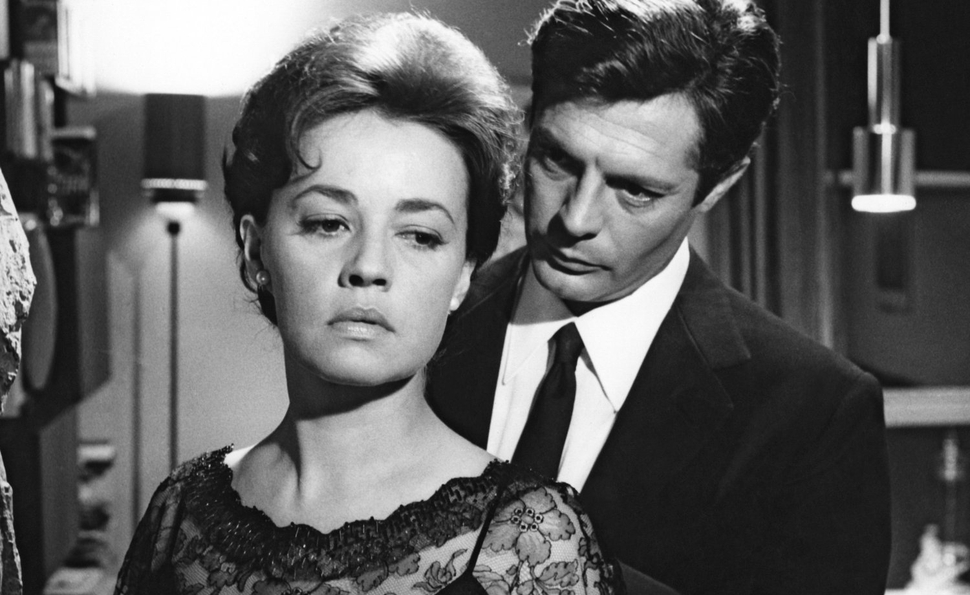
"La Notte" (1961)
There's a certain point in relationships where you have been together with someone for so long that it becomes difficult, if not impossible, to imagine that other person not being in your life. And when you add in marriage into the equation, this magnifies tenfold. Where you might not have been willing to forgive a small lapse in a longstanding partnership, you will be much more likely to forgive and forget transgressions when married. It is not only difficult to see yourself without the other person, but you just don't want to deal with the complications and difficulties that would come if you broke things off. But the other person also knows you better than anyone else, and you them, and, when you reach older and older ages, you just don't want to have to worry about and deal with being single and unsupported. This is exactly the point in a relationship La Notte's picks up with.
Giovanni (Marcello Mastroianni) and Lidia (Jeanne Moreau) don't love each other anymore. They tolerate one another, and they avoid the prickly subject matter of Giovanni's infidelity (which he has done on more than one occasion since the film began). They don't want to be together, but they also can't imagine not being together. Writer-director Michelangelo Antonioni purposely separates them for much of the story, as they can't seem to stand being around one other. Whenever they are together though, they're stilted and formal. Giovanni talks about only himself, and Lidia is tired of listening. Giovanni doesn't realize just how good he has it.
Cinematographer Gianni Di Venanzo emphasizes the loneliness, isolation and longing of the couple. The film is gorgeously moody. But Antonioni also trusts Moreau's face to convey the depths of her depression and unhappiness. It's a beautifully understated film, and nowhere is this more apparent than in Moreau's performance. Mastroianni's character is flashier; he's a brooding writer, trying to find muses in all the wrong places, when he should have long since been drawing inspiration from his wife.
Antonioni provides a clear-sighted and bittersweet portrait of a disaffected marriage on its last leg. The couple consistently finds themselves near or within crowds, particularly once they arrive at a party that neither wishes to be at. But both of them, for the most part, seem to be miles and miles away from those around them. Lidia offers up the suggestion that they go out and do something; it's a desperate last ditch effort to try to stir up whatever chemistry and connection exists between them. But they end up talking past one another (and that's when they're talking at all). Yet sometimes people would rather have someone to talk past, rather than no one to talk to at all. However, listening and hearing are often times very different things though. By the time Giovanni and Lidia do the latter, it's much too late.
Grade: ★★★
Wednesday, November 20, 2013
"Tie Me Up! Tie Me Down!" and the Horrors of Addiction (and Relationships)
Tie Me Up! Tie Me Down! is a film about addiction. Though it seems like a psycho-sexual drama, it often plays more like a horror film. The return of the repressed, Marina's (Victoria Abril) former heroin addiction, comes in the form of Ricky (Antonio Banderas). Ricky is obsessed with Marina, after a previous one night stand that she can't even recall, and kidnaps Marina in order to make her fall in love with him. Much of this plays out in protracted sequences where Ricky threatens Marina's life and limb if she does not cooperate with his crazed fantasy. After leaving a mental ward, Ricky sets about stalking her, like a horror villain eying his prey. Ricky believes he can will her into growing feelings for him. Through some unsettling Stockholm Syndrome, Marina begins slowly falling for her captor, embracing his disturbing sense of affection and romance. The highs and lows of Marina's twisted relationship with Ricky parallel those of her former addiction. Marina is beaten, bruised and mishandled, and yet unable to will herself to escape Ricky's clutches, as she finds herself oddly and strongly turned on by him. Granted, Ricky has a strong sexual magnetism of the Stanley Kowalski variety (He is, after all, Antonio Banderas). But it still doesn't distract from how alarming his actions are, no matter how erotically charged they may be.
The film opens itself up to be read this way by having Marina be a featured star in a horror movie. It's meant to be her big break into acting, after a career in pornography. Though she's been ostensibly exploited and objectified due to her former profession, the stigma carries with her. The aging director claims her as a muse, but his real motives appear to be getting her to desire him. But everyone in the film is strung up on some obsession or desire. Marina's sister wishes to be noticed by the director, but she is continually overlooked and never taken seriously. A journalist does interviews on the set of the horror film, only for us to discover she's done it as an excuse to "run into" an ex-boyfriend. Everyone is judging their self-worth based on their appearances or their sexual prowess. Oddly enough, Ricky never describes his interest for Marina in these terms, but it doesn't make the rest of his behavior any more tolerable.
But the film isn't using eroticism for the sake of eroticism. It's equating the power of Marina's addiction to an almost sexual control over her. "I don't know how to explain it," she tells her sister about the relationship, but that's because most people who've never had a drug addiction, or an abusive relationship, for that matter, hardly can begin to grasp what the person's experiencing. All that matters to the addict is getting the next fix; it doesn't matter how aware they are of the detrimental and destructive effects of their disease. They will pursue getting their high at any cost. Abusive relationships work in a similar regard to addiction in that people will find ways to justify or overlook their mistreatment or blame it on themselves rather than taking action against it and help themselves. It's this latter suggestion that writer-director uses for black comedic effect, pointing out the absurdity of the entire scenario. And it's ultimately through the film's humor that the unbearability of the premise becomes diffused.
Tie Me Up! Tie Me Down! feels like an incomplete film. It's unfocused, taking too long to get started up and finishing on a weirdly anticlimactic note. But there are still the nuggets of some great ideas throughout about relationships, addiction, obsession and genre.
Grade: ★★★
Saturday, November 16, 2013
"Robot & Frank" (2012)
On its face, Robot & Frank is a goofy little film about an elderly man, in the near distant future, whose estranged children give him a robot servant/companion to take care of him. The film is, for a large portion of its run-time, a buddy comedy with Frank (Frank Langella) playing straight-man to the overly rational robot (voiced by Peter Sarsgaard). But the film's playfulness, even its minor sci-fi elements (thankfully never overplayed), hide a deeper sense of longing and sadness. Frank is at the start of falling into Alzheimer's and his memory is slowly failing him, but that might be for the best, for him at least anyway, as his past doesn't appear to be something anyone on their last leg would want to dwell upon for too long. He was a terrible husband and a worse father, unsuccessfully pursuing cat burglary as a profession, at the expense of his familial ties. His relationships are now strained and his career is an unfulfilled dream. Frank is reluctant to have the robot around but he bonds with the bot, discovering his first real connection in ages, while the robot keeps reminding Frank he's not a human, even as he keeps referring to him as "friend" as if he is human. The film parallels Frank with the robot; it has the memory capacity, as well as the drive to improve Frank, that Frank so desperately needs. The story also contrasts Frank with the changing world; Frank is increasingly a relic in a digital age which makes his connection all the more amusing but also poignant. The film is funny, but its melancholic edge allows it to say meaningful things about growing old and yearning for the past. All of this leads to an ending that is surprisingly affecting but never sacrifices the film's oddball sense of humor.
Grade: ★★★
Grade: ★★★
"Chungking Express" (1994)
Director Wong Kar-Wai's stylish and intoxicating mood piece film-making reached its fullest expression, up to that point, in Chungking Express. Wong's previous efforts, As Tears Go By and Days of Being Wild, feel like they were just dry runs; Wong proved he had talent, but those films didn't have as crystaline a vision as Express. Express is deliriously, palpably dripping with longing and sexual desire. Everything about the film is in the name of sensuous pleasure: the precise camera placement, the atmosphere, the dazzling color scheme, the lingering emotional suggestion. The film has a plot (about two heartbroken cops coping with their loss and falling into new, strange holding patterns and relationships), but discussing the plot fails to capture what make Express so erotically charged. The film is ennui wrapped up in sexual tension. It's a slow burn, and the film is interested in exuding a time and a place, and giving us a direct understanding and identification with the youthful listlessness of its characters. But it's the novelty by which Wong does this that really makes it stand out; the longing is so specifically rooted in its characters psyche, as if it's a character study by way of mood piece. The sensuality is so strong that it lingers long after the screening, clinging to the back of your mind and making you long just a little bit yourself.
Grade: ★★★
Grade: ★★★
Tuesday, November 12, 2013
"The Magnificent Ambersons" (1942)
Tens Items or Less
A new writing segment, "Ten Items or Less" is an attempt to consciously cutback and restrict how much I write. I get ten sentences or less to discuss a movie. That's it. Let's see if some genius comes out of working around my self-made obstacle.
Writer-director Orson Welles' ostentatious, opulent The Magnificent Ambersons is a film about the rippling effects of the past playing out into the present. Much like Welles' Citizen Kane, the film deals with people deeply wounded by events long since faded into memory, which they bitterly and nostalgically still cling to. The film shows the inevitably of change and the many scales on which it plays out on; the town goes from a Midwestern countryside hamlet to a bustling city, and the Ambersons go from wealthy benefactors to footnotes in the history of the town. Eugene Morgan (Joseph Cotton) pines for the woman, Isabel Amberson (Dolores Costello), who he long lost, and his daughter Lucy (Anne Baxter) is courted by his lost love's son George (Tim Holt). This all takes place under the scrutinizing gaze of the family and the townsfolk. In some ways, the film is about how family legacies are passed through generations, as well as how the evolution of the town is seen through the lens of the Amberson's experiences. Welles' direction is purposely showy but he fills each frame with a tremendous amount of telling detail. It's no wonder why Wes Anderson looked to Ambersons when making The Royal Tenenbaums, it's a film that uses background detail, character detail and precise framing to make unstated, dense points that enrich and inform the greater narrative. It's also a film about a wealthy, dysfunctional family coasting on their inheritance and legacy. But Welles' meticulous, brazen style hides a deep sense of melancholy reflective of individuals who hurt themselves and one another by refusing to let go of the past or by denying change in the present.
Grade: ★★★
Monday, November 11, 2013
"Darkman" (1990)
Tens Items or Less
A new writing segment, "Ten Items or Less" is an attempt to consciously cutback and restrict how much I write. I get ten sentences or less to discuss a movie. That's it. Let's see if some genius comes out of working around my self-made obstacle.
Sam Raimi's passion project Darkman is a strange movie, more interesting than good really. Raimi shoots the films with a kinetic direction that gives the film a charisma that carries it through its unsubstantial and crazy plot. But it is a film that feels like Raimi ran amok with the big budget of a studio and it led to something occasionally inspired but more often simply peculiar. A scientist (Liam Neeson - at his gravel-voiced finest), badly burnt and disfigured in an explosion, uses his experiments with synthetic skin grafting to temporarily restore his appearances or adopt the appearances of the men who wronged him in order to get revenge. This means that most of the film features Neeson covered in bandages and hugged in a heavy, black trenchcoat, walking around hunched over and growling angrily to himself. Neeson is committed to the role, if nothing else, and the film embraces its craziness (gangsters, shady real estate developers, a tragic, moody antihero) which makes it more readily acceptable. This embrace leads the film to some curious but fun moments, and the film's sugar-rush pacing and Raimi's atypical, energetic directing makes it all go down much more easily. It's a superhero-action film that grunts and laughs in the face of superhero conventions -- a precursor to the dark comic book adaptations such as The Dark Knight trilogy. The film is not trying to take itself serious -- although it takes its hero's tragic state and his descent into darkness quite seriously -- but the self-consciously absurd tonality and narrative still makes for a film that is not entirely satisfying but at least, thankfully, is not forgettable.
Grade: ★★
Sunday, November 10, 2013
"Thor: The Dark World" (2013)
The comic book world of Thor is the most grandiose and operatic of the current Marvel franchises, and therefore it is the one that has the most difficulty discovering the human core that makes it all ring true. Similarly, Thor is one of the less compelling characters of the Avengers. Captain America struggles with the meaning of heroism in an age that has shrugged off heroism into the dustbin. Tony Stark combats his ego and the expense it causes on his personal and professional life. It is not like there is not an underlying thematic pinning to Thor's struggle, but it feels very one-note. Thor confronts the nature of power and its corrupting influence, but it is not exactly the most well nuanced examination nor does the franchise seem all that keen on seriously exploring the issue. It does on the other hand love huge CGI spectacle, but it is often at the cost of really getting a grip on what makes Thor tick; he is into old fashioned notions of honor in a way that aligns him with Captain America but the films have yet to fully shade his character in a relatable or understandable way. He's a big heavy who can kick some serious ass and wants to defend all the worlds and innocents, but mostly because he was born to be this person rather than because he necessarily chooses to. Far more interesting than Thor are the many characters surrounding him, particularly Loki who continues to get more fascinating and complex each time we encounter him. Tom Hiddleston gives a Shakespearean eloquence to line-readings, turning even less than stellar moments into fun fleeting passages in between the brutal, epic fights elsewhere. Idris Elba even gets some expanded screen time as the gatekeeper Heimdall, giving surprisingly weighted, but brief, thoughtfulness on the duel-edged sword over the burden and love of duty. An under-serviced Kat Dennings brings comic relief but she also gives far more of a sense of what makes her character, the intern Darcy, who she is than the writing does for Thor. Chris Hemsworth looks the part and can deliver lines with stoic grandeur, but Thor just isn't that exciting of a character. He's only more well-considered than his love interest Dr. Jane Foster, in an embarrassingly simplistic part that turns Natalie Portman shamelessly into a damsel in distress.
The plot is not worth pondering too long on. Aliens plot against Thor's homeworld of Asgard and the plan threatens to harm Earth. There's some mumbo-jumbo science-magic stuff called Aether that uses Jane as a vessel to attempt to turn all worlds into primordial darkness. It doesn't matter; there are Big Bads and they intend to do harm, but it is the least memorable part of the film, a serviceable but forgettable excuse for initiating conflict. Thor: The Dark World is a fun film but it suffers from re-establishing characters and plots after the gap of time in between seeing most of these characters in any film. It also suffers just as much from being a stepping stone towards bigger ambitions that Marvel has in mind for the sequel to the Avengers. Finally, it suffers from excess; Thor kills a giant rock monster at the end of a lengthy battle sequence early in the film and the question then becomes: where is there to go after we've watched such a sprawling battle that ends on such a grace note? The film finds ways to mock itself, its dense mythology, and the success of Marvel films generally within both its world and our own, and that allows for a good deal of fodder. But the film's best moments are when the action, the motivation of characters and a sense of unrestrained exuberance come together (Thor's mother (Rene Russo) fighting in one-on-one combat to defend Jane, or Thor and Loki reluctantly teaming up to exact revenge). It doesn't happen enough throughout the movie but it definitely is an improvement upon the first Thor movie, which in too many ways felt like an after thought. This has far more ambition and care even if it lives under the duel edged sword of burdens to its duty and pressure over doing justice to that obligation.
Grade: ★★
Saturday, November 9, 2013
"To Have and Have Not" (1944)
Tens Items or Less
A new writing segment, "Ten Items or Less" is an attempt to consciously cutback and restrict how much I write. I get ten sentences or less to discuss a movie. That's it. Let's see if some genius comes out of working around my self-made obstacle.
There's a moment early on in To Have and Have Not where Humphrey Bogart and Lauren Bacall, in her debut role, are within inches of kissing and yet they don't, and it almost feels anticlimactic but the simple fact is that they didn't need to kiss. Bogart and Bacall were as successful as a pairing as they were because their chemistry was so astoundingly palpable that studios could, and did, build entire films just around their presence together, and To Have and Have Not does exactly that, playing down the Ernest Hemingway elements of the narrative in favor of watching the two actors play off eachother with fantastic interplay and charm. They would later marry in real life and you can witness that in their interactions; there are side glances and smirks arrived at that feel completely organic and that's likely because the two, at time, weren't acting but simply having such a good time playing off one another. They appear to be in on some great inside joke that we are being let in on as well. It helps that they were given dialogue as sharp as this, written by William Faulkner and Jules Furthman, and which only serves to make their scenes all the more charming and entertaining. The plot is a dark, dangerous story about revolutionaries in Martinique, and Bogart's Harry Morgan getting reluctantly caught up in the intrigue and excitement. Howard Hawks is great at efficient direction; he tells as much as he needs to in the non-Bogart and Bacall scenes and even finds ways to let the romance dovetail with the ensuing drama. This efficiency is also great at establishing and creating immediately recognizable characters, including the great character actor Walter Brennan as the lovable drunk Eddie. But ultimately it all comes back to Bogie and Bacall and their invaluable life lessons about whistling.
Grade: ★★★★
Friday, November 8, 2013
"Kirikou and the Sorceress" (1998)
Tens Items or Less
A new writing segment, "Ten Items or Less" is an attempt to consciously cutback and restrict how much I write. I get ten sentences or less to discuss a movie. That's it. Let's see if some genius comes out of working around my self-made obstacle.
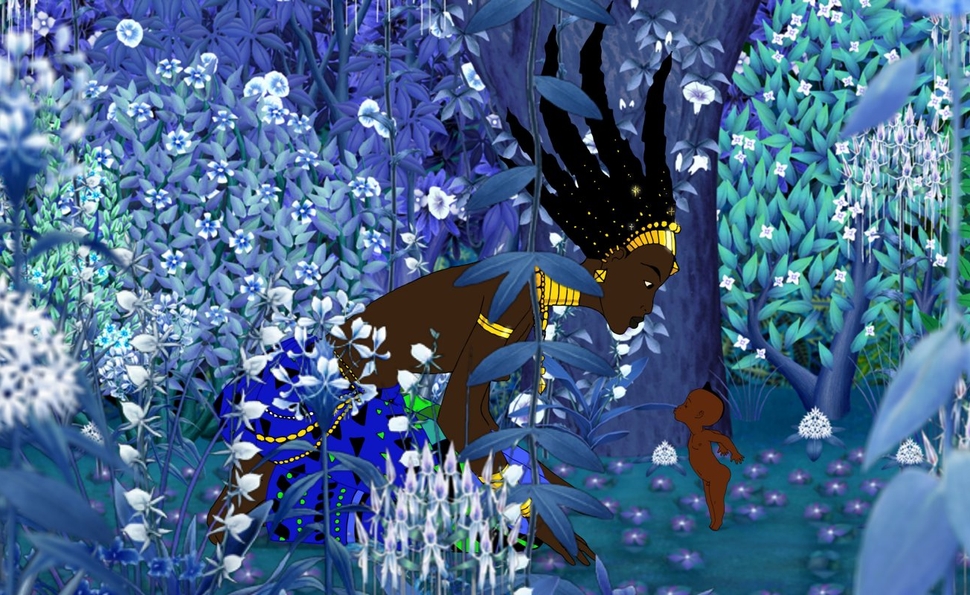
Kirikou and the Sorceress is an animated fable filtered through the sensibilities of pop art while staying true to the spirit of the folk tales it's indebted to. The film draws upon West African legend, and its abundance of irreverence sets it apart from the hero's journey of other animated films. Kirikou is a baby who gives birth to himself and sets about defeating the evil sorceress Karaba, who turns out be merely misunderstood rather than malevolent. More generally though the film is about the rhythms of village life with a fairy tale twist, and there's an episodic nature where the little moments of daily life are shown with an earnest and affectionate eye for detail. Kirikou is most importantly a joyous and whimsical film. It's idiosyncratically and deadpan funny, and sporadically filled with spontaneous musical numbers and colorful characters in a colorful environment, drawn with a flat, eye-popping color design. Like all good fables, the film has small events that stand in as bigger lessons, including growing up, doing the right thing, and being inquisitive. But the strongest is about ageism told, like all the film's messages, through eloquently precise, laconic aphorisms ("I want to be big" "And when you are big you'll want to be small") and digressive side quests. The film also has a pleasingly feminist undercurrent with Kirikou's mother and Karaba refusing to give into gender expectations. While Kirikou's story and its designs are simple, its messages are not. Though its quirky, its playfulness hides a darker sense of how the world sometimes can be mean and nasty for no other reason other than that life's unfair like that sometimes.
Grade: ★★★
Wednesday, November 6, 2013
"The Postman Always Rings Twice" (1946)
Tens Items or Less
A new writing segment, "Ten Items or Less" is an attempt to consciously cutback and restrict how much I write. I get ten sentences or less to discuss a movie. That's it. Let's see if some genius comes out of working around my self-made obstacle.
Some relationships burn so fast and so passionately that they're bound to implode, such is the case with Frank Chambers (John Gardfield) and Cora Smith (Lana Turner) in The Postman Always Rings Twice. Turner and Garfield have the kind of sizzling, immediately charged chemistry that's necessary for the gripping, sexy noir to work as well as it does. Turner and Garfield play it as if it was destiny that wandering, rootless Frank Chambers and the gorgeous, trapped Cora Smith ended up together and the film moves past their initial meeting -- a great moment that's all sexual tension and suggestion -- to deconstruct this, setting the couple down a path of escalating destruction and doubt. The great thing about the film though is that unlike most noirs, Turner's femme fatale appears to actually be in love with Garfield, making later double crosses and faded passion feel like a relationship turned sour in the worst way possible. The film's initial plot focuses on the couple hesitantly going forward with murdering Cora's husband, the meek but kind Nick (Cecil Kellaway), a man she married out of convenience but not love. But the the scheming, the false starts, and eventual execution of the plan are only about half the film's time. Soon comes the court case, with the vigilant, obsessive district attorney Kyle Sackett (Leon Ames) pressing the case as fiercely he can, only to be countered by rival lawyer Arthur Keats (in a great scene-stealing performance by Hume Croyn). The passion that initially drove the relationship proves to be unable to withstand not only the heated trouble, but also proves itself unlikely to have been sustainable no matter what the couple tried to do to keep it going. The Postman Always Rings Twice benefits from impeccable casting, particularly Turner and Garfield, who have some electrifying chemistry. You don't need nudity or sex when you have this sort of chemistry; sexual tension hangs over every moment as if it's another character.
Grade: ★★★★
Tuesday, November 5, 2013
"The Adventures of Buckaroo Banzai Across the 8th Dimension" (1984)
Tens Items or Less
A new writing segment, "Ten Items or Less" is an attempt to consciously cutback and restrict how much I write. I get ten sentences or less to discuss a movie. That's it. Let's see if some genius comes out of working around my self-made obstacle.
The Adventures of Buckaroo Banzai Across the 8th Dimension is one of the oddest and most interesting movies. Telling its story with comic book grandeur and self-assured coolness, the film is essentially the hyper-imaginative, wish fulfillment fantasy for everything a geeky ten year-old could hope for in a film. Buckaroo Banzai (Peter Weller) is a hero of outsized proportions, a physicist, neurosurgeon, secret agent and rock star, who is followed around by his sidekicks/band who help him in his quest, which involves aliens and being awesome. The more we learn about Banzai, the more impossibly cool and accomplished he becomes. There's a built-in absurdity to the premise, but the film wisely chooses to do two things: play it straight and increasingly escalate the cartoonishness. It's an uneven and frequently convoluted movie but there's enough ideas, energy and generally fun vibe that the film passes on its charm and charisma alone, much like Banzai himself does.
Grade: ★★
Monday, November 4, 2013
"Peeping Tom" (1960)
Tens Items or Less
A new writing segment, "Ten Items or Less" is an attempt to consciously cutback and restrict how much I write. I get ten sentences or less to discuss a movie. That's it. Let's see if some genius comes out of working around my self-made obstacle.
"I'm watching you watch me," Mark Lewis (Carl Boehm) tells his next unsuspecting victim as he films her filming him, and in that line and moment is the thematic and visual crux of Peeping Tom, a film about scopophilia, or the act of taking pleasure in viewing something. Peeping Tom is a film steeped in metatextual commentary on filmmaking and asks us to question why it is we get such pleasure from film watching experiences and how strange and potentially troublesome the voyeuristic qualities of viewing a film are. It does this by making us identify with its unsettling protagonist and see events through his eyes. The film is a psychologically rich and disturbing character study. Mark is awkward and soft-spoken, which allows him to pass as a shy person rather than one who is on the verge of turning violent at a moments notice. He is the titular peeping tom, and he can't seem to meaningfully interact with anyone or get enjoyment out of anything, except for through taking photos and filming things, especially sexual and violent acts. He's living his life through the filter of the camera, and he doesn't know how to live any other way because he was raised by an obsessive scientist who filmed his son twenty-four seven and used the experiment to test the effects of fear on children. Beyond the fascinating ways the film calls attention to its questions about our film experience, there is simply the creepy story of Tom as he fights his baser impulses and kills women while filming them, in order to re-watch the footage later for the pleasure it will bring. But Tom is still very human in spite of how sickening and unbalanced he is, in part, due to a great performance by Boehm, but also due to Leo Marks' script and Michael Powell's direction allowing us to understand why Tom is as messed up as he is and sympathize with him even as we can't stand to look at him.
Grade: ★★★★
Sunday, November 3, 2013
"Heavenly Creatures" (1994)
Tens Items or Less
A new writing segment, "Ten Items or Less" is an attempt to consciously cutback and restrict how much I write. I get ten sentences or less to discuss a movie. That's it. Let's see if some genius comes out of working around my self-made obstacle.
These days Heavenly Creatures is primarily remembered for having the first featured role for Kate Winslet and being the first film that really put director Peter Jackson on the map, and that's truly a shame because the film is a dark, gorgeous, achingly real story about adolescent and female friendship, isolation and loneliness, and obsession and its cost. The film is based on the tragic real life 1950's story of social misfit fourteen year old Pauline Parker (Melanie Lynskey) who found a kindred spirit in the far more upwardly mobile new student Juliet Hulme (Winslet). In her own way, Juliet is misunderstood, overlooked by her globe-trotting, detached parents, who are barely keeping their marriage from falling apart. The film uses its period setting to show how social constrictions slowly suffocate the growing affection between the two, and how it in turn causes them to escape into a dream world of their own making, beautifully portrayed through some nifty special effects. Their relationship is all very "innocent", as their parents put it, but the more societal pressures and their, mostly, well-meaning, parents push back the more they become invested in the relationship and shut out the rest of the world, ultimately to devastating effect (hinted at from the film's great opening moments that parallel the tragic reality of events with the fantasy world the two girls so desperately wish to be real). Jackson's direction is energetic but it's also great at conveying huge amounts of information through simple but inventive compositions, such as a number of montages that illuminate the growing relationship and demonstrate what each one of them is getting out of the bond. Pauline is more immediately infatuated while Juliet just wants someone who agrees with her opinions and notices her without expectations. The playfulness of the first third of the film slowly shifts as Jackson and Fran Walsh's great script pays attention to the contradictions between the girls' perceptions and the life around them, exposing the hypocrisies of their parents while also recognizing the lack of maturity of the two teens but also the earnestness and value of their relationship. It's a hauntingly beautiful film; tragic and heartbreaking not just for its ultimate consequences but even more due to how all of it could have been avoided.
Grade: ★★★★
"The Raid: Redemption" (2012)
Tens Items or Less
A new writing segment, "Ten Items or Less" is an attempt to consciously cutback and restrict how much I write. I get ten sentences or less to discuss a movie. That's it. Let's see if some genius comes out of working around my self-made obstacle.
Cinema is a vehicle for spectacle and pleasure in a way few other mediums are, and when its executed as well as The Raid, it leaves you with your tongue down to the floor drooling with brain-addled delight. The film is essentially an hour and a half of really great, relentless, visceral action, but that ignores how well choreographed and planned out that action is. This a intelligently filmed movie that makes great use of space and camera placement. In its best shot moments, the movement of the camera follows along with the characters to make us feel as if we are there. In more than one virtuoso piece of kung fu meets 80's action movie sequence, there is a fantastic sense of showmanship. The film corners itself into tricky and difficult moments of intense action and finds clever and exciting ways to extricate itself from its SWAT team takes on drug kingpin story (That is action-wise but not necessarily story-wise whose minimalism would make minimalist films laugh). There is no shaky cams or rapid-cut editing as there is too frequently in American action films these days; the film lingers on moments to really show the physicality and brutality of the action taking place as well as to allow us to appreciate how exceptionally difficult many of the stunts are. The Raid is a thrilling movie but it also has an appreciation for the expertise behind the fighting it's displaying, like a Jackie Chan or Bruce Lee martial arts film.
Grade: ★★★
Subscribe to:
Posts (Atom)