Thursday, February 28, 2013

"Sholay" - Film Review

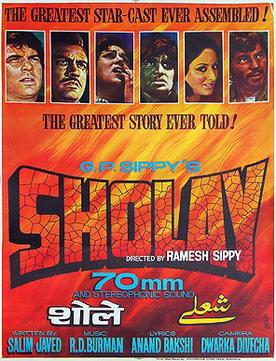
Sholay is a Western; it’s part of a subgenere of films known as “Curry Westerns”. Much like how Spaghetti Westerns provided an Italian take on the Western, the Curry Western is an Indian form of the Western. Anyone with a semblance of knowledge of Indian cinema will recognize some of the Indian cinematic tells: the sweeping musical numbers; the broad humor; the typical romance plot.

Sholay has a lot to offer. It may be a Western, but it features elements from a number of different genres, including comedy, romance, drama, and action movies (even occasionally, if I'm not misreading it, a smidgen of kung fu). These various elements don’t always mesh well, but there’s never a scene where something isn’t trying to at least entertain you.

However, the mismatched sequences are a large part of what hinders the film. Much of the narrative feels very stop and start. There are also some majorly jarring tonal shifts, particularly when the film chooses to transition from musical numbers to action sequences (or vice versa). 

That’s not to knock the film; though holistically this is a patchworking of various components, many of these individual parts taken by themselves are really good. The action sequences are beautifully staged, and incredibly exciting and enthralling, while the musical numbers are equally well choreographed and fun. Composer A.D. Burman's music is one of the film's highlights.

The film is far too overlong though (with a screentime just shy of three and a half hours). There are things that are just unnecessary and too out of place. The musical numbers are to be expected from a Bollywood movie, but the various sight gags, slapstick, and satirical moments (including a bizarre sideplot about a prison warden who looks like Hitler) are far too frequent. It has an unfortunate tendency to get sidetracked and lose focus of the very interesting narrative of a village harassed by a bandit (played with wonderful gusto and swagger by Amjad Khan) and the two petty crooks (Amitabh Bachchan and Dharmendra) hired out to save the town by a former police officer (Sanjeev Kumar). 

Though its length becomes a burden and it’s a melting pot of genre elements, it’s fairly entertaining. It's Western and action-adventure elements are massively enjoyable and engrossing (and in some instances surprisingly very dark). The film was one of the highest grossing Indian films of all time and is widely regarded as one of the best examples of classic Indian cinema, it's gone on to have massive influence on the Indian film industry.

Grade: B

Wednesday, February 27, 2013

New Girl - "TinFinity" - Review

The best ensemble comedies can take any of their characters, stick them together, and watch as they bounce off eachother. Once characters have become well defined, writers can pair any combination of characters and get different jokes and stakes for a situation.

This is where a show like The Walking Dead constantly fails. So many of the characters have been and continue to be underdeveloped and thus when certain characters are given air time we have no real reason to care about them. Too many of the character don’t have a defined set of character traits that can be reliably returned to and that determine how they’ll act in any given situation. 

Besides the occasionally erratic Winston (who, to be fair, they've gotten better about), the five main characters of New Girl are well-realized. When a character makes a joke, I know it’s a Jess joke or a Nick joke or a Schmidt joke and it speaks to that character and thus the joke is ultimately funnier for being a well-observed character moment rather than just something designed to create a reaction.  

This is the beginnings of a comedy that’s amusing but it’s the shows that go one step further that are really brilliant. The next step is to play these characters off one another to explore different dynamics and examine relationships. New Girl continues to do this incredibly well. 

It’s present in the A-plot which revolves around Schmidt throwing a 10 year anniversary for him and Nick being roommates. There’s laughs to be had at they’re odd couple bickering over the party’s details, but the scene that truly sells this episode’s pairing of them is the scene towards episode’s end where Nick comforts a heartbroken Schmidt (who has just witnessed Cece getting proposed to by Shivrang). 

It also exists in the ongoing awkwardness between Nick and Jess as they dance around suppressed feelings and general uncomfortableness. The show has handled the fallout from the kiss really well (more than I could have ever imagined). It’s landed every beat of this story, and the aftermath remains to find new ways to express the tension between these two characters that don't feel repetitive. 

It’s even there in the Jess-Winston plot where they fight for the attention of a footballer named Jax McTavish. This story may not go far enough, but it’s still a nice look at Winston and Jess that reminds us why their friends. There’s a competitiveness here that speaks not just to vied affection but the type of rivalry that could only arise between two longstanding friends. 

It’s this consideration to character that makes the show work so well. This is especially true when the plots aren’t particularly very good. The whole B-plot about Jax the football play isn’t new or interesting, nor is him revealing a more feminine side, but the plot doesn’t feel pointless or needless because it remains squarely about Jess and Winston and what this situation means to them. New Girl can get away with plots that I might find less than stellar because its character work is too good not to elevate some occasionally second rate material. Which isn't to say this episode is all second rate material, the Schmidt material in general is great and it's a really good exploration of his relationship with Nick. Plus this continues to deal with the longstanding plots of the relationships between Cece and Schmidt, and Nick and Jess in a way that still resonates.

Stray Observations:

-Jess’s continued inability to articulate sexual desires remains hilarious: “I need a different mouth on my mouth” “I want to French you”
-Schmidt is not above writing a strongly worded email to his florist.
-“Now that our mom’s approve, you want to do this thing?”
-“Take your football back to Europe”
-Nick is proud about his decision to buy a portapotty: “I’m a small business owner”
-Nick to Jess on convincing people to use his terrible portapotty: “Really sell it”
-Jess on the ongoing problems between her and Nick: “You think this is about a portapotty?”
-Max Greenfield’s acting when Schmidt sees Cece get proposed to is excellent and so damn heartbreaking.
-Jax proves to be a real problem: “I found my third wife”
-Apparently hot air balloons need propane to work. Go figure. 

Grade: B+

"My Dinner with Andre" - Film Review

Films are often obsessed with getting somewhere; to propulsively lead us to the final scene. But when a film plots itself in such a way that it’s all build up to that one moment, the journey itself feels a little less meaningful. The films, and many films that don’t quite understand the value of a plotting, often stage themselves to tell a story and hit all the necessary narrative beats we’ve come to expect from a film. But these beats, in turns, can appear artificial or superficial. The question of “what does it all mean?” remains unanswered. A really well-wrought, tightly constructed story can work incredibly effectively, but usually those films also have some extra umph setting them apart.

My Dinner with Andre doesn’t contain your typical plot. There’s one set, a New York City restaurant, that the film primarily stays in and we stay there for almost the entirety of screentime besides a brief beginning and ending voiced over montage. For the majority of the film’s story it’s not entirely clear where the movie is going. If this were an average, ordinary film, the scene at the restaurant would be brief, minimalized, infantilized, reduced to the point of short hand and of abstraction. Perhaps it would be the catalyst to snap Wallace Shawn (playing himself) out of his stupor and cause him to realize the wonders of life or some other formaldehyded, stock cliché.

Andre is a story about a man whose been avoiding a friend he’s since lost contact with (Andre Gregory playing himself) and rediscovering why he was friends with the guy in the first place. Wallace is hesitant about the dinner; he believes he’s gonna want to get in and out, but then Andre starts recounting his worldly adventures, an odd theater shop in Poland, an intriguing trip to Tibet, a bizarre time in the Saharan Desert. As he realizes the rumors he’s heard about Andre have misguided his perceptions, he’s slowly won over by Andre’s peculiar charm and abundant storytelling capabilities (muchof the first half of the film is just Wallace listening to Andre talk at length). Soon Wallace starts opening up, revealing a side of himself he’s often nervous to show. They get to talking about the problems of modern living and theater, trading worldviews and enjoying good, meaningful conversation. Before either knows it the rest of the restaurant is empty and they’ve talked the night away.

The film works so well because it’s unpredictable. It isn’t really worried about getting from point A to point B to point C. Rather, it’s content just to observe these two interesting people and the experience they share.  

My Dinner with Andre is an unconventional but wonderful character piece carried by strong performances from its two leads. 

Grade:B+

Tuesday, February 26, 2013

How I Met Your Mother - "Weekend At Barney's" - Review

Part of a show’s success is suspension of disbelief. Our ability to tune into a show and a slip away into its world. How I Met Your Mother doesn’t really succeed at this anymore.

There’s some funny lines and gags here, but I’m at the point where I just don’t care. 

Lily is an art consultant. But what is the point of her and Marshall visiting an art exhibit? In what way does it advance the plot of Lily’s career or her relationship with Marshall? If it were just a story about 30-soemthings growing up and it felt true to real life, than it might be passable, but that’s a different story, and a type of plot the series has shied away from lately. 

Ted breaks up with Jeanette, but what’s the point of watching Barney coach him (terribly) using the Playbook. There’s some amusing failed attempts to use the schemes, always ending with Ted offering to show his penis. However, we know Ted’s not going to end up with any of these people and it doesn’t service a forward direction towards meeting the mother. Jeanette had already broken up with Ted, and her return felt needless. The end where Ted’s stuff lies in ruins from Jeanette going crazy was a cop out. It (unsurprisingly) didn’t add up with how explosive and big the show suggested it would be. 

Robin is missing for most of the episode (enough so that I was starting to question the decision), but it pays off in one of the better scenes from the episode. After discovering that Barney hasn't actually destroyed the Playbook, Robin storms out. Barney’s reminder that their relationship is built on lies made me consider temporarily why these two are together; when you think about it, it’s fairly unstable foundation, one only upheld by Barney's love for Robin, and it’s a fact the show should play around with more. Of course, Neil Patrick Harris plays this all too sincerely and charmingly not to be won over just as much as Robin is.

The Robin-Barney scene was the only scene where I was drawn in, sucked in to the point where I forget "Oh yea, I'm watching a tv show". It's a great moment, but elsewhere this episode just doesn't have the heart or the feeling of purpose that earlier seasons had in abundance 

Stray Observations:

“Thank God. There’s no concert”
-“We don’t want to miss what their one big song was”
-Jeanette returns Ted’s grandmother’s ring: “She was buried wearing this”
-Two great smash cuts to Barney and robin’s reactions to Ted breaking up/getting back together with Jeanette.
-“Wow, even his scarf is up and coming”
-Lily describing her many “nip slips” was both a nice character beat and very funny.
-After all the references to the 80's flick throughout the series's run, it was only a matter of time before we got a Weekend at Bernie's spoof. 

Grade: B-
   

Girls - "Video Games" - Review


The title of this Girls’ episode is “Video Games”; it comes from a line from the women, Petula, Jessa’s father is currently shacking up with. She’s a spacey free-spirited hippy obsessed with being organic. And she suggests that life is like a video game. The only way to move forward is to “level up”. 

This piece of advice sounds like empty hokum but when you actually consider it, it’s essentially the argument the whole series has always been making. Our protagonists, Hannah, Jessa, and Marnie (and as last week demonstrated Ray as well), are no longer kids anymore and they need to start growing up and accepting responsibility. Girls began with Hannah’s parents cutting all funding to Hannah, forcing her to face adulthood head on. And yet Hannah has constantly avoided being honest with herself. Even little breakthroughs such as the one in “One Man’s Trash” never really get taken to heart. Hence her lack of real advancement. 

The show has handled the implications of the brash self-involvement of the characters rather well so far, but it’s a theme and character dimension that can only be plumbed so much. So here, instead, we get a different aspect of our characters, one that suggests what’s wrong with them. If “Video Games” is about anything, it’s about parent problems. In another sense, it’s about the unintended effects parents can have on us. Jessa may deny that her and Hannah’s parents have nothing in common, but that’s not entirely true: their parents raised them in such ways that they’re both massively incapable of living.

We finally meet Jessa’s father this episode. He’s a mopey, loser-like fellow who keeps making excuses from the word go. When he doesn’t pick up Hannah and Jessa from the store at episode’s end, it’s not really surprising; this guy is a deadbeat that was never there for his daughter. Yet Jess can’t help but seek his approval. 

I like all the above in theory, but it didn’t need an entire episode dedicated to it. Nor did we need anyone else there besides Jessa. I would have liked to have seen the other characters (just in their own stories). Jessa has been underutilized this season, but there were other ways that she could have been sent over the edge. It’s not implausible that she’d up and leave without warning after the awkward meetup with her dad, but we know next to nothing about this guy and it didn’t tell us anything we didn’t already know about Jessa. 

Stray Observations: 

-The moment Jessa’s dad started calling her “you beautiful creature”, I knew  he was an ass.
-“It’s not a theory, Camry drivers are cunts”
-“You’re the cushion”
-“She was a masseuse at the last rehab he went to”
-They eat pet rabbits in this family.
-Jessa’s dad can’t spend time with her because there’s lecture based on a Japanese study on “nuclear toxicity”.
-Drug of the Week: Whippits
-“I wrote a paper on corporations once. They’re evil”
-Lesson learned: don’t ever have awkward graveyard sex.
-“I was just trying to have continuity with you”
-“Who was your first time with?” “A girl…”
-Jemima Kirke's is very obviously pregnant by this point.
-The show should stop letting Hannah steal the spotlight of the story. It never seems to fully trust letting other characters carry stories. 

Grade: B-

"The Gods Must Be Crazy" - Film Review

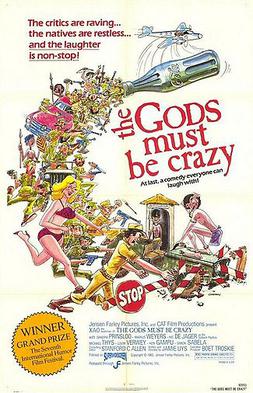
The Gods Must Be Crazy is a one-note movie. Granted, its central concept sounds brilliant (and it initially is), but much of the film feels like it’s merely a justification for that one interesting idea.

When a Coca-Cola bottle is dropped carelessly out from a plane onto an African bushman village, the tribe has never seen such a thing before and soon becomes obsessed with the object. They assume their gods must have sent it down from the heavens for them to use. But when it begins to change their way of life for the worse, they send off one of their own, Xi (Nǃxau) to go to the “end of the world” to get rid of it.

It’s an amusing little story in the beginning and it hits all the right beats regarding the bushman’s reactions to the Coke bottle. But then the film begins to branch out and it starts to get convoluted. The film loses sight of the bushman and the Coke bottle and increasingly focuses on the story of a news reporter whose decided to teach children in Africa and the scientist helping her get to the town she’s supposed to work in. 

The film devolves into a series of sight gags of varying quality. Some of which just don’t seem all that necessary. Between the sight gags and the slapstick, the film has an aura of silent film homage.

One of the better aspects is the light but amusing satire. The criticisms of American consumer society in particular are only surface level deep but their still funny. There’s also other hit or miss jabs at African dictatorships and warlords, and ethnographic documentaries. 

The Gods Must Be Crazy doesn’t live up to its premise’s potential, but it’s a pleasant if not disappointing film. 

Grade: C+

The Walking Dead - "I Ain't a Judas" - Review

The Walking Dead has never been a great series. It’s a good series with occasional glimpses of a show that could be great; a show that would take its zombie façade to create gleeful horror setpieces and penetrating morally grey questions in equal measure. That is to say, it’s a version of the show that’s always been just out of reach from the writers’ grasps.

There’s so much potential here. For my money, there’s not another series on par in unused potential. Even episodes like the first three episodes of the backhalf (which have been mostly a letdown)  have all the makings of something that leaves you in awe and wanting more. 

For starters, there’s the obvious but potentially interesting parallel between Rick and the Governor’s descents into madness. It’s an instance where the show never makes the point explicit enough. The show could ask the question, one it keeps dancing around, about why Rick and co. are better than the people of Woodbury. Andrea’s decision of choosing between both camps could be deeply exciting and complex, but instead the show keeps returning to moral reductivism: Rick and the rest of our protagonists are the good guys because… they’re the protagonists. 

Another frustrating problem is that the show finds it near impossible to let the characters take seriously the leadership of anyone besides Rick. This logical fallacy makes no sense though; the way Rick’s been acting lately, Glen, Darryl, or a number of other characters could step up, and it would create new dynamics that would keep the show fresh. Rick going crazy isn’t idiotic because it’s bizarre; it’s idiotic because it hasn’t led anywhere (besides getting Tyrese to go to Woodbury). 

The show finds itself content to always return back to basics every time it opens up the possibility for new, captivating directions. Darryl off with Merle away from the rest of the group was a story that could have gone on for a few episodes more if the writers wanted, but, nope, Darryl has to plow through a character arc to make sure the status quo is maintained. Rick doesn’t trust Michonne and wants to send her packing; oh wait, Michonne is part of the group now. 

If the series had conviction in the stories it was telling, if it acted as if everything I was watching mattered and merited my attention, than it would be very entertaining. Such a plot treatment would mean characters are developing, alliances shifting, and dynamics changing. However, the only sense I’m getting here is that Woodbury and the prison will soon be at war with one another; a fact we’ve known since the beginning of this season.

This was a conflict the show made me look forward to at the start of this season, but, in the wake of the mid-season finale, the show is failing to make the aftermath of the first skirmish weigh heavily, consequentially enough on the characters and how they act. In terms of theme and character, it just isn’t working, and the plot just keeps chugging along with no real purpose other than “Oh, hey look zombie splattering”.  

Stray Observations:

-Andrea’s return felt very stilted. The reactions from everyone were in-character, but Andrea’s “I’m in the dark” act always strained just a little bit. Plus Andrea is the most poorly defined character.    
-Why are they so deadset on fighting the people from Woodbury? Yes, people have died, but they are outnumbered; it just doesn’t seem like a sound decision unless they can find some way to get the upper hand.
-The scene between Andrea and Michonne was great. I believe that’s the most expressive Michonne’s ever gotten.
-Merle is uneasily accepted as part of the group, although probably a bit too quickly. 

Grade: B-

Monday, February 25, 2013

"The Central Park Five" - Film Review

Before I get into my review, I want to speak about documentaries more broadly. We close off documentaries as a genre of films separate from all other kinds of movies. Too many people are unwilling to watch documentaries and it’s a shame because some of our best filmmakers are making documentaries and they don’t get the press they deserve. I know I’m as much to blame for this phenomenon as anyone else, but it’s my sincere goal to watch more documentaries in the future.

Everyone perceives documentary as people telling the “truth” about real life events. But the fact of the matter is that documentaries are carefully calculated and how documentarians present information to us is often just as manipulative as many well-wrought fictional narrative.  

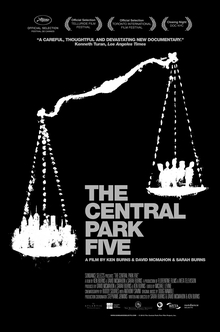
The Central Park Five tells the fascinating story of five African American and Latino teens falsely accused of the rape and murder of a white woman in Central Park in 1989. The case soon blows up, and, pressed to find the culprit, the predominantly white New York police force coerces a confession out of the five teens. Years later the actual person responsible, a serial rapist terrorizing New York in that same year, admits responsibility to the crime. It’s too late though; the five have been gone through 6 to 12 year prison sentences and their lives have been forever changed. 

Co-directors Ken Burns, Sarah Burns, and David McMahon focus the story on the five victims as they recount events. Through their testimonies, the film creates a deeply humanistic, moving, frustrating story of racial strife and political expediency.

The film does a great job of couching the personal stories in greater social, historical, and cultural trends. It grounds the incident in a larger narrative of racial animosity, rising crime, and urban decay in New York City in the 1970s and 80’s.

It’s at times uncomfortable to sit through as one injustice after another is retold, but it’s an engrossing, captivating story that’s not only well-crafted but told with compassion and resolve.    

Grade: A-

Sunday, February 24, 2013

My Thoughts on Season 1 of "The Sopranos"


 Spoilers on Season 1 of "The Sopranos" Below:

Imagine a family. In this family there are two brothers, born not too far apart from one another. The older brother down the line becomes a bit of a success; his parents are heaping on the praise, his business is doing well, he’s got a wife and kids; white picket fence; the whole nine yards. The younger one lives in the shadow of his brother his whole life. He’s a bit of a lovable screw up. Every now and again he does something right. Makes a nice investment here and there. But he just isn’t getting the same recognition as his brother from friends and family. In later years though, the older brother’s success begins to play against him. He gets complacent, a bit doughy, fat, and greedy. His business starts to waver and people in his industry begin to doubt his ability. The younger brother finally has an opportunity to get out from under his big bro's shadow. He begins to make a few notable business deals; he gets a girlfriend, and he doesn’t have the big house like his brother but he has a nice apartment and it’s clear that he’s on his way to getting engaged. Suddenly, his older brother is looking like the failure of the family.

If that whole parable didn’t make any sense, let me put it a bit more clearly: it’s the (slightly flourished) story of movies (the older brother) and television shows (the younger brother). As film studios became strapped for cash they pushed out middle of the run films (and the creative talent associated with them – including David Chase) that weren’t big budget block busters but, though not independent films, were creatively impressive. Even though the marginalized talent still believed in the greatness of cinema, they perceived of an opportunity to be had in television. Always a bit more cash strapped than the film studios, television networks became a breeding ground for quality visual media. So much so that many have argued that the past 15 or so years have ushered in a golden age of television that began to put television in many instances on the same creative tier as movies. Nowhere was this example more obvious than David Chase’s The Sopranos. 

To say The Sopranos was influential on television dramas is like saying that The Beatles were influential on music. Though the series is deeply indebted to many series that became before it (Hill Street Blues played around with the serialization that the show would go on to use so effectively, Oz told an antiheroism narrative that the show would come to adopt, and Twin Peaks was one of the first series to have the distinct stamp of one unique, auteuristic vision), it was so audacious and so flippantly breaking television conventions more than any series that came before it that it became impossible for it to not be part of the conversation at the time it was on the air. The Sopranos in turn opened the flood gate for a slew of excellent dramas; FX created The Shield because HBO proved that this type of drama could be successful; AMC was similarly inspired in its decision to take a risk on Mad Men and Breaking Bad (whose antihero elements are deeply indebted to the series); even Lost’s complex, intricate storytelling owes tribute to The Sopranos convincing television networks that given the right formula, people are willing to watch slow burn, long, complex television stories.    

A recent convention has cropped up where hating on The Sopranos and being cynical and angry at it (for the shortcomings in later seasons and its ending, which considerably divided and pissed off many) is almost the accepted norm. But that refusal to remember and acknowledge how damn good the show was and how much quality, ambitious, interesting television the show provided over the series’ run is unfair. The show had its flaws, no question about it (the depiction of race in "A Hit is a Hit" is very caricature, and the storylines for the kids were always just shy of being cliche). But come on: James Gadolfini and Edie Falco were acting powerhouses. And in the hands of the incredibly capable and competent hands of David Chase and his writing staff (including a burgeoning Matt Weiner who would go on to create Mad Men) the best of their, and the rest of the casts’ (particularly Nancy Marchand as Livia Soprano, who is an absolute monster), acting abilities were allowed to shine very bright in deed. 

So what made the series so groundbreaking? Well, for starters, it amped up the moral greyness, in its characters, in its themes, in its plot, in the questions in its audience asked themselves (David Chase has a dreadfully negative view of humanity and everybody in the show is on one level or another a bit of an asshole). This doesn’t seem like a big deal, until one considers the fact that for some 70 odd years’ prior, next to every tv series played it safe. They didn’t try to make you think deeply or complexly. They instead aimed to attract the broadest base of an audience to sell ads (I'm being purposefully noninclusive and broad in this statement here. Many would argue that television has been constantly forced to evolve to survive changing trends and tastes). The Sopranos had little intention of pleasing or appealing to anyone. 

It was a gangster show that wasn’t about gangsters. It featured gangsters and their dirty work, but In fact, the show arguably had more to do with Tony dealing with his personal life (his mother, his wife and kids, living in suburbia, talking to his shrink); most of the mafiosa business stuff tended to be in the subplots or background of the series. Thus it made great contrast and juxtaposition of these conflicting elements. 

The Sopranos also made infamous its penultimate episodes, establishing the trend of series putting their most climactic, explosive moments in their second to last episodes, and focusing on quieter finales that tied up loose ends. It’s largely a considerably better form of telling television that entails more satisfying, holistic narratives. 

The series told its stories with such confidence, and never held our hand through it. There’s no breather post-pilot; we’re immediately thrown into the deep end and left to figure out who’s who and what’s what on our own. 

The series also had a penchant for anticlimaxes; Chase wanted the show to feel true to real life, and so conflicts rarely ever boiled over, but instead fizzled out. It would often wrap up a story quickly than let it drag on like some shows might (this is apparent when Tony and Junior resolve their beef in the third episode. It’s a story that looks to be the driving force of the season and it ends in anticlimax). 

On a smaller scale, little details were noteworthy, such as exposition causally taking place in locations such as a strip club or on the side of the road, or people getting beat on or whacked for seemingly no reason (and often). 

But perhaps most important was the show’s sense of continuity, of the accumulation of past actions and events that weighed on the future. The series nailed down its characters and then never deviated from what we knew about them, and it used what we knew about the characters to bear on the plot and give it a richness of detail.  

As Todd VanDerwerf so accurately put it, the show isn’t exactly a series one adores, but one holds with a level of almost reverence. People really go out of their way to get people to see series such as Breaking Bad and The Wire (both excellent series on par in quality with The Sopranos), but The Sopranos is almost put on a pedestal where we don’t necessarily watch it to enjoy it but just to appreciate everything it’s choosing to be. Don’t get me wrong, it’s an entertaining series (with a dark, absurd sense of humor) but people tend to discuss the series as an out of body experience as if the show exists outside of itself, only mattering for how it came to bear on the whole of television. 

This short shrifts the series though. Chase built up a great world worth inhabiting and filled with interesting, fully realized characters. And he used both to tell some thematically rich and complex stories. 

It’s right there from the get-go. Just look at that theme. Has a theme ever so perfectly captured the essence of what a show was all about before? The visuals combined with Alabama 3’s “Woke Up This Morning” playing over it provide our first entry point into the dark, twisted world we’re about to enter and it does it with steely panache. It’s utterly cool and stylish, but it’s dark and gritty; almost world weary. 

Now the series is really good in its Pilot, and its Pilot is rather confident and telling of the direction the series would head (there’s an overwhelming sense of dread and decay hanging over the episode that would continue throughout the first season), but it wasn’t until “College” that The Sopranos definitively became the series we know it to be today, and that it proved itself to be significantly different from television that came before it. While Tony is visiting colleges with his daughter Meadow, he sees a former mob member turned witness protection. The whole time you can’t imagine Tony killing this guy. This guy is a nobody; he’s done nothing to warrant being killed. And yet Tony does. The Sopranos wasn’t going to play by televisions rules. HBO was against the murder, but Chase stood steadfast arguing that viewers would respect Tony even less if he didn’t go through with it. It’s not just this moment that makes the episode so fantastic (there are some great scenes between Tony and Meadow where she asks him about the “family business”, and the scenes between Carmella and Father Intintola are equally interesting), but it’s this moment in particular where the series started to truly come into its own; to take risks that other series would shy away from.   

Those people who argue that we were or weren’t supposed to like Tony Soprano miss the point entirely. The show purposefully makes the relationship we invest with Tony to be incredibly complicated to the point where it becomes hard to decide whether we find him to be a monster or a man doing what’s necessary to provide for his family, or perhaps even a bit of both. There’s even the more interesting question of whether Tony’s therapy sessions actually helped make him better at his job. Does that in turn implicate Dr. Melfi as being responsible on some level for the many crimes Tony Soprano committed? 

I’m not going to belabor the point. There's plenty more to say (I haven't even gotten around to mentioning how awesome the show was at depicting interngerational conflicts, which remains to be my favorite aspect of it). Many and more have written about the series and what made it so groundbreaking, and they’ve done it much better than I have or could. Needless to say, to understand American television as it currently stands, you can’t get around having at least a basic knowledge of The Sopranos.
"The Conformist" - Film Review

Marcello Clerici (Jean-Louis Trintignant) is one of cinema’s most unremorseful, broken sociopaths.

He wants people to like him. He wants his mom to love him (even though she’s distracted and sleeping with the chauffer); he’s got major mommy issues. He wants to be in control, especially of the women in his life; he takes more than a little pleasure in a few rape fantasies. He’ll get people to like him any way he can; he’s conniving and deceptive to everyone, especially himself. 

He’s obsessed with appearances. He wants the outside world to believe he’s perfect. He’s a fascist, or at least he wants to Italian government to think this in order to advance his career. Thus he joins the Fascist party without a second thought. He’s suppressing some hidden homosexuality, and he chooses to marry a woman Giulia (Stefania Sandrelli) because it’s the normal, good looking thing to do. At 34, he needs to marry or people will start asking questions, and he just couldn’t let that happen.

Above all else, Marcello is, as the title claims, a conformist. He could care less about his wife; he could care less about fascism; he could care less about cheating on his wife; he could care less about religion but he’ll still pretend to practice it. He mustn’t look bad. His outward appearance must conform to people’s expectations. 

Bernardo Bertolucci shoots the film with a calculated stillness; a rigid uniformity; a blue-hazed, hermetic, sanitized, dull facade. The world Marcello exists in is as empty as his cold black heart. 

Part of the secret police, Marcello is sent to kill a radical professor (Enzo Tarascio) in exile in France. There he seduces the professor’s wife Anna (Dominique Sanda), partly to take more pleasure when he kills her and partly because he’s attracted to her ability to cut through “conforming”, constricting social standards. The film is charged with noticeable sexual currents growing out of Marcello’s fractured sexual identity, his obsessive desire for perverted sexual experiences, and his interior state clashing with his disillusionment of the outside world.

This morbid, fascinating character study is delightfully twisted. The film works as both an examination of the effects of fascism and conformity more generally. Its sumptuous, absorbing visuals are equally matched by a penetrating look into the mind of its protagonist.

Grade: B+

"Yojimbo" - Film Review

Yojimbo is almost pulpy in its execution. From the 60’s blaring pop to the over-the-top (sometimes shoddy) fight sequences to its central plot about a lone warrior dead-set on stirring up trouble, it’s one part sensational to every part topnotch craftsmanship.

Of course in the hands of the always competent and ingenious writer-director Akira Kurosawa, this material is elevated to the point where it rises above some of its more lurid and junk qualities.

Though the plots thin, the story is too fun and energetic not to win you over. Stylistically the film heavily borrows from noir, gangster, and Westerns genres to become its own unique vision.  At times it feels more American than Japanese, like a good old American gangster showdown than a kung fu good versus evil matchup. Indeed, the former samurai (Toshiro Mifune) plays two evil rival factions vying for supremacy off eachother to rid the town of their ill designs. In the process he deceives, kills, and generally does bad things in the name of the greater good.  

The film is notable for its massive influence on the Western. Sergio Leone re-made the movie in A Fistful of Dollars, and Clint Eastwood’s Man with No Name was heavily influenced by Mifune’s character. 

Kurosawa turned time and again to tails of samurai; he took the period trappings of Tokugawa and Post-Tokugawa Japan and plumbed the simple tales of samurai warriors to tell whatever story that pleased him. Here Kurosawa mines the simple narrative for all its worth and molds it into an immensely, purely fun film that’s highly cinematic and incredibly exciting.   

Grade: A-

Saturday, February 23, 2013

"My Neighbor Totoro" - Film Review

My Neighbor Totoro looks like a lovely painting. There’s a watercolor, impressionistic quality to the film that lend it a richness that is missing in many other animated films. And what the film often lacks in the way of plot, it makes up for with gorgeous, naturalistic animation that’s color palette is warm, soft, and inviting, and whose imagery is often impressively intricate and detailed. The film is filled with depictions of wildlife and nature that have painstaking anatomical accuracy.

Totoro is also great for being a film about kids that doesn’t feel childish or pandering. There are no talking, anthropomorphic animals and a lot of the darker elements never get fully resolved. 

This isn’t to say the film is completely dark; in fact, the film is carried by a childlike whimsy and a sense of wonder. However, it’s a commendable how the film slips in subtle, darker elements into the film, notably an ailing mother with (what appears to be) a terminal disease. 

Part of the film’s charm comes from grounding the more imaginative, marvelous facets amongst a world that feels incredibly realistic. It’s like finding the wondrous amongst the mundane. Indeed, the film‘s plot centers around a father and his two daughters moving to an old house out in the countryside; a story that in of itself holds nothing special until the story peels back layers to reveal forest spirits and soot sprites hiding in the rafters. 

Much of the film early on has little interest with establishing a plot (surprising for a film that clocks in at under a hour and a half). Rather it meanders and builds up a world worth exploring and draws us in through its beautiful imagery. The film seems more concerned with creating a particular tone, and allowing us to appreciate the artistry at hand.

Outstanding animation and a fantastic visions all its own make My Neighbor Totoro a great animated film and one of the best from writer-director Hayao Miyazaki.

Grade: B+

Friday, February 22, 2013

The Vampire Diaries - "Stand by Me" - Review

The Vampire Diaries has proven itself capable of handling death very well. When Jenna and Alaric died, "The Sun Also Rises" and "Do Not Go Gentle" provided incredibly well the emotional heft these particular moments deserved. For both these episodes, the series set aside large amounts of time just to have people mourn for the loss of the people they loved and cared about.

“Stand by Me”, however, is an episode about a dead person that doesn’t feel like it’s about that death, and that’s a bit disconcerting at times. 

Part of the problem is that other plot wheels keep turning in the background, such as the rise of Silas and Damon’s search for Bonnie. Other problems arise from how Elena deals with this situation. So though it’s an episode about the death of Jeremy, it becomes an episode primarily about Elena. 

This isn’t entirely unreasonable. She did just lose her brother and in turn her last human connection. Some of her reaction in theory is interesting and plausible, but the writers keep driving it further and further to a point where it feels overstated.

Not only that, but I’m not sure this is a direction that the show necessarily wants to take the character in. We end with Damon using the sirebond to shut off her humanity and Elena burning down her house to cover up Jeremy’s death. 

Now I liked the idea of Elena becoming a vampire; it felt bold and decisive and suggested exciting potential directions for the future of the series. Indeed, the season three finale is one of the show’s brightest moments, and yet nothing has ever been as well-realized as that momentous plot decision seemed to point towards. 

To an extent it’s brought out interesting aspects of her character that I really like, but it’s largely been poorly handled. First with the sirebond misstep, and then with the cure, both of which undermined the very premises of the series at large and the plots advanced up to that point.

But Elena as a vampire and Elena with no humanity are two polar opposite character decisions. Her becoming a vampire almost feels inevitable now, but her losing her humanity feels wrong even as it remains shocking and unexpected. Elena has always been defined by her humanity; her need to help and care for others is a defining trait; what happens now that that’s gone? 

Don’t get me wrong; perhaps it’ll end up being an absolutely ingenious decision. But for now I’m not sure the show can surefootedly deal with such a huge changeup (It really hasn’t seriously been capable of such a major shakeup since the third season). 

Mourning elsewhere isn’t entirely off. Matt gets some great moments where he confronts Jeremy’s death. Bonnie’s reaction to the news is also nice and believable, even though it’s undermined by how batshit crazy Bonnie is starting to become. 

But everywhere else it’s nonexistent. Damon and Rebekah are off in their own stories, too busy to consider or care about the matter. Stefan makes one passing comment about feeling sad but never really shows any outward emotions towards the death. Caroline is still too concerned about Tyler to even really notice the death.  

And thus the death passes without the weight it deserves. Elena would be the one to react the most and the hardest to this, but it’s played up to the point where I stopped buying it.  

May be this comes down to intention versus execution. I can understand what the writers intended (in fact, I find what they intended to do to be brilliant), but in execution, it just doesn't work as gracefully as it feels like it could. 

Stray Observations:

-Don't get me wrong, this is a very good episode that moves forward with clarity and efficiency, but I couldn't stop shaking how forced it felt in places. 
-Silas can take up the appearance of other people (in this case Shane) and is manipulating Bonnie to do his bidding.
-Caroline is uncertain about what to do and suggests “make a casserole” amongst her list of how to help.
-“That’s Damon Logic: you’re mean to the ones you love.”
-The use of the music to drown out everything else while Bonnie talks and the camera closes in on Elena is wonderful. It’s very atypical music for this series. I got a very Breaking Bad vibe. 

Grade: B+

Community - "Conventions of Space and Time" - Review

There are two major aspects to shows and movies that make them what they are: form and content. Form is structure; it’s the types of shots and lighting and editing that frame everything we see. Then there’s content; content boils down to plots and characters. It’s who we’re watching, and what they’re doing.

Form wise Community is much, much less snappier. Its pacing is slower, and the cuts are a bit more lackadaisical. 

Content wise the show is ostensibly the same … and yet it’s not.

The whole idea of an Inspector Spacetime Convention doesn’t actually sound all that interesting in the first place. This was a one-off joke that became overused and grating. It worked as background piece of set dressing but beyond that we didn’t need any more elaboration on how it fit into the show’s universe. 

So the initial idea for the content of this episode doesn’t hold water. Fine. There’s been plenty of Community ideas I can say the same thing for, and they still worked better than I’d expect… This, however, is not one of them. 

The problems begin to crop up with the fact that the writers don’t seem to have any clue what to do with the characters beyond Abed and Troy. None of them, besides Britta who is now Troy’s paramour, would ever have any reasonable interest in the convention. The reasons the show then proceeds to contrive to get the rest of the cast in the picture utilize them poorly or implausibly, or both (not to mention there’s no Dean and no Chang – Although I could do without Chang so that’s fine by me).   

The most obvious here is Alison Brie’s Annie. Not only do I not believe Annie would fake being married to Jeff and then have the rest of the hotel staff play along with it, but, more importantly, it begs the question what is the point of this? It’s a storyline that detracts from the nuance we’ve seen built up in this character. She’s no longer that doe-eyed naïve girl we knew way back in season one and this is a step back for her character. Brie does the best with the material but it’s simply not very funny and doesn’t add up with what we know about the character. She’s off by herself for far too long for no foreseeable reason. 

Britta’s also largely poorly utilized. The fact is that the show hasn’t elaborated enough on the Troy-Britta relationship to justify it or even to define what it is. But Britta exists as nothing more than a roadblock in this episode whose sole purpose is to keep Troy from Abed while Abed deals with the cuckoo #1 Inspector Spacetime Fan.   

Shirley and Pierce’s storyline isn’t half-bad actually (and nicely humorously meta), and it’s practically the only real reason that makes sense for their appearance whatsoever. But they’re disconnected from the rest of the plot for too long, and it all feels massively, massively contrived.  

This wasn’t very funny, and altogether very formless. It was even a little heartless, like a succubus masquerading as Community and ripping out what remained of its heart entirely. 

Grade: C+

"The Conversation" - Film Review

For more than two-thirds of its existence, film has been a medium of sounds. Yes, films are a visual medium and part of their artistry and impact comes through the visual design. But it also largely comes from a film’s sound design. Films create visual landscapes, but they also form “soundscapes”, whole worlds of sound that describe the particular world the film is set in and cue us in on what’s taking place.

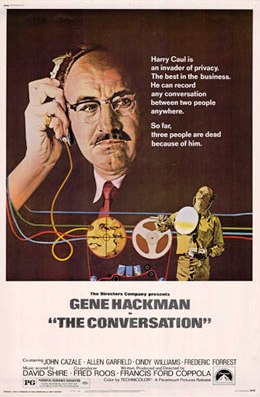
The Conversation is a film about wiretapping and surveillance, and in that vein it’s a film whose sound design is carefully calculated and matched or disassociated with the images we’re witnessing. Take the opening scene for example. We have super wide shot of a public plaza, but the sound we are hearing doesn’t match with what we’re seeing. We’ll soon discover it’s part of a recording for a surveillance operation. But before that, we’re not entirely sure where we’re supposed to be looking at in this crowded space. 

The film is also a story of voyeurism. Harry Caul (Gene Hackman) is an introvert who’s barely socially functional; he can barely hold conversations not on his work in everyday life. So it’s fitting that his personality should lead him into a line of work where he doesn’t have to interact with people; he can just observe other people without having to get involved. 

Harry is also massively paranoid. He’s jittery about even using his own home phone, using a payphone or outside line to make calls. His paranoia in turn leads to obsession. He’s obsessed with his most recent job, a recording of a conversation between a man and woman. He’s certain he has the scenario figured out, and the more he begins analyzing the tapes, the more positive he becomes that the two individuals might get murdered. 

Harry wants to give the tapes to the company that hired him, be done with the job, and clean his hands of the whole mess, but his fragile moral compass keeps leading him to what he believes is true north. He’s obsessing over the case, and increasingly becoming fearful for his own life. Apparently he did a case out in New York years ago that led to the killing of three people, and he still feels guilty and haunted by it. It’s the reason he moved out to San Francisco in the first place. 

Despite knowing he ought to get out while he can and throw his blinders on, he finds himself unable to stop getting involved and interfering. The more he pushes back, the shakier the ground he walks on becomes. The light, jazzy piano score starts to ramp up into more industrial and electronic as the stakes get higher, the cuts of shuts become quicker, and Harry’s paranoid state more frequently starts to seep through the screen. 

Writer-Director Francis Ford Coppola is primarily remembered for making The Godfather films, which are absolute masterpieces. But while Godfather Part I and II and Apocalypse Now are recognized as unequivocally brilliant works, The Conversation often get short shrifted. This is a shame because it’s a masterful, surefooted, engrossing thriller. The film features much of what made Coppola’s other movies great: impeccable writing and technical craft, unparalleled character work, and a hard to peg down feeling of texture and richness.   

Grade: A-

Thursday, February 21, 2013

"La Strada" - Film Review

La Strada exists in that feverish place between reality and surrealism. It’s an Italian Neorealist film by writer-director Federico Fellini, but, though it tells a very grounded, very realistic story, there’s a level of lyricism to it that makes it almost poetic at times.

“La Strada” translates from Italian to “The Road”, the location we spend the majority of the film on. The story takes us to one town, seashore, and circus after another, and observes the lives of the two protagonists, brute Zampano (Anthony Quinn) and good hearted Gelsomina (Giulietta Masina), and the people they come in contact with.  

Desperate and impoverished, Gelsomina’s mother sells her into the employ of Zampano. Zampano is a strongman who goes around performing feats of strength for people he meets along the way. 

Gelsomina cares for Zampano, may be even loves him, but Zampano is no good for anyone. He’s a drunken lout who hits on other women and ignores Gelsomina’s kindness. 

Even after raping and beating her, Gelsomina can’t shake her affection for him. “If I don’t stay with him, who will?” she asks herself. 

We want her to escape this terrible situation she’s in, but every time she’s given an out, she just won’t take it. And it’s heartbreaking. 

Gelsomina, in the hands of Masina, is adorably wide-eyed and sincere. When she first leaves home, she’s just happy that she’s going to finally get to see other parts of the world. 

When that unequaled, exuberant smile begins to fade… well, a little bit of hope starts to dissipate from the world with it.

Nino Rota’s score is wistful yet melancholy. The tune feels like carnival theme, which is oddly fitting, both for the film’s ties to the circus as well as Gelsomina’s childlike nature.  

The film lends a level of compassion and sympathy in its portrayal of the people that inhabit it. Even Zampano is allowed to be more than a one note character, eventually finding redemption.

Beautifully shot, the simple tale is filled with vignettes that are funny, moving, and sad.

This is one of Federico Fellini's best early works that looks forward to his more fantastical later films; it's also a great example of Italian Neorealism.  

Grade: A-

Wednesday, February 20, 2013

New Girl - "Parking Spot" - Review

New Girl is a show that works as well as it does because its characters are always consistent. The writers have these characters down to a peg, and every line and interaction feels true to what these characters would actually do and say.

It’s this attention to character detail that turns characters from joke delivery machines to individuals we want to follow on a weekly basis. 

The chase to get to the parking spot is a funny scene, but it works as well as it does because it plays off what we already know about these characters. Jess stopping to pick up trash is an amusing moment, but it’s also totally in character, and those little character beats elevate New Girl from just another show about twenty-somethings to one of television’s best ensemble comedies. 

The interactions between Nick, Schmidt, and Jess as they confront the situation of who gets the great, open parking space (and eventually the kiss-shaped elephant in the room, or “rum” as Schmidt would pronounce it) is filled with nicely observed character moments that are at once very funny and yet all the funnier for how specific the jokes are to these characters. 

Take the parking spot sit-in scene for example. Schmidt pees himself, Jess brings hard candy, and Nick essentially eats garbage. Those three actions in of themselves aren’t funny; in fact, if you told me that some show was doing these things to get laughs, I probably wouldn’t watch it. But in the context of these characters, it works and it’s funny. 

The integration of the ongoing tension between Nick and Jess into the main storyline also works really well. Rather than turning this into its own plot that would probably start to get predictable and distracting, the writers find ways for it to play off of the current antics. Jess “flirting” with Nick by wearing his hoodie and talking for what passes as sexy for Jess advances both storylines while remaining hilarious and in-character.

This cast features some great performers and the writers utilize them well to tell meaningful, endearing, entertaining stories where I never question a character's actions or decisions but look forward to seeing what those might be.

Stray Observations:

-The opening toothbrushing scene also worked really well. I particularly liked the way both Nick and Jess kept saying “Sucked face”.
-Schmidt was scrubbing out the backside of a dumpster when he discovered the parking spot.
-Schmidt asks Nick rhetorically what the Constitution says to do: “Don’t share stuff”
-The roommates play their particular trump card. Jess: female. Winston: race. Nick: lazy drunk. Schmidt: found the spot first.
-“Justice may be a lady, but Victory has a dick”
-Coach gets mentioned when Schmidt discusses the “Nail Oath”.
-Winston doesn’t have money on him and really wants to get laid: “I am in desperate need of condom,” he yells to the store’s other customers.
-“What do you think, mono is just some sort of joke?”
-“If I had kissed Winston, you’d be the first person I told”
-Jess tries to purple nurple Schmidt and can’t find his nipples … Alrighty then?
-Winston in his desperate search for a condom goes to Cece, who is the middle of trying to fix her relationship with the Indian “chemical engineer” Shivrang (Satya Bhabha) her mom's set her up with.
- “Did you just pee inside yourself?”
-“Know what drives men? Sex and competition. It’s why the U.N. was created. It’s why women aren’t allowed on pirate ships”
-“You nailed my mouth. And you nailed it good”
-Schmidt kisses Jess to defuse tensions … and it so does not work. They left this whole story a little too unfinished. It needed about a minute or two more to resolve itself before Winston barged in.  
-“You are literally sitting in a pile of your own piss”
-“Is everyone having sex but me?” - Mainly for Lamorne Morris' delivery

Grade: A

What's in a Grade?: On the Difficulty of Assigning Grades and My Process

I’ve actually found the back-half of the 8th season of How I Met Your Mother to be much better than the first half of the season. But everywhere I’ve turned I’ve seen people tearing to shreds episodes that I may not have found to be the show’s finest work, but also didn’t perceive as the worst offenders either.

Perhaps I should grade the series more harshly, but since HIMYM has already so significantly disappointed in the past, I go light with the critical heat when the series may be middling but isn’t glaringly awful. 

A show has to go severely off course and lose all sense of self in order for me to actively despise it, which is why The Office is privy to my most damning reviews, whereas HIMYM gets off more easily.

But then again, the grades I assign are essentially arbitrary. I’m sitting on a cloud of judgment handing down qualitative markers that, when it comes down to it, don’t mean crap. 

I’ve never felt comfortable assigning grades, even when I was doing it early on (and perhaps more so then because I had a worse grip on it). It comes down to a gut feeling and my opinion is wont to change. Plus grades are just so completely loaded in the first place.  

I choose to give out grades to challenge myself and to add another facet to the review to make it more interesting. I could do it in a non-letter grade format, but the letter grade format ultimately feels like it’s the most challenging method to dole out grades with, and hence why I chose it. With numbers and stars you can split hairs more easily. 

My general approach to grades is this: If it’s anything below a B- it’s probably pretty bad. If it’s a C+, it may not be the worst thing in the world, but the film/episode has significant enough problems that any of its noteworthy qualities (if any) are mostly overshadowed. Anything below a C- is highly unseemly and deeply disappointing. It doesn’t have to be poorly made; it can be a high quality production that’s purposefully mediocre. And, well, hopefully I never watch anything in my free time that gets the dreaded F.  

A’s are exceptional and should be given out sparingly. I know I’ve given a Pandora’s Box’s worth of A’s out lately to the films I’ve watched, but that’s because I’m purposefully watching films I know to be/have heard to be good. Even for these films though I’ve been tough on a couple of them that others would say I judged too harshly or didn’t understand (I’m thinking: Eraserhead, Re-Animator, Last Year in Marianbad. All of which I actually softened the blow of my review for.)

Generally speaking, a work should aim to land somewhere between an A and a B+. The B+ is often times more niche, more curio, more cultish, and/or falls short here or there, but is still usually brilliant. B+’s for me tend to be movies I deeply enjoyed but aren’t as artistically significant or holistically masterful as A’s and A-‘s. 

The line between grade to grade is string thin. While a work may be obviously in the A-range or B-range or C-range, the distinction between one grade and another is just what feels right. 

I’m talking about art, and art is subjective.