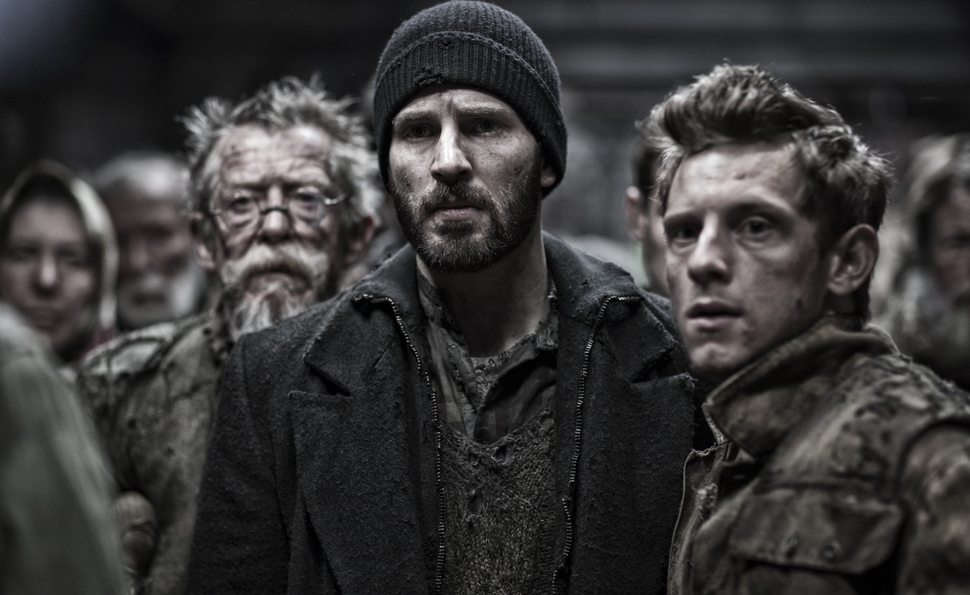
Snowpiercer is a
blunt metaphor in the guise of a sharp action thriller. Its plot is almost
entirely symbolic of a class struggle, and yet Bong invests it with such an
idiosyncratic vitality that it never feels like its beating you over the head
with its underlying messages about the broken, entrenched class divide. This
begins with its strange, fantastical vision: in a not so distant
post-apocalyptic world, spurred on by failures to combat climate change, the
remnants of humanity live in the titular train, which protects them from the
deadly subzero temperatures that have engulfed the planet; the Snowpiercer
circles the planet, completing its journey once a year. The train uses its
compartments to literally compartmentalize, placing the haves in the front and
the have-nots in the back.
The members at the back of the train are planning a revolt,
headed by none other than Captain America himself, Chris Evans. Revolts have
failed in the past, but they are certain it will succeed this time because they
know where the tech-savvy creator of the train’s lock systems (Bong regular
Song Kang-ho, who uses a nifty translator in order to speak in Korean; he’s joined
by a female partner in crime played by Go Ah-sung) is, stowed away in the
train’s prison – designed like the filing system of a morgue. A kink is thrown
in the plan when it seems like their best bet is a drug addict, hooked on
Kronole, what amounts to hardened industrial fuel. Song and Go’s character’s
become the film’s soul, finding wonder and beauty in the midst of gripping
agony and loss while others fail to stop and appreciate how the world still
thrives even in damnation.
The rest of the cast is rounded out with a murderer’s row of
actors, including Octavia Spencer, Jamie Bell, and William Hurt as lower class
revolutionaries, and Tilda Swinton as a Margaret Thatcher-like (in deeply
unsettlingly conservative politics as much as toadie, toad-like appearance)
second in command sent out by the ominously mentioned conductor of the train
Mr. Wilford – he seems to have essentially developed a cult of personality
through conscientiously deployed propaganda and indoctrination. The film is an
international co-production that feels that internationality, boasting a
consciously diverse international cast.
With each new train compartment, Bong comes up with another
distinctive setting; the train cars don’t blend together, though there’s a
fluid logic to their order. Painstaking set design is put into each so that
they all have a personality; crafted with tiny, thoughtful detail. The earlier
cars are grimy and dirty, industrial and worn; Bong makes sly distinctions
through careful aesthetic choices, such as the way he dresses characters -- the
clothing of the upper class figures gratingly pop, and flow with curved angles.
As the rebels fight their way up to the front, Bong becomes ever more creative,
providing us with cars we might not have anticipated and using them to provide
us with tremendous amounts of information about this world’s past and the
rationale of the system.
Bong knows how to choreograph an action sequence and
utilizes the tight spaces to add to and enhance the action. There is more than
one moment where the rebels enter a new cart facing a crowd of thugs and have
to face off because there is simply nowhere else to go but forward. Bong and Kelly
Masterson’s script take advantage of this by constantly keeping the story
moving forward and never providing a chance for you to question some of the
implausibility of all of this. It isn’t necessarily meant to make literal sense
but works, instead, in a heightened, florid manner.
At times, the film is brimming with countless ideas, as if
it wasn’t entirely sure it would be able to manage to fit them all in. It never
settles to solely be a metaphor but a kickass thriller as well, and a weird
sci-fi techno- and ideo-scape. At times, this can be exhausting, and by its end
it seems to dare itself to consider one heady conceptual argument too many
(It’s both a cynical film and a hopeful one – and that isn’t a contradiction:
that middle ground is what makes progress take so damn long). But the film is
also invigorating; it is quite unlike anything else, and that makes it
delightful and infectious, as if it’s getting away with something a little more
audacious than it is.
Bleak and, at times, bracing as the film’s story is, a dark
strand of humor runs throughout ensuring it never spills over into something
truly morbid. This comes out in little character details (Swinton and Song really
play up their characters to joyous effect) and little bits of absurdism that
double down on how unrealistic and bizarre the film’s premise is. The film’s
abundance of imagination also helps steer it into more charming and whimsical
territory – a number of the carts are little tossed off jokes that leaven
things in between the brutal, close quarter fisticuffs.
The film’s metaphor is transparent, but it’s also subtler
than it initially appears to be. It isn’t just about oppression of the poor or
the rigidity of the class system. The film is interested in the ways and
reasons we maintain such a lousy capitalist system. The ways ideology is
translated through generations and the ways those in power ensure that no one
rises up, because that wouldn’t benefit them. The way capitalism and
consumerism, and their inherent class struggles, have become our religion (The
engine and the conductor are referred to in hushed terms of religiosity). The
crucial role the education system has in perpetuating problems. The way we
ensure that working class people self-police themselves, assuming it’s their own
responsibility for circumstances that are systemic. Perhaps the film’s most
interesting question is why the system remains in place, why we can’t see
outside or beyond it towards a better possible future – people think they’ll be
figuratively “left out in the cold” as much as literally.
Like Bong’s previous efforts (Memories of Murder, The Host, Mother), the director uses genre
elements to ask and consider things far more reaching and meaningful than
those genres might suggest possible. Bong wants to tell a good, energizing
story, but he also seems intent on refusing to settle for simple, or “good
enough”. His films are about the failures of societies and families, and
especially individuals; people haunted by actions taken and untaken, wishing
they could go back to a time before the events of the film. They dig themselves
deeper into quagmires (both literal and emotional) of their own making; but
they also refuse to allow themselves to be put down and that makes us root for
them. They fight to the bitter end, even if that ending might be as bad in its
own way as the present situation. What matters is the fighting, whether you’re
fighting a lost cause or not – you have to try at least, bullet train in a post-apocalyptic
tundra or not.
Grade: A-

No comments:
Post a Comment