Dawn of the Planet of
the Apes’ ending is writ into its title. We have several films that already
inform us where the outcome of this is heading. The film is aware of this and
its script, written by Mark Bomback, Rick Jaffa, and Amanda Silver, finds ways
to make that inevitable ending perhaps the film’s greatest strength. The story
tightens the screws continually, crafting a no-win situation where neither the
apes nor the humans can truly win; where neither will be in the right, where
they stand to lose so much more if they do go to war against one another. It is
a good old fashioned tragedy; something the film’s final images, powerful and
deeply moving, reinforce: this shouldn’t have happened, and yet there was no
other way it could have happened.
Dawn is set ten
years after the events of Rise of the
Planet of the Apes. A simian flu accidentally released by a research lab,
who’s experimenting helped breed the super-intelligent apes at the center of
the film, has wiped out the majority of humanity. A small band of survivors who
seem to be immune to the virus have taken refuge in part of San Francisco. It
is a world of post-apocalyptic grit and decay; human works still stand but they
have come into disuse and disrepair. It is a visual template of darkness and
somberness to match the progressively tonally dark and narratively ambiguous
story.
The apes have evolved significantly since the end of the
last film. Their every movement is more human than simian now, and they have
formed a human-like community, a ramshackle but impressive dominating wooden
structure, a cross between fortress and jungle-gym, at the heart of a forest on
the far side of the Golden Gate Bridge. They still speak mostly through signing
but human language has gradually started coming into use. The film shows the
day-to-day operations of the ape community. It lets us inhabit this place and
fills it with details that make it feel lived-in – such as classes to learn the
English alphabet or ideological underpinning like the mantra “Apes don’t kill
other apes”. Director Matt Reeves, along with the special effects team, really
has an eye for the physical presences of apes in the real world environment
(like in shots of whole packs of apes swinging from branch to branch, shot
underneath to accentuate the movement). Unlike the old films, the apes actually
look like real apes. Their movements and body language signals small but
crucial changes to physiognomy, but they still have more of the physical and
genetic structuring of apes than of humans.
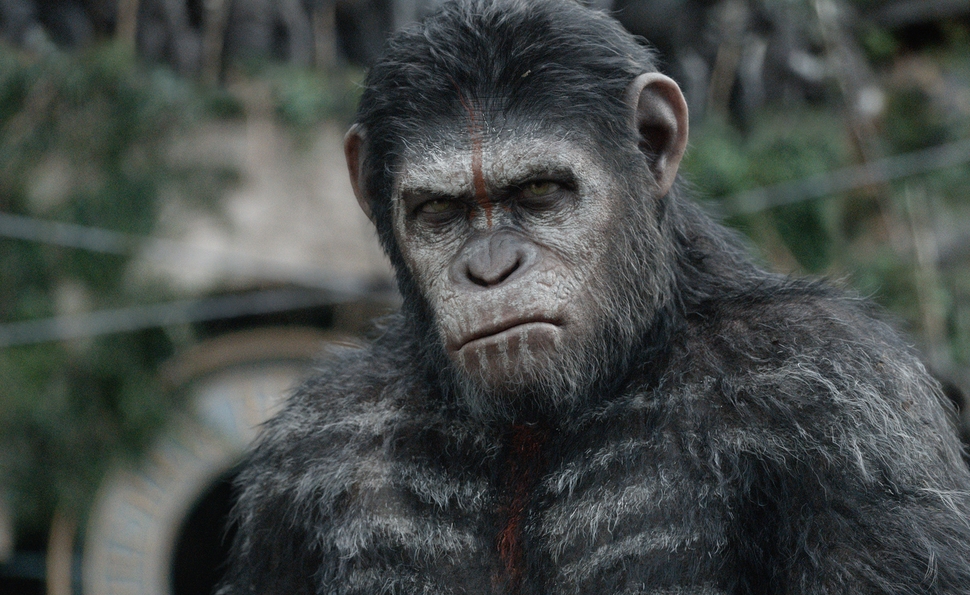
The special effects for this film are stunning. This is some
of the most seamlessly rendered CGI effects I have ever seen. Real people wore
motion capture to make the apes have a real presence and to have a nuance of
emotion; most notably, Andy Serkis reprises his role of Caesar, the leader of
the apes, and it is one of those remarkable, deeply felt performances that it is
hard to imagine another actor capable of pulling off. With each new performance
using motion capture, Serkis has refined his craft, becoming less showy and
more subtle with his work (His performance of Caesar is filled with small
emotional cues and body language changes that are so understated that you don’t
completely realize the small ways Serkis is thoroughly shaping your response). Serkis
has long been ignored for his work due to playing parts where he effaces
himself through digital effects work. Whether it is Gollum or King Kong,
Serkis’ face isn’t literally present but without him these roles simply don’t
work. Without Serkis it is just CGI imagery that we feel nothing for; with him,
Caesar is a character as fully realized and as fully felt, and every bit as
present as the other actors Serkis works with.
Caesar has become the patriarch of this ape community. He’s
a Godfather-like figure that quietly
demands and commands the respect and loyalty of the other apes. He accepts the
counsel of others – including the temperamental, formerly experimented upon second-in-command
named Koba (Toby Kebbell), who holds a deep unyielding hatred towards humanity
– but, at the end of the day, it is always his to make any given decision for
what the apes do. Caesar is no longer the young ape he was in Rise. He’s grizzled with hints of grey
hair and battles scars, and he is married to Cornelia (Judy Greer) with one son,
Blue Eyes (Nick Thurston) – still in need of battle testing and feeling
overshadowed by his father -- and another on the way. He is a no longer a
freedom fighter but rather a family man with far more to lose, and he fears
losing it every bit as much as the humans.
The script and Reeves’ direction build up this world and
that of the humans, filling out each with internal rules and conflicts and
inhabiting them with various personalities. Neither’s perspective is privileged
and neither side is outright made hero or villain. Instead, Reeves splits time
between the two camps, creating sympathies amongst them, reasons to root for
and like both, as well as reasons to dislike them. The split between point of
views and the motivations behind them leads to a fascinating conflict where the
film gives us the standard blockbuster action and spectacle but roots it in a
morally and emotionally complicated narrative foundation. (That isn’t to say it
isn’t entertaining. A film with an ape riding a horse firing off dual machine
guns couldn’t help but be fun and thrilling. But Reeves choreographs the action
and the events leading up to it in a way that gives it all a certain heft). Reeves
is patient and deliberate, pushing the action into the third act.
What makes the third act so deeply painful to watch when it
arrives are the glimpses Reeves provides of the humans and apes setting aside
their differences to live in harmony. Mistrust exists almost immediately when a
group of humans, looking to use a nearby dam as an alternative power source,
run into some apes and trigger happy, pithecophobic Carver (Kirk Acevedo) panics
and shoots one of the apes. The situation is salvaged when perceptive, kindly
Malcolm (Jason Clarke) recognizes that his party will be safe if they
demonstrate that they intend no harm. Caesar, who was raised by humans and
still bears some feelings towards them, sends the humans off with a warning to
leave.
Members of the ape community, including Koba, are torn over
whether to go straight to war but are assuaged by Caesar’s choice for merely a
display of strength. Reeves doesn’t get heavy handed with the parallels,
abundant and apparent as they may be. For instance, it isn’t at all a
coincidence that the leader of the human camp Dreyfus (Gary Oldman) starts
considering war with the apes soon after the same conversation happens amongst
the apes. At its core, there is a “we’re not so different you and I” message
floating around in Dawn, but it is
one of those rare instances where it really works because the film places it way
in the background. It’s not an entirely subtle message but it is exceptionally subtly handled – placed
as it is in subtext, situations and character arcs. The apes of the Ape movies have long stood in for
minority groups (the older films have long been speculated to be about race and
civil rights), but here they stand in for something else as well beyond those groups
being othered.
Dawn has a strong
thematic center related to the world’s growing energy crisis. After the apes
make clear they will not fight so long as both sides maintain their distance,
it becomes apparent that this is not a tenable situation for the humans. The
humans are running out of fuel and are in need of access to the dam in order to
survive. This, of course, means violating the pre-agreed upon peace
arrangements. Malcom comes up with a plan to bring a small group to parlay with
the apes and come to an understanding. Hanging over this is Dreyfus’ warning
that if the group hasn’t returned in three days’ time, the well-equipped humans
will retaliate against the apes (very much a Chekov’s gun stockpile). From here
arises the question of what any group of people, or nation, is willing to do,
how far they are willing to go, in a world where resources are increasingly
dwindling and finite. Survival is paramount for both sides, but everyone,
whilst looking out for themselves, fails to see other possibilities or
solutions.
Malcolm is an almost impossibly decent person, which should
rub us the wrong way, but the film shows him as not solely good-hearted but also
discerning, seeing there is more to be gained from diminishing suspicion. (In
deed, the true irony of the film is that its most fully formed, most human
character is, well, an ape). It is tiny, subtle, organic writing like this that
saves the film from feeling like it is inhabited by a bunch of non-entities.
The humans at some times are a degree or two off from being underwritten, but
the script has nice small moments where motivations and concerns are quietly
delivered – such as the recognition that family members have died from the
virus. The film is also helped by some really good performances with actors
fleshing out characters by investing so much into small performances.
Caesar and Malcolm slowly initiate a bridge towards trust
but keep running into hiccups – with dissent and lack of trust from both of their
sides causing breakdowns in their grasp for detente. Each of these stumbles
feels like they could lead to something disastrous, but they prove themselves
to be, instead, slippery steps towards an even more terrible, emotionally
wrenching conclusion. The inevitable – the apes will ultimately come to
dominate this planet; it’s just a matter of how – hangs over everything like a
foreboding, terrifying cloud. Every redeemable, good act that moves forward
diplomatic relationships is made all the more devastatingly bittersweet by how
it only truly staves off what is always going to happen. (The film understands
the power and meaning of small acts and gestures, ending on one such moment of
shared human-ape connection/dissolution that is beautiful and deeply despairing
in how it sums up everything the film has been trying to say throughout). In
the end, Dawn isn’t science fiction.
It’s a tragedy. By showing those steps, it makes the unraveling all the more
moving and harrowing. Reeves understands the power of a slow moving cataclysm; its power isn’t in knowing where
you’re going but watching in terrified awe as you get there.
Grade: A-

No comments:
Post a Comment