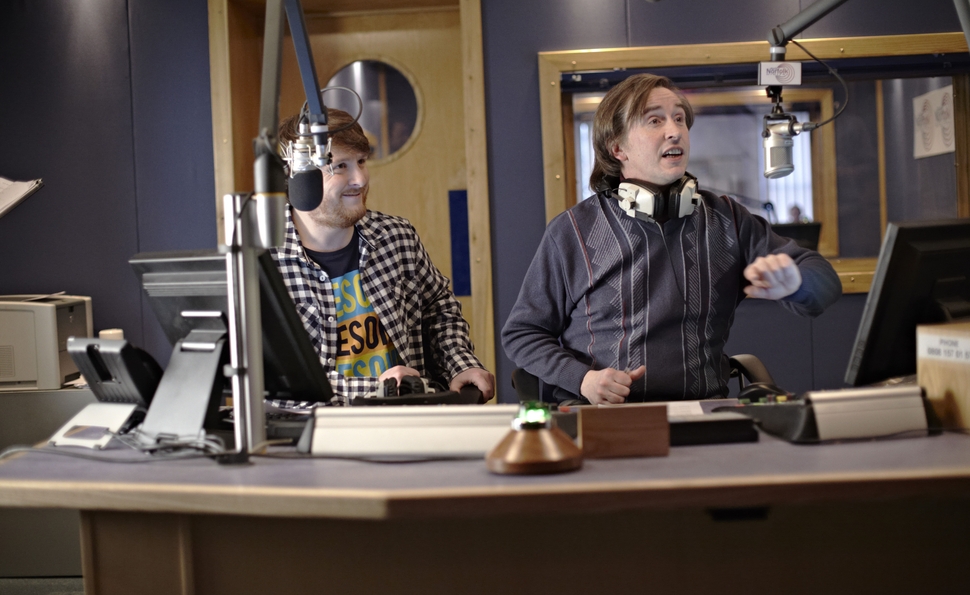
We find Partridge as a disc jockey at a small-time radio
station in Norwich, a place slowly becoming more corporate and cold to compete
in the crowded marketplace. This especially infuriates his longtime colleague
Pat Farrell (Colm Meaney), whose program feels fuddy duddy amongst the digitizing
and automating sea changes. When the station is bought out, Pat seems like the obvious
candidate for the cutting block; something that is exacerbated when Partridge
blunders his effort to defend Pat in front of the company board, arising out of
the realization that the company is picking between Pat and himself for the axing.
Pat snaps and, with shotgun at hand, he holds the station and many of its
workers hostage.
Partridge unwittingly becomes the mediator between Pat and
the police, as Pat believes that Partridge is the only one who gave a damn
about him before his firing. But Partridge’s narcissism and short-sidedness
only protract the situation and turn it into a media spectacle. The film
becomes a black comical take on the more dramatically rigorous work of a film
like Dog Day Afternoon with Partridge
playing up the media craze in hopes of securing his employment and spinning it
into a lucrative job deal.
Director Declan Lowney doesn’t add much to the way the film
is shot. Lowney’s background is largely in television and the film has a lot of
the functional filmmaking common in television shooting. Instead, the film’s
script (credited to Neil Gibbons, Rob Gibbons, Steve Coogan, Armando Iannucci,
and Peter Baynham) brings much of the film’s strength, playing to the chaos and
stress of the hostage crisis as well as Partridge’s egotism. This is usually
done by matching up the incongruity of the situation’s seriousness and how
lightheartedly the film and the character’s tend to treat it. For instance,
Partridge and Pat host a hit radio show from within the “siege” by drawing on
viewers interested in the crisis. But perhaps, at the end of the day, it is best
that someone like Lowney helmed the film as it is essentially an extended
episode of television, with barely enough plot to sustain itself for ninety
minutes.
The film has some casual commentary on the changing state of
media, especially for an aging medium like radio. But this is way in the
background. More foregrounded but still low on the film’s mind are questions
related to aging. Both Partridge and Pat are well into their fifties and
looking back on a life that hasn’t gone entirely satisfactorily or as planned.
Pat and his dark plans force Partridge to confront some of his delusions and selfish
ways. Partridge is a massive dick at almost all times, but there’s something
fundamentally sad about him. Like The Office’s
Michael Scott, or, more appropriately, David Brent, he desperately wants to be
liked but doesn’t quite realize he’s going about it in deeply misguided ways. At
the end of the day, Partridge is going to do the right thing but it’s only
after massive effort and radical outside circumstances force him to that point.
In the intervening time before the buried conscience of
Partridge arrives, Coogan delights in his role, one he has fine-tuned and honed
over the years. Coogan simply knows how to play this character to the hilt. The
film is farcical because Partridge is such an exaggerated figure. Initially the
character was created as commentary on a particular type of media personality,
and that satirical, self-consciously preposterous quality carries over into the
film. Alan Partridge is a darn funny
film that still manages to have a soft, mushy center focused on its characters
and their endearing shortcomings.
Grade: B
Grade: B

No comments:
Post a Comment