The film muddles around half-heartedly in stories revolving
around the band’s rise to fame and then the consequences of that fame, starting
in 1951, but the film has no sense for modulating the different periods in the
lives and careers of its subjects. An inordinate amount of time is spent on Frankie
Valli (John Lloyd Young), Nick Massi (Michael Lomenda), and Tommy DeVito (Vincent
Piazza) doing odd jobs for the New Jersey mafia while they sweat it out in
local night clubs hoping to strike big. Eventually the fourth member of the
quartet Bob Gaudio (Erich Bergen), the composer of most of the band’s
music, is introduced and he helps cut a record deal. But this isn’t before the
film extensively soaks up Jersey Italian mafia culture that’s reminiscent of The Sopranos,
even featuring some alum from that series. The film’s nearly two and a half
hour run time never once feels justified, instead allowing for all sorts of
questionable digressions that take away from the film’s raison d’être: the
music.
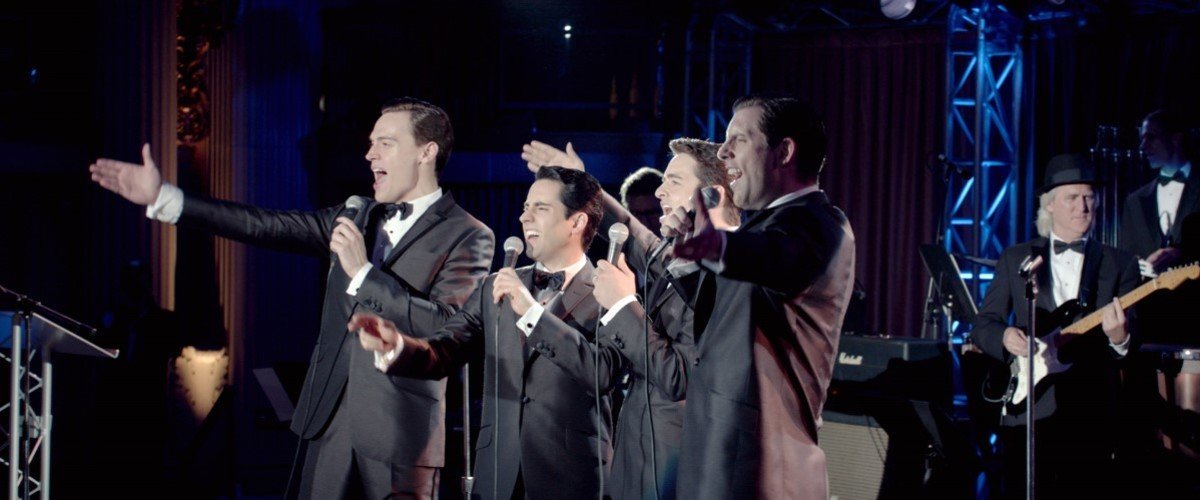
And even when the film does remember that it’s partially a
musical based on one of Broadway’s most successful shows, the musical moments
feel as blandly and disinterestedly shot as everything else. Despite bringing
back the stars featured in the musical to reprise their roles -- crucial
especially in the case of Valli’s falsetto -- the music just isn’t filmed with enough
care or visual panache to come alive like it surely did in the stage
adaptation. This isn’t helped by the singers not looking at all like the ages
of the people they’re playing – they’re all far, far too old -- or that none of
them have a really strong screen presence. They shoot awkwardly in front of the camera,
incapable of commanding your attention or handling a lot of the dramatic
material.
Marshall Brickman and Rick Elice’s script fumblingly maintains
the Rashomon style narration from the
play of the characters randomly talking directly to audience. But there’s simply no
good, logical justification for this fourth wall breaking -- especially since outside of
Frankie the film has such minimal interest in the group’s members (Frankie is the
only one who we see the family life of, and even then it’s such an underwritten
element that it often comes off like a vestige of a very early draft).
The screenplay is also girded by a casual misogyny, as the
film too often uncomfortably aligns and agrees with the central foursome’s
questionable, narcissistic, retrograde view of women. The film is a
Conservative one, in love with fast cars, a smooth glass of a scotch, and a
woman who cares for the kids and pleases her man. It’s a man’s man film, built
on a classical sense of manhood and masculinity. The film doesn’t quite grasp
how odious this is – even when Frankie’s daughter dies late in the film due to
his selfish, arrogant machismo, the rotten, deluded enterprise is maintained
and the incongruity is missed.
Clint Eastwood’s directorial choices are largely at odds
with the story he is filming. The film is shot like it’s filtered through a
grey, faded prism that provides a sense that this is a period piece but also
adds to the feeling of colorlessness that abounds in so many other areas of the
film. The most recent film Jersey Boy’s
storytelling and directorial choices are reminiscent of oddly enough is The Amazing Spider-Man 2. Both film feel
like they were slapped together with the minimal required effort, and their
plots move forward with a slow, plodding indifference. They’re overlong,
bloated, and mechanically orchestrated. It’s a Cinema of Auto-Pilot.
Grade: D+
Grade: D+

No comments:
Post a Comment