Life Itself is
based on Ebert’s memoir of the same name – passages of which are read by a
voice actor passably recreating Ebert’s distinctive Midwestern drawl. The film
begins with one of my favorite statements from the writer: “For me, the movies
are like a machine that generates empathy. It lets you understand a little bit
more about different hopes, aspirations, dreams, and fears. It helps us
identify with the people who are sharing this journey with us.” Life Itself is not only empathetic but
sympathetic towards its subject. It is affectionate towards and fond of Ebert,
but it also never tries to paint him as anything less than human. He was, in
the words of one friend, “nice, but not that nice”. He had terrible taste in women
prior to meeting his wife Chaz in his early fifties -- the film understandably
dedicates a significant amount of time to their relationship – and had an unhealthy
obsession with buxom women that led him to briefly write films with skin flick
director Russ Meyer. He struggled with alcoholism (We learn that he met his
wife at AA; a fact she admits for the first time publically). He could also be
quite arrogant and had an incredibly high opinion of himself. This could best
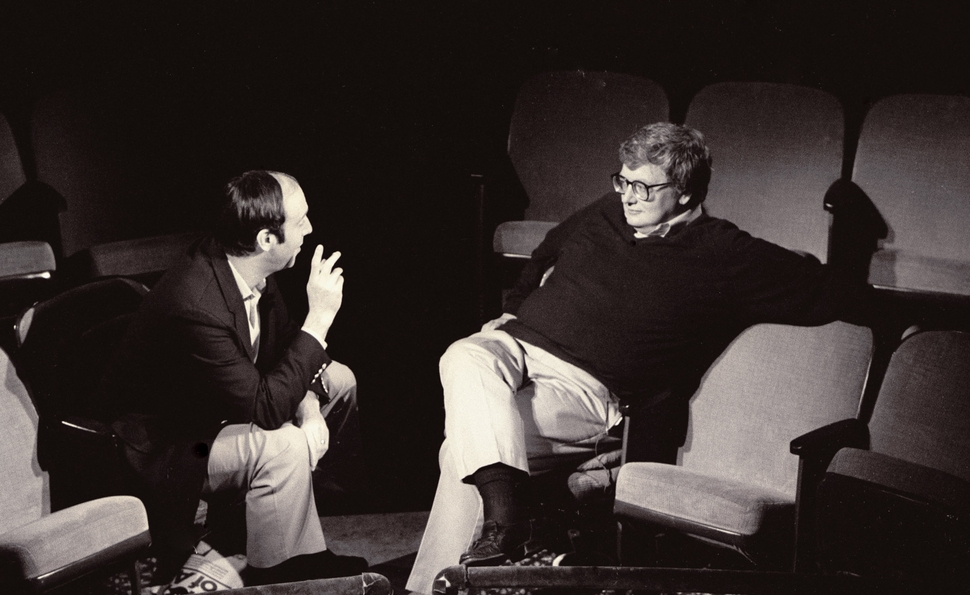
be seen in his contentious relationship with fellow critic Gene Siskel, whom he
co-hosted the television program Sneak
Previews and later At the Movies.
The film features standard documentary filmmaking on the
whole: talking heads are interspersed with old footage and photos. The film’s most
remarkable, powerful element was driven by outside circumstances. The film
began production prior to Ebert’s death. Ebert insisted James film his time in
the hospital leading up to his passing. Ebert tells James at one point, “This
is not only your film”, and he helps provide such great, unexpected moments as
his G-tube being suctioned out (disgusting but also kind of wonderful). Wearily
but understandingly James responds, “It makes for a better story”. And that
really is the case, as it turns a solid but familiar biopic into something more
resonant and poignant. James cuts back and forth between the past and the
present, and the worn down but still vibrant Ebert lying in a hospital bed
colors so much of the largely chronological discussion of his life. Friends,
colleagues and filmmakers (many whose career he helped launch, including Martin
Scorsese, Werner Herzog, Errol Morris, Ramin Bahrani, and Ava DuVernay) warmly
re-call Ebert’s life and the film becomes a memorial or elegy.
The warts-and-all of approach of the film, especially in
Ebert’s earlier years, paints him as a good but flawed person. Ebert’s greatest
legacy arrived in his final years as he was diagnosed with cancer that took his
jaw and his voice. Ebert dug deeper into his writing, utilizing the internet to
engage more directly with fans and film lovers. Ebert’s writing become ever
more personal, precise and lean in these years and his illness instilled a
greater sense of empathy in him. He did his best work during these years.
Similarly, the further the film moves along the more generous it becomes. Even
his staunchest critics, Richard Corliss and Jonathan Rosenbaum -- who feel
Ebert and Siskel devalued criticism and oversimplified the process to a simple
thumbs up or thumbs down system (something the film dismisses a little too quickly
and easily) – have a deep respect for the man.
The film is a loving tribute to an important public figure that
was influential and meaningful to so many different people who loved watching,
and writing and arguing about films. The film is a love story: between Ebert
and his wife, between Ebert and Siskel, and between Ebert and film. Ebert used
to like to say that a film isn’t about what it’s about but rather how it’s
about it. James doesn’t try to earn gravitas or to gloss or gussy up the story.
He shoots the film in a direct, reserved way that lets Ebert’s life speak for
itself. The film is emotional (I cried at more than one point) but those
emotions come from a sincere, inviting portrait of its subject.
Throughout watching the film I kept thinking of what critic Nathan
Rabin wrote from Sundance where the film first screened; Rabin wrote, “Life Itself is a film worthy of Ebert,
and that is just about the highest praise it can possibly get.”
Grade: B+

No comments:
Post a Comment