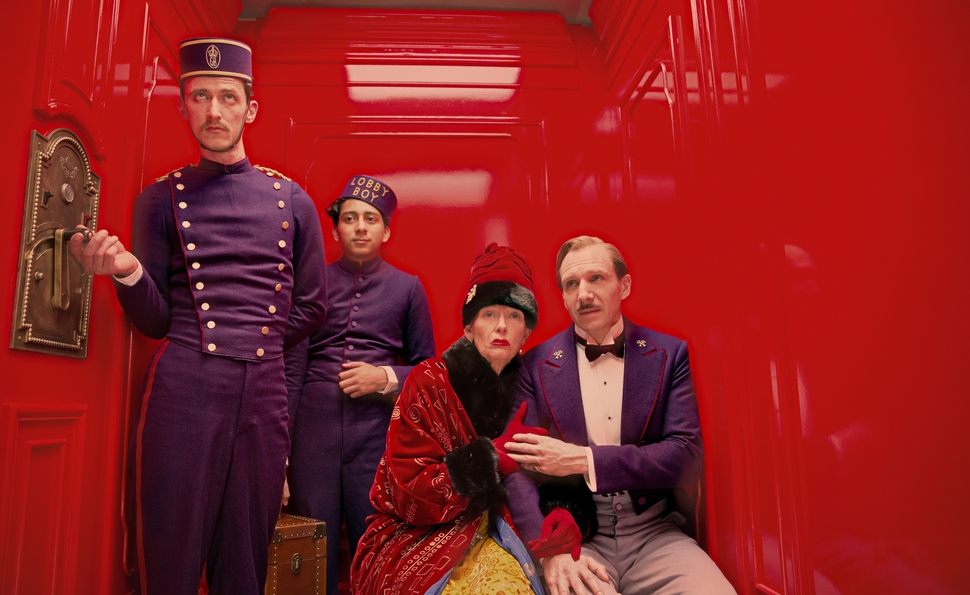
The Grand Budapest
Hotel is possibly Anderson’s most mannered film to date -- and that's saying something for the notoriously meticulous auteur. It’s written
within an inch of its life, but it never feels overwritten. The film is fleet,
clocking in at an hour and thirty-nine minutes, but like Anderson’ other films,
it’s also dense, rich with detail in every frame.
The hotel is another diorama like the submarine in Life Aquatic. The film is designed like it's constantly situated in
a proscenium; everything is framed immaculately as ever. More than ever Anderson’s film seems to not
take place in reality but in a heightened dream state. The film is shot with a confectionery color-palette and feels like a child’s daydream gone sour. The hotel (fictional and set in a fictional
place) feels like it exists outside of time and space. It’s a hodgepodge of
European nationalities and sensibilities, especially aristocratic and bourgeoisie
ones.
While the film still has the feel of being a “Wes Anderson
movie”, the film feels distinguished from Anderson’s past efforts. Anderson
calls upon his usual film nerd creds (Richard Lester, Orson Welles), but he
expands them here, drawing on sources from a wider range. It’s certainly Anderson’s
most European film. Beyond its Old European sense of nobility and gentility, there is the subtle
insinuation of Max Ophuls and Ernst Lubitsch, among others.
The film is set in the fictional country of
Zubrowka, a possible nod to the Marx Brothers’ classic Duck Soup about fictional warring countries Freedonia and Sylvania.
Anderson also borrows the comic anarchy of that film; this might be his
goofiest film yet. But it’s also his saddest. The misfortunates of his
characters are matched by the misery of a dying world and dying culture.
Fin-de-Siècle was brilliant but brief; it burned fast and bright and the hotel
is a remnant of a bygone era.
The film has multiple framing devices; it involves multiple individuals
recalling the past wistfully and nostalgically. In the present day, a young,
bookish girl approaches a monument to an unnamed author and begins reading from
his book. The Author (Tom Wilkinson as an old man, and Jude Law as a young man)
has written about the titular hotel, and the older version, in the 1980's, recounts how the
younger version learned of the hotel’s story in 1968. But most of the story is
told by the elderly Zero Moustafa (F. Murray Abraham). In 1932 the younger Zero
(Tony Revolori) worked as a bellhop at the hotel where he became a friend and confidant
with Monsieur Gustave (Ralph Fiennes), the ranking member of the staff.
It is a nostalgia-ception, but it’s also more meaningful
than that. It’s about the underlying sadness and bitterness that drives
nostalgia and remembering the past. It’s also about shared experiences and emotions
that translate through the decades.
The plot is exasperatingly intricate and moves with a
sugar-high forward drive. Gustave befriended a wealthy patron of the hotel Madame
D. (Tilda Swinton) and the Madame died under suspicious
circumstances. She wished to leave her most valuable possession to Gustave, a
painting called Boy with Apple. The
Madame’s son Dmitri (Adrien Brody) refuses to have what he sees as
rightfully his go to some hotel manager.
Gustave is denied the painting so he steals it and hides it
in the safe of the hotel. Dmitri sends his personal hit-man J.G. Jopling (Willem Dafoe) to kill
Gustave. Gustave ends up in prison for the Madame’s murder. At a certain point
during all this, Gustave makes Zero his heir and Zero falls in love with and becomes
engaged to the baker girl Agatha (Saoirse Ronan). Farcical shenanigans ensue
involving a prison break and a heist plan to recover the painting.
Throughout Anderson shoots the film like a storybook. Establishing
shots have the quality of a pop-up book, perhaps more than any of Anderson’s
previous oeuvre; locations often resemble the animated designs of The Fantastic Mr. Fox, like carefully
molded paper-mache and hand-crafted animation. The story is narrated with a
disarming, charming simplicity but Anderson consistently counters it by packing every
frame with throwaway details that hint at something deeper and wounded beneath
what’s outwardly wacky.
It’s simultaneously Anderson’s most immature and mature
film. Its plot is the stuff of cartoons. But it’s intellectualized silliness.
Like so many of Anderson’s other films, it’s about grown men acting like kids
and kids acting like grownups and arrested development reigning supreme.
Anderson’s plotting and storytelling have never been more
precise; it’s economical and completely without waste. It’s his most elaborate,
long-spanning narrative but he refuses to expand it beyond his pleasant
ninety-minutes or less storytelling mode. This could have been told in two or
three hours, but it would have felt protracted and indulgent. Instead, Anderson
has made another short film that doesn’t feel slight but full.
This may be Anderson’s most classical film. It has the style
and content of an old Hollywood studio movie, as filtered through a subversive lens. Anderson
is drawing upon a very specific subset of film, going back to 1932’s Grand Hotel, about capers and antics
being had at fancy hotels, often in Europe. But like Grand Hotel, there is something more resonant to the colorful
story, which ends with a cloud of sadness hanging over the proceedings. But
that’s what nostalgia is: taking pleasure in things that have long since died
and faded from memory.
Grade: A

No comments:
Post a Comment