Author John Green writes funny, smart Young Adult novels
about funny, smart teens asking and thinking about Big Important Questions. In
his most recent and most popular book The
Fault in Our Stars Green matched the urgency and immediacy that faces young
adults with a set of life and death stakes to make all that earnest pondering
about the meaning of existence feel all the more pressing and poignant.
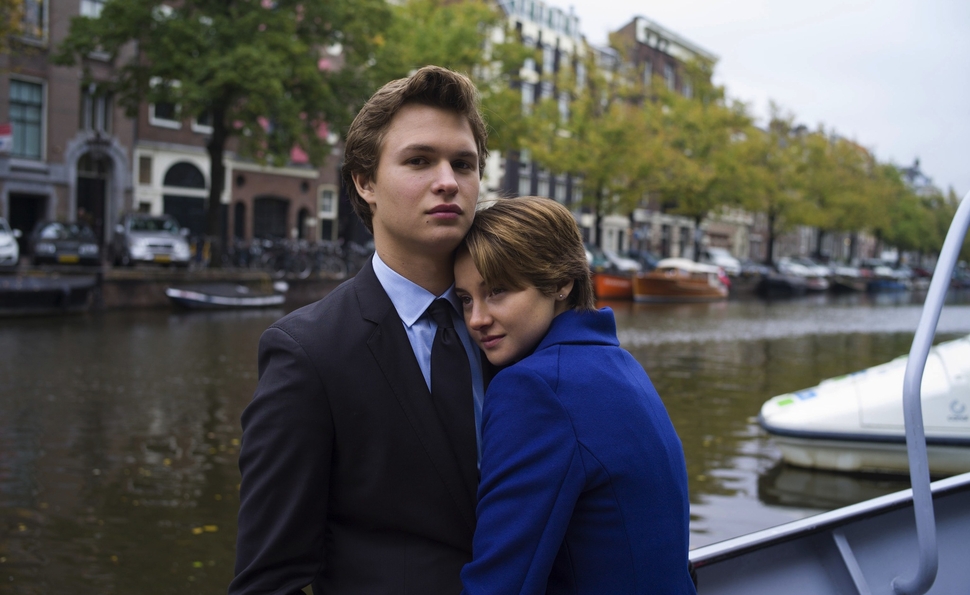
Hazel Grace Lancaster (Shailene Woodley) is a sixteen year
old with terminal thyroid cancer. She was diagnosed at thirteen and
miraculously has been living on borrowed time due to a trial drug. Hazel’s life
consists mostly of homebound boredom and constant intakes of medication; the
rare occasions that she sees the outside world are to go to the mall, where she
gazes longingly at non-sick teens, and to attend a support group.
At one of these meetings Hazel attends mostly to appease her
mother (Laura Dern, great despite her minimal presence), she, by chance,
encounters Augustus Waters (Ansel Elgort). Gus has recovered from osteosarcoma
and lost a leg as a result of his cancer. Hazel and Gus bond and relate over
more than just cancer but over a shared sense of humor (this is often,
unexpectedly, a very funny film) and a desire to create meaning in a life
limited and likely to be shortened by illness.
This doesn’t sound like the beginnings of a swooning,
star-crossed romance. But driven by an awareness that life is short, especially
given their circumstances, and heightened by the expiring days inevitably left,
they fall for one another slowly but earnestly and purposefully. The romance is
never oversold and is fairly grounded for all its intensity. It’s sweet and
tender, and Woodley and Elgort have significant chemistry together.
The adaptation too often awkwardly literalizes Green’s
narrative and does a little too much fan service (Some of the book’s most
well-trotted quotes make their way in one form or another, occasionally
awkwardly). That being said, for all its shortcomings, it must be remembered
that technically the film is aimed at teens and in this regard the film and its
thoughtful story feels like a welcome alternative to so many other mainstream
films (It also, in my opinion, works just fine for anyone who isn’t a tween or
familiar with its source).
In particular, I’m pleased to see a complex female
protagonist in a mainstream film (and one that isn’t about dystopian futures).
Woodley demonstrates yet again why she’s one of today’s most promising talents.
Notice the micro-emotions; Woodley is capable of making small moments feel
weighted with purpose and complexity (Elgort is also good but Augustus feels a
little underwritten – as Kimber Myers writes, “if his lines were said by
another, less talented actor, we might have rolled our eyes more than sighed,
but that wasn't the case”). I also like seeing such sincere portraits of young
people; smart and articulate, but believably vulnerable. They’re not archetypes
or stereotypes (This isn’t a John Hughes movie, thankfully).
The Dissolve
described the film as a “feel bad” film. One of those films we watch going in
aware that it will likely depress and move us, perhaps even make us cry. At
face, the film might sound like just attractive people dying from disease. But
it’s more than a manipulative tearjerker. This is, in part, due to Green’s book,
which bucks conventions even as it often plays to them and which has a
tremendous amount of sensitivity towards its subject matter. These are good
people who have been dealt a bad hand and who make the most of the lives they
have.
Josh Boon’s direction and Scott Neustadter and Michael H.
Weber’s script do play to the sentimentality and heart-tugging a story like
this entails, but there’s also real wisdom and hard, hard-earned truths about
life. The film can be overly precious and cute, but it’s also often enough
bracing and uncompromising. Hazel is always recognized to be staving off the
inescapable, and the film doesn’t provide easy answers or convenient outs for
all the difficulties and heartbreaks it presents. Hazel is going to die (whether
it’s within the two hour timespan or not), but so is, as the film notes,
everyone eventually, and it’s in drawing those connections and asking those
universal questions that The Fault in Our
Stars never stoops to being insufferable or maudlin. It’s honest; the
clear-eyed honesty of a sixteen year old, and think just how painfully earnest
we all were at sixteen.
Grade: B+

No comments:
Post a Comment