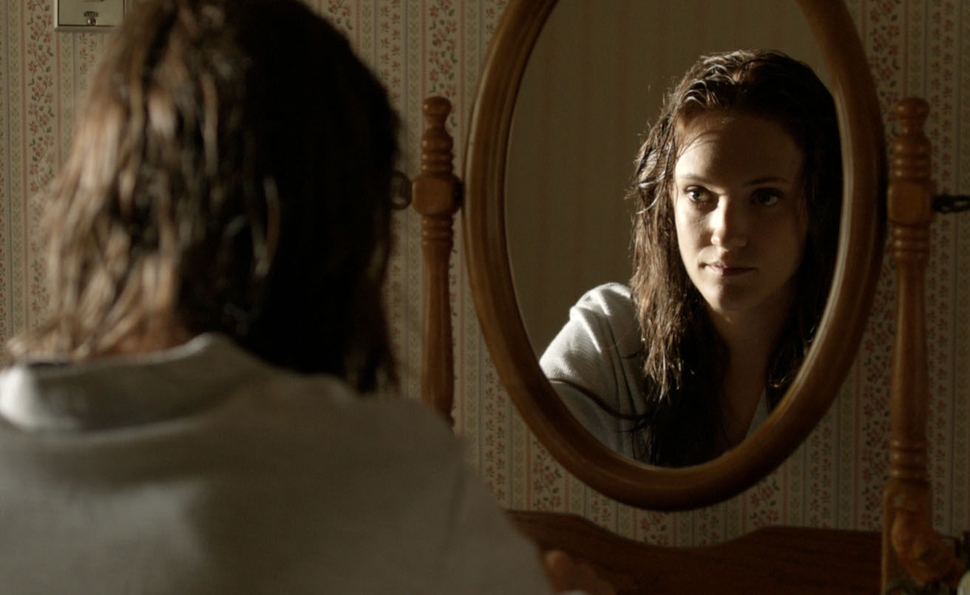
Early on Proxy, consumed by Esther’s grief, is
haunting and melancholy. Rasmussen’s performance is
intriguingly understated and Kevin Donner and Zack Parker’s script reveal
little of who she is or what’s going through her head. The film proceeds initially
as an examination of trauma from a fragile woman, and Rasmussen, right from the
first scene, plays the character with a compellingly dead-eyed,
handle-with-care appearance. Even before the horrible accident, Esther looks
like she’s in need of saving, and this becomes further apparent as the
non-existence of human connections in her life becomes abundantly clear.
And then things get very, very strange. From it’s opening on
a black screen matched with a crescendoing, unsettlingly dark score, Proxy televises itself as a film that
will be playing around in the sandbox of horror. But for all of the visual
grammar of horror Proxy consistently
makes use of, it only comes across in small doses that what is occurring is set
in the horror genre. But the film doesn’t situate itself as horror in the
expected sense; it’s a film about soured psyches and unhinged personalities.
Blood is spilt, but Parker’s direction suggests a fascination with mystery and
a desire to leave things ambiguous and unresolved. It’s horrific without being
horror, thrilling without being a thriller, and mysterious without being a
mystery.
To be completely honest, there’s a certain point in Proxy where I’m not entirely sure what’s
happening. Some will argue that about mid-way through Proxy loses track of its larger narrative and goes completely off
the rails (And for a time, this argument is somewhat sound but the ending
manages to bring the two threads together in an oddly satisfying, but admittedly
mismanaged, way). But there’s another argument to be made that the back-half of
the film remains true to the vision of the earlier portions of the film, and that
each piece’s elusive craziness appropriately ping-pongs off the others'. Still,
as is, the film feels like two very different films separated by significant
tonal shifts.
Esther becomes fixated on her relationship with Melanie, in part,
because she seems to have no one else to turn to and, in part, because she’s increasingly
unstable. This becomes doubly true when it becomes discernable that Melanie is
possibly not being entirely honest about her reasons for pursuing group
therapy. It’s as the film shifts from the grounded psychological tenors at its
start to more expressive, abstract horror as it advances that it will likely
lose and baffle some (okay, most) audience members.
Proxy places
Esther and Melanie as a study in contrast. Both could not be more different, in
terms of appearance, demeanor or personality. Esther is a willowy, softs-spoken
brunette, plain in almost every regard; Melanie is an attractive, sociable
blonde, immediately appealing and put-together. Yet both are fundamentally broken
and use the other for their own ends (in a way that befits the film’s title),
and there’s a feverish, Persona-like suggestion
that they may be one and the same, if not literally than undoubtedly psychologically.
Proxy never takes
for granted any of its immediate surface appearances, building an allure out of
questioning what motivates its characters. Eventually the film attempts a few
too many reveals to beggar belief, but in needling its own foundations the film
asks us to be as confused and pained as its characters and feel their unmistakable
emotional turmoil.
Grade: B

No comments:
Post a Comment