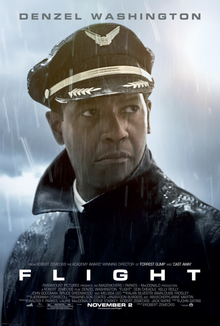
It’s all over the place. There’s entertaining things happening
on occasion but for what purpose, it’s frequently tough to tell.
Denzel Washington was nominated for an Oscar for his work as
in Flight, and though I don’t know if
the nomination was justified, Washington is one of the better aspects of the
film. Whip Whitaker is an airline pilot with major addictions, largely to
alcohol. He shows up to work drunk and high on cocaine, and when the plane malfunctions,
going into a nosedive, he flips the plane upside down to level it out in order
to make an emergency landing in a field. The plane crash sequence is genuinely
exciting and one of the film’s highlights, but afterwards the film becomes
something far more brooding.
It chooses to delve into the self-destructive tendencies
inherent in Whip. Whip initially decides to go cold turkey after discovering
the flight attendant he was having a fling with died in the flight (saving a child
no less). He quickly returns to his old ways, however, when he learns that the
toxicology report has him pegged for manslaughter for the six people who died
on the flight. A fact that’s complicated by the fact that the real cause of the
crash seems to lie in the plane’s mechanical failures and Whip appears to have
pulled off a feat that no one else could have.
For awkwardly developed, slightly contrived reasons, Whip
befriends Nicole (Kelly Reilly) a recovering heroin addict he first meets at
the hospital. She tentatively tells him where she lives, and in a drunken haze,
after failing to rekindle relations with his estranged son and ex-wife, he
saves her from the deadbeat she owes drug money to. With his help, she kicks
her drug habit (eventually joining AA – he goes along for one meeting, but quickly
leaves, turned off by the whole idea), but has to watch as Whip continues to
destroy himself slowly, guilt stricken by the crash and consuming increasingly
excessive amounts of liquor.
This has all happened within the first hour of a film that’s
over two hours long. And it isn’t that it’s not entertaining or not well-acted
or poorly directed, in fact, Flight
is entertaining, well-acted, and well-directed by Robert Zemeckis (though it has some major pacing and structural problems). The individual moments and scenes work well in of
themselves, but holistically it’s kind of a mess. The film early on is bouncing
between Whip’s relationship with Nicole and his preparation for the trial. These two
aspects are interesting but they’re often at odds with one another, having
little to do with eachother and clashing tonally.
At times, it’s cheesy or clichéd but Washington and a really
great cast that also includes Don Cheadle as the lawyer Hugh Lang assigned to
him for the case, who’s simultaneously disgusted and in awe of Whip, and John
Goodman as his druggie best friend Harling Mays (who’s incredibly underdeveloped
and who’s introduction is terribly handled). However, the ending undercuts much of the
moral complexity the film had established and shoves a far, far too simplistic
message down our throats.
Flight is an entertaining film, but the its initially
interesting premise gets lost in the shuffle of a grab bag of ideas that work
with varying degrees of success.
Grade: B-

No comments:
Post a Comment