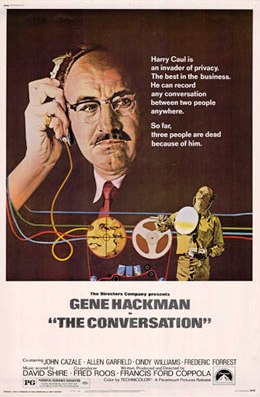
The Conversation
is a film about wiretapping and surveillance, and in that vein it’s a film
whose sound design is carefully calculated and matched or disassociated with
the images we’re witnessing. Take the opening scene for example. We have super
wide shot of a public plaza, but the sound we are hearing doesn’t match with
what we’re seeing. We’ll soon discover it’s part of a recording for a
surveillance operation. But before that, we’re not entirely sure where we’re supposed
to be looking at in this crowded space.
The film is also a story of voyeurism. Harry Caul (Gene
Hackman) is an introvert who’s barely socially functional; he can barely hold
conversations not on his work in everyday life. So it’s fitting that his
personality should lead him into a line of work where he doesn’t have to interact
with people; he can just observe other people without having to get involved.
Harry is also massively paranoid. He’s jittery about even
using his own home phone, using a payphone or outside line to make calls. His
paranoia in turn leads to obsession. He’s obsessed with his most recent job, a
recording of a conversation between a man and woman. He’s certain he has the scenario
figured out, and the more he begins analyzing the tapes, the more positive he becomes
that the two individuals might get murdered.
Harry wants to give the tapes to the company that hired him, be done with the job, and clean his hands of the whole mess, but his fragile moral
compass keeps leading him to what he believes is true north. He’s obsessing
over the case, and increasingly becoming fearful for his own life. Apparently
he did a case out in New York years ago that led to the killing of three
people, and he still feels guilty and haunted by it. It’s the reason he moved
out to San Francisco in the first place.
Despite knowing he ought to get out while he can and throw
his blinders on, he finds himself unable to stop getting involved and
interfering. The more he pushes back, the shakier the ground he walks on becomes.
The light, jazzy piano score starts to ramp up into more industrial and
electronic as the stakes get higher, the cuts of shuts become quicker, and Harry’s
paranoid state more frequently starts to seep through the screen.
Writer-Director Francis Ford Coppola is primarily remembered
for making The Godfather films, which
are absolute masterpieces. But while Godfather
Part I and II and Apocalypse Now are recognized as
unequivocally brilliant works, The Conversation
often get short shrifted. This is a shame because it’s a masterful, surefooted,
engrossing thriller. The film features much of what made Coppola’s other movies
great: impeccable writing and technical craft, unparalleled character work, and
a hard to peg down feeling of texture and richness.
Grade: A-

No comments:
Post a Comment