Tuesday, June 17, 2014

"Enemy" (2014)


A fair amount of critical judgment of director Denis Villeneuve’s Prisoners seemed to regard the film as handsomely mounted but ultimately a little hollow. I think some of that criticism is misplaced, failing to accept Prisoners as an uncommonly well-made and involving mainstream thriller despite how unoriginal, and occasionally thin, it may have been. In fact, most of the criticisms aimed at Prisoners would be better pointed at Villeneuve’s follow-up feature Enemy.

Enemy has similar immediate surficial pleasures, boasting some great cinematography by Nicolas Bolduc. But where Roger Deakin’s cinematography for Prisoners was unmistakably inviting, Bolduc’s cinematography, while not without its allure, is shot through with a sickly yellow glow. The film’s outward appearances hint at something sinister but it rarely actually manifests. It remains a quiet, anxious hum just beneath the surface of the film’s story. 

This isn’t to say that Enemy’s story isn’t without its unsettling peculiarity. The film’s central premise involves meek professor Adam Bell (Jake Gyllenhaal) discovering the existence of a man, the confident actor Anthony St. Claire (Gyllenhaal), who looks exactly like him (This after coincidentally renting one of the movies he’s all but a glorified extra in). Javier Gullón’s script keeps dancing right up to the line of explaining the reasons for their identical looks, suggesting there’s some malicious or strange explanation for it. But we never receive answers and the film slowly falls off a cliff into convoluted abstraction. 

This has been a banner year for doppelgängers, including Muppets Most Wanted and Richard Ayoade’s oddly similar sounding but superior The Double. The Double also features a man, played by Jesse Eisenberg, meeting another man who is precisely the same except for drastically different personalities. Unlike The Double though, Enemy never uses the doppelgänger angle to instill the film with any greater meaning. There’s a literary tact in The Double where the yin-yang of mirrored individuals becomes symbolic of the main character’s internal desires and frustrations. Enemy, by contrast, merely uses it for total weirdness and disappointing, one-note psychosexual nonsense. 

Enemy makes grasps for weighted meaning. Villeneuve’s shoots the film elliptically and has the film fold in on itself. The film pretentiously opens with the epigraph “Chaos is order yet undeciphered”. Early scenes feature Adam, in all too obvious thematic exposition, lecturing to his class about control and repetition (featuring casual references to the Roman Empire and Karl Marx as if it’s all so very deep), and it’s all intended to imply greater substance. The film doesn’t follow through on these themes with enough care or interest for them to feel like they matter though. 

Again as in Prisoners, Gyllenhaal gives a performance stronger than the film he’s in. Gyllenhaal imbues his characters with small gestures that make Adam and Anthony feel like two distinguished and recognizable people. Notice the way he delivers his lines as Adam, stumbling, constantly doubting; this is a man who is uncertain of every tiny thing he does. He falls over his words and chokes on his own over-heated mind. The other performers are given hardly anything to do. Melanie Laurent and Sarah Gadon star as the romantic partners of the two leads. Little is done to characterize them. They’re presences, not people. 

The film splits its storytelling modes between a straightforward thriller narrative and a trippy arthouse oddity. The further it moves along though, the more the film flows with the logic of a dream. Haunting, disturbing imagery presents itself and is then never explained. There is a reoccurring image of a tarantula; at one point it seems poised to destroy the city of Toronto, where the film is set. The gonzo final scene of the film, which I won’t reveal, is as baffling as it is unnerving. It’s hard to tell how much of what we see is actually happening (at one point, a character even asks, “What is happening?”). 

In case you couldn’t already guess where this was headed: Adam and Anthony’s live start to bleed into one another. Anthony becomes interested in taking advantage of the situation for personal gain, while Adam is reluctant. It’s hard to get invested though. Beguiling surfaces aside, Enemy is pointlessly dark and obscure and it is hard to get too committed to it. Yet it’s not elusive but evasive, failing to follow through on the story it informed us it intended to tell and only half-heartedly telling what it does at that. 

Grade: C

Sunday, June 15, 2014

Game of Thrones: "The Children"

 ** Spoilers Follow: **

The Red Wedding is widely agreed to be (and rightfully so) the greatest thing George R.R. Martin has ever, and probably will ever, write. Good as the books after A Storm of Swords (which is, for the most part, what was being adapted this season) are, they pale in comparison and they seem desperate to try re-create the breathless set of developments that made their predecessors so good.

Yet a post-Red Wedding Game of Thrones has felt oddly invigorated in some ways. I’m of the opinion that creators David Benioff and D.B. Weiss were being incredibly delicate towards their adaptation of the books pre-Red Wedding, and now they’ve been freed up to be much more fast and loose with telling the story. Fans are far less concerned with how some of this later material is handled, and we’ve seen much more liberties taken this season than in any other season. 

This hasn’t always worked. There have been loose plot threads and wheel spinning – the show still isn’t entirely comfortable being centerless and some characters it doesn’t have a clue how to handle. But more often than not it’s felt like we’re Arya setting off onto the horizon. The future is uncertain but it sure looks pretty darn good. 

I gave a fair amount of praise to last week’s episode, and I seemed to be critically in the minority. Yes, it was an episode that was pretty low on good storytelling. But it was peerless technical craft and spectacle. Sure I should be knocking it a few grades down, but then I think of how this show is first and foremost a delivery system for entertainment and it was way too much sheer pleasure to get too cranky.

That being said, this finale “The Children” is a reminder of the ways in which Game of Thrones’ unique weekly storytelling modes can be really advantageous. 

For all its lack of colossal battles, “The Children” nicely wrapped up a number of ongoing stories while looking ahead to the future. It was also a reminder that sometimes limiting our exposure to some characters and locations can be highly dissatisfying and restricting. (Oh, how I’ve missed so many of these familiar faces in the one week’s absence). 

It’s a busy episode that manages to never feel overcrowded. A few characters are missing (Sansa, Theon) but we end up stopping in on mostly everyone. And not only that, but the episode also ties together these stories with precision and cohesion. 

The theme is subtle and just beneath the surface (suggested, but not overstated), and hinted at by the episode’s title. It could easily be referring to so many different things. The most obvious place is the place it appears literally in the episode; Bran, Meera and Hodor (RIP Jojen) meet a small individual who says that men used to call them “children”. This is one of the Children of the Forest, a group of people who were the first of inhabitants of Westeros before men arrived. It’s a part of the evermore complicated mythology of the show. 

Children could just as easily refer to the Starks who have been scattered to the winds, and here we see accomplish major goals long in the making. Jon (who even brings up his father at one point) goes to negotiate with Mance Rayder only for Stannis to arrive with his army and eliminate the remaining threat of the wildlings. It plays unexpectedly despite how much it’s been hinted at. With Stannis, Davos and (an eerily shot through flames) Melisandre at the Wall, the status quo has been uplifted in one of many places (but more on that in a bit). 

Bran finally meets the Three-Eyed Raven he’s been having weird visions of since season one. Meanwhile, Arya has one of the most eventful storylines (in a very eventful episode). Brienne and Poderick come across the Hound and Arya. Brienne recognizes her, and the Hound and Brienne battle over Arya and the safety they claim to give her (in an intense and draining fight for both viewers and fighters). It’s a testament to the relationship the show has developed between Arya and the Hound that our feelings are so complicated during this sequence. We believe in the Hound’s real investment in Arya beyond a desire for a payment and we know Brienne’s sincere about her intentions even if she has difficulty proving it.   

I don’t know what’s more devastating: the fight or the long, slow, painful death scene of the Hound. The Hound loses the fight (but only barely), and as he bleeds out he begs Arya to put him out of his misery. Maisie Williams has rarely been as good as she in this moment as she contemplates her next action and her mixed feelings towards this man who she claims she wants to kill but who she has also made a real connection with. 

Children could also refer to Dany’s dragons, which she has increasingly lost any control over. One of her dragons has gone awol and has killed a three year old girl (a child); this causes Dany to chain-up and lock away the other two dragons. Dany looks crushed as she walks away (in a wonderfully shot scene by director Alex Graves, who makes such great use of light). These are the closest things to children Dany will have (now that as was suggested in the first season that she is incapable of bearing children). Game of Thrones loves taking a typical fantasy scenario and then flipping it on its head, and so it shouldn’t be too surprising that Dany isn’t immediately and always a master over a trio of full-grown dragons. 

Outside of the Stark child trio and dragon child trio, we had the three Lannister children. Cersei refuses to stay under the thumb of her father Tywin, openly flaunting the truth of her incestuous relationship with Jaimie. (As the Stark kids continue to do right by their parents in death, the Lannisters at first in life and then in death actively flout their parent’s memory). Cersei goes to Jaimie with this news which appears to rekindle their relationship (We’ll see how long that lasts with Tyrion freed and Cersei on a downward spiral). 

Yet Jaimie still is pro-Tyrion and helps free him from prison with the help of Varys. But Tyrion can’t help but take one last opportunity to see his dear father. What he discovers is Shae in his father’s bed, and he proceeds to strangle her. He then finds his father on the privy. Tywin tries to talk him down from it but he’s insensitive as always, failing to acknowledge his son as, well, his son. Tywin ends up with two crossbows to the chest, and, while I will dearly miss the great Charles Dance, Tywin had it coming. He thought he was getting his house in order but failed to accept the reality of his children as anything but an extension of himself and the family name. 

We end the episode with two people on ships. Tyrion and Arya, in different ways and for different reasons, lacking other choices, set out across the Narrow Sea. Arya to Braavos, and Tyrion to parts unknown. The show ties together their respective bottoming outs while suggesting it’s ultimately for not only these characters but the show as a whole.  

Game of Thrones, for the most part, has been pretty lousy at finales. Outside of the first season finale, the series hasn’t really had a clue how to set up the new season while crafting an episode that doesn’t play like a giant recap. We stop in a lot of places in “The Children” but it largely feels well integrated while also being forward looking. The final shot of Arya reads like a mission statement: there are good things to come. 

Stray Thoughts:

-Other children business: Brienne and Arya discuss their fathers’ different approaches to their interest in swordfighting. Cersei talks about the situation with her own children. 

-The theme also ties nicely to the show’s interest in how children survive in a medieval world where there’s no real conception of a transitionary period between childhood and adulthood. This is especially fitting for Arya, who keeps sliding into darkness. That whole death scene with the Hound is so fucking stone-cold and disheartening. (It also ties nicely with Sansa’s transition from two episodes ago – which is further neat because of the two sisters’ shared relationship with the Hound)

-The first appearance of Stannis and Davos through the mist is so well shot. The overhead shots of the assault on the wildlings were also pretty nifty. The episode held out the reveal of Stannis for a long time in clever little ways. 

-Qyburn (the sort-of-maester Jaimie met on his way back to King’s Landing) is ordered by Cersei to revive the dying Mountain; he says, “He may not be the same”. Pycelle doesn’t approve (but who really cares about that untrustworthy dude). Lots of ominousness hinted at here folks. But then again, most things feel ominous these days on this show. 

-Dany Learns to Rule a City: Dany has more troubles with freeing the slaves of Mereen. A former slave wishes to be reinstated as a slave because his lot in life was better. 

-That skeleton warrior fight before Bran’s arrival at the Three-Eyed Raven was cool, but it still has nothing on Brienne and the Hound’s fight which was weighted with so much emotion and was so brutal and bloody. I didn’t expect the show to actually have their paths cross and especially not like this, but it ended up being a really smart, effective decision. 

-Arya thinks first to try to get passage north, presumably to Jon at the Wall. In her mind, that’s probably the last of her familial connections.  

-Jon helps Mance’s life get spared. He claims it’s what his father would have done but I think he also has too much of a personal bond with Mance at this point to see him get killed. 

-I mentioned the shot of Melisandre already, but I wanted to also note how she stares weirdly and suggestively at Jon. There’s an implied connection of sorts there. I also like, during the same scene, the glance given between Jon and Stannis who already have an almost immediate understanding of their obligations to one another. 

-Tyrion shoots the crossbow after Tywin calls Shae a “whore”, a very big sticking point for him ever since (as discussed in season one) he once married a prostitute who then Tywin had Lannister guardsmen all pay to have sex with. 

-The Three-Eyed Raven is pretty creepy looking, and this is helped by how he’s shot, which has an almost Guillermo del Toro vibe (I’m thinking Pan’s Labyrinth). 

-Jojen’s death didn’t really affect me. There just wasn’t enough build-up. But I do like the notion that he gave himself up in order for Bran to make it; that’s something hopefully Bran will have to come to terms with. (God, Bran really fucking needs a good storyline; here’s hoping for next year).

-According to an interview Maisie Williams gave, the script direction for Brienne and Arya's discussion of swords and fighting read:  "Arya smiles. She likes this weirdo. Brienne smiles. She likes this weirdo." I loved the meeting of these two very similar women with very similar aspirations, and it only makes the ensuing conflict all the sadder and more heart-wrenching.

-Well, it’s been fun guys. Here’s hoping that I see you guys here in a year’s time when more of Game of Thrones will be had.

Grade: A

Saturday, June 14, 2014

"How to Train Your Dragon 2" (2014)

DreamWorks Animation’s track record has always been spotty at best. For every Shrek, there’s an Over the Hedge or Shark Tale that makes the studio feel indifferent and mercenary in their efforts. One of the studio’s most surprising efforts, one that was both a critical and commercial success, was How to Train Your Dragon a clever and colorful hero’s journey based on Cressida Cowell’s book series of the same name. How to Train Your Dragon left off in a place that didn’t seem to necessitate a sequel, but the dictates of the current film climate have led to this second film.

While its pleasures are less abundant than its predecessor, How to Train Your Dragon 2, like other questionable but still fun animated sequels like last year’s Despicable Me 2 and Cloudy with a Chance of Meatballs 2, is still a dependable piece of family entertainment that even occasionally manages more mature stories and themes. It's unmistakably a cash-grab but it admirably attempts to be a dark companion piece to the first film -- even if it isn't wholly successful in its efforts.

The film picks up five years after the first film. (The film’s five year jump almost feels unnecessary. It allows for the establishment of a new status quo, but it also causes all the formerly fifteen year olds who drove the first film’s narrative to be in their early twenties. The film’s treatment of these characters and their emotional inner states too often makes them feel like they’re that of adolescents, not individuals on the cusp of adulthood -- Side rant over!).

Dragons have firmly been established as harmoniously part of the formerly anti-dragon town of Berk. The characters inhabiting this world are a strange but joyous blend of Nordic Vikings and Scottish highlanders (think Brave). They live in medieval thatched-roof cottages perched upon rocky mountainsides that look like islands floating in a sea of mist and accentuate the need for flying creatures to maneuver anywhere. 

With outside threats non-existent since Berk learned to tame (or, more appropriately, train) the dragons, the pressing concern turns to the village’s chief Stoick the Vast (Gerard Butler) insistent on his son Hiccup (Jay Baruchel) preparing to take over as the town’s leader. Hiccup is sensitive and pensive, and he stands in stark contrast to the more rowdy and boisterous members of his community. Hiccup doesn’t believe he’s well-suited for the position. 

It’s easy to guess where this is going; Hiccup is ready, even if he doesn’t realize it yet, and will learn through a new adventure to accept the responsibility and recognize his qualifications for the job. 

Writer-director Dean DeBlois, who directed the last installment, has two significant developments play out to expand the film’s universe and to deepen the emotional stakes. The first comes in the form of a Big Bad who goes by the name of Drago Bludvist (Djimon Hounsou). Drago is a shadowy figure who is sending out soldiers, including hunky leader Eret (Kit Harrington), to trap dragons to become part of his dragon army. Stoick tells of tales of Drago’s destructive wrath, but Hiccup, despite his father’s wishes pursues Drago in hopes of negotiating peace. Drago’s not an especially memorable villain and his motivations are pretty blasé, so much so that at one point in the film Hiccup self-awarely notes how uninteresting and empty Drago’s plans are. 

In his journey, Hiccup accidentally stumbles upon his long-lost mother Valka (Cate Blanchett). In the twenty intervening years, Valka has taken it upon herself like an environmental enthusiast and preservationist (resembling something of a Jane Goodall, except with dragons not apes) to save and protect dragons, creating a sanctuary safe from both the formerly violent Berk and Drago. It’s a nice little way to tie together the two different films without overreaching, and, with the help of Blanchett’s performance, the film creates some really emotionally resonant scenes between Hiccup and Valka, and Valka and Stoick.  

For a time, the film appears to be moving towards an Empire Strikes Back-like second film narrative positioning. The film has the potential to leave the film in a very murky, complicated and devastating place, but it backs away in favor of a more pleasant, sun-shiny one. This isn’t completely detrimental to the film’s story, but it does leave one wondering just where and how DeBlois and Dreamworks intend to take this story forward in the pending third film. 

The film retains the vibrant animation of the original. A more sizable budget and ambitions only allows for more wonderful displays of spectacle and world-building. In one scene Hiccup enters a stone and grass atrium flowing with countless varieties and colors of dragons, some we’ve never seen before, flying in a spiral like a kaleidoscopic tornado. Moments like these are so exuberant and carefree and they demonstrate the series playful penchant. The film also still retains the humor of the first in Hiccup’s friends (America Ferrera, Jonah Hill, Christopher Mintz-Plasse T.J. Miller and Kristen Wiig) and his uncle Gobber the Belch (Craig Ferguson). 

Despite whatever may have been lost in the process of cashing in on the first’s success, How to Train Your Dragon 2 is charming and entertaining. It lacks the snap of the first film, that sense of unrestrained discovery, but once you’ve trained a dragon, isn’t it safe to say that it’s likely the high point of your existence. 

Grade: B

Wednesday, June 11, 2014

"Edge of Tomorrow" (2014)

Tom Cruise, by virtue of his charm, charisma and ageless good looks, is one of those leading men that can sell the hell out of a movie simply by his presence. His job, stemming back to a lineage of stars such as Cary Grant, is to be the bedrock which makes the plot around him sing no matter how ludicrous it may be. But when the plot around him is also sharp and smart, like the proficient popcorn thrills of Mission: Impossible – Ghost Protocol, it elevates everything to a new level of efficient, involving entertainment. This is the case with Edge of Tomorrow, a sleek, smart, action-packed, sci-fi watch-a-ma-call-it that benefits as much from its no frills plot as it does from Cruise’s likable presence.

Cruise stars as Major William Cage, a former member of the military who now uses his advertising skills to market the war being waged in the near future against an invading alien race, referred to as Mimics. The war, going on five years now, is going badly for humanity, and the human race intends to mount one last counter-offensive with everything they have. Cage is told by the leader of the military forces, General Brigham (Brendan Gleeson) that he will be embedded to cover the war effort from the front lines, and Cage, who has no intention of being near the action, strongly refuses and angers the stubborn general. When Cage wakes up, he learns that the general has sent him to combat, stripped him of his ranks and sent out a formal order stating he’s a deserter.

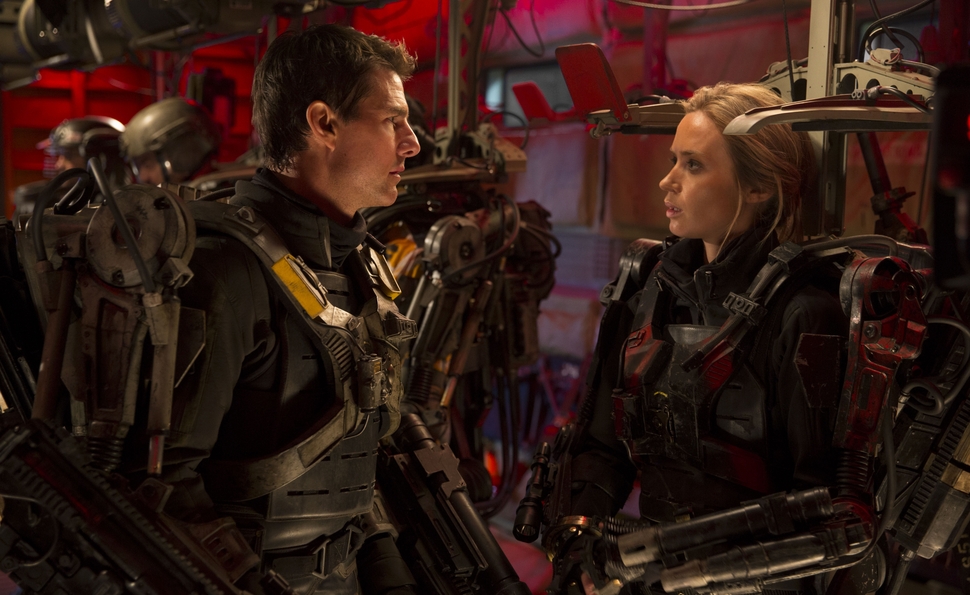
Cage is flown into combat for the Western European insurgent operation. The event is like D-Day re-imagined as if set in the future, bigger, more bombastic, more explosive and sleeker. Soldiers are in combative, robotic exoskeleton suits that make them look like super-soldiers or beefed up members of Starship Troopers. The aliens are squid-like, wriggling tentacles and the wisping mobility of phantoms; there are shades here of the Predator and the alien from the Alien films and the sentinels from The Matrix, but they stand on their own as something familiar but not bland. 

It turns out the aliens were waiting for the attack and it turns into a massacre. The aliens serve as mostly a plot device, a MacGuffin even. The film’s real interest lies in killing off Cage early … and then bringing him back to life at the beginning of his day, aware of the events to come. The film’s central conceit, which it uses cleverly and buoyantly, involves having Cage re-live the day over and over Groundhog Day style, attempting to save humanity from their doomed fate. In this mission Cage is helped by Sergeant Rita Vrataski (Emily Blunt), who had previously experienced the time jumping and attributes it to coming into contact with the blood of a special set of Mimics. 

The film plays out almost episodically. Cage learns of his circumstances and tries to convince anyone around him to listen (and mostly just fails). He’s unprepared for combat and is taught how to fight by Rita. Cage and Rita map out a way to get to the Omega, the central consciousness of the Mimics and the force responsible for the time reset. Doug Liman’s direction and Christopher McQuarrie, Jez Butterworth, and John-Henry Butterworth’s script are playful and emphasize the progression of Cage’s exacerbation and growth of knowledge in each of the contained scenarios. The film is at its most enjoyable when it considers in detail the consequences and possibilities of its neat central idea. Cage dies and the film often cuts immediately back to that same moment as Cage fixes his mistakes. Cruise has a lot of fun playing someone who has gradually accrued a wealth of knowledge of the situation he’s in and is slightly amused and tired of the tedium of it all. The film also gets a great deal of mileage out of the audience’s lack of certainty as to just how many times Cage has been through any given part of the day; sometimes it’s more than he leads on, and it adds to the thrill and uncertainty of where the film is headed. 

Liman shoots the film for maximum action, and the fight sequences have an immersive, you-are-there quality. While Liman’s background includes The Bourne Identity, the film adopts Bourne’s brisk, energetic pace and action setpieces, but doesn’t have its choppy, quick-cut editing or shaky steadicam shooting. It’s more carefully framed and uses wider angles more consistently. James Herbert and Laura Jennings’ editing must be given praise; the film’s editing adds to its fleetness. It’s tight, controlled and fluid – so seamless and integral to the action, like the best editing, you forget it’s being done. The film flows so smoothly and assuredly. It knows where it wants to head and it knows how long to hold a particular plot point before shifting to a new one. 

There is a video-game-y quality to the film. Not in the Paul W. S. Anderson and Resident Evil way, but in way that speaks to real time strategy and role playing games. The design of the Mimics and the military equipment could resemble anything from Warhammer to Mass Effect. The mechanisms for the film’s plot are isolated puzzles that need careful problem solving. The film’s immersion stems from placing you in the moment of the film’s reality and taking you along for its propulsive ride. We don’t question the logic of it because it becomes so compelling and vital; once it has created a logic unto itself, Edge of Tomorrow becomes addictive, and just plain infectiously hard to resist. 

Edge of Tomorrow could probably stand to have some greater meaning or purpose. It lacks the idea-driven nature of, say, Inception, and it doesn’t have the stealthy profundity of its clearest parallel Groundhog Day. The film lives and dies by how inventively and adeptly it makes use of its premise. Thankfully it mostly lives. And then dies. Then proceeds to live and live some more. 

Grade: A-

Tuesday, June 10, 2014

"The Fault in Our Stars" (2014)

Author John Green writes funny, smart Young Adult novels about funny, smart teens asking and thinking about Big Important Questions. In his most recent and most popular book The Fault in Our Stars Green matched the urgency and immediacy that faces young adults with a set of life and death stakes to make all that earnest pondering about the meaning of existence feel all the more pressing and poignant.

Hazel Grace Lancaster (Shailene Woodley) is a sixteen year old with terminal thyroid cancer. She was diagnosed at thirteen and miraculously has been living on borrowed time due to a trial drug. Hazel’s life consists mostly of homebound boredom and constant intakes of medication; the rare occasions that she sees the outside world are to go to the mall, where she gazes longingly at non-sick teens, and to attend a support group. 

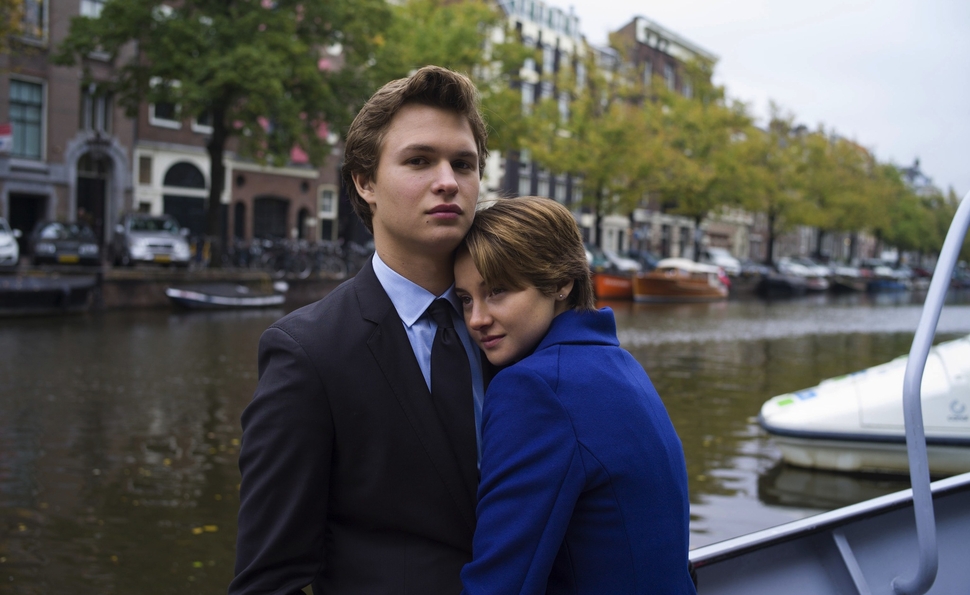
At one of these meetings Hazel attends mostly to appease her mother (Laura Dern, great despite her minimal presence), she, by chance, encounters Augustus Waters (Ansel Elgort). Gus has recovered from osteosarcoma and lost a leg as a result of his cancer. Hazel and Gus bond and relate over more than just cancer but over a shared sense of humor (this is often, unexpectedly, a very funny film) and a desire to create meaning in a life limited and likely to be shortened by illness. 

This doesn’t sound like the beginnings of a swooning, star-crossed romance. But driven by an awareness that life is short, especially given their circumstances, and heightened by the expiring days inevitably left, they fall for one another slowly but earnestly and purposefully. The romance is never oversold and is fairly grounded for all its intensity. It’s sweet and tender, and Woodley and Elgort have significant chemistry together. 

The adaptation too often awkwardly literalizes Green’s narrative and does a little too much fan service (Some of the book’s most well-trotted quotes make their way in one form or another, occasionally awkwardly). That being said, for all its shortcomings, it must be remembered that technically the film is aimed at teens and in this regard the film and its thoughtful story feels like a welcome alternative to so many other mainstream films (It also, in my opinion, works just fine for anyone who isn’t a tween or familiar with its source). 

In particular, I’m pleased to see a complex female protagonist in a mainstream film (and one that isn’t about dystopian futures). Woodley demonstrates yet again why she’s one of today’s most promising talents. Notice the micro-emotions; Woodley is capable of making small moments feel weighted with purpose and complexity (Elgort is also good but Augustus feels a little underwritten – as Kimber Myers writes, “if his lines were said by another, less talented actor, we might have rolled our eyes more than sighed, but that wasn't the case”). I also like seeing such sincere portraits of young people; smart and articulate, but believably vulnerable. They’re not archetypes or stereotypes (This isn’t a John Hughes movie, thankfully). 

The Dissolve described the film as a “feel bad” film. One of those films we watch going in aware that it will likely depress and move us, perhaps even make us cry. At face, the film might sound like just attractive people dying from disease. But it’s more than a manipulative tearjerker. This is, in part, due to Green’s book, which bucks conventions even as it often plays to them and which has a tremendous amount of sensitivity towards its subject matter. These are good people who have been dealt a bad hand and who make the most of the lives they have. 

Josh Boon’s direction and Scott Neustadter and Michael H. Weber’s script do play to the sentimentality and heart-tugging a story like this entails, but there’s also real wisdom and hard, hard-earned truths about life. The film can be overly precious and cute, but it’s also often enough bracing and uncompromising. Hazel is always recognized to be staving off the inescapable, and the film doesn’t provide easy answers or convenient outs for all the difficulties and heartbreaks it presents. Hazel is going to die (whether it’s within the two hour timespan or not), but so is, as the film notes, everyone eventually, and it’s in drawing those connections and asking those universal questions that The Fault in Our Stars never stoops to being insufferable or maudlin. It’s honest; the clear-eyed honesty of a sixteen year old, and think just how painfully earnest we all were at sixteen. 

Grade: B+

Sunday, June 8, 2014

Game of Thrones: "The Watchers on the Wall"

 ** Spoilers Follow: **

Game of Thrones episodes rarely stand out. They often seem to blend together. Though they’re typically exciting and entertaining, if I were to name an episode title, odds would likely be against you telling me anything that specifically happened in any given episode. That is, possibly, with the exception of the show’s standout penultimate episodes.  During these episodes, the creative team behind the series seems to decide to pull out all the stops and produce some of the best episodes not just of this series but that will air on all of television this year. Whether that’s Ned’s beheading in “Baelor” or the gruesome Red Wedding in “The Rains of Castamere”, the show simply knocks it out of the park.

The episode that immediately comes to mind while watching “The Watchers on the Wall” is “Blackwater”, the self-contained battle at the end of the show’s second season. “Blackwater” took time to focus on one location and set of characters and in spending a greater amount of time with them and pushing the show’s budget to its very limit to produce the largest battle to date, the series created one of its finest hours of television. 

“The Watchers on the Wall” is almost a response to “Blackwater”. It’s a different location and characters but of the same mind, but sets out to also be bigger and more explosive. At times, “The Watchers on the Wall” is almost less elegant than “Blackwater”. This is for a number of reasons. The first being that the episode tries to eke out a lot of plot in the episode -- more than it probably should. Another is that the Wall has far less recognizable characters to reliably draw upon than King’s Landing did. And the criticism most in the episode’s favor is that the episode is far too ambitious for its own good and, at times, overreaches.

But some very minor quibbles aside, “The Watchers on the Wall” is Game of Thrones at it bests. It leans into the aspect that makes Game of Thrones stand out. Mad Men is deeper; Hannibal is rawer; Orange is the New Black has a better handle on its large cast. But Game of Thrones has a majestic sweep quite unlike any other show. The courtly politics are part of the show’s pleasures but it’s the unique sprawl, the sense of a vast, lived-in world we’re only just beginning to scratch the surface of, which makes the show so endlessly watchable. 

In no other show could you see large armies clash with the epic scope of The Lord of the Rings. This was an hour-long action film delivered into our homes. Yet it was more brutal and intimate than your mainstream action flick. The episode begins by providing some quiet calm before the storm as characters waited for the inevitable reckoning to come. And these small moments are quickly succeeded by grueling fight scenes. The Wall is attacked from both sides and the undermanned, undersupplied Nights Watch fights for dear life, taking heavy losses, including senior members. 

The show brought back Neil Marshall, who previously directed “Blackwater”, to direct, and Marshall brings a great eye to the action sequences. They are packed with a visceral intensity. Marshall keeps emphasizing the scale on which things are occurring. There are small, throwaway moments that reinforce the sweep of things. For instance, the first movement of the wildlings on the Wall, from either direction, is marked by a remarkable breadth to match the urgency. 

I’ve mentioned throughout this season that Game of Thrones storytelling structure ends up being damaging to the story it tries to tell, despite it being seemingly the only way to manageably tell Martin’s books. But episodes like “The Watchers on the Wall” demonstrate what the show could and can do when it takes time to settle in on one of its many little worlds. And in doing so, like Joffrey’s wedding earlier in the season, it demonstrates how rich and worthy of exploring these many different stories and locations are. 

There may have been characters I missed stopping in on, but it was absolutely worth it for an episode as excellent as this.

Stray Thoughts:

-Ygritte dies, perhaps not surprisingly, and she’s given some great sendoff moments, whether it was her speech pre-attack at the campfire or the depths of pain and betrayal expressed in her encounter with Jon. Rose Leslie will be greatly missed. 

-Gilly returns and Sam kisses her and all but professes his love. He also plays lawyer by justifying his behavior as it doesn’t violate the actual letter of the Nights Watch Oath. 

-Favorite shot: the tracking shot of the all action at Castle Black. Chaos and violence and brutal majesty. 

Grade: A

Saturday, June 7, 2014

"Proxy" (2014)

Esther (Alexia Rasmussen) is nearly nine months pregnant when we first meet her. As she’s leaving her OBGYN from her last ultrasound test, in a great tracking shot, we watch her walk to her car, only for her to be abruptly and viciously attacked by an unknown assailant. Esther’s baby dies from the assault, and at the behest of a nurse she joins a support group where she meets Melanie (Alexa Havins), a woman who says she’s lost her son and husband.  

Early on Proxy, consumed by Esther’s grief, is haunting and melancholy. Rasmussen’s performance is intriguingly understated and Kevin Donner and Zack Parker’s script reveal little of who she is or what’s going through her head. The film proceeds initially as an examination of trauma from a fragile woman, and Rasmussen, right from the first scene, plays the character with a compellingly dead-eyed, handle-with-care appearance. Even before the horrible accident, Esther looks like she’s in need of saving, and this becomes further apparent as the non-existence of human connections in her life becomes abundantly clear. 

And then things get very, very strange. From it’s opening on a black screen matched with a crescendoing, unsettlingly dark score, Proxy televises itself as a film that will be playing around in the sandbox of horror. But for all of the visual grammar of horror Proxy consistently makes use of, it only comes across in small doses that what is occurring is set in the horror genre. But the film doesn’t situate itself as horror in the expected sense; it’s a film about soured psyches and unhinged personalities. Blood is spilt, but Parker’s direction suggests a fascination with mystery and a desire to leave things ambiguous and unresolved. It’s horrific without being horror, thrilling without being a thriller, and mysterious without being a mystery. 

To be completely honest, there’s a certain point in Proxy where I’m not entirely sure what’s happening. Some will argue that about mid-way through Proxy loses track of its larger narrative and goes completely off the rails (And for a time, this argument is somewhat sound but the ending manages to bring the two threads together in an oddly satisfying, but admittedly mismanaged, way). But there’s another argument to be made that the back-half of the film remains true to the vision of the earlier portions of the film, and that each piece’s elusive craziness appropriately ping-pongs off the others'. Still, as is, the film feels like two very different films separated by significant tonal shifts.  

Esther becomes fixated on her relationship with Melanie, in part, because she seems to have no one else to turn to and, in part, because she’s increasingly unstable. This becomes doubly true when it becomes discernable that Melanie is possibly not being entirely honest about her reasons for pursuing group therapy. It’s as the film shifts from the grounded psychological tenors at its start to more expressive, abstract horror as it advances that it will likely lose and baffle some (okay, most) audience members. 

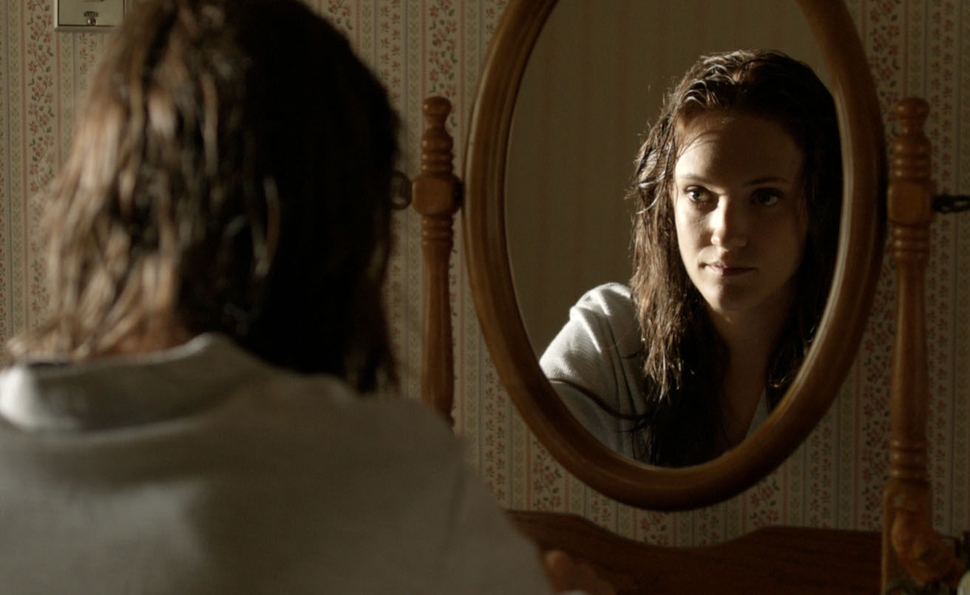
Proxy places Esther and Melanie as a study in contrast. Both could not be more different, in terms of appearance, demeanor or personality. Esther is a willowy, softs-spoken brunette, plain in almost every regard; Melanie is an attractive, sociable blonde, immediately appealing and put-together. Yet both are fundamentally broken and use the other for their own ends (in a way that befits the film’s title), and there’s a feverish, Persona-like suggestion that they may be one and the same, if not literally than undoubtedly psychologically. 

Proxy never takes for granted any of its immediate surface appearances, building an allure out of questioning what motivates its characters. Eventually the film attempts a few too many reveals to beggar belief, but in needling its own foundations the film asks us to be as confused and pained as its characters and feel their unmistakable emotional turmoil. 

Grade: B