Every frame of
Ida
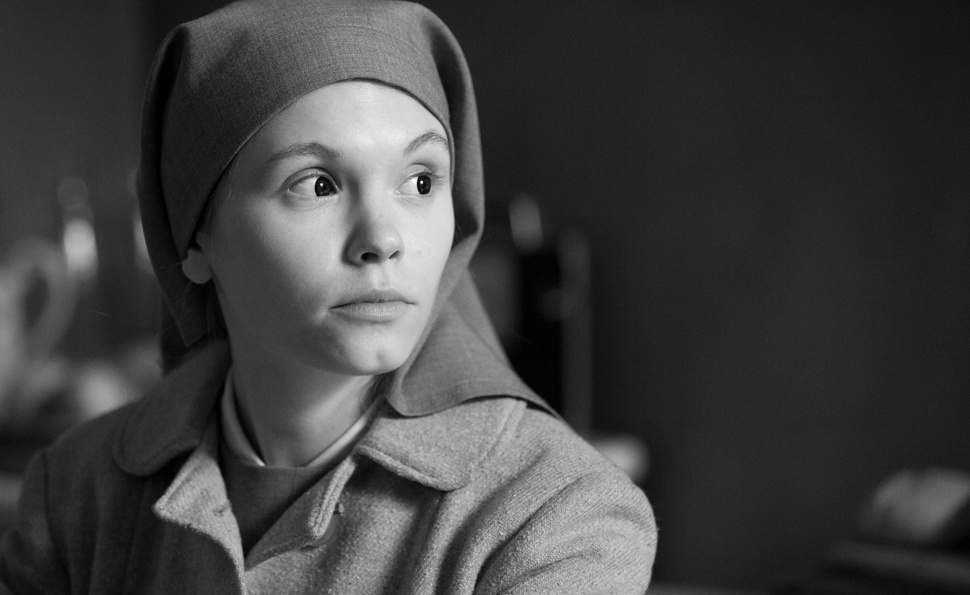
is immaculate, framed and shot with a rare precision and thoughtfulness – and shot
unconventionally in the aspect ratio of 1.37:1 (or the Academy ratio). Shot by Lukasz
Zal and Ryszard Lenczewski, and directed by Paweł Pawlikowski, the film looks
gorgeous. Shot in a stark but frequently expressionistic black and white, the
film looks something like a cross between old post-WWII photography and neoclassical
paintings. The film has the quality of the imagery of Polish master Andrzej
Wajda’s films (especially
Ashes and
Diamonds), and, like Wajda’s war trilogy, its interests also lie in placing
a small story as a stand-in for a larger story about Poland in flux. 18-year-old
Ida (Agata Trzebuchowska), who initially believes her name to be Anna, has been
raised in a convent and will soon take her vows. The Mother Superior asks her
to visit her last living relative, her aunt Wanda (Agata Kulesza), before she
goes through with her vows. Wanda -- stubborn, flighty, boozy, and sexed-up --
is initially reluctant but eventually starts discussing Ida’s deceased parents
and family. Ida wishes to visit her parents’ graves, but this proves to be
problematic. Ida is given a great shock when she learns that she is in fact
Jewish. She survived through World War II and the Nazi occupation of Poland due
to being in the convent. The news understandably shakens her and causes her to
question her beliefs. Much of the film finds Ida in a crisis of faith,
contemplating whether she truly wishes to be a nun. The film finds tremendous
value in Ida and Wanda’s odd couple pairing, and a dry, bitter humor understatedly
runs through the film. Wanda and Ida are firm opposites, and Pawlikowski gets a
lot out of each confounding, and subtly growing on, the other. But this is an unconventional
road trip movie that is in no rush to get where it’s going, content to
contemplate a moment or a mood. And for good reason: Wanda is helping Ida seek
out where her parents may have been secretly buried, returning to the old
village where their family grew up, and, in the process, angering and upsetting
a number of people who wish to see the past stay in the past. Set in the 1960’s,
the recent past of World War II and its aftermath are a fresh wound still
bleeding fresh. The memories remain in the form of the new Stalinist regime
that installed itself immediately in the wake of the Nazi government’s
collapse. The black and white cinematography has some degree of austerity which
fits with Ida’s unfailingly serious and reserved demeanor and the intensity and
solemnness of the story. For all its seriousness, however, the film doesn’t
feel stodgy. Rather, the film is absorbing, filled with stunning beauty, both
in the quiet, stark moments on display, as well as its spectacular imagery.
Like the films of Ingmar Bergman, which it shares a degree of thematic and
visual similarity, there is a transcendence to the narrative, interrogating spirituality
for uplift and insight, as much into the protagonists as into ourselves.

No comments:
Post a Comment