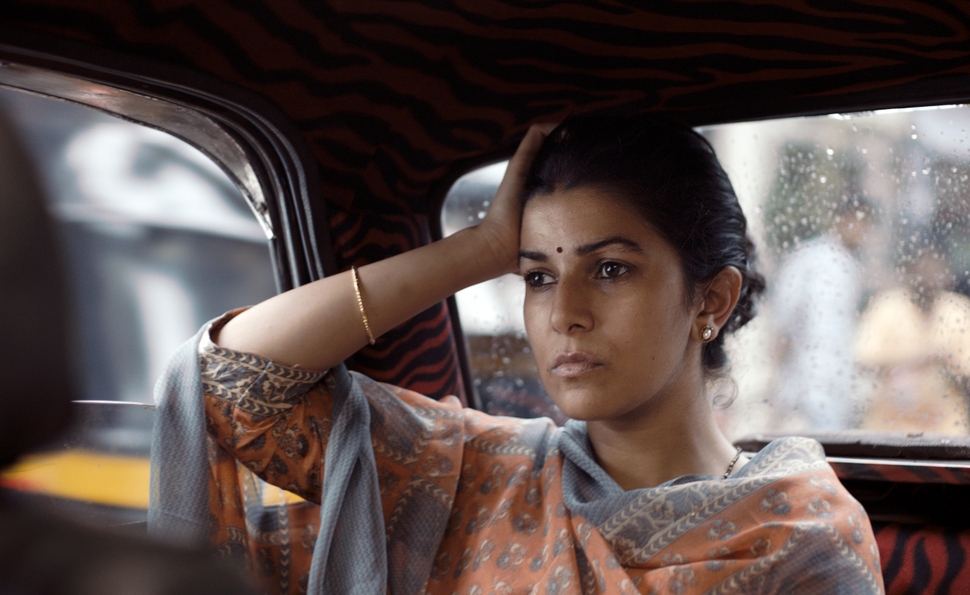
The film begins with a daffy little romantic comedy premise:
The Mumbai delivery service accidentally gives the lunch Ila (Nimrat Kaur)
intended for her husband to another man Saajan Fernandes (Irrfan Khan).
Ila is having marital problems. Her husband is distant and cares more about his work than her. Ila had believed that if she could win her husband’s stomach than she could win his heart as well.
Ila is having marital problems. Her husband is distant and cares more about his work than her. Ila had believed that if she could win her husband’s stomach than she could win his heart as well.
Saajan loves her cooking so much that he eats every last
morsel. Ila and Saajan soon begin exchanging notes, initially to clarify the
mix up, and slowly they start offering deeper contemplations. The more they
reveal in the exchanges, the clearer it becomes that they are both disappointed
and unfulfilled by their respective lives.
The anonymity of the messages offers an opportunity to state
things one normally wouldn’t, a letter counterpart, in a way, to the walk and
talks of Before Sunrise. The more the
two invest in the meaning of these exchanges, the more they begin seeing it as
an out to their humdrum lives.
The film sets up a situation in which we desire to see them
together, these two individuals who have create a beautiful bond. But the film
is continually being tempered by reality. The film is not a Bollywood romance;
it is a grounded neo-realist tale, flavored with the spark of a love affair. Writer-director
Ritesh Batra keeps emphasizing the changing, modernized landscape of India. It
is not a setting to be romanticized. Mumbai is bustling city, crowded and
dirty. It’s beautiful for the docu-realistic lens Batra frames it through,
noticing the humanity bubbling over in the setting. On more than one occasion,
Batra pulls back to suggest that Ila and Saajan’s story is merely one small
story amongst countless other stories taking place in India.
Where a Hollywood film would find some way to bring these
two individuals together, to grant them a little happiness and reprieve, The Lunchbox keeps finding
complications. Running away together to Bhutan is hopelessly romantic, but it
certainly isn’t practical. Missed opportunities and missed connections define
the film. It doesn’t argue that this romance is impossible, but it allows its
characters to take actions that undermine their dreams and satisfaction in the
name of being realistic.
And yet, the film is still deeply romantic. The brief window
of time in which the exchanges take place is dreamy and exciting, and also raw
and tender as secrets and regrets are revealed. The mid portion of the film is
colored by a sunny, warm quality where the film indulges in low-key humor and a
fluffy sense of possibility. Even as the film takes on an increasingly
bittersweet tone, the possibility of consummating the romance is held out (the
film’s ending is ambiguous on this account, even as it’s a doubtful ambiguity).
While it may never occur, the way the conversation has affected and altered
both carries through. Both take control of their lives and refuse to quietly be
consumed by their grief, sadness and frustration. They have become better, more
capable people who can now take charge of their lives.
That somewhat oversimplifies the film’s aims, however. The
characters’ journeys are about accepting that life is a little dissatisfying
and difficult. It’s about learning to ground yourself within the life you have
and not the one wish you had. That’s a little bit headier than the film’s
seemingly commercial premise would immediately suggest, but it’s also richer
and more rewarding. Saajan and Ila are real people struck by a moment of
serendipity, not dictated by cosmic fate but a mishap of modern infrastructure.
No matter what its causation though, it still remains serendipity and The Lunchbox remains a delight, a crowd
pleaser that never simply settles for just being pleasant.

No comments:
Post a Comment