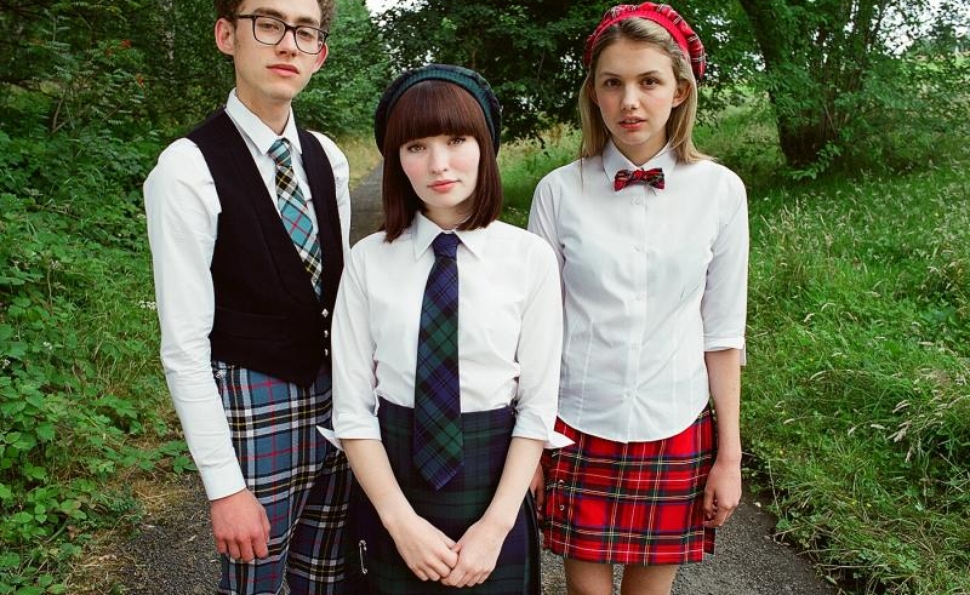
The film doesn’t exist in reality. It is a pop song as film.
It is an ode to an endless summer. It has an aesthetic of youthful romanticism.
It has the silly, playful improvisatory feel of early Godard and Richard
Lester. It has very little plot and an abundance of charms.
Films like God Help
the Girl, quirky, self-consciously whimsical affairs, tend to get written
off. We bulk them together under the label of “Twee”. These films, admittedly,
are easy to nitpick. This is because they don’t run on plot or traditional
logic or even typical storytelling or structuring. But nitpicking misses the
point entirely about these films. They’re about a mood and a tone; a
perspective regarding the world and how to live in it. Yes, sometimes in their
concern for creating an artificial, fantastical vision, they can sometimes feel
a little too hollow or empty.
But “Twee” has become a dismissive term. It has become a
blanket statement. It allows for the ability to refuse to actually fully engage
with a work. There are elements to twee that we just aren’t reckoning
with. There are certainly things to twee and its aesthetic that can be
questionable. It can be indulgent and disconnected from reality to a fault
(Michael Gondry is a prime example for this sort of criticism, see especially
in regards to his most recent film Mood
Indigo). But there’s a more problematic underlying motivation for
criticizing these works. Twee is defined by being
feminine, and, by virtue of this, we tend to take it less seriously. Feminine
works, to oversimplify, typically focus on things like emotion and character
over plot. They also tend towards stories that are more low-key and less
propulsive.

Masculine works, by contrast, are more deliberately
self-serious and dark, and this quality has begun to infect not only our films
but also the way we talk about them. We have begun to equate gritty and dark
with important and good. The recent evolution of this is often tied back to
Christopher Nolan’s Batman films,
which were so popular and successful that their style and tone started to seep
into many major mainstream works. But that serious, gritty tone doesn’t work
well for every type of story and every type of film. For instance, Man of Steel very consciously apes that
tone and style, and it is an absolute mess because it takes a style that was
great for one character and utilizes it for another character who required a
different touch. Man of Steel was one
of the most divisive films of last year. The critical split was largely drawn
around what side of the argument over the Nolan Touch and its effectiveness you
fell on.
In regards to both gritty revisionism and twee, we have failed
to create nuance in using and defining our terminology (James Parker in his review of Marc Spitz’s book Twee notes
that Spitz’s definition for it is so broad as to be impossible to pin down),
and we’ve started to do it at the same time that filmmakers are widely using these
popular, though loosely defined, styles and sometimes inappropriately for the
given material. We don’t necessarily always have the best grasp over what
“twee” means, and thus we use it a little carelessly, not to mention
mean-spiritedly. One stereotypical conception of it is Zooey Deschanel
Incarnate. But looking on Deschanel’s filmography as a whole suggests that this
is a reductive argument and perspective. It’s far more diverse than just
“twee”. Almost Famous, The Assassination of Jesse James by the
Coward Robert Ford, and even The
Happening paint a different picture.
Even accounting for a seemingly crucial, oft-cited example
of Deschanel’s twee-ness, (500) Days of
Summer, demonstrates cracks in the designation and its sloppy, needlessly
scornful use. It’s worth noting that much of Deschanel’s labeling as twee
centers on her playing supposed Manic Pixie Dream Girl roles. But (500) Days of Summer is a valuable
critique of the manic pixie dream girl archetype. The film is told entirely
from the perspective of protagonist Tom (Joseph Gordon-Levitt), and the film
slowly reveals how Tom’s failure to imagine Summer as a human being rather than
an Ideal erodes their relationship. All
the supposed empty whimsy of (500) Days
of Summer actually speaks to far more meaningful, thoughtful ideas. It
isn’t merely quirk for its own sake. So, to some extent, we evidently haven’t
really fully considered the implications of the term twee. (Another consistent piece to the argument of Deschanel as a prime example of twee is her tv series New Girl. But, in many ways, that series is a compelling argument in favor of twee as both a life philosophy and a storytelling style).

But on a more lighthearted note, I just find that we could
use more twee in our films now – specifically what I desire in relation to it
I’ll get into in a moment. I’m tired of all these dark, gritty films. When
they’re done well, they can be really good. But our obsession with this tone
and style of storytelling has limited the types of stories we tell and the
possibilities of the ways in which we tell said stories. These dark, gritty
films are about how terrible, insecure and corrosive the world and the people
in it are. They are about breaking things down rather than building things up. (A
good example from television is the contrast of Breaking Bad and Parks and
Recreation. Both are excellent, but both also have vastly different views
of the world. We have plenty of what the former was attempting scouring the
television landscape and not enough of what the latter aims for).
I think we tend to devalue things that are light and feel-good.
We prize drama more highly than comedy, for one thing. And we value darker,
sadder responses to works over responses of joy and contentment. Yet when we go
to the movies we wish to watch over and over again, that we turn to when we’re
feeling down, those are films that are about lifting us up. So why do we treat
them as lesser and or less valuable?
Which brings me back, finally, to God Help the Girl. The immediate reaction to it is perhaps to treat
it as frivolous. The film, written and directed by Belle and Sebastian member Stuart Murdoch, is about three
twenty-somethings who decide to make a band. The film centers on them
performing a number of infectiously feel-good indie pop rock numbers. Murdoch
emphasizes a vibe, a sustained mood of carefree buoyancy. There is loosely a
plot center -- Eve (Emily Browning) is recovering from an eating disorder and
has a possible romantic relationship with flat-mate James (Olly Alexander) --
but it’s just a point from which to pivot off of to create a bunch of musical
sequences.
Those musical sequences are indelible. As shot by Murdoch,
matching the winsome, catchy rhythms of the songs, they craft an irresistibly
effervescent experience. There is little else here though. As previously noted,
it’s the film equivalent of a pop song. While inhabiting its cheery, lovely
airtime, it doesn’t matter that it’s all ultimately a little airy and light. It
makes you feel good and that’s what ultimately matters.

And yet, it isn’t total escapism. Murdoch understands that
the best songs are created by infusing life experiences into the music, some
that aren’t always pleasant, and transforming them into something beautiful
even transcendent. The songs written and performed by the band members are
based on difficult, trying life experiences, especially Eve’s struggles with
mental illness – and, even more accurately, Murdoch’s life experiences. We take
for granted that quiet sadness often underlines some of the best pop songs,
just as we take for granted that twee is one of many available, not necessarily
bad, options for telling a story. God
Help the Girl is far too personal and intimate a film to be written off;
it’s filtered far too thoroughly through Murdoch’s perspective to be seen as
just mere fluff. Ultimately, twee, at its best, consistently masks this sort of
deeper emotion and more personal visions through its artifice of whimsy and cute
affectation. (Indeed, Wes Anderson is one of the most notable examples of twee
and also one of our best working directors. His films are a perfect example of
quirky artifice that conceals troves of melancholy).
We need more films like God
Help the Girl. It isn’t perfect, but it’s perfect at what it’s trying to
do, and not enough films are trying to what it attempts. It’s an invitation to
temporarily depart reality. To escape into someone else’s vision of what the
world is like. It’s a pleasant one. I think I’ll put it on repeat.

I loved this article! God, I sound like a spambot.
ReplyDeleteI think the point about devaluing things associated with femininity is spot on, but I'd actually argue that "twee" is associated with gender non-conformant men and not with women. Wes Anderson, Michael Gondry and their imitators are ground zero for twee, and much of the work that gets mentioned in this category centers on lonely male protagonists. Miranda July is another eminent public ambassador of twee, but on the whole I think of it as coming from a hyper-fastitious, design-centric, heterosexual male perspective.
Thanks! Appreciate you reading and providing feedback.
DeleteActually by femininity, I did not mean to necessarily equate those films with being for or by women. I think when we say "feminine", we immediately leap to the assumption that we're talking about something related to women -- which can be true but isn't always the case.
You make a great point that I hadn't even considered though. Many of these works are being done by men who are stepping outside of traditional roles and notions of heterosexuality and masculinity. I don't think it's a coincidence that we have only seen this type of work arise since the 90's. It's only been within the last two decades that we've really witnessed society become more tolerant of non-traditional types of masculinity and heterosexuality. If we accept that more men are dominating this type of film, than it's not hard to see why so many of these stories center on lonely male protagonists: they're writing to their own experience -- feeling like outsiders of the norm.
What's interesting in the case of God Help the Girl is that Murdoch is filtering much of what he wants to say through a female character. This slightly sits outside the norm. But, then again, the female characters are often very similar across these films: wry, silly, slightly melancholy dreamers.
A thought just occurred to me that the way men versus women are socialized might have something to do with some of this: females accept some of these values and aesthetics as something natural. It wouldn't make as much sense for females to fetishize something treated as the norm. Hopefully that makes sense -- I have the sneaking suspicion that that could be misinterpreted and taken as offensive. I hope it hasn't.