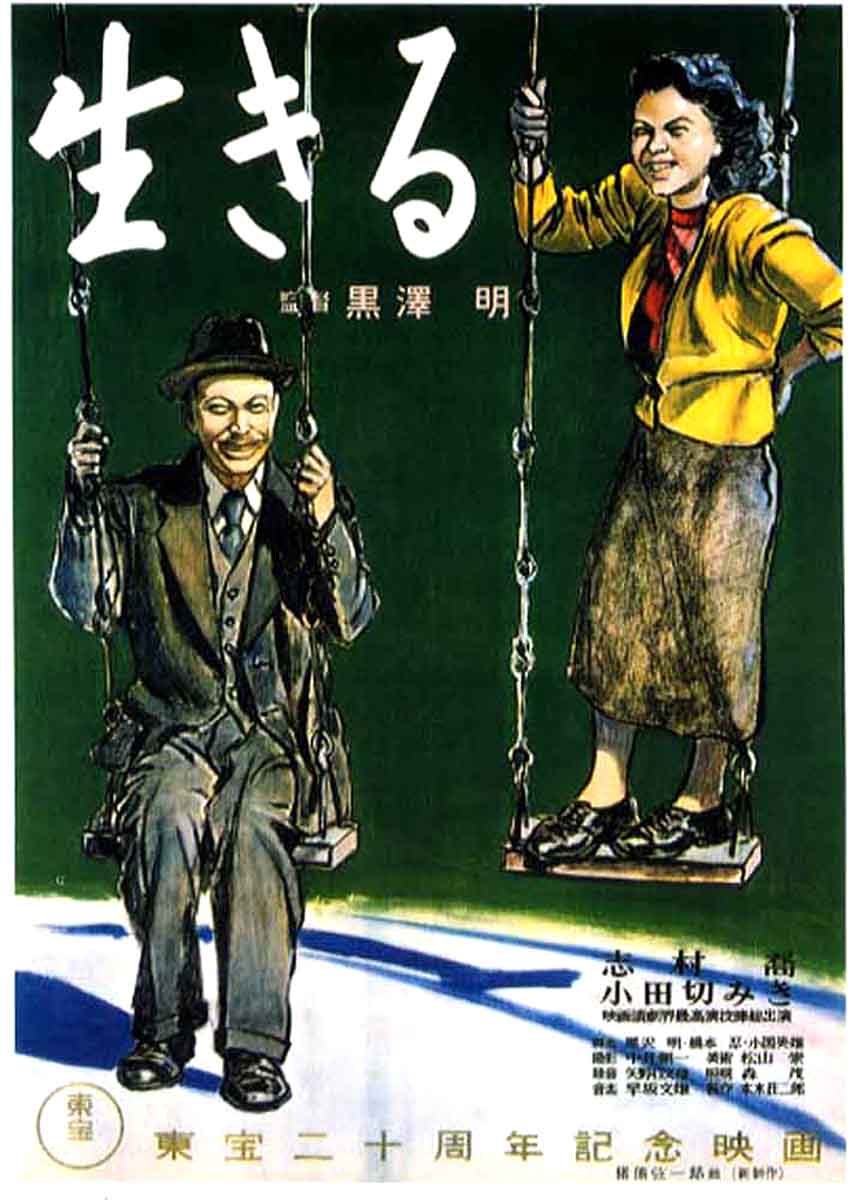
Kanji Watanabe (Takashi Shimura) is a lifelong bureaucrat. He’s been paper pushing all his
life in a boring government job. Life has passed him by; his work has become
his life.
Suddenly he discovers he has stomach cancer. He has at best
six months to live. Unsurprisingly, he’s out of sorts. He starts taking a hard
look at his life and realizing how unfulfilling it’s been. He’s haunted by the
past; after his wife died, he dedicated all his attention towards his son, who has
since become ungrateful.
Watanabe can’t seem to tell his family about his illness. He tries
but they’re so self-interested that they’re more worried about finances than
hearing the man’s opinions. He falls into a depression; he can only muster up
the nerve to tell a total stranger of his illness. They take him along for a
night of drunken debauchery, but it can’t fill the hole inside himself. The
night ends with him drunkenly singing a mournful, bittersweet tune ("Gondola no Uta") in a
haunting bass.
He stops showing up to work, something he’s never done. He
befriends a young former female co-worker Toyo (Miki Odagiri) who has decided to quit due to boredom.
Everyone mistakes his time spent with her as an affair, but he just wants to be
around someone whose young and full of life. However, eventually after spending
so much time together, she starts to get the wrong impression and find him
creepy. He finally admits to her about his illness and she’s baffled by why he
would have wanted anything to do with her.
But she provides him with the inspiration of how to spend
his last few months. He goes ahead with spearheading a parks project that the bureaucratic
nightmare (played for laughs throughout the film) had shutdown.
The film jumps ahead to after the park’s completion and his death.
We see his family, co-workers, and other bureaucrats at his wake. They argue
over how important to the park’s success he was. As the night progresses and
the alcohol consumption increases, it dawns on them just how hard he worked to
get the park made. Each one begins recounting a memory and it starts to flesh
out our sense of how hard he fought for the park and how crucial he was to its
construction. He had never made anyone aware that he knew about the cancer but
they soon realize this as well.
They promise that they’re not going to let the bureaucracy kill
proposals like the park anymore. They’re going to live like Watanabe died! Of course,
they don’t. The words spoken that night are left where they lay. And all that
lives on of the legacy of Watanabe is the park.
The shift in perspective away from Watanabe is important. His
co-workers understand and respect what he did, but they don’t really get it. People don’t change the way they
live unless life forces them to change, and even then that’s not a guarantee.
But that’s how people live their lives; they should be off pushing proposals for
parks through a maligned government bureaucracy, but instead they’re trying to
advance themselves at a job they don’t even care about in the first place.
It also brings across the point of how little we actually
know people. Everyone thought they had figured out Watanabe, but they didn’t. The
bureaucrats want to chalk up the park’s success to coincidence or a convergence of
factors but that’s not the reality. The stranger wants to believe Watanabe is living up the last few
months of his life but he’s really wallowing in regret. Toyo wants to believe that he’s a
weird old man, but he’s just a sad sack on his last leg. His son wants to
believe that Watanabe was a burden who never considered what his son wanted. We rarely
ever know a person and even in death we fall back on assumptions we’ve accrued.
Though Ikiru
provides a nuanced exploration of confronting death, what’s really wonderful
about it is how life-filled it is. It’s not about how people deal with
impending death, but how people live their lives. Throughout the movie we see
people living their lives, many of them in petty or selfish ways. But the
greatness of Ikiru is how director
Akira Kurasawa makes us completely understand the motivations behind the actions
taken by people throughout the film. He never suggests these people are bad,
but demonstrates how people get so caught up living their lives that they both
cease to really live and harm others in the process. In essence, we can see ourselves in so
many of these characters, particularly Watanabe.
The film, however, never falls into excessive sentimentality. It looks head on at these existential questions exploring them seriously, intimately, thoughtfully, and with deeply felt emotion.
Akira Kurasawa’s direction and a number of great performances, particularly from Takashi Shimura, make Ikiru a powerful, poignant treatise
on dying … and living as well.
Grade: A

No comments:
Post a Comment