Saturday, August 9, 2014
Thoughts on "Guardians of the Galaxy"

Friday, August 8, 2014
Thoughts on "Only Lovers Left Alive"
Friday, August 1, 2014
Review: "Date and Switch"
Date and Switch starts
from that place of infantile humor and questionable views of women and sex, but
it quickly throws a wrench into the equation. The film begins with a familiar
premise: best friends Michael (Nicholas Braun) and Matty (Hunter Cope) make a
pact to get laid in time for prom. Problem is that Matty happens to be gay,
something he confesses for the first time. Michael doesn’t take this well, and
the film takes advantage of this situation to call bullshit on some of the more
unfortunate laden homophobic views in adolescent and straight male culture.
In Matty, the film creates the antithesis of the
stereotypical notions of homosexuality. Like Happy Ending’s Max, Matty is a schlubby slacker who outwardly
appears like a guy’s guy. He’s only gay in the one sense that really matters,
his desire to sleep with men. The film uses Matty’s coming out to show how
uncomfortable and difficult this kind of thing is for a young newly out gay person.
Admirable as the film’s underlying messages and themes are,
it still falls prey to typical sex comedy traps, getting caught up in some
truly idiotic jokes and some overly familiar scenarios. Outside of its big
twist, which it plays up to great effect, the film doesn’t have that many new
things to add to the tired stories of male friendship or the quest to lose one’s
virginity (not that we needed much more said about either in the first place).
Braun and Cope are both far too old for the parts they’re
playing, which only serves to make the scenario, already treated with a juvenile
light-heartedness, less convincing (It also doesn’t help that neither is an
especially strong actor). Supporting performers help round things out making
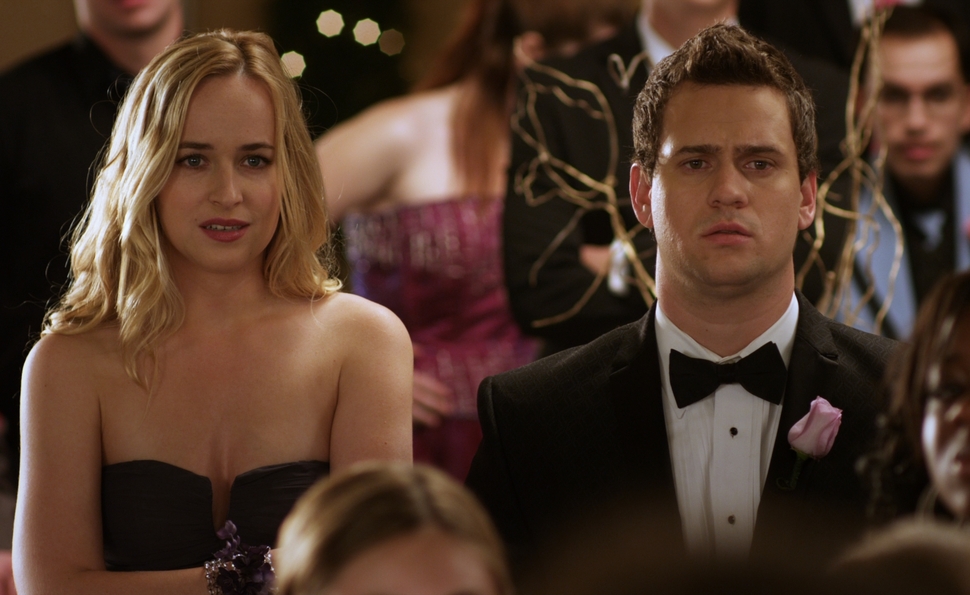
the most of a little, like Nick Offerman as Michael’s father and Dakota Johnson
as Matty’s understanding former
girlfriend (Johnson keeps being great in bit parts that squander her – here’s
thinly hoping that 50 Shades of Grey actually
changes that). But the film, like the pot brownies at the center of its plot (because, of course, that's a major plot point),
feels half-baked.
Grade: C+
Grade: C+
Tuesday, July 29, 2014
Review: "Dawn of the Planet of the Apes"
Dawn of the Planet of
the Apes’ ending is writ into its title. We have several films that already
inform us where the outcome of this is heading. The film is aware of this and
its script, written by Mark Bomback, Rick Jaffa, and Amanda Silver, finds ways
to make that inevitable ending perhaps the film’s greatest strength. The story
tightens the screws continually, crafting a no-win situation where neither the
apes nor the humans can truly win; where neither will be in the right, where
they stand to lose so much more if they do go to war against one another. It is
a good old fashioned tragedy; something the film’s final images, powerful and
deeply moving, reinforce: this shouldn’t have happened, and yet there was no
other way it could have happened.
Dawn is set ten
years after the events of Rise of the
Planet of the Apes. A simian flu accidentally released by a research lab,
who’s experimenting helped breed the super-intelligent apes at the center of
the film, has wiped out the majority of humanity. A small band of survivors who
seem to be immune to the virus have taken refuge in part of San Francisco. It
is a world of post-apocalyptic grit and decay; human works still stand but they
have come into disuse and disrepair. It is a visual template of darkness and
somberness to match the progressively tonally dark and narratively ambiguous
story.
The apes have evolved significantly since the end of the
last film. Their every movement is more human than simian now, and they have
formed a human-like community, a ramshackle but impressive dominating wooden
structure, a cross between fortress and jungle-gym, at the heart of a forest on
the far side of the Golden Gate Bridge. They still speak mostly through signing
but human language has gradually started coming into use. The film shows the
day-to-day operations of the ape community. It lets us inhabit this place and
fills it with details that make it feel lived-in – such as classes to learn the
English alphabet or ideological underpinning like the mantra “Apes don’t kill
other apes”. Director Matt Reeves, along with the special effects team, really
has an eye for the physical presences of apes in the real world environment
(like in shots of whole packs of apes swinging from branch to branch, shot
underneath to accentuate the movement). Unlike the old films, the apes actually
look like real apes. Their movements and body language signals small but
crucial changes to physiognomy, but they still have more of the physical and
genetic structuring of apes than of humans.
The special effects for this film are stunning. This is some
of the most seamlessly rendered CGI effects I have ever seen. Real people wore
motion capture to make the apes have a real presence and to have a nuance of
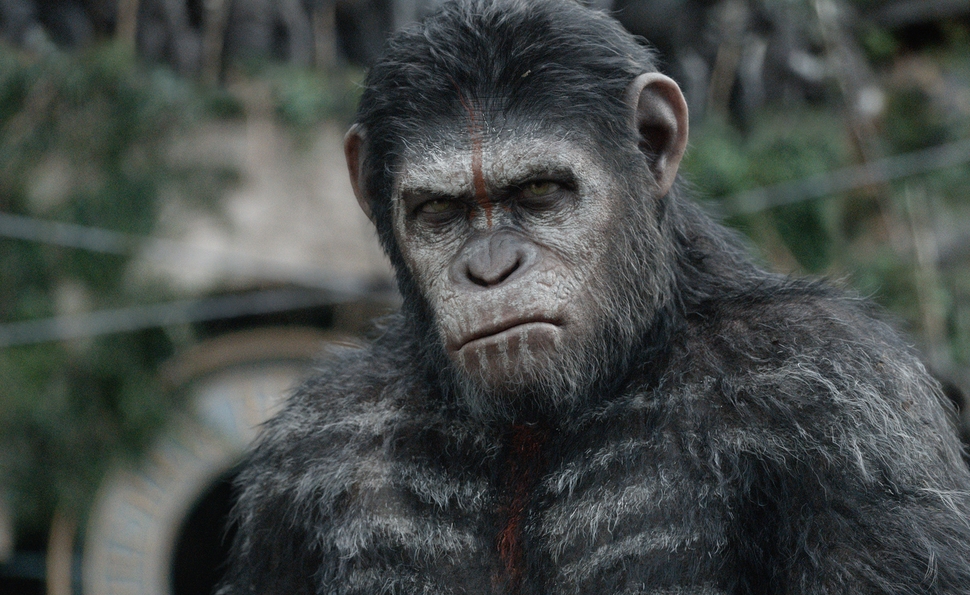
emotion; most notably, Andy Serkis reprises his role of Caesar, the leader of
the apes, and it is one of those remarkable, deeply felt performances that it is
hard to imagine another actor capable of pulling off. With each new performance
using motion capture, Serkis has refined his craft, becoming less showy and
more subtle with his work (His performance of Caesar is filled with small
emotional cues and body language changes that are so understated that you don’t
completely realize the small ways Serkis is thoroughly shaping your response). Serkis
has long been ignored for his work due to playing parts where he effaces
himself through digital effects work. Whether it is Gollum or King Kong,
Serkis’ face isn’t literally present but without him these roles simply don’t
work. Without Serkis it is just CGI imagery that we feel nothing for; with him,
Caesar is a character as fully realized and as fully felt, and every bit as
present as the other actors Serkis works with.
Caesar has become the patriarch of this ape community. He’s
a Godfather-like figure that quietly
demands and commands the respect and loyalty of the other apes. He accepts the
counsel of others – including the temperamental, formerly experimented upon second-in-command
named Koba (Toby Kebbell), who holds a deep unyielding hatred towards humanity
– but, at the end of the day, it is always his to make any given decision for
what the apes do. Caesar is no longer the young ape he was in Rise. He’s grizzled with hints of grey
hair and battles scars, and he is married to Cornelia (Judy Greer) with one son,
Blue Eyes (Nick Thurston) – still in need of battle testing and feeling
overshadowed by his father -- and another on the way. He is a no longer a
freedom fighter but rather a family man with far more to lose, and he fears
losing it every bit as much as the humans.
The script and Reeves’ direction build up this world and
that of the humans, filling out each with internal rules and conflicts and
inhabiting them with various personalities. Neither’s perspective is privileged
and neither side is outright made hero or villain. Instead, Reeves splits time
between the two camps, creating sympathies amongst them, reasons to root for
and like both, as well as reasons to dislike them. The split between point of
views and the motivations behind them leads to a fascinating conflict where the
film gives us the standard blockbuster action and spectacle but roots it in a
morally and emotionally complicated narrative foundation. (That isn’t to say it
isn’t entertaining. A film with an ape riding a horse firing off dual machine
guns couldn’t help but be fun and thrilling. But Reeves choreographs the action
and the events leading up to it in a way that gives it all a certain heft). Reeves
is patient and deliberate, pushing the action into the third act.
What makes the third act so deeply painful to watch when it
arrives are the glimpses Reeves provides of the humans and apes setting aside
their differences to live in harmony. Mistrust exists almost immediately when a
group of humans, looking to use a nearby dam as an alternative power source,
run into some apes and trigger happy, pithecophobic Carver (Kirk Acevedo) panics
and shoots one of the apes. The situation is salvaged when perceptive, kindly
Malcolm (Jason Clarke) recognizes that his party will be safe if they
demonstrate that they intend no harm. Caesar, who was raised by humans and
still bears some feelings towards them, sends the humans off with a warning to
leave.
Members of the ape community, including Koba, are torn over
whether to go straight to war but are assuaged by Caesar’s choice for merely a
display of strength. Reeves doesn’t get heavy handed with the parallels,
abundant and apparent as they may be. For instance, it isn’t at all a
coincidence that the leader of the human camp Dreyfus (Gary Oldman) starts
considering war with the apes soon after the same conversation happens amongst
the apes. At its core, there is a “we’re not so different you and I” message
floating around in Dawn, but it is
one of those rare instances where it really works because the film places it way
in the background. It’s not an entirely subtle message but it is exceptionally subtly handled – placed
as it is in subtext, situations and character arcs. The apes of the Ape movies have long stood in for
minority groups (the older films have long been speculated to be about race and
civil rights), but here they stand in for something else as well beyond those groups
being othered.
Dawn has a strong
thematic center related to the world’s growing energy crisis. After the apes
make clear they will not fight so long as both sides maintain their distance,
it becomes apparent that this is not a tenable situation for the humans. The
humans are running out of fuel and are in need of access to the dam in order to
survive. This, of course, means violating the pre-agreed upon peace
arrangements. Malcom comes up with a plan to bring a small group to parlay with
the apes and come to an understanding. Hanging over this is Dreyfus’ warning
that if the group hasn’t returned in three days’ time, the well-equipped humans
will retaliate against the apes (very much a Chekov’s gun stockpile). From here
arises the question of what any group of people, or nation, is willing to do,
how far they are willing to go, in a world where resources are increasingly
dwindling and finite. Survival is paramount for both sides, but everyone,
whilst looking out for themselves, fails to see other possibilities or
solutions.
Malcolm is an almost impossibly decent person, which should
rub us the wrong way, but the film shows him as not solely good-hearted but also
discerning, seeing there is more to be gained from diminishing suspicion. (In
deed, the true irony of the film is that its most fully formed, most human
character is, well, an ape). It is tiny, subtle, organic writing like this that
saves the film from feeling like it is inhabited by a bunch of non-entities.
The humans at some times are a degree or two off from being underwritten, but
the script has nice small moments where motivations and concerns are quietly
delivered – such as the recognition that family members have died from the
virus. The film is also helped by some really good performances with actors
fleshing out characters by investing so much into small performances.
Caesar and Malcolm slowly initiate a bridge towards trust
but keep running into hiccups – with dissent and lack of trust from both of their
sides causing breakdowns in their grasp for detente. Each of these stumbles
feels like they could lead to something disastrous, but they prove themselves
to be, instead, slippery steps towards an even more terrible, emotionally
wrenching conclusion. The inevitable – the apes will ultimately come to
dominate this planet; it’s just a matter of how – hangs over everything like a
foreboding, terrifying cloud. Every redeemable, good act that moves forward
diplomatic relationships is made all the more devastatingly bittersweet by how
it only truly staves off what is always going to happen. (The film understands
the power and meaning of small acts and gestures, ending on one such moment of
shared human-ape connection/dissolution that is beautiful and deeply despairing
in how it sums up everything the film has been trying to say throughout). In
the end, Dawn isn’t science fiction.
It’s a tragedy. By showing those steps, it makes the unraveling all the more
moving and harrowing. Reeves understands the power of a slow moving cataclysm; its power isn’t in knowing where
you’re going but watching in terrified awe as you get there.
Grade: A-
Thursday, July 24, 2014
Review: "Alan Partridge: Alpha Papa"
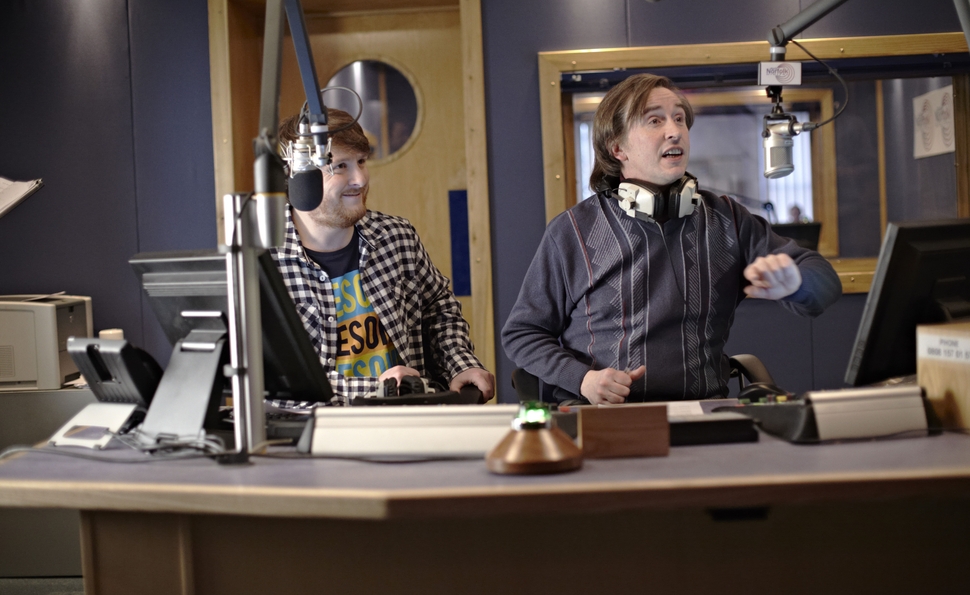
We find Partridge as a disc jockey at a small-time radio
station in Norwich, a place slowly becoming more corporate and cold to compete
in the crowded marketplace. This especially infuriates his longtime colleague
Pat Farrell (Colm Meaney), whose program feels fuddy duddy amongst the digitizing
and automating sea changes. When the station is bought out, Pat seems like the obvious
candidate for the cutting block; something that is exacerbated when Partridge
blunders his effort to defend Pat in front of the company board, arising out of
the realization that the company is picking between Pat and himself for the axing.
Pat snaps and, with shotgun at hand, he holds the station and many of its
workers hostage.
Partridge unwittingly becomes the mediator between Pat and
the police, as Pat believes that Partridge is the only one who gave a damn
about him before his firing. But Partridge’s narcissism and short-sidedness
only protract the situation and turn it into a media spectacle. The film
becomes a black comical take on the more dramatically rigorous work of a film
like Dog Day Afternoon with Partridge
playing up the media craze in hopes of securing his employment and spinning it
into a lucrative job deal.
Director Declan Lowney doesn’t add much to the way the film
is shot. Lowney’s background is largely in television and the film has a lot of
the functional filmmaking common in television shooting. Instead, the film’s
script (credited to Neil Gibbons, Rob Gibbons, Steve Coogan, Armando Iannucci,
and Peter Baynham) brings much of the film’s strength, playing to the chaos and
stress of the hostage crisis as well as Partridge’s egotism. This is usually
done by matching up the incongruity of the situation’s seriousness and how
lightheartedly the film and the character’s tend to treat it. For instance,
Partridge and Pat host a hit radio show from within the “siege” by drawing on
viewers interested in the crisis. But perhaps, at the end of the day, it is best
that someone like Lowney helmed the film as it is essentially an extended
episode of television, with barely enough plot to sustain itself for ninety
minutes.
The film has some casual commentary on the changing state of
media, especially for an aging medium like radio. But this is way in the
background. More foregrounded but still low on the film’s mind are questions
related to aging. Both Partridge and Pat are well into their fifties and
looking back on a life that hasn’t gone entirely satisfactorily or as planned.
Pat and his dark plans force Partridge to confront some of his delusions and selfish
ways. Partridge is a massive dick at almost all times, but there’s something
fundamentally sad about him. Like The Office’s
Michael Scott, or, more appropriately, David Brent, he desperately wants to be
liked but doesn’t quite realize he’s going about it in deeply misguided ways. At
the end of the day, Partridge is going to do the right thing but it’s only
after massive effort and radical outside circumstances force him to that point.
In the intervening time before the buried conscience of
Partridge arrives, Coogan delights in his role, one he has fine-tuned and honed
over the years. Coogan simply knows how to play this character to the hilt. The
film is farcical because Partridge is such an exaggerated figure. Initially the
character was created as commentary on a particular type of media personality,
and that satirical, self-consciously preposterous quality carries over into the
film. Alan Partridge is a darn funny
film that still manages to have a soft, mushy center focused on its characters
and their endearing shortcomings.
Grade: B
Grade: B
Monday, July 21, 2014
Review: "In Fear"
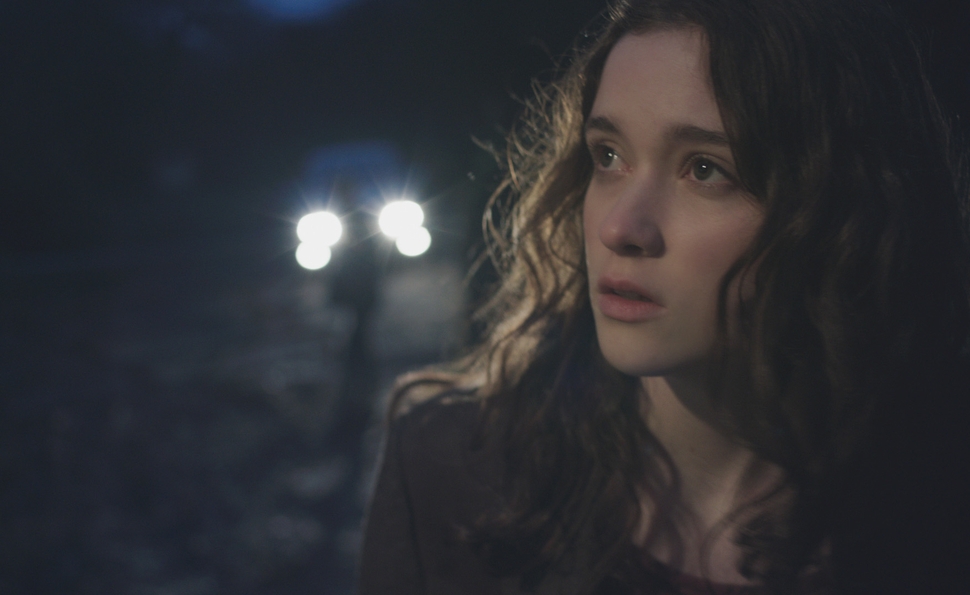
Englert previously proved her mettle in the underrated Ginger & Rosa, another film, like In Fear, that kind of falls apart at the
end but holds so much auspicious possibility prior to that. Director Jeremy
Lovering provides a wonderful sense of maddeningly being lost and the world
seeming to close in on you. The film nicely ekes out anxiety by making every
last inch of its setting feel menacing and then cutting to Englert’s controlled
but worried face.
But though it boasts the necessary fundamentals to create a
successful horror movie, In Fear is more than a
little underwhelming. The film too often feels like it was being written as the
production went along, and that's because it actually was, with the actors being left in the dark and forced to improvise with very little sense of direction as to where the story was going from Lovering. There is barely enough plot to sustain this and the actors desperately grasp to make something marginally substantial out of the thinness of the conceit at hand. That being: Tom (De
Caestecker) invites Lucy (Englert) to a music festival and on the way there tells
her he has made reservations at a tucked away hotel, all the better to
jumpstart their two week old relationship. Lucy reluctantly agrees, and soon
they find themselves in a maze of backwood roads that never seem to end and
fold in on themselves.
There seems to be a casual joke about the sexes here. Tom
refuses to look at the map or stop and ask for directions. As he tries to
assert his manhood and prove himself a worthy boyfriend, he sinks the two
deeper into trouble.
The film gets a lot out of a little, pulling big scares out
of small but freaky things happening, like the appearance and disappearance of
items in the middle of the road. But at a certain point, it becomes clear Lovering
(who is also credited with scripting the little of the film that was apparently penned) has no idea where he is taking this story or how to end it.
In the end, it’s more frustrating than frightening.
Grade: C+
Sunday, July 20, 2014
Review: "They Came Together"
It’s an easier target than Wet Hot. However, Wain and Showalter largely avoid going for the
easy or obvious joke. The film is broad enough that this could be any romantic
comedy its poking fun at but filled with all sorts of tiny digressions that go
after very exact works. That said, even when you can’t quite put your finger on
what the film is making funny of, it still remains really funny. Wain and
Showalter, as well as the many great comic talents they bring on board, have a
background in sketch comedy, and it can be felt in the film’s go for broke
quality. Don’t like one joke? Well there are a dozen more on their way to try
to floor you. And the jokes run the gambit, from sly visual jokes to surreal,
absurd blackout gags.
They Came Together,
starting with its unassumingly bland title, gets the fluffy genericness of
rom-coms right, and it writes that into film’s every detail. Take the way
everything is shot: the dull, pleasingly blindingly bright lighting and the
carelessly under thought, boring directorial scheme of switching between one
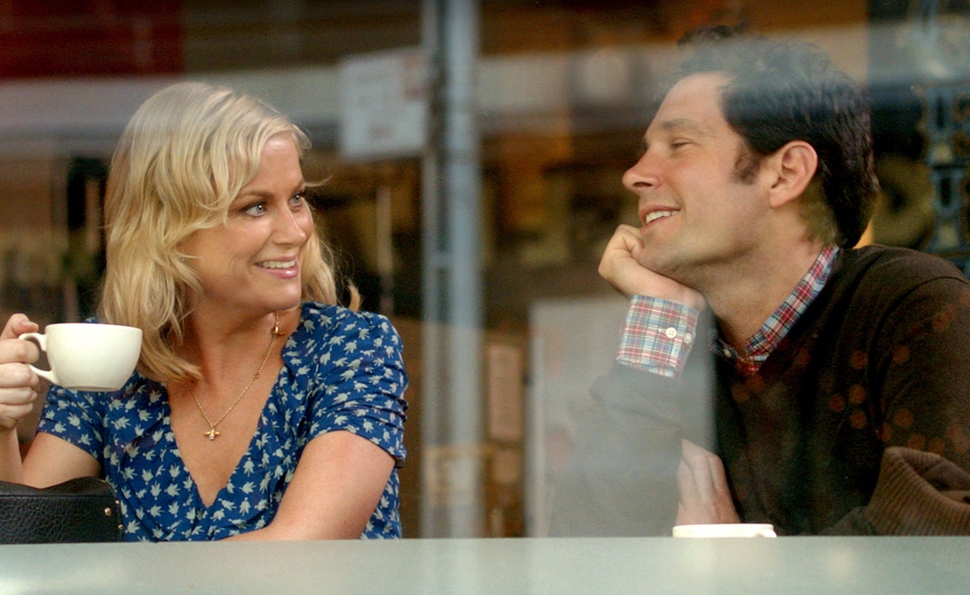
shots and two shots. Even the two main characters’ names Joel (Paul Rudd) and
Molly (Amy Phoeler) remark upon the under-baked nature of the scripts for the
genre – the characters never even receive last names. The couple’s story
involve staples of the genre: Joel’s corporate company has designs to put out
of business Molly’s candy store (a fantastic commentary on the inane, unlikely
professions that often seem to only inhabit rom-coms). From there their close
friends hope to set them up but they end up hating one another, but, of course,
only to fall for each other. Only then for exceedingly pointless complications
to set in, after which they get together. On the margins of the story, a
revolving door of supporting players, including friends, siblings, and parents,
arrive for one or two scenes to dissect all sorts of tropes from the
genre.
In the broad strokes, it’s every rom-com you’ve ever seen,
and the film plays almost everything straight. If you passed this on
television, you might be fooled for a while. But the devil is in the details,
and They Came Together is constantly,
slyly wild and flying off the handle. I’m not an avid watcher of the genre –
among cinephile circles the genre has become one of the most poorly regarded
and maligned – but I still found myself laughing hysterically. Much of this
stems from the film working on another level. Much like Wain and Showalter’s
previous effort, the humor comes from a general sense of out of left field
silliness.
But what really elevates the whole effort is how little
disdain is shown. The film has affection for the works it’s mocking. It notes
the idiocy and laugh at it, but it also kind of loves that idiocy. It’s easy to
look down on something as too many spoofs do these days; it is another to make
fun of something from a real place of good will and endearment.
Grade: B
Grade: B
Subscribe to:
Posts (Atom)