Cruise stars as Major William Cage, a former member of the
military who now uses his advertising skills to market the war being waged in
the near future against an invading alien race, referred to as Mimics. The war,
going on five years now, is going badly for humanity, and the human race
intends to mount one last counter-offensive with everything they have. Cage is
told by the leader of the military forces, General Brigham (Brendan Gleeson)
that he will be embedded to cover the war effort from the front lines, and Cage, who has
no intention of being near the action, strongly refuses and angers the stubborn
general. When Cage wakes up, he learns that the general has sent him to combat,
stripped him of his ranks and sent out a formal order stating he’s a deserter.
Cage is flown into combat for the Western European insurgent
operation. The event is like D-Day re-imagined as if set in the future, bigger,
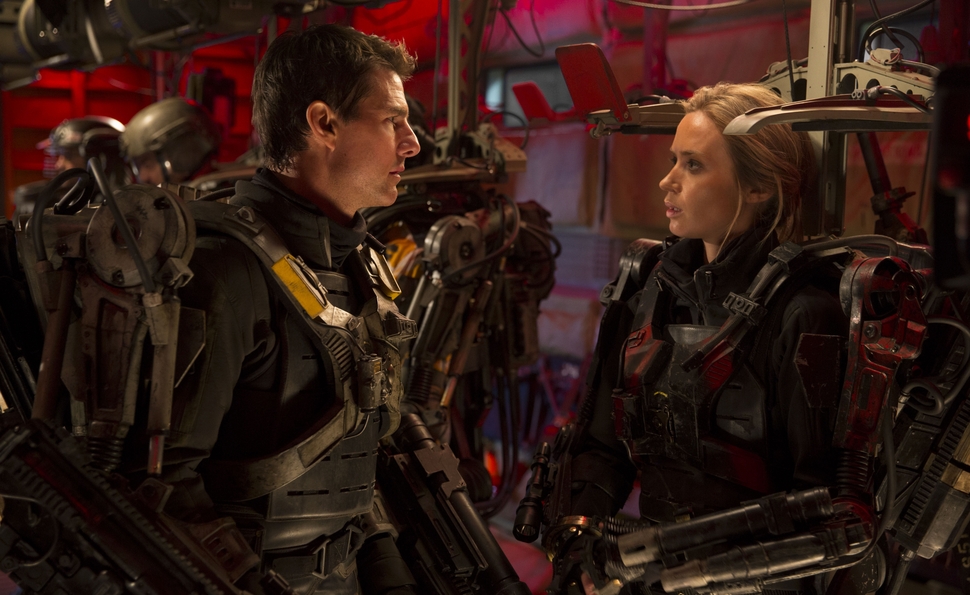
more bombastic, more explosive and sleeker. Soldiers are in combative, robotic exoskeleton
suits that make them look like super-soldiers or beefed up members of Starship Troopers. The aliens are
squid-like, wriggling tentacles and the wisping mobility of phantoms; there are
shades here of the Predator and the alien from the Alien films and the sentinels from The Matrix, but they stand on their own as something familiar but
not bland.
It turns out the aliens were waiting for the attack and it
turns into a massacre. The aliens serve as mostly a plot device, a MacGuffin
even. The film’s real interest lies in killing off Cage early … and then
bringing him back to life at the beginning of his day, aware of the events to
come. The film’s central conceit, which it uses cleverly and buoyantly, involves
having Cage re-live the day over and over Groundhog
Day style, attempting to save humanity from their doomed fate. In this
mission Cage is helped by Sergeant Rita Vrataski (Emily Blunt), who had
previously experienced the time jumping and attributes it to coming into
contact with the blood of a special set of Mimics.
The film plays out almost episodically. Cage learns of his
circumstances and tries to convince anyone around him to listen (and mostly
just fails). He’s unprepared for combat and is taught how to fight by Rita.
Cage and Rita map out a way to get to the Omega, the central consciousness of
the Mimics and the force responsible for the time reset. Doug Liman’s direction
and Christopher McQuarrie, Jez Butterworth, and John-Henry Butterworth’s script
are playful and emphasize the progression of Cage’s exacerbation and growth of
knowledge in each of the contained scenarios. The film is at its most enjoyable
when it considers in detail the consequences and possibilities of its neat
central idea. Cage dies and the film often cuts immediately back to that same
moment as Cage fixes his mistakes. Cruise has a lot of fun playing someone who
has gradually accrued a wealth of knowledge of the situation he’s in and is slightly
amused and tired of the tedium of it all. The film also gets a great deal of mileage out of
the audience’s lack of certainty as to just how many times Cage has been
through any given part of the day; sometimes it’s more than he leads on, and it
adds to the thrill and uncertainty of where the film is headed.
Liman shoots the film for maximum action, and the fight
sequences have an immersive, you-are-there quality. While Liman’s background includes
The Bourne Identity, the film adopts Bourne’s brisk, energetic pace and
action setpieces, but doesn’t have its choppy, quick-cut editing or shaky
steadicam shooting. It’s more carefully framed and uses wider angles more consistently.
James Herbert and Laura Jennings’ editing must be given praise; the film’s
editing adds to its fleetness. It’s tight, controlled and fluid – so seamless
and integral to the action, like the best editing, you forget it’s being done.
The film flows so smoothly and assuredly. It knows where it wants to head and
it knows how long to hold a particular plot point before shifting to a new one.
There is a video-game-y quality to the film. Not in the Paul W. S.
Anderson and Resident Evil way, but
in way that speaks to real time strategy and role playing games. The design of
the Mimics and the military equipment could resemble anything from Warhammer to Mass Effect. The mechanisms for the film’s plot are isolated
puzzles that need careful problem solving. The film’s immersion stems from placing
you in the moment of the film’s reality and taking you along for its propulsive
ride. We don’t question the logic of it because it becomes so compelling and
vital; once it has created a logic unto itself, Edge of Tomorrow becomes addictive, and just plain infectiously
hard to resist.
Edge of Tomorrow could
probably stand to have some greater meaning or purpose. It lacks the
idea-driven nature of, say, Inception,
and it doesn’t have the stealthy profundity of its clearest parallel Groundhog Day. The film lives and dies
by how inventively and adeptly it makes use of its premise. Thankfully it
mostly lives. And then dies. Then proceeds to live and live some more.
Grade: A-