
Thursday, May 15, 2014
My Film Review of "The Amazing Spider-Man 2"

Sunday, May 11, 2014
Game of Thrones: "The Laws of Gods and Men"

** Spoilers Below: **
Following the death of Joffrey, Vulture published an article entitled "So Who on Game of Thrones Am I Supposed to Hate?" Yes, it was intended somewhat jokingly, but it also pointed to an interesting piece of audience identification and reception that had us so heavily despising that character.
Following the death of Joffrey, Vulture published an article entitled "So Who on Game of Thrones Am I Supposed to Hate?" Yes, it was intended somewhat jokingly, but it also pointed to an interesting piece of audience identification and reception that had us so heavily despising that character.
Game of Thrones,
in part due to the unique storytelling structure of the books, likes playing
around with perspective and who we identify with. The really interesting thing
though is how there is essentially no major character who the series chooses to
have us not sympathize or identify
with. It’s a tact taking place on The
Americans as well where the shifting point of view has us rooting for the
Soviets one moment and the Americans the next, and ultimately no one is really
the villain so much as the system.
The interesting thing is that this leads to a constant moral
fluidity that makes us have few bearings to ground us. The show crafted a moral
center in Ned before decapitating it and then suggested a new one in Robb
before pulling out the rug once again. Now, who the fuck do we place our chips with when the cards are down?
One of the major driving narrative questions of the show, one
that has become increasingly obsolete as the show has progressed, is who will
end up on the throne when all is said and done. The show keeps defaulting to
this sense that there’s always someone vying for the throne, but it also is simultaneously
flippant about it. It matters but it’s really just a convenient engine to churn
out conflict after conflict. There will always be someone who hopes to steal
the throne away. It’s precisely this reason that Tywin is constantly scrambling
to settle one problem after another (But more on that later).
The first two-thirds of “The Laws of Gods and Men” concerns
itself with the major figures who could throw a kink in Lannister hegemony. We
start with Stannis and Davos asking the Iron Bank in Braavos for money to fuel their war
efforts. Stannis is the big current threat. He has a pretty good claim to the
throne and with Lannister control faltering enemies are just waiting to come out
of the woodwork to throw out there support behind someone else.
Stannis gets put through the motions by the board of directors
(played here by Mark Gatiss, best known for his work on Doctor Who), and we see Stannis, no matter how powerful he may believe
himself to be, forced to bow before power that exists in more than just name
alone. It’s a funny moment when Stannis sits down frustrated and impatient. “Power
is where you stand,” Davos insightfully notes; he makes a passionate case for a
Stannis victory being more than simply a pipe dream. Who has the power: the man
who would be king, the man who bankrolls him, the sell-sword, such as Salladhor
Saan, who fights the battle, or perhaps a man like Davos who can coordinate all
of them?
Dany is also finding herself powerless as she searches for greater
control, but in her case it’s by her own choice. Dany’s slave uprising was
exciting but it was also just a little too full of itself. A few episodes ago
Tywin noted there was a difference between gaining power and ruling, and Dany
is learning that the hard way. She is incapable of controlling her dragons and
she discovers that the symbolic act of crucifying Mereen’s slave-owners was not
the simple black and white act she assumed it to be. The Masters, as these officials are called
in Mereen, were not a monolithic evil but were a complex group with their
pluses and minuses.
Yara also makes a bid for Iron Island power by trying to
save her brother Theon. But she learns that Theon is too forgone to be saved. Theon
is no more; in his place is the weak and servile Reek who obeys the commands of
no one but Ramsay Snow. Theon, to me, is one of the most interesting cases of
shifting audience reception and identification. Theon has always been pitiable, but
his actions against the Starks, his adoptive family, turned him into a slightly
despicable character. Theon’s torture seems intended as a plot device to
recalibrate our empathy towards the character. It begins as a punishment for
his actions but goes past the point where it feels like justice is being served
and plays against our desire to see retribution (Perhaps you disagree, I’ve
already heard countering arguments and I’d love to hear more).
The Boltons also represent a threat to the crown; as their
ambitions continue to grow, how can we be certain their desires will be satiated?
Anyone who you make an ally could very easily turn into your biggest threat
eventually. The Tyrells and Martells are precariously perched in such a
position for the Lannisters, and the Starks are already preexisting proof of
this.
Interestingly enough we don’t get any scenes with
Littlefinger who seems to be a another strong example of this. But we do get
his doppleganger better half Varys. In a great scene, Varys makes clear his
intentions to Oberyn that his ultimate desires lie with the thrown. Bryan
Cogman’s script wisely leaves the implications of the gesture ambiguous but it’s
just enough of a hint to remind us that Varys is a bigger power play than he is often
given credit. Director Alik Sakharov creates one of the best shots of the
episode, placing the throne suggestively in the background between Varys and
Oberyn. The throne is what stands in between not just these two but really
everyone.
The buildup of the episode leads to the long sequence of
Tyrion’s trial. Yet again the show benefits enormously from letting this final
sequence have a little extra screentime, and it uses it to draw out both how
much of a kangaroo court this is and how thoroughly, tragically Tyrion is being
dragged through the mud. The episode ends with this storyline because its set
at King’s Landing. While the rest of the episode details how contenders for the
throne are faring, this sequence reminds us once more that Lannister power is
really waning.
Consider for a moment that Tywin essentially manipulates this
whole situation to his own benefit. He allows the trial to be an awful,
transparent sham because it will force out Tyrion as his heir. In turn, this
will necessitate Jaimie stepping down from the Kingsguard, where he’s
technically supposed to be celibate, so that he can become Tywin’s heir, the
one he thinks he deserves. It’s some fuck-up politicking, ruthless and cold. But it
also has the faintest whiff of desperation.
Indeed, every person who comes to testify against Tyrion has
clearly been paid off or holds a grudge against him. The judges are rigged as
well. Mace Tyrell is a non-entity, and Oberyn is the only one who appears to have
the remotest (and it feels very remote at that) interest in some worthwhile inquiry.
And then there’s the real kicker: Shae is brought in as a
witness against Tyrion. Why? Perhaps due to resentment towards Tyrion for how he treated her,
sending her away. Perhaps she was threatened with death, or, worse, paid off.
The why and how of it matter far less here than the effect it produces. It’s a
devastating moment. In the show, Tyrion and Shae, in their own weird way, were
one of the healthiest, strongest couples, and to have her betray him like this
pushes Tyrion over the edge.
Jaimie had maneuvered (or, at least, he believes he did,
when really Tywin had intended this all along) to have Tyrion sent to the Wall
rather than be sent to death. But Tyrion is tired of what’s really on trial
here, the fact that he’s a dwarf. He righteously lashes out, a powerful moment for
how it cuts through all of the false modesty and bullshit of the courtly politics.
Tyrion calls for trial by combat. Let the gods decide he
says; their laws have to be better than the ones men have made. Inside King’s
Landing those laws created this ludicrous charade and outside they allow for the
people of the kingdoms to starve and suffer while war wages, for sadistic
people like Ramsay to ruin them and naïve ones like Dany to add to their ache
further.
In a place where being responsible for saving the lives of thousands
is still met with the enthusiastic desire for summary execution, how can we want any
of these people to gain power? Game of
Thrones tempts us time and again with people who could be a good rulers, putting them into a position to wield power
before taking it away from them or undermining it. But, again, don’t get mad at the people; the medieval
world of Westeros has created a socio-political system that is designed so that
no one who probably should have power ever gets it. That’s why the shifting perspective
matters. It not only muddies up the morality, but it turns everyone into a victim,
even often when they’re being the victimizer.
Stray Thoughts:
-Apparently, Tywin is 67 years old, which is also as it
turns out Charles Dance’s age in real life. He’s in pretty good shape
despite what Davos says about his virility.
-Yara’s soldiers marching on the Dreadfort is intercut with
shots of Ramsay getting it on. The intended meaning, I think, relates to Theon’s
manhood being sent as gift to Yara. You do the rest of the math as far as
intent there.
-“My brother is dead.” Gemma Whelan is excellent in that
moment, and it makes me wish we got to spend more time with Yara. A really
interesting, underutilized character.
-Mace Tyrell as a total idiot is an easy joke but the show
hasn’t leaned on it all that much so I still find it very entertaining.
Watching him bumble in his efforts to please Tywin at the small council meeting
was delightful.
-Pycelle is also another reliably amusing character, and he
hasn’t been called upon for a while now. He seemed like he would be a much bigger
deal back in season one but little has come of it.
-I really liked the moment where the small council
acknowledges and discusses the growing threat of Dany. It makes these characters
seem less oblivious and dumb (as they would need to avoid being to maintain control of
the crown), and it also makes the world of the show feel lived-in.
-Another important point regarding perspective: everything
recounted about Tyrion actually happened but is placed completely out of context.
Perspective is crucial on this show.
Grade: A-
Friday, May 9, 2014
"The Sheriff of Fractured Jaw" (1958)

Mansfield’s roles all essentially involved her playing what
amounts to a cartoon character. But that’s entirely part of what makes them
entertaining. In The Sheriff of Fractured Jaw, Mansfield is a feisty, savvy
saloon owner who represents the warm-hearted vulgarity of the United States at
its most raw and wonderful.
Mansfield’s blunt Americanism is set against Kenneth Moore’s
prim-and-proper English gentleman Jonathan Tibbs, and the film’s pleasures
derive from putting Tibbs deep into one fish-out-of-water situation after
another.
Jonathan is a stuck-in-the-clouds employee of his family’s
firm, which sells professional firearms. When business subsides on the opposite
side of the Atlantic, Jonathan begins looking across the ocean to make a bold
business venture. The Wild American West is full of lawless gun fighting and
thus, Jonathan believes, is a perfect market to get in on.
When he arrives stateside, Jonathan is beyond being out of
his depth, but he is so good-natured and sincere that he constantly unwittingly
solves problems with a Mr. Magoo-like zen-beauty. Indians attack his caravan
and he simply steps out to negotiate peace with them, and succeeds – on
accident and without any awareness it was on accident. Jonathan is thoroughly
optimistic and chipper and every American is so bone-deep cynical that his
hopefulness can’t help but win out by the laws of Hollywood film logic. His earnest
bumbling indvertedly leads to him being made the sheriff of the town, a fact
completely, ironically at odds with how little Jonathan knows about using the
guns he is out to sell.
The Sheriff of Fractured Jaw is a slight, slightly
under-baked film. Howard Dimsdale's script often time doesn’t seem to have enough material to
warrant a feature film length. Anytime the plot moves forward the film creaks
under the minor herculean effort it takes to be anything more than a highly
charming trifle. The film also falls into groaning, groan-inducing territory
when it turns Native Americans into some of the supporting live-action cartoon
characters on its roster (though they’re admirable ones; so there’s that!).
It’s a weird representational issue where it’s not exactly offensive (it’s even
oddly progressive in its way), but it reads really weird (It’s trying to be
smarter than it actually is, but it just comes off politically incorrect).
The film looks to skewer Western film conventions in an
almost similar, but far, far tamer and less successful, manner to Blazing
Saddles. When it finds time for the elasticity of a cartoon world there are some
laughs to be found. Like a Saturday morning animated feature, there is a nice,
silly, inviting space created by The Sheriff of Fractured Jaw that is warm and
friendly if a little fleeting and forgettable.
Grade: B-
Grade: B-
Thursday, May 8, 2014
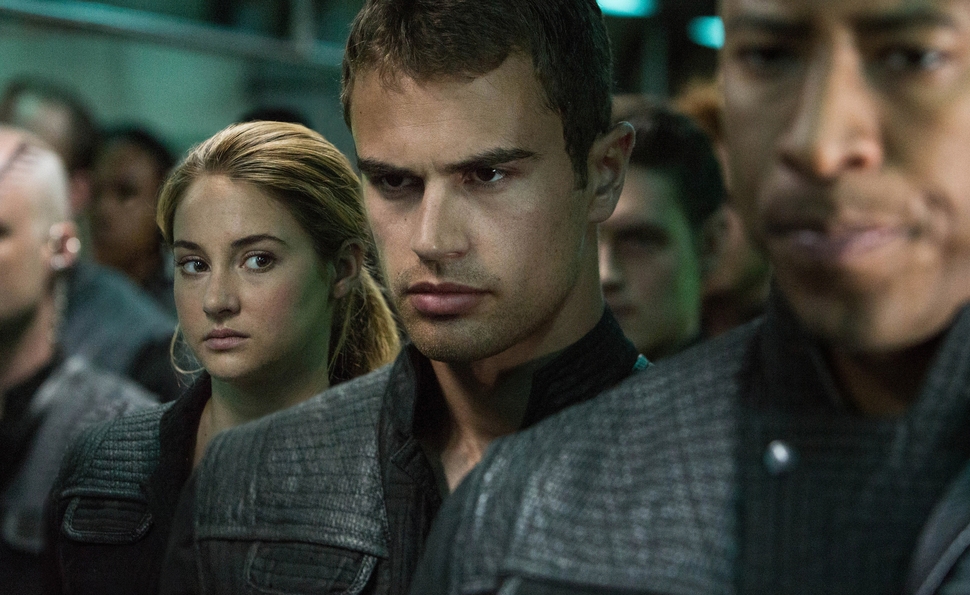
My Film Review of "Divergent"
Sunday, May 4, 2014
Game of Thrones: "First of His Name"

“Everywhere in the world they hurt little girls.” - Cersei
“First of His Name” begins on the crowning ceremony of Tommen
Baratheon, the titular first of his name getting officially made king. But the episode
quickly shifts focus; the opening scene isn’t about a new male taking power,
but rather it’s about the woman behind the man, the true source of power here,
Margaery.
It’s a moment that emphasizes what “First of His Name” will really
be about: the place of women in society. And the episode keeps reiterating
through different variations what life is like for women in Westeros (and Essos
as well) and the continual answer is that it’s pretty terrible.
The theme of the episode is admittedly a little more nuanced then that
though. Director Michelle
MacLaren keeps pushing the camera out, showing
characters as specks on the horizon. It places them as small and helpless, and
a little daunted. But MacLaren does something else; she keeps framing people
in doorways and arches, suggesting they’re trapped and boxed in. It’s an image
that’s highly fitting for the women of this world. No matter how great they are
as part of the system, at playing it to their advantage, they’re still limited
by their gender.
The central throughline of the episode is the two characters
and stories we keep coming back to, Cersei and Sansa's. These characters are very
different individuals and they’re in rather different circumstances, but both
find themselves hitting a wall.
After claiming power for so long, Cersei is forced to
concede power and authority to other people in hopes that she can gain leverage
later. We see Cersei go to Margaery and for once act if not kindly, at least
diplomatically. Cersei realizes that with the precarious position the
Lannisters are in that she needs to sacrifice what she wants a little bit to create
some stability. So she offers Margaery the marriage to Tommen and the position
of queen. Cersei also gives into the demands of her father to marry Loras,
after long refusing to. Both acts secure the power of her family but at the
cost of her own power.
Sansa has even less options than Cersei. Sansa arrives at
the Eyrie with Littlefinger pretending to be his niece. In short order her aunt
Lysa has married Littlefinger, who is so clearly manipulating her for his own
gain and none of the happiness she assumes. Lysa has lost a few marbles. Not
only does she admit to poisoning her former husband John Arynn at Littlefinger’s
request, but she also jealously accuses Sansa of sleeping with Littlefinger.
Lysa has been worked over by a man taking advantage of his male privilege.
Outside of these storylines the episode stops in briefly on
a number of other female characters. What we end up seeing is a spectrum of
women, powerful and powerless.
Dany takes power in Mereen but discovers there’s
consequences to upsetting the power structure in Slaver’s Bay. Against the advice
of her male counselors to head to Westeros and take the throne, she, instead,
decides to stay in Mereen and prove she’s capable as a ruler.
Brienne takes having Poderick as her squire as an insult, a
gesture suggesting she’s incapable of handling being a knight. Poderick slowly
grows on her as he tells her of the time he saved Tyrion’s life at the Battle of
Blackwater. Brienne is hesitant to accept Poderick because she has experienced too many men judging her for her choice to be a warrior and this will hang over Brienne always; she’s a woman doing something
people believe is suitable only for a man.
Ditto Arya, who the Hound catches practicing her "water
dancing", something not very lady-like masquerading as something that is. When the Hound knocks down Arya it stands in for him beating down all
the aspirations of females in this world.
And that’s why so much of what happens in that last sequence
of the episode greatly matters.
First we get a dark, painful scene where the mutineers threaten
to rape Meera. It’s the situation of women of this world in a nutshell. All
women are seen as good for is satisfying the desires and whims of men. They’ve
deprived Meera of agency and a right to herself and her body. Jojen, Hodor and
Bran look on aghast not just because terrible things are about to happen to
their friend but because they also are unable to assert their masculine
dominance. Being tied captive has deprived them of what they believe is their
male duty, that chivalric calling, to defend the lady, when in fact we know if
Meera weren’t tied up she would be plenty capable of defending herself.
That’s why we ultimately get a female beating the Big Bad
and not Jon Snow. It’s a moment of female agency being asserted in an episode
structured so that we get countless moments of females being denied agency until
this instance. After being abused and mistreated for so long by Craster and
other men, Craster’s wives (note the language I even have to use to describe
them) stand up for themselves. Given the opportunity to go with Jon and the
other Watch members they decline. “Burn it down,” one of them says in regards
to Craster’s Keep (What’s the expression: a man’s home is his castle). They’ve
burnt down the symbol of patriarchy they’ve been trapped in for so long. And
damn it feels righteous.
Stray Thoughts:
-A moment of dark comic beauty: Sansa lying in her bed hearing her aunt scream loudly while having sex.
-Another very funny moment: the Hound complaining about Arya reciting her death list before bedtime. Followed by her adding him as the last name to the list.
-Sansa doesn't ever catch a break; she's being forced to wed her dweeby younger nephew Robin.
-Tywin again provides us with more murmurs of the power of the Iron Bank which the kingdom is apparently in serious debt to. Take note of this for later I suppose. Also, the Lannister's stopped mining gold about three years ago. All their talks of always paying their debts is apparently for show.
-In a weird moment of sort-of-kindess, Tywin admits he sympathizes with Cersei's lack of feelings for Loras ... but he still will see her marry him.
-We also get that kind of clarity from Cersei who confesses that Joffrey was a monster to Margaery.
-There's a bumbly, adorable charm to Poderick. He may not be Jaimie but give him a chance Brienne!
Grade: A
Saturday, May 3, 2014
"Saturday Night Fever" (1977)

Watching Saturday Night Fever I was reminded of how much Italian
American youth culture has changed (some would say declined) and yet how much
of it remains the same. Specifically I was regarding it in terms of something
that likely, and thankfully, doesn’t spring immediately to mind: The Jersey
Shore.
On the face Saturday Night Fever is more evenhanded and the
cultural niche it represents isn’t nearly as much a sad caricature. The film
also gives a greater sense of classiness. There isn’t grinding here; this is
disco and it is a dance form and mating ritual that requires skill and
knowledge. The courtship patterns revolve around your ability to prove your
dancing capability.
But this is still of the same working class milieu as that
oft denigrated series, and there’s an almost anthropological quality to the
film. The film is a wonderful slice of Italian American culture: The heavy
Catholic conservatism, the devotion to traditional gender roles, the working
class sense of pride and machismo.
Casual racism and sexism are tacitly accepted. Latin
Americans are frequently disparaged and racial slurs are muttered under the
breath constantly (The great irony of Italians being assimilated into American
culture is their adoption of the behavior once aimed towards them). Tony and his friends
are good old boys out skirt chasing. “What did you say your name was?” one guy
asks after a hook-up, and it establishes this group’s feelings towards the
opposite sex. Tony and his friends are dismissive of women if they’re not fulfilling
their desires or acting as trophies.
Tony (John Travolta) is the protagonist here and what sets
him apart is a constant awareness of how lousy this life he is living is. He is
not content like his friends; he recognizes how confining being stuck in
Brooklyn is, and he desperately wishes to escape to Manhattan. He has a job at a
paint store where he has security and he is well-liked even when he is a bit
flakey. Tony’s only escape from reality is dancing and it matters more to him
than anything else. “You make it with one of these chicks and they think you’ve
got to dance with them,” he says.
Tony’s awareness of how trapped he is doesn’t make his
behavior forgivable but a through-line of the plot, and what enriches it, is
how Tony comes to realize how wrong-headed his beliefs are, especially towards
women. Tony and his boys see women as objects, but when Tony falls for Stephanie (Karen Gorney), a woman
who isn’t immediately head-over-heels for him, he has to change his tact, and
when his smooth operating fails in a pathetic act of desperation he
half-heartedly tries to rape her (a plot-line that the film sadly doesn't resolve as fully as it probably should and that dovetails with another later, highly uncomfortable sex scene that borders on rape).
Most people forget these darker elements lurking in the
film. What sticks in the mind are the dance numbers set to the best of the Bee
Gees. The dances are electrifying and director John Badham shoots them so that we feel the
raw passion and satisfaction of the performers; this is the only time they feel
truly alive. The camerawork often has the swagger of Tony, subjectively taking
on his perspective and turning his love for this lifestyle into our love for it.
But when his regrets arrive, they become our regrets as well (and we start to
realize them far in advance of him).
Saturday Night Fever’s pleasure derives, in part, from luxuriating in
the environment of Italian American culture but what remains remarkable is its willingness
to show all the nitty-gritty, awful and (as an Italian American myself I can
admit) largely true details.
Grade: B+
Grade: B+
Thursday, May 1, 2014
"The Pantom of the Opera" (1925)
I’ve always found that Andrew Lloyd Webber’s interpretation
of The Phantom of the Opera presents the story all wrong. Webber romanticizes
what is an inherently horrific story. Webber’s music provides the opera aspect
of the title but it overlooks the ugliness of the story. The Phantom isn’t a
tragic figure; he’s a pathetic one.
Take the casting for the 2004 film adaption which horribly
miscasts the part with Gerard Butler, a romantic leading man (with a hilariously
misplaced Scottish brogue). He’s swooning and to die for, but it misunderstands
what makes the character so fascinating. He is uncomfortably obsessed with and
darkly possessive of Christine, the second-string opera singer he becomes
fixated on.
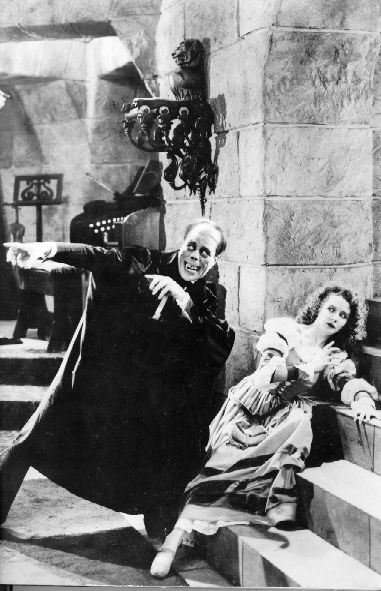
The original silent adaption understood far better the disturbing
nature of the narrative and it aims for creepy, unsettling horror. The film has
no shortage of melodrama but it also wishes to fuck with your head far more than your
heart (The non-horror bits are almost perfunctory). Lon Chaney, “the man of a
thousand faces,” easily slips into the role and the film doesn’t try to hide
the sinisterness of the figure and his actions. The make-up and costume design of
the Phantom are excellent, aimed for maximum ghoulishness.
And that’s what the Phantom is: a ghoul, a ghost, an individual
who is haunting and haunted (heck, it’s right there in his self-appropriated
title). For the first third of the film
the Phantom is spoken of in cautious whisper; his presence a suggestion and his
shadowy demeanor emphasized by sets and lighting of an exquisite Gothic design.
The film imbibes lessons learned from the art design of German Expressionism,
especially in the underground lairs and chambers underneath the Paris Opera
House.
The modern horror of shock value and excessive blood may
leave us numb and potentially incapable of being frightened by The Phantom of the
Opera. Its horror is psychological, of slowly building dread and gloomy, potent
imagery. The Phantom’s relationship with Christine is one of psychodrama. When
he lures her, hypnotizing her to come to the decaying underground world, she chillingly
calls him “Master”. The Phantom believes he can convince her to love him like
he loves her (though what he feels is not love, but a manic fixation).
On a smaller but crucial note: There’s something slightly
sexist in what takes place. Christine is not a fully realized character, and
she is torn between a mad man and a boring chivalric hero coming to her rescue.
Both men claim their goals from a place of male privilege; they’re figures of
patriarchy at its most self-serving and self-righteous. That might sound like
me picking too hard at the threads of something marked by its era, but it
matters: the Phantom does what he does because
he feels it is what society owes to him.
Webber’s version may have, in some ways, become the standard
version of the film, but so much of what Webber visually takes comes from the
silent original: the falling chandelier, the winding hidden corridors (In deed,
almost everything underground), the eerie mask (though later versions reduce the facial area covered), etc. It might seem ironic that
a film about opera can’t actually make us hear any opera music. But that music
might just be distracting. What carries over is all the heightened emotion of
opera, the grandeur of sentiments offered. Operas are larger than life and The
Phantom of the Opera paints on a similarly large canvas as well, turning
intimate terrors into grandiose nightmares.
Grade: A-
Subscribe to:
Posts (Atom)