Monday, March 11, 2013

The Walking Dead - “Arrow on the Doorpost” - Review

The Walking Dead is a severely uneven. Its characters’ actions are often inconsistent and its plotting is just as haphazard. I don’t expect every series to be as perfectly plotted as a season of The Wire. I’m willing to suspend my disbelief and be taken along for the ride to wherever a show might want to bring me, no matter how occasionally uneven, if it feels like I’m ultimately being rewarded. Plenty of great series were uneven. Many series often stumble in their later seasons. Friday Night Lights after its first season was uneven but still very good. Breaking Bad’s fifth season thus far has been doing things that are really pushing that show to a point where it’s questionable. Arrested Development’s third season was becoming much more hit or miss.

But unlike these much better series, The Walking Dead has almost always been inconsistent. The series has this odd tendency to go from very good to borderline bad, and often within the same episode. After “Clear”, last week’s excellent episode and a season high, “Arrow on the Doorpost” was likely not going to live up entirely. Much of the literary quality of “Clear” is gone, which isn’t a bad thing; no one ever said a show had to be literary to be good (Archer, Cougar Town, Parks and Rec, Bob’s Burgers are all examples of series that I would likely never describe as literary but are some of the best shows on television). However, instead though we’re back to the odds and ends hemming and hawing that’s been an irregular death trap for the series. 

It’s not all bad. Darryl and Martinez’s conversation, as well as Hershel and Milton’s are both nicely observed. Maggie and Glen finally talking through their issues was well played by Steven Yeun and Lauren Cohen; even if this happens a bit too fast, the two actors have too much chemistry to not buy it. I appreciated Glenn standing up to Merle, especially as it calls back to his recent character development.  Rick’s hesitation about handing over Michonne also fits well into the plot movements from last week’s episode. 

Its moments like these (and some of you might disagree or choose other ones) that the series occasionally pulls off in the midst of fragmented episodes (which is to say most episodes). But as for the moments that should really count, it somehow never seems to stick these; the real biggie here being the Governor and Rick finally meeting for the first time. 

Part of the problem is shorthand. Television does this often; it sometimes doesn’t tell us everything and has us fill in the gaps ourselves. This isn’t always a problem but it is on a series like The Walking Dead which rests upon constant pressing human (or at least zombie) conflict. In media res isn’t a bad plot decision but it doesn’t make sense for this episode. It hasn’t been established that Rick and the Governor were going to negotiate.  Sure it was hinted at that Andrea would try to set something up, but immediately jumping to this huge plot moment without having built up to it means that what should be an intense and exciting moment has to be spread out for far longer than it can sustain itself. Andrew Lincoln and David Morrissey are pretty good actors and so they cover for some unsatisfying, repetitious dialogue. Thus I wasn’t feeling anything during their sitdown, the most important part of the episode. 

The shorthand on a much larger scale is even more disconcerting. To me, the whole “war” between Woodbury and the prison doesn’t make any sense whatsoever. The Governor is crazy and so it’s reasonable that he’d want to be further crazy and destroy our merry band. But Rick and co. have no logical reason to fight this war. They may have a stockpile of guns now, but they’re still outnumbered and the prison isn’t as defensible as they keep convincing themselves it is. Some may have vendettas against the Governor, but in a world with zombies, shouldn’t your first priority above all else be to survive. Zombie stories are partly interesting because the main thrust is that the only true meaning in life anymore is to survive for the sake of surviving. Not only that but with their ad hoc family formed, these people have more meaning to their lives than a lot of people still alive must.  When Hershel said that some people wanted to leave, I yelled out, “THANK YOU!” None of them have been acting like real people on this count; they’re being irrational, paranoid, and gung ho with no extensive, well founded basis for it. 

I’d say this is better than the first three episode of the mid-season return, but it’s a step down from last week’s episode which showed so much of the promise this series has. Its untapped potential is truly depressing. The first eight episodes saw improvement and it’s still a better season overall compared to both season one and two, but it’s still a series that continues to take the easy way out. Now we’re on track for another showdown and the uncertainty surrounding the protagonist, particularly Michonne, is a direction that has some serious potential, but then again I never enter an episode of TWD with high hopes. I’m usually amused but it just doesn’t enthrall me like I wish it would.   

Saturday, March 9, 2013

Community - "Cooperative Escapism in Familial Relations" - Review

The more television I watch, the more it seems to me that what makes a series work is its ability to form a foundation that it can always fall back upon. In the case of comedies, the comedies that are the most likely to leave you satisfied and that don’t retread themselves terribly in later seasons are the ones with emotional and character cores. These character and emotional underpinnings establish series as not just vehicles for being funny but explorations of whatever is on the writers’ minds. This allows a show to make jokes without the series getting its head too lost in the clouds and losing all purpose.

This may not sound revelatory but it’s a huge distinction that sets apart shows that are bad and mediocre from those that are good. For example, It’s Always Sunny in Philadelphia, especially in its earlier seasons, is a funny series. However, it also is a series that has its characters do inexplicably terrible things in the name of being funny. Sometimes it goes too far and the characters feel like unrepentant cartoon characters out of something like Drawn Together. These characters are amusing but they frequently have to no basis to any actual human being or reality whatsoever. Take a totally different example, Modern Family. Modern Family, starting in its second season, and increasingly so afterwards, lost the whole premise of tension and emotion underlying it. The characters on Modern Family early in the series had to fight and finagle their way to understanding and appreciation of one another. The characters didn’t always immediately forgive and forget; they didn’t always just return to status quo of “We’re family = We love eachother unquestioningly”. 

Community was able to get away with its many homages, spoofs, and parodies because it would ultimately use these crazy antics in the service of telling something meaningful about the characters (as well as breaking down just why it is we love the particular pop culture genres we do). In the season four premiere with The Hunger Games parody, there was no real reason to do it other than to try to provoke laughs out of us; to essentially shock us into some guffaws. It wasn’t a cleverly designed means of exploring these characters and their relationships and therefore it felt very, very empty. The Inspector Space Time Convention was an even more extreme case of this phenomenon. 

"Cooperative Escapism in Familial Relations", on the other hand, feels like early Community in how it utilizes homage and ties it back to the characters. The jokes aren’t just for the sake of jokes. They’re funny, yes, but more importantly the jokes are used with the intention of saying something about the characters. The prison break/Shawshank Redemption spoof is amusing; however, the ability to ground that in how it pertains to Troy, Abed, Annie, and Pierce’s relationship to Shirley elevates it. Similarly, Jeff meeting his dad for the first time is an interesting examination of Jeff’s character, and it brings up an aspect that’s been hinted out constantly throughout the series run. In turn, the way this plot manages to touch upon Britta and Jeff’s relationship is another great use of joke telling and storytelling in order to look at that pairing and why it matters.

This is a step up from the previous episodes of the fourth season, and I really hope they keep it up.

Grade: B+

Friday, March 8, 2013

"Laura" - Film Review

A hardboiled detective. A femme fatale. Shadowy lighting. Moral ambiguity.  Yep, it’s a noir film alright.

Laura was one of the earliest films from the noir genre, and its footprint can be felt in countless noir stories. 

The Detective Mark McPherson (Dana Andrews) is investigating the murder of a woman named Laura (Gene Tierney). There’s a number of suspects at hand; the two most likely responsible are her fiancĂ©, meek, shy Shelby Caprenter (Vincent Price), and an ex-lover, Waldo Lydecker (Cliffton Webb), who is an eccentric critic who appears to be an open book. And each one, and others as well, is taken seriously as a potential suspect. At one point or another, you’re going to believe it was one of them, even the detective starts to seem peculiar as he becomes obsessed with Laura, even impossibly falling in love with her just from the sight of her portrait and the taste in her music. 

The more we get to know about Laura, the more we’re forced to ask “who was this person?” Everyone keeps saying “She was so sweet”; but was this the truth or was there perhaps a more sinister side to Laura? She seems to have played both Waldo and Shelby like a fiddle, stringing them along. Or this merely the sense we're given since we only ever see her from the perspective of men lusting after her?

The greatness of Laura lies in its constant twists and turns. Just when you think you’ve got it all figured out, it tosses a curve ball and has you questioning everything all over again. It’s gripping and engrossing, and builds to an incredibly suspenseful and taut climax that’s as pulse pounding as anything made today in Hollywood.  

Great acting and wonderful build-up make Laura a first-rate mystery.

Grade: A-

Thursday, March 7, 2013

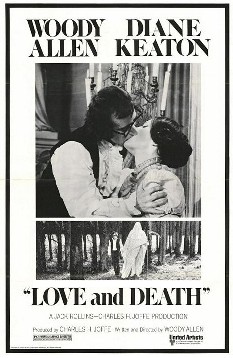
"Love and Death" - Film Review

 Love and Death is a vehicle, like many Woody Allen movies, for Woody Allen to tell whatever jokes or observations are on his mind. The film is essentially a historical satire (and to differing extents a satire on Russian literature and contemporary European cinema), but it’s very broad in how it tells this satire. The film is more concerned at poking fun at anything and everything that in Allen’s eyes is weird, questionable, or absurd.

Set in Russia during the Napoleonic Wars; the film tells the story of Boris (played by Allen, who for all intents and purposes is practically playing himself). There are two plots at the heart of the film. The first is about how Boris finds himself in love with his cousin (Diane Keaton), but unfortunately she has no interest in him. The second involves him being drafted into the war effort against France despite his total disagreement with the war. 

Love and Death doesn’t lean on any particular type of joke. It’s the sort of comedy that throws everything at its disposal at you in order to provoke a laugh. When it’s effective, it’s incredibly effective and Allen makes you laugh like no one else. But when the film fails to be funny or becomes self-indulgent, it noticeably falls flat. However, credit has to be given to Allen for incorporating everything from slap stick to more subtle literary references. There’s humor targeting existentialism, stereotypes, racism, death, love, war, and everything in between.      

Allen’s trademarks are all here. There’s a flare for the absurd and surreal at turns. A white cloaked visage of death keeps popping up and having amusing conversations with Boris. The man that proposed to Sonja dies the moment she announces the engagement. Boris is shot out of canon and lands in the enemy’s officer tent thus ending the battle. It also features Allen’s trademark fourth wall breaking; he continually looks right at the camera and makes a summarily thematic speech or quip.  

The film reminds me most of all though of Mel Brooks. Brooks became less and less interested with plot over the course of his career and increasingly tossed too many jokes to count at his audience. This method didn’t always work but you could always appreciate the effort, especially because the films were often too entertaining to care otherwise. This film has a similar sensibility of humor to Brooks, perhaps not surprising considering they were Jewish comedians producing films around the same time.

Love and Death is uneven (and it’s best not to read into the plot too much), but that’s mostly made up for by how funny it often is.

Grade: B+

Wednesday, March 6, 2013

"Paths of Glory" - Film Review

Heading into World War I, everyone involved expected an easy, quick conflict. For years Europe had devoted themselves to the notion of “progress” that technology and war would advance society for the better. Those attitudes still prevailed early on in the war before it had really started to take its toll. WWI was in many ways the first war that made people realize that may be war was bad and perhaps it should be avoided.

The military mission given to the French troops (although played by no one French and with no French spoken throughout)  in Paths of Glory is impossible, even foolhardy. They’re to take a fairly useless strategic position, a hill labeled the “Anthill”. In the process, the loss of more than half the troops is expexted, and once they’ve taken the hill they’re to hold it for several hours until backup arrives. It’s a pointless military assignment that doesn’t serve to advance the war effort and all-in-all is meant to look good for the politicians and press back home. 

Paths of Glory is an “antiwar” movie. Its message is didactic and it’s filled with archetypes and lofty themes about the cost of war. There’s not exactly real people to get attached to, but rather people who stand in for different ideological systems or who become constrained by those ideological systems. There’s the general, Major General Georges Broulard (Adolphe Menjou), who has no real sense of the cost of war and still enthralled by the so-called chivalry of war. He keeps insisting they take the position even as it becomes increasingly unfeasible and dangerous. There’s the solider, Colonel Dax (Kirk Douglas), who chooses to oppose him. Idealistic and concerned for his troops’ lives, he questions the purpose of the mission from the word go.

When the mission stalls, the troops are unable to make it more than halfway through no man’s land (some don’t even leave the trenches because their commanding officer died before they were given an order to exit), the general court marshals all the surviving troops, who are few and far between considering most died in the foolish forward march. The colonel won’t stand for this and defends them in their military trial, a loaded court case overseen by top military officials who intend to make an example of three soldiers chosen as stand-ins for their companies. They, not unexpectedly, lose the trial and are sentenced to death by firing squad.  Nobody learns anything, other than the colonel, and the war continues on. 

The film is directed by the inimitable director Stanley Kubrick in one of his earliest feature films. Kubrick would become increasingly abstracted and thoughtful about the nature of the medium of film. This is arguably his most accessible film; fans of his film will know that his later films would find him exploring the medium’s possibilities with exceedingly strange but brilliant results. Kubrick was best remembered as a calculating perfectionist. Much of his immaculate framing and impeccable sense of detail are present in the film. Kubrick had a tendency to put his audience at arm’s length from the action taking place. We can see this in the forward movement out of the trenches. It’s one long tracking shot, occasionally spliced with a less extreme wide shot of Douglas. It’s not overly stylish; it’s not gruesome. People are frequently being mowed down by bullets and the lines noticeably thin, but there’s no sense that Kubrick is trying to get us engrossed in the action or deeply involve us in this moment. We’re at a distance, watching this tragedy unfold. There’s no honor or glory here, just death.

It’s not all that thought provoking or original of a message, but it’s an incredibly assured and well-crafted film and Kirk Douglas gives a great performance. 

Grade: A-

Tuesday, March 5, 2013

Girls - "It's Back" - Review

Lets face it, relationships are sometimes awful. We’re often so desperate for intimacy and connection that we’ll put up with people’s shit even when it’s a massive burden. It’s a question that series often are forced to ask themselves: why do these people spend time together? Often times we date someone or we’re friends with someone out of complacency. May be things aren’t the same between us, the sparks dwindled, but the familiarity is comforting even as we’re being dragged through the muck.

Todd VanDerWerff at the AV Club said something back during the first season of Girls that has continued to strike me. He described Charlie and Marnie’s relationship: 
“A long-term relationship has its own kind of inertia. Once you get past the year mark, your life becomes harder and harder to picture without the person you’re dating, and it becomes easier and easier to see the rest of your life stretching on with them in it, heading off into the future. Even if the person you’re with does something really awful, you might find yourself fighting to get them back simply because having to reimagine your future without them in it can be so terrifying. It eventually becomes less about how much you love them and more about how much your life makes sense with them in it, never mind the fact that it only makes sense with them in it because you’ve reordered your cosmos to include them. Love is a part of it, yeah, and there will be times when you really, really love them. But the real success of a long-term relationship comes from constructing the most comfortable habitat for it, like a really impressive animal cage in a zoo.”
He was talking about Charlie and Marnie, but he might as well be discussing any of the relationships on this series. Even though Marnie and Hannah are supposedly at odds with one another, they continue to be incredibly attached to one another at a level of unhealthy codependency. At her dinner party in "It's a Shame About Ray", Hannah defends Marnie when Charlie badmouths her, despite the fact she’s still pissed off by her. In “Boys”, both characters keep dancing around their need for one another and lying to one another in the process. This is friendship isn’t good for either; inevitably it just ends up bringing out the worst in both. But after a certain amount of time relationships trap you inside their weird internal logics. 

Marnie isn’t the only one with a strained relationship to Hannah. Adam returns in his own plot where we see him at an AA meeting rant about his frustration over Hannah. The scene really elaborates just why Adam feels so strongly about Hannah, something that never made total sense from a character stand point. Here at the meeting an older woman is so intrigued by his speech asks him to call her daughter, Natalia, on his date. Adam is nervous but he wants a distraction and so calls her up. Turns out she’s gorgeous and down-to-earth, and just as cynical about her mother’s blind date suggestion.

If Adam is starting to get over Hannah, well Hannah is unfortunately ignorant of this fact. She’s so paranoid about Adam stalking her that it’s kicked in her OCD, which hasn’t been triggered since high school. I didn’t even consider that Hannah might have OCD, but once this character detail is presented to you, it totally makes sense. Hannah always thinks she’s right, she always thinks she knows better, and she’s often oblivious to things around her when she sets her mind on something. While this feels like it comes out of left field, it's not entirely implausible and after the immediate reveal the show handles it surprisingly well. Her getting frantically unnerved and freaking out as her OCD returns is made all the more amusing due to her parents being in town on a visit. This of course leads to another occasion of disappointment for Hannah’s parents as they're cofrced to take her to a pediatrician whose office is open weirdly late. 

Marnie is also unable to shake a person still lingering over her mind. She discovers Charlie has invented an app, started a company, and become a bit successful. I’m not sure Marnie even wants Charlie anymore so much as the sense of security and ease of that coupling. Charlie is familiar; reestablishing their relationship, however, is probably not going to happen again and it would probably be a terrible decision anyway.  

Meanwhile in the only semi-cogent relationship of the bunch, Shoshanna and Ray still have yet to work out the apparent problems in their coupling. Ray likes Shoshanna but he doesn’t know if he sees this as meaningful or lasting. Shoshanna has had her fairytale, Disney romantic notions undercut by the lack of togetherness (and the age difference) of Ray. And due to the lack of communication on both their parts, Shoshanna finally crosses over into that territory that girls so frequently takes its characters: “NO WHY WOULD YOU DO THAT?!” Territory. Shosh is trying to gab to a friend,Radhika (a charatcer that comes out of nowhere) she hasn’t seen in a long time at a party, but the girl is so thoroughly disinterested (and no offense, I’m kind of siding with her on this one) that Shosh gets fed up and leaves the party. Before she can leave though, she’s won over by the charms of a rakish doorman and is hooking up in a coat closet. 

Relationships are tough. They require work, investment and deep consideration and sympathy on the parts of all people involved. Over time these relationships can be our undoing though. We build them up and they begin to confine and trap us. When we know they’re no good for us, we can still keep being drawn back to them. When we want to get out but find ourselves incapable, it can bring out the worst in us. 

Stray Observations:
-“Where is she. What is she wearing? Is it linen?”
-Part of the nicely observed absurdity inherent to the series: there’s White Castle being served at the party.
-“She’s the richest Hindi I know”
-“You learned another life lesson. How adorable”
-“You can’t dress like a magician’s assistant much longer”
-“You’re not anorexic. I’ve seen you in a bathing suit”

Grade: B+

"The Navigator" - Film Review

Buster Keaton’s Rollo Treadway is, like many Buster Keaton characters, placed in the most unlikely of situations. He finds himself taking a trip on a ship mistaken for one owned by a nation the country is at war with. This leads to Rollo being in the wrong place, at the wrong time, when the ship is sent off to sea by international spies. One crazy happenstance after another has Rollo scrambling, scared and witless. But through it all is Keaton’s signature stoic, deadpan expressions as he quietly suffers through one situation after another.

Unlike Charlie Chaplin, the other most ubiquitous silent film comedian, Keaton was never one for emoting. The other actors around him certainly do, including Kathryn McGuire as the luckless female companion who accidentally ends up on the titular Navigator. But Keaton has since garnered attention for how understated his performances are. Zany things are frequently happening around him and yet he grins and bears it. Part of the film's charm comes from how reserved Keaton is at every turn. Also unlike Chaplin, Keaton’s movies frequently have a dry sense of humor. There’s subtle wit and sarcasm throughout The Navigator. After his engagement proposal is rejected, he refuses to get chauffeured around; instead claiming he plans to take a long walk to clear his mind. Cue him walking right back across the street to his house.  

The film is filled with some incredible setpieces, including notably the ship itself which was an actual passenger liner purchased by Keaton, and some impressive stunts by Keaton (who did all his own stunt work). Though it's not Keaton's best work, it's still has some great slapstick and surprisingly intense action, especially in the film's climax.

Grade: B+