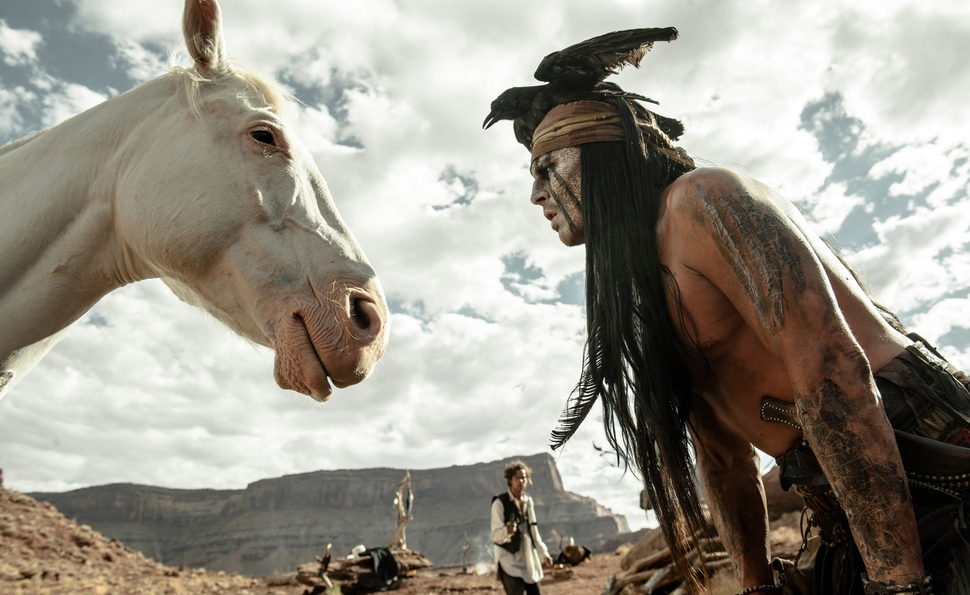
The film shares a lot of qualities with director Gore Verbinski and producer Jerry Bruckheimer's efforts on The Pirates of the Caribbean. Most apparently, Johnny Depp returns for another eccentric, garishly-garbed supporting role that, for better and for worse, ends up stealing the spotlight. Depp plays Tonto, the Native American who plays stone-faced companion and frenemy to Armie Hammer's Lone Ranger, a lawyer forced to turn vigilante when his brother and posse are viciously murdered by bandits. Ranger features the Pirate series' expansive sweep, and pyrotechnic, overwrought action and storytelling.
It's ultimately the self-involved, exceedingly complicated and overdrawn narrative which brings Ranger crashing to a screeching halt. The film tells its story in sputtering fragments of clashing tonalities -- silly slapstick is closely followed on the heels of tremendous violence -- and intentions. It's consistently an overlong slog to get through with the film never truly picking up momentum.
The film's haltering pacing also is, in part, due to weird thematic ambitions. The film boils down to a massive indictment of the skeletons in America's closet, in particular the genocide of the Native Americans and the nation's failure to fully atone for its past sins. The film questions the myths the country was founded upon and how we collectively and actively write these myths at the expense of historical truth.
Though the film does manage to use its scope and its excess for some lively action sequences, they come far and few between in a story that's often tedious to get through due to how uncertainly and unevenly told it is.
Grade: ★★

I was surprised at how awful this movie was deemed by critics. It was pirates in the west. Jack sparrow was much cooler than Tonto and the "dead" treasure made for a clever plot but this was much better than expected. The train sequences were cool/fun.
ReplyDeleteIt's definitely not a bad movie. It's just a movie that doesn't seem to know what it wants to be. And the length doesn't help -- It needed to be a good 30-40 minutes shorter. But you're totally right: Lots of very fun moments, particularly the two train scenes that bookend the film. But there's so much that's unnecessary: the whole sequence at the whorehouse -- and Helena Bonham Carter's character -- and the whole framing device with Tonta in the museum, etc.
DeleteWow, i think i just signed a kidney away submitting that comment. :)
ReplyDelete