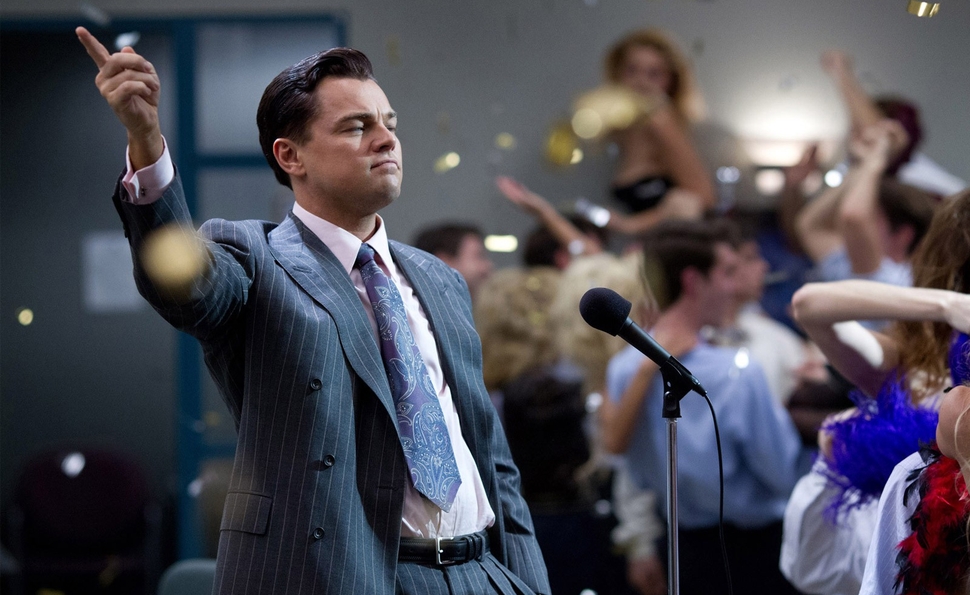
Belfort goes in fresh faced and naive into the late 80's stock market scene only to be blitzed by the mindset that bred Gordon Gecko -- introduced by a brief but pitch-perfect appearance by Matthew McConaughey as Belfort's first mentor. This simple-minded, straight edged all-American good boy is seen for a handful of minutes before transforming into a depraved, drug-addled, fraudulent man who is all too proud to call himself a "degenerate". It's a ferocious performance by Leonardo DiCaprio. He brings all his usual charimsa and charm to the role of a character who is by all rights monstrous. Yet Belfort is depicted as just selfish and deluded enough to fail to see past his limitations and the general idiocy of his misguided efforts.
Belfort is in Wall Street for a month before the 1987 stock mark crash causes him to be out of the job. He soon takes a job at a company working with penny stocks, where he cruelly screws over working class citizens who can barely afford stocks in the first place. Realizing the value of these worthless stocks being sold at a marked up value, Belfort creates his own company, Stratton Oakmont, that grows into, an all consuming broker giant. Even as he garners the attention of the SEC and FBI, Belfort carries on his illegal stock games and illicit personal habits.
Scorsese seems to want us to be swept up in the allure of this lifestyle. The delirium of his ever roving camera, pop and rock soundtrack, and the gameness of all actors involved gets us as addicted to the appeal of this little world as those actually popping pills and snorting coke. More importantly, Scorsese gets us caught up in this lifestyle before slowly stripping bare the atrociousness of these people, what they stand for, and everything they choose to be. There are some instantly memorable moments, particularly a sequence, we'll call it the "Quaalude Scene", which sees DiCaprio and his broker confidante and pal Donnie Azoff (Jonah Hill) in despicable, cringe-inducing, and very funny ways exposing how far their addictions and their belief in their own invincibility has gone.
In some ways the film feels like a dare to itself, introducing us to one deliriously shot, ludicrous situation after another. Though it clocks in at three hours, the film never feels long. Scorsese makes every moment as entertaining, surprising, and a piece-of-the-whole as the one that came before it. The incongruity between the way the characters perceive themselves, and the way we're meant to perceive them gives ample room for Scorsese to make us laugh at these awful human beings, who are sadly all too human -- Scorsese ultimately tries to get us to uncomfortably to see a potential version of ourselves in them -- despite how hyper and heightened the humor and style of the film is.
Grade: ★★★★

No comments:
Post a Comment