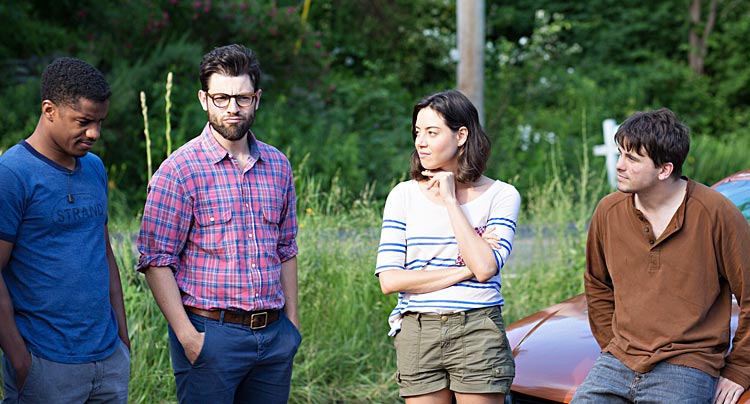
"Kelly and Cal bond over their outsider statuses and the fact that they are kind of terrible people. It is easy to imagine pre-disability Cal as a jaded loner who believed himself to be better than everyone else. The accident has only given him a convenient excuse to gripe about how awful everyone is. Kelly also carries a holier-than-thou attitude that similarly borders on grating. Kelly & Cal’s real strength draws from how dark and weird it is willing to be. Like earlier 2014 indie release Adult World, Kelly & Cal finds unexpectedly offbeat and bleak notes within conventional narrative limitations. Unlike other “unlikely friendship” films, there is no whimsy or a sense of doomed beauty to the events on display. Up to a certain point, the film makes just about every character deeply unsympathetic and unlikable. Kelly is selfish and narcissistic, and her funk stems as much from arrested development as it does from postpartum depression. However, her husband is often an inattentive, emotionally unavailable asshole, and this makes Kelly’s bizarre relationship with Cal all the more plausible."
Thursday, September 4, 2014
Review for "Kelly & Cal"
My most recent film review for Way Too Indie is on the oddball friendship film Kelly & Cal, which is a surprisingly dark, up to a point, story about refusing to change. Here is a sample:
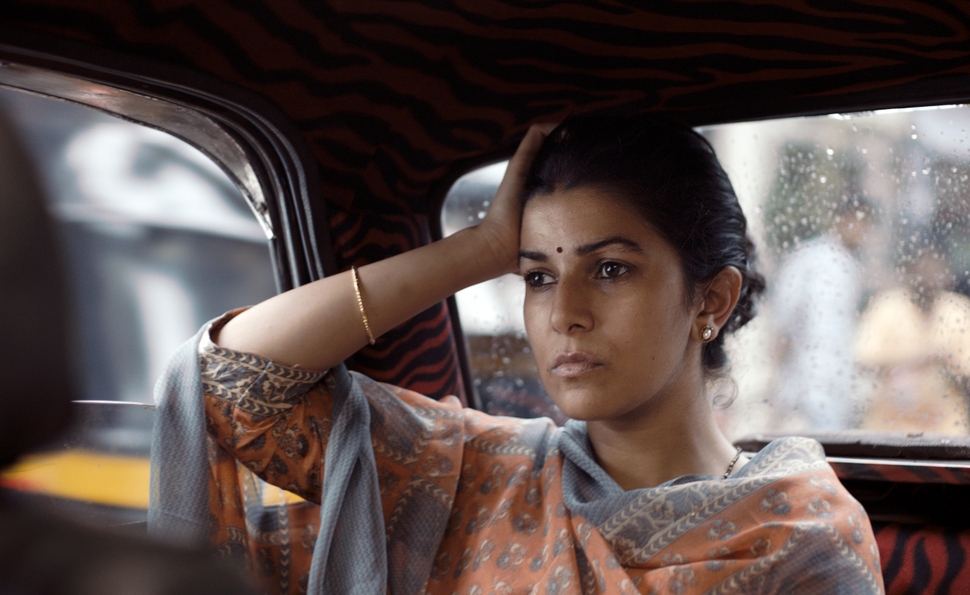
"The Lunchbox", Rom-Coms, and Expectations vs. Reality
The Lunchbox is a
film about the gap between expectations and reality; between the way life is
and how we wish life would be, and how the twains shall never meet.
The film begins with a daffy little romantic comedy premise:
The Mumbai delivery service accidentally gives the lunch Ila (Nimrat Kaur)
intended for her husband to another man Saajan Fernandes (Irrfan Khan).
Ila is having marital problems. Her husband is distant and cares more about his work than her. Ila had believed that if she could win her husband’s stomach than she could win his heart as well.
Saajan loves her cooking so much that he eats every last
morsel. Ila and Saajan soon begin exchanging notes, initially to clarify the
mix up, and slowly they start offering deeper contemplations. The more they
reveal in the exchanges, the clearer it becomes that they are both disappointed
and unfulfilled by their respective lives.
The anonymity of the messages offers an opportunity to state
things one normally wouldn’t, a letter counterpart, in a way, to the walk and
talks of Before Sunrise. The more the
two invest in the meaning of these exchanges, the more they begin seeing it as
an out to their humdrum lives.
The film sets up a situation in which we desire to see them
together, these two individuals who have create a beautiful bond. But the film
is continually being tempered by reality. The film is not a Bollywood romance;
it is a grounded neo-realist tale, flavored with the spark of a love affair. Writer-director
Ritesh Batra keeps emphasizing the changing, modernized landscape of India. It
is not a setting to be romanticized. Mumbai is bustling city, crowded and
dirty. It’s beautiful for the docu-realistic lens Batra frames it through,
noticing the humanity bubbling over in the setting. On more than one occasion,
Batra pulls back to suggest that Ila and Saajan’s story is merely one small
story amongst countless other stories taking place in India.
Where a Hollywood film would find some way to bring these
two individuals together, to grant them a little happiness and reprieve, The Lunchbox keeps finding
complications. Running away together to Bhutan is hopelessly romantic, but it
certainly isn’t practical. Missed opportunities and missed connections define
the film. It doesn’t argue that this romance is impossible, but it allows its
characters to take actions that undermine their dreams and satisfaction in the
name of being realistic.
And yet, the film is still deeply romantic. The brief window
of time in which the exchanges take place is dreamy and exciting, and also raw
and tender as secrets and regrets are revealed. The mid portion of the film is
colored by a sunny, warm quality where the film indulges in low-key humor and a
fluffy sense of possibility. Even as the film takes on an increasingly
bittersweet tone, the possibility of consummating the romance is held out (the
film’s ending is ambiguous on this account, even as it’s a doubtful ambiguity).
While it may never occur, the way the conversation has affected and altered
both carries through. Both take control of their lives and refuse to quietly be
consumed by their grief, sadness and frustration. They have become better, more
capable people who can now take charge of their lives.
That somewhat oversimplifies the film’s aims, however. The
characters’ journeys are about accepting that life is a little dissatisfying
and difficult. It’s about learning to ground yourself within the life you have
and not the one wish you had. That’s a little bit headier than the film’s
seemingly commercial premise would immediately suggest, but it’s also richer
and more rewarding. Saajan and Ila are real people struck by a moment of
serendipity, not dictated by cosmic fate but a mishap of modern infrastructure.
No matter what its causation though, it still remains serendipity and The Lunchbox remains a delight, a crowd
pleaser that never simply settles for just being pleasant.
Monday, September 1, 2014
"Young & Beautiful", Voyeurism, and the Male Gaze
Young & Beautiful is
a film fascinated with voyeurism; with people watching other people; with
people looking at themselves; with us, as a viewer, watching these people
gazing. In short, it is a film concerned with the male gaze.
The film begins with an unknown observer surreptitiously
watching the titular young beauty Isabelle (Marine Vacth). On a beachside, she
undresses to sunbathe. Director Francois Ozon uses the voyeurism to undercut
the potential pleasure of the moment. We are seeing a nude body, but there is also
something perverse and sinister due to the framing of the moment. We become
self-conscious of our act of viewing.
Throughout the film, there are many scenes where men will
look upon Isabelle, but the power dynamic of the situations are consistently
complicated by the way Ozon films these scenes. Ozon is constantly showing
Isabelle returning the gaze of the males who wish to possess her, and, in turn,
returning the gaze of us, the viewer.
After a brief introductory sequence where Isabelle awkwardly
loses her virginity to a German hunk (a situation which he controls and
Isabelle is largely a passive participant in), the film spends most of its time
to showing Isabelle’s involvement as a call girl. Ozon never explains where
this desire stems from. Isabelle actions, instead, become ever more curious.
She doesn’t seem to derive a whole lot of pleasure out of her encounters. Vacth
portrays Isabelle with a tantalizingly blank expression (shades of Catherine
Denueve in Belle de Jour).
The pleasure that Isabelle gains seems to be in the power
the sexual acts provide her. The money seems to give her little interest and
the sex is often icky and degrading. But Isabelle enjoys the power over men
this gives her (though she probably couldn’t quite ascertain and pinpoint this
herself). She is in control. She is desired. She commands the
“to-be-looked-at-ness” of her.
Ozon plays to the to-be-looked-at-ness of his protagonist.
Isabelle is well aware of her beauty. People note it with some frequency. She
knows that people desire her and that this is an asset. The film starts with a
shot where Isabelle has no control over the way she is looked at and it slowly
moves towards her dominating the way she is viewed both within the narrative
and by the camera.
In the traditional analysis of the male gaze, the act of
gazing was given acceptance because the men we do the vicarious gazing through
were nice people, heroes. The majority of the gazers in Young & Beautiful, Isabelle’s clients, are the antithesis of the expected male gazers. They are old and
not especially good-looking. They also are not charming or charismatic
individuals. Put simply, they are casual assholes. They treat Isabelle crudely
and misogynistically. They are dismissive and rude. We can’t identify with
them, and our identification aligns ever more closely with Isabelle.
Our awareness of our place as spectator causes us to judge
the behavior of these men more harshly. We become more cognizant of the way
these men objectify and sexualize Isabelle; and the way this sexism extends to
more normal, traditional realms of Isabelle’s life.
Midway through the film, Isabelle’s call girl activities are
discovered. A client dies, and the police inform her family. Suddenly, everyone
in Isabelle’s life is deeply self-aware and self-conscious of the power of
Isabelle. They are hyper-mindful of the capacities of her young ingénue
appearance. Soon every encounter with a male in her life becomes a charged
moments, potentially freighted with meaning, read into or otherwise.
There is a fair amount of meta-textual-ness taking place
throughout the film. The film’s chief narrative pull comes from attempting to
comprehend the enigmatic motives of Isabelle. But Ozon underlays this with a
significant degree of subtext about the way we watch films. In a way, we are
just as possessive of Isabelle as her clients. We are drawn to her beauty and
possibly even desire her. It’s acceptable though, right? It’s solely within the
context of a film. However, Ozon keeps challenging that notion by making the
act of viewing a fraught experience with complicated responses to the actions
on display.
Sunday, August 31, 2014
"Veronica Mars" and the Fear of Being Vulnerable
**Spoilers for the First Season of Veronica Mars**
(NOTE: I have not seen beyond the first season, and I'm interested to see how much of my assessment holds up going forward)
Veronica Mars, like most great shows, is about a lot of different things. It’s about race, class, and the way socio-economic status creates divisions within a town. It’s about family ties and the way we are defined by and reject the influence of our parents. It’s about the way people act out expected gender roles and masculinity and femininity. It’s about the hierarchies of social orders and the fluidity and instability of those divisions.
Most obviously, it’s a show about the intricate murder
mystery of a young female, Lily Kane (Amanda Seyfried), a popular
girl who had a knack for causing and getting into trouble. Lily is a femme
fatale, but her ability for the fatalism of that title is one of many
subversions Veronica Mars brings to
the film noir genre.
But if I had to say what Veronica
Mars is about at its core, it’s really a show about vulnerability. Moreover,
it’s a series about the fear of being vulnerable. It’s about people posturing
and pretending to be so much more than they are. Film noir is a genre with deeply
damaged people trying to act like they’re above the shattered world around
them. It features archetypes who are haunted by dark, complicated pasts they
wish they could outrun. Veronica Mars
plays to those archetypes, but it ultimately creates an emotional realism to
them that transcends their genre origins. These are fragile, flesh-and-blood
people who break on more than the philosophical, abstract level noirs can seem
to exist in. (It ties that emotional wellspring to the volatile, complicated
emotional lives of teenagers and high school as the incubator for those feelings)
At the center of the show is the titular character. Veronica
(the excellent, perfectly casted Kristen Bell) begins the series dealing with the fallout of her father’s
investigation into the murder of her best friend Lily. His insistence on
pursuing Jake Kane, a software mogul who caused Neptune to reach an economic
boom. This creates a rift between the Mars and much of the rest of the town.
Keith Mars (Enrico Colantoni) loses his position as sheriff, and when Veronica sides
with her father, she finds herself ostracized and ousted from the popular
crowd. If this weren’t enough, in the aftermath, Veronica’s mother flees town.
Another story dovetails with the murder investigation throughout the season;
Veronica was drugged and raped at a party shortly after the murder.
All of this has understandably hardened Veronica. Her
choices in outfits are markedly different from her time with the cool kids, less
girly and more reserved, for starters. But her whole personality has shifted as well.
She’s steelier and more cynical. She hides behind sharp, sarcastic quips.
Veronica is burying her feelings through conscious decisions. Veronica has
become scared to experience what she’s feeling. She’s not sure she could handle
it.
Stylized as the visuals of the show can get, in that moody,
shadowy noir manner, they mask deeper emotions behind their surfaces. They also
hint at a sense of darkness hiding behind the sunny California surfaces. Appearances
matter in the world of the show. They mark status, privilege and wealth. Veronica Mars is a highly class
conscious show. Veronica’s friend Eli "Weevil" Navarro (Francis Capra)
is a Latino who comes from a working class background. His race and lower class
standing garner him a lowered reputation -- while the community’s in-crowd is
run by rich white kids. Weevil is forced to continually put up a front in order
to survive the heated environment (yet, of course, he’s a nice guy at heart).
But everyone is acting out a certain version of themselves
to the outside world. This becomes most apparent in Logan Echolls (Jason
Dohring, exceptionally magnetic in the role). Initial appearances would peg Logan as a supposed bad boy. But his
outwardly faux-douchieness is a form of play-acting. Logan’s family life is troubled.
His father is not only a serial adulterer but regularly beats his own son.
Logan is also burying his emotions.
Logan begins opening up in the wake of his mother committing
suicide. Logan is desperate to believe that his mother’s death was staged, and
he hires out Veronica to discover the truth. When her death turns out to be
true, Logan, in a rare display of emotion, breaks down in front of Veronica. This
is all the more peculiar for the displays of antagonism and distrust Logan has demonstrated
towards Veronica up until this point.
This proves to only be the start of Logan’s transformation.
He soon shows unexpected shades to his personality, revealing a sensitive and
noble side to Veronica. Late in the season, Veronica and Logan share a passionate
kiss in the heat of the moment. It leads to deeper intimacy and eventually a
relationship. Neither quite knows what they’ve gotten themselves into. They’ve
stumbled into a relationship they describe as “illogical”, shared as it is with
a supposed rival.
Notice the way Dohring changes his voice, softer, lower, more cautious, in portraying Logan
when he’s around Veronica. It’s the genuine article. It’s the voice one uses
when they completely trust someone. In Veronica’s world, trust is hard to come
by. As a budding gumshoe, she takes on cases where it is never entirely transparent
as to who is responsible and who is trustworthy. The one defining element to their
relationship going into the end game is how much Veronica can really trust Logan.
She considers whether she is being used by him. Veronica is scared of letting
people in. People have let her down too much – from her classmates and former
friends to her flaky mother. Beyond this, her brittle demeanor comes from her experience
of being raped. The show doesn’t extensively dwell
on the incident, but it is clear that she has avoided romantic relationships (and relationships more broadly),
in part, for this reason.
Interestingly enough, the couple’s past relationships –
Logan’s with Lily and Veronica’s with Lily’s brother Duncan (Teddy Dunn) – in hindsight,
seem like their own form of playacting. As revealed in flashbacks, these
relationships come off as stereotypical romances, clichés not of high school
romances but something closer to a cheap teen comedy. They were rich, privileged
kids doing what rich, privileged kids believe they are supposed to do, rather
than what is necessarily most fulfilling. The charade of these relationships
clarifies in the corrosive nature to Lily and Logan’s coupling. The two frequently
were breaking up, and Lily was known to have a number of other boys on the side
(in another bit of subversion, Logan is the faithful one). Logan and Veronica’s
relationship which outwardly makes no supposed logical sense, is actually a
healthier and better relationship for both than the seemingly sounder fairytale
romances they previously held.
The Veronica-Logan relationship, at once, comes out of the
blue. And yet, it feels like it was
inevitable. There is an emotional validness to it that eclipses the messiness
to the way the plot arrives at it. Its organicness derives from taking
advantage of television’s long-term storytelling strengths. Slowly Veronica’s
chipper demeanor and impeccable sleuthing peel away to reveal someone
uncommonly damaged and who is sometimes not always right in her convictions. Logan initially comes off like an asshole, but
by the end, he’s more akin to a lite anti-hero status. He’s a good person whose
fundamental moral footing has gotten out of step.
The last stretch of Veronica
Mars’ first season dedicates a significant amount of time to their
relationship. It’s easily the most charged portions of the season. It feels
exciting because the show has been playing a long game, hinting at not only
answers to its mysteries but deeper emotions as well. The show becomes ever
more baroque as it heads towards its finale, and it begins relying more on a
character-based, emotional emphasis over the more plot focused concerns of
the earlier goings. Much of this stems from the writers’ carefully constructed
plot which starts delivering payoffs with a wonderful precision in the
homestretch. As the show starts revealing its hand, the emotional material
takes front and center more and harmonizes with the plot mechanics ever more
elegantly and satisfyingly. As the
emotional underpinning become text rather than subtext, Veronica and her peers
are allowed to expose more of their inner selves, disregarding social mores and
betraying their own human frailty.
Veronica Mars’
central narrative comes out of the death of a damaged person. Lily was never
good enough in the eyes of her parents. She harbored a sadness that led to a
self-destructive streak, and ultimately to her death. Her death opens up a
crack in the carefully crafted facades of the Neptune community. In the process,
of solving the murder case, Veronica allows herself to come to terms with the
events that took place and to accept her complicated emotions towards what
occurred. In other words, she allows herself to finally be vulnerable.
Saturday, August 30, 2014
'It Felt Like Love''s Beautiful, All-Too-Real Take on Adolescent Female Sexuality
Gina Piersanti has one of those faces. It is a face that could
be filmed for hours and you would never get tired of it. Piersanti films well,
yes, but, moreover, she has an unusual, distinctive face. She is not a great
beauty in the traditional sense. She is beautiful as we grow to know her (as
some modest friend of yours might grow to be a knockout in your eyes as you
begin to realize she’s far more interesting than half the dullards in your life).
Piersanti’s Lila in It
Felt Like Love is like many of us in early adolescence. For many of us, there may be an
uncomfortable recognition of our awkward past selves, possibly
even more so for female viewers. The way director Eliza Hittman and director of
photography Sean Porter shoot her, Piersanti always comes at the film’s material
with naturalism and understatement. The events of the film feel like they’ve happened. They have unshakable aura of not just realism,
but something that occasionally borders on vivid truth (or, put another way,
there is an emotional fidelity to it as much as a faithful rendering of
reality).
It Felt Like Love’s
subject is adolescent sexuality and that of a young female. Films and
television shy away from this subject. Western society is so deeply puritanical
and the United States is so repressed that we get squeamish at the thought of
this. It must be doubly hard for a person like Lila. She is fourteen years old.
She is smart and, more importantly, she is weird. She is different, with a mess
of dark, bushy hair and a constant external humming of young insecurity. She
owns her strangeness with a quiet defiance. But she still would like some boys
to notice her and pine for her. Lila’s closest friend is Chiara (Giovanna
Salimeni). Chiara has already had sex and goes through a steady rotation of
boyfriends. This is the one area where Chiara is wiser and better versed.
The difference between Lila and Chiara is like the
difference between Laura and Claire in Eric Rohmer’s Claire’s Knee. At one point, in that film, it is remarked about how
Claire is currently more beautiful than Laura, but how it is also easy to tell
that Laura’s beauty will only grow and surpass Claire’s as she becomes older. All
Claire has is her looks and the fact that she is young. The same can be said
for Lila and Chiara. Chiara’s beauty is fleeting, and she is taking advantage
of the gifts puberty has provided her. Meanwhile, Lila is drowning in puberty
and the new found interests it has given her.
Lila is navigating a minefield. She has a strong fascination
with sex. She goes out of her way to try to lose her virginity. She is out of
her depth. Lila has not quite discerned the larger, complicated cultural and
social views of women and sex. She doesn’t understand that there is so much
more to sex than the act itself. And even the act of sex itself she doesn’t
entirely comprehend. All she knows is that she wants it. Her friends are doing
it, and she feels like she is getting left behind.
Lila talks to her younger neighbor with a careless bragging
bravado. Much of it is word-for-word repetition of what she has heard from
older, more experienced individuals. She doesn’t get what it means. She feigns.
This is the one time and place where she can reign supreme. It is the only time
where her confidence and self-esteem can be raised, where she doesn’t have to feel
uncomfortable, confused and uncertain. In a better world, she would stop
pursuing much older guys who have no interest in her. She would date the age
appropriate next door neighbor. They would simply make out and it would be
enough.
But the world wants Lila to grow up, and grow up faster than
she can always handle. It is easy to imagine that a few years earlier that
Lila’s awkwardness and gawkiness were fine. She was just a little kid and being
a little frumpy and strange was acceptable. Now, she must be constantly
hyper-aware of her body and the changes taking place to it. She must be deeply
self-conscious of how people are looking at her and thinking about her. She has
been asked to grow up faster than is possibly fair.
It Felt Like Love
has one of the best titles of any film released in 2014. The title beautifully captures
the delicate, bittersweet poignancy of the film. It wonderfully sums up Lila’s
complicated feelings and her journey throughout the film. When we are young, we
assume our emotions and feelings have a purity and honesty. We believe them to
be real and true. Life is constantly forcing us to readjust our beliefs and to
recalibrate our emotions. Lila mistakes her budding sexual feelings for
something deeper and more meaningful than they actually are.
And yet, there is a resiliency to Lila. She has an inner
strength to her. Piersanti’s performance is great because it invites us into
Lila’s headspace. Piersanti reveals to us an inner life through posturing and
small facial adjustments. Lila is vulnerable, but she doesn’t want anyone to
pick up on that. Yet there is constant anxiety fluttering underneath. Even when
she is willful and impulsive, there is a sickly sense of doubt and fear that
bubbles under the surface. I want to see
Piersanti appear in more. This is her first featured performance and she is remarkably assured. She is so well-matched with Hittman’s vision. It Felt Like Love’s vibrancy comes from
Piersanti tapping into that all too familiar adolescent apprehension and laying
it bare like an exposed nerve.
Monday, August 25, 2014
Review for "About Alex"
I recently wrote this Way Too Indie film review for the lightweight indie dramady About Alex, about old college friends getting hung up about the past. Here is an excerpt:
"As noted through casual meta-jokes, About Alex is essentially The Big Chill for a new era: a group of college friends spend a weekend together rehashing the past after one of their own attempts suicide. The meta-ness ends at the passing references to the film’s familiarity though (“This is like one of those ’80s movies,” one person says at one point). From there on out, About Alex falls into the traps associated with its subgenre. Jesse Zwick’s script (Zwick also directed) is laboriously constructed to the point where the summer home the gang goes to feels like it has more personality and well-worn history."
Thursday, August 21, 2014
Why You Should Watch Teen Drama "Skins"
Initially, anyway, that is.
Skins is a strange
series that was bred out of unique circumstances. The series was produced by
E4, a companion channel launched by Channel 4 in hopes of attracting the
profitable 15–35 demographic. For its first few years, E4 aired American
programming that it had acquired syndication rights to. But by the mid 2000’s,
E4 was looking to make a name for itself (If you’re trying to get a picture of
this network’s brand, think edgy WB/CW). Skins,
created by the father-and-son writers Bryan Elsley and Jamie Brittain, was the
channel’s first stab at scripted original programming. With that came a certain
degree of creative freedom, and that can be read in a lot of the series’ odd,
distinctive, free-wheeling storytelling. This freedom soon became coupled with
the fact that the series quickly proved itself to be E4’s most successful
program, and it proceeded to grow into a British cultural phenomenon, drawing on
the fervency of its young fan base and the coinciding rise of the internet to help
cull fandoms.
While it has since become influential in England, here in
the states it has remained more of a cult favorite. This is something I wish to
see remedied. The show uses its stories and its freedom in telling them to address
subjects that are pressing and relevant, and yet it always packages this into
something so raucous and lively, overflowing with unmistakable spirit and
spunk. But underneath its silliness, whimsy, and flippancy lay something
darker, bolder and often hugely affecting. All the sensational elements were
merely a way to grab your attention in order for the series to deal with the
things that it was truly concerned about. Conceptually, it is a series built as
if the stoner class clown and the valedictorian feminist got together and made
a show. Raunchy, vulgar contours sit comfortably side by side with thoughtful,
pointed, emotionally florid, centers.
The series’ concept starts off familiar enough: an ensemble
piece that follows the lives of Bristol teenagers as they finish up their final
two years of secondary education in sixth form (essentially high school). The first
kink in that traditional design: Every two years a new generation of characters
is introduced, allowing for new subjects and issues to be broached, and
ensuring the series didn’t attempt contrived reasons for keeping characters
around that would have no business of logically sticking about. The second
kink: the series is primarily written by young writers who are actually the age
of, or, at least, close to the age of, the main characters, writing their
personal experiences and perspective into the series and helping make it more
true to life.
These teens fall into love, and they fall out of it. They
pine for people, some unattainably out of reach. They hook up. They have sex,
lots of it. They drink and do drugs and throw parties -- it’s quite possibly
the only thing they do more than obsess over sex. We observe their home and
family lives, working and middle class and not always cushy. We observe them by
themselves, alone with their thoughts and feelings, anxieties and insecurities.
We observe them amongst peers. And when they’re not amongst their friends, who
they like but also have the sneaking suspicion they might be better off
without, they contemplate how bored and lonely and utterly lost they are. They
believe in the singular uniqueness and tragic unfairness of their life. They
are you. They are me. They are us in our late teens. It is painful and poignant
how notably they remind us of ourselves. And just as things are getting too unbearably
deep and jagged and raw, the show makes an absurd, juvenile joke to cut through
the cloud of angst.
That prior description encapsulates much of what I love
about Skins, but, before I go
overstating my adulation for the show, I must caution that wonderful as the
series is, it is undeniably flawed. Good intentions can only go so far.
Execution is what really counts, and it is here where I have to do a slight bit
of walking on egg shells. I will be the first to admit that Skins is somewhat messy. It has a
penchant for broad, silly, sometimes plain dumb, humor, and it too often gets
caught up in relationship drama that doesn’t always ring true. The show also
doesn’t have a strong handle on long-term plotting (outside of its excellent
third season, easily its best) and occasionally it makes some rather outlandish
or flat-out bad storytelling choices – most defensible, some not so much.
That said: Skins
is a good, sometimes great, always singular series. And, at its best, the show nicely
matches its pleasurable surface charms -- a playful, irreverent sense of humor,
delectable romance, angsty drama – to some interesting, even under-examined,
issues and topics. While a fair amount of defenses and praises of the series
are guarded and likely to begin with some variant of “I’ll admit…” (look no
further than to earlier in this post), for everything Skins gets wrong (more than I’d care to admit and sometimes
breathtakingly so) it gets a dozen or more so genuinely and refreshingly right
that it often erases away a lot of the potential ill-will its shortcomings
create (As Flavorwire’s Judy Berman noted, “It’s hard to explain if you haven’t seen the cult British series … but Skins can somehow get away with things
that would just seem cheesy and overwrought”. The elements that should clunk
more often than not don’t because they aren’t a bug but a feature). These types
of gauged defenses are slightly unfair though. They treat the series like it is
a guilty pleasure. Besides the fact that guilt or self-flagellation over the things
we like/enjoy, and in the process crafting a moral cultural hierarchy, is
needless, pretentious, outmoded, helps no one, and adds little of critical
value; we should also simply accept that the show when it was on its A-game was
honestly just a pleasure, purely, simply and with little need for justification
or qualification.
The show’s distinctive ability to create admiration and
amusement began with its unusual formatting. Skins is one of the most structurally audacious series of recent
memory, which is both one of its greatest assets and something that lead to all
sorts of weird storytelling issues. Each episode focuses on one, or in some
instances multiple, characters. Essentially the show takes on the form of a
collection of short stories with serial elements playing out in the background.
Its odd structure was a boon to what was something the show was always good at:
character and characterization. (Even at its worse, the show’s storytelling
typically made sense on a character level even if on a plot level it could be
eyebrow raising).
The show’s structure opened it up to trying on new
identities and personalities week-to-week and season-to-season. One week it
could be a raucous comedy, the next a peculiar avant garde play, and yet
another a quiet family drama. This meant that some episodes could reach brilliant,
ecstatic highs – acting as fantastic examples of what this tv genre is capable
of at its finest – and still others could crash and burn as fevered,
frustrating blunders – sometimes these drastic tonal shifts existed from scene
to scene leading to greatness and significant enjoyment buried even amongst the
most misguided efforts (This was especially true in the third generation’s
seasons, the most divisive and uneven, and the ones to have the lowest lows to
counter the highs. The show was simply running out of steam by that point, but
there is still some good and especially some very curious stuff there). Thankfully
the counterweight typically balanced out more towards the good than the bad. Like
other shows with outsized ambitions and that changed markedly episode to
episode, such as Lost or Community, this made diving into each
new installment of Skins thrilling to
watch. You never knew quite what you were going to get (or whether it would be
fully, successfully pulled off), but you knew it would look nothing like any
other episode, and sometimes like nothing else on television.
Each episode starts from a place of: “Let’s hone in on this
one character and dig into what makes them who they are, and why they matter”.
It’s that last point that makes the show stand out; Skins is a deeply empathetic show and sympathetic towards and
interested in people that films and television have never really had a good
handle on. This begins with having an earnest, meaningful look at teens, but it
extends to the writers’ choices in who those teens are – from people from
rarely seen ethnic backgrounds and people from rarely depicted subcultures to
individuals with atypical personalities and identities.
Skins was noted
upon its release for its “authenticity”. Others were critical of it for its
lack of realism. These differing opinions aren’t as hard to reconcile as it
might sound. Skins, to an extent, is
a soap opera or melodrama, and in the best tradition of that genre the series
uses a heightened sense of emotion and dramatic storytelling – and, like the
best melodramas, Skins’ underlying
true interests are also unexpectedly incisive and provocative.
This heightened, exaggerated sense of reality began with the
show’s depiction of and attitude towards carnal pleasures. Skins was criticized for the excessive drug use, drinking and
sexual escapades of its characters. “Teens do those things, sure,” enraged
parents and introverted youths said, “but not to this ludicrous extent!” But critics
missed the point. No one was depicting these aspects of young people’s lives –
not really. Either you got something really, really earnest (which isn’t
necessarily bad: just ask Switched at
Birth) or something heavy on having a message (a la Degrassi -- that makes it
sound worse than it is, but it’s very after school special-y). Yea, you have other
series that feature these things in a non-preachy way, but those series often
tend to glamorize it (your Gossip Girl’s
and 90210’s) -- and their general
sense of storytelling and character are too often odious. Skins, instead, just sort of matter-of-factly has it as atmosphere
and minutiae, a meaningful part of the environment: teens do these things, so
it makes sense that you would have them. (I’ve always seen Britain’s far
greater tolerance of drinking – England has a massive, widely accepted drinking
culture – and their always cheeky treatment of sex as having a big impact on this.
It’s hard to imagine these depictions happening or working on American television.
Something proven by an American remake of Skins
failing due to extensive outcries – some claims went so far as to equate it
with child pornography. The amorality just doesn’t fly over here).
In particular, the most true to life element of this
sticking point was the adolescent sexuality. Due to social prudishness and cultural
denial, we don’t really consider the sexuality and sexual experiences of
adolescents (especially young females, of whom Skins does a much better job of fully, seriously putting front and
center than most media content). We couch sex in innuendo, suggestion and
winking knowingness, but we exclude the actual messiness of its realities –
which only serves to make it all the more confusing and complicated for those
first discovering and learning about it. Skins
is, by turns, sexy and tantalizing, but it has a real eye for the underlying messiness
of sex and sexuality. The show finds its character having their first sexual
encounters and their first real relationships, and the show takes time to
portray what that entails, how simultaneously perplexing and thrilling those
first discoveries and experiences can be (Plus, it's also one of the most sex positive shows, showing a variety of sexual experiences and refusing to criticize or pass judgement). In the world of Skins, romance is all consuming. Sometimes that could make love
seem like an inescapable addiction – one of the more problematic underlying
suggestions of the show and its obsession with one true pairings -- but it also had a more logical gravitational
pull, something viewed with a fervent, delirious attentiveness familiar to
teens; a thing marked with signifiers of status, self-worth and identity.
The implausibility of some of this party readiness (from
“how the hell do they afford this” to “how are they not dead”) is intentional.
The show isn’t supposed to always make literal sense. It trades in tactile
authenticity for emotional authenticity. By placing us thoroughly in the
perspective of these characters, we are meant to understand to a large extent
this is a subjective presentation of events (This often makes a lot of the
sillier, broader elements, such as the caricature-esque depiction of parents, a
lot more forgivable and palatable than they might otherwise be). On one level,
it’s faithful to the all-consuming emotional surplus of the age-group it
depicts, with the associated self-involved drama in tow.
Moreover, and more importantly, the show utilizes its
heightened emotionality to create a more direct emotional connection with its
characters. Perhaps the show’s greatest value and most admirable feat was its
desire to take seriously its young characters. Characters on Skins can, and do, act awful and take
some terrible, impulsive actions. But the show reserves judgment. The show’s
interest lies in understanding motivations, aspirations, and desires. In other
words, it aims to do nothing short of recognizing, identifying, and
appreciating the complex inner emotional lives of its young characters. This is
something frankly pop culture tends to avoid doing. The culture at large has
infantilized our comprehension of what it means to be a young adult. We presume
children and teens don’t have complicated, fascinating inner lives. Skins recognizes and understands that
simply isn’t true.
Skins has a deft,
intuitive sense for the psychology of its characters, and each installment asks
us to consider some new character, sometimes someone the show has gone out of
its way to make us dislike. That distaste may not necessarily go away but it
needn’t for the intended effect to work. Skins
doesn’t always beg for your sympathy (though it usually achieves it) but it
does insist on your empathy – something too infrequently seen of tv series.
Some of this probably makes Skins seem more serious-minded and heady than it actually is. First
and foremost, the show is interested in being entertaining and it’s largely
very good at that. Skins places the
“deep stuff” in between lots of amusing comical digressions – dramatically and
emotionally dark as the show can get, it often plays more like a racy and lewd
yet effervescent comedy -- and involving interpersonal drama. The ongoing drama
makes for something that’s easy to get invested in, as it creates relationships
(romantic, platonic, and familial), and complications for those relationships,
that are absorbing and even a little resonant.
The series is also progressive, transgressive, and
subversive, and that makes it exciting, surprising and fascinating. While it
features a number of the outward appearances of the average teen drama, and
indulges occasionally in a few tropes, Skins
is consistently smarter and deeper than its genre counterparts.
For instance, the first generation’s ostensible central protagonist
Tony (Nicholas Hoult) has all the outward appearance of the vacuous, pretty-boy
nice guy lead, but he reveals himself to be a Human Monster, a manipulative
sociopath. Tony’s disturbing behavior becomes a way into indirectly deconstructing
all these wonderful issues of masculinity, privilege and the hierarchies of
young social orders. Meanwhile, the wounded, bleeding heart of the first
generation slowly proves itself to be such unexpected, winning presences like
bottoming out pill popper Chris (Joseph Dempsie) and spacey head-case Cassie (Hannah
Murray) (The show benefited tremendously from its stellar casting, which paired
fantastically capable, largely untested, young actors – actually the age of
their characters, for a change -- superbly well with particular characters that
they then made their own).
The second generation’s seasons -- for my money, even better
than the already quite good first two seasons -- confidently doubled down,
inviting us to look at a range of challenging and underserved issues, including
depression, sexual identity, immigration, and autism (as well as the more
familiar, but no less important, issues of race, class and gender). This made
the show rather controversial, but the show’s treatment of this material
demonstrated tact and sincere engagement. Throughout its run the show would
tackle remarkable, difficult subjects, and often with relative insight and
understanding. The show was perceptive and sincerely concerned about such
rarely dealt with topics as living a religious life in a modern world, combatting
and learning to live with mental health problems, and learning to accept and
embrace having non-traditional sexual orientations and identities (The latter
of which produced, in the third season, the show’s single best storyline: a
beautiful, poignant tale of first love, played with achingly real vulnerability
by Kathryn Prescott and Lily Loveless. This is, simply put, the best treatment
of the discovery of sexual orientation I’ve ever seen, and it acted as a lovely
center that spun outward to elevate everything around it, turning the third and
good portions of the fourth season into exceptionally good television. I’m not
sure what’s more admirable and impressive: that, to my mind, there has never
been a lesbian story like this or that at the end of the day it’s just
matter-of-factly a story of young love). Then there were the non-controversial
stories still underwritten in media that Skins
less brashly and more quietly depicted: female friendship, fundamental human
decency, and the acceptance of the consequences of one’s actions.
The series is highly evocative of a particular time and
place. It is flavored by the distinctiveness of taking advantage of its setting
in Bristol (It never feels generic or bland; it very much feels like its slice
of life of a certain locale). But it also feels very much of its time; in a few
years’ time, we may look back on the show as something of a time capsule of
what it meant to be a teen in the early 2000’s. But Skins has a universality to the experiences it depicts that cuts
across generations. The details may not be the same but the general evocation
of that feeling of confusion, disaffection and ennui; of close but tenuous
bonds; of heartache and heart-break; of loneliness and connection during that
fleeting but defining point in our lives is unmistakably familiar.
More than anything else that made Skins a good show was its generosity. Warmly, intimately,
invitingly, the series kept its arm wide open to embrace its characters, to
suggest that they mattered, and that if you were like anyone on the show you
mattered too. But it rarely achieved this cloyingly. It would put its
characters through hell and high water for some compelling drama, but it would usually
only dangle them over the ledge so far. Its heart – so transparent under all
that supposed edge and grit, and boundary pushing – was something it wore on
its sleeve. It cared a heck of a lot, and it made us have a heck of a lot of
fun doing it.
Sure, Skins is far from perfect, but, then again, whose teen years are?
Subscribe to:
Posts (Atom)