Tuesday, April 8, 2014

"Pepe Le Moko" (1937)

The Casbah in Pepe Le Moko is teeming with life. Every time we witness its labyrinth of narrow, winding pathways we see it filled with countless people going about their day-to-day lives, as if to say we are merely seeing one of what are surely countless stories. The film features numerous supporting characters, some even without names, not because they necessarily serve the plot but because they add to the richness of the environment (My favorite: the random dude playing cup-and-ball all the damn time). The portrayal attempts to convey just what life is like for a place intended for 10,000 people but instead containing 40,000. The Casbah was the native quarters under French occupation in Algeria, and its impenetrable maze of corridors and alleyways made it impossible for the French to maintain order of the place. When the government wants to arrest the titular notorious French criminal (Jean Gabin), hiding out in the Algerian quarters, they have to find ulterior ways to smoke him out. The Casbah is both a blessing and a curse for Pepe: it shields him from being taken away by the police but it also confines him. He’s gained power and position here, but that’s easy for someone as talented as him and helped along by people constantly being beat on by colonial forces. He once roamed the streets of Paris; even the clothes he wears mark him as different. He’s polished and put-together, scarcely a sign of dirt, but in his demeanor, how he carries himself, we see that he’s a cynical existential coil waiting to snap. Pepe Le Moko is sometimes described as “poetic realism”. Its style, grounded in reality but romantic and, at turns, lyrical, inspired the directors of the French New Wave. Its placement of the everyday side by side with some gangster poetry can be seen in the films of Godard, Truffaut and Chabrol. Though it is not of the noir era, the film has, if not a fatalism, a certain inevitability to it. The charming gangster is doomed to be smoked out, and due to two different women, no less. It is a softer and more hopeful than the full-blooded noir, but it is still pervaded with an existential chill under its warm surfaces.

Grade: B+

Sunday, April 6, 2014

Game of Thrones: "Two Swords"

 Spoilers Below:

“I want things my way” -Oberyn Martell

By this point in Game of Thrones we know largely what to expect. Its sprawling cast of characters and narrative are always going to be both a blessing and a curse, and its episodes will rarely feel like a conventional episode of television (or really like anything else on television). But that’s part of its pleasure. David Benioff and D.B. Weiss, and, of course, George R.R. Martin, have given a world fascinating enough and worthy enough of being explored and filled with characters who we want to follow through thick and thin, even if it can be brutal to sit through. 

Last season felt like it had two premieres where the show had so much narrative and so many characters to stop in on that it couldn’t achieve it in one hour of television. But “Two Swords” suffers far less from excess. Clearing the board, so to speak, last season with the deaths of a Catelyn and Robb has opened up the writing and storytelling to feel leaner and less cluttered. 

The focus is very heavily on King’s Landing but all of the scenes feel, to differing extents, necessary. Tyrion is still the most prominently featured character (because the show is still trying to pretend he’s the show’s main character without Ned around), but all of his scenes lack a sense of stalling or filler. 

Tyrion is sent to greet the arrival of the latest addition to the cast Oberyn Martel (played by Pedro Pascal), the brother of the King of Dorne. Tyrion is set up to do this because there is bad blood between the Tyrells, the Lannisters and the Martels (which is, of course, the way it would have to be as these three major houses are together wielding power in Westeros), and being a “lesser” Lannister he, at face, seems like less of a threat. Oberyn is pissed because he believes that Tywin ordered the Mountain to murder his sister and her children during the last days of Robert’s Rebellion. 

Oberyn receives an interesting scene where he and his lover Ellaria Sand (Indira Varma) pick out courtesans to have some erotic wiles with. Now, Game of Thrones has always been pretty lousy when it comes to handling nudity. This scene isn’t the most offensive example of sexposition, but it certainly does feel like: “Let’s fill our boob quota!”.  But, at the same time, I’m fascinated by how the show uses this scene to suggest some things about Oberyn, his mistress and Dornish culture. They come off as the closest things Westeros has to swingers. Yet they’re not all about free love; when Lannister bannermen insult Oberyn he’s quick to step in and show them who’s boss. Again, the show reminds us power often hides in plain sight or comes in places that, on the surface, we might not expect.  

Take Arya who continues to lose the moral center her father and family initially provided her. Having seen the horrors of war lead to the death of three of her family members, she’s turned cynical and filled with hatred. Given a chance opportunity to kill Polliver, one of the men on her death list of people responsible for her family’s terrible circumstances, she pushes ahead to force a situation which will inevitably end ugly. How great is the odd couple pairing of the Hound and Arya? These two were made for eachother, and they’re more alike than either of them fully realizes or admits. These are individuals with honor codes and warrior’s hearts, but whose views have been tempered by life and circumstances.

If one of the goals of serialized television in this age of great television is to slowly strip back and chip away at the surfaces of a previously well-worn subject and peel back to reveal some of that subject’s shortcomings (The Sopranos: Gangsters, Mad Men: 1960’s, Deadwood: the Western, The Shield: Cop dramas, Buffy: Horror) than Game of Thrones frequently tries to take to task fantasy. The Oberyn quote that opens this post stuck with me throughout the hour. Ned had to die for Game of Thrones to work, and Robb and Catelyn had to die as well. Because in a medieval feudal society doing the right thing might be noble, but there’s a difference between right and necessary. So character may want things, but they probably aren’t going to get them because they live in a deeply unfair and unforgiving system. 

Shae may want Tyrion to be with her, but that will likely end badly for both of them. Jaimie might think it’s right for him to be near the woman he loves and the son that’s technically his, but though they’re connected by blood, his interests are probably best served elsewhere. Dany might be self-assured in her abilities and her power because she successfully conquered two cities and released their slaves, but her powerlessness over her three dragons implies she’s slowly getting out of her depth. 

Then there are the characters who have no say in dictating what they want. Sansa is still a hopeless, broken person. She’s hit rock bottom, going to the Godswood because it’s the only place where she won’t have to interact with other people. Arya gets a lot of the attention from critics and fans of the series, in part, because her story is dynamic and action-packed and, in part, because Maisie Williams has no business being as talented as she is. But Sophie Turner is consistently and increasingly turning out one of the best, most understated (and often under-appreciated) performances of the whole show as Sansa. See how her face sinks and sinks and sinks, and how she lets us understand the depths of her despair without actually saying very much. 

There were still major players who were off the board. Davos and Stannis, Bran and Hodor, Theon and Ramsay. But the great thing about this show is how little we notice a character’s absence until the episode has finished. Plus these are all characters who are currently at crossroads: Stannis and Bran, in different capacities, are headed to the Wall (or beyond it), and I think we can all agree we’ve had enough Theon torture porn for a lifetime. And Littlefinger and Varys are doubtless off scheming up something sinister. 

“Two Swords” like a lot of Game of Thrones premieres has a lot of table-setting, but it’s great to see how confident and certain it has become at making this feel somewhat effortless. To be sure, this is far from a perfect episode, but Game of Thrones rarely is ever perfect. It’s messy and has way too much going on, and it sometimes fails to tell long arcs as thoroughly as it should (minus Ned’s whole story arc). But it’s also one of the most compulsive pieces of television. Its' a show that can be deeply visceral and gut-wrenching and also quiet and intimate, and neither of those moments need be an either/or proposition or mutually exclusive. That Arya and Hound scene is placed at episode’s end to goose things up, but it’s also quietly devastating in how it makes us really feel the physicality of the fighting and the decay of Arya’s innocence. That’s the true greatness of Game of Thrones. There’s always a price. 

Stray Thoughts:
-Diana Riggs remains to be an utter delight as the Lady of Thorns. The fact she immediately adores Brienne makes her even better and a total winner in my book. 

-Cersei is slowly losing it. Cersei, like a lot of characters, likes having control of her life and she doesn’t have that right now.  Then again, very few do. 

-In the scene that opens the episode and gives the episode its title, Tywin turns Ned’s Valyrian sword (read “special sword” for all you non-readers) into two swords, one he tries to give to Jaimie, but Jaimie sours the moment by refusing to give into Tywin’s demands that he leave the Kingsguard. 

-Jon returns to the Wall where he finds most people incapable of buying his story of pretending to become a wildling in order to infiltrate their ranks. He finds support from Maester Aemon but he’s about as safe at Castle Black as he was undercover. 

-Ygritte does not take being betrayed by Jon kindly, and is revved up to attack the Wall. Also, we meet one segment of the wildling population, the Thenn, who are cannibals, which is disgusting to most everybody else, as it rightly should be. 

-Bronn gets in some excellent one-liners because Bronn is awesome, and also understands quite well the way this world works. 

-Joffrey ignores strategic defense plans for making him safe at his wedding. Instead, he indulges his well-known inner sadist by gazing up at some swords on the wall. 

-The symbolism of Tywin throwing that the wolf into the flames of the smelting swords was a tad blunt but I also think it set the tone and got across the point that we’ve reached a new era for the show. 

-"Tell him the Lannisters aren't the only ones who pay their debts."

-Daario Naharis providing Dany with flowers gets us into rom-com-esque territory I’m not sure the show wants to dabble in. Also, Daario was re-cast with Michiel Huisman replacing Ed Skrein. Somewhat distracting like that time the Mountain was replaced between season one and two. 

-Ser Dontos approaches Sansa in the Godswood where he thanks her for saving his life at the hands of Joffrey way back in the season two premiere “The North Remembers”. There was also another far reaching call back from Arya in her comments to Polliver before she cold-bloodedly killed him.

-This is the first time that the show has really dealt with Dorne and how it fits into this world. The show kind of just dives in whole hog, which may have been confusing for some. It reminds me slightly of the introduction of Stannis, Davos and Melisandre on Dragonstone in the season two premiere. There's very little hand holding and the show hopes that you're already invested enough at this point that you'll be willing to fill in the gaps as the story moves along.

-Is it just me or was this one of the single most fun and funny episodes of the series thus far? Sometimes the sheer brutality of the story overwhelms this series and threatens to consume it. It’s still present and we’re helpfully reminded about it in the final few minutes, but there’s a spring in the show’s step as well here. 

-The nudity in the Oberyn scene is questionable in its necessity. But for anyone who doubts that Game of Thrones deep down is concerned about saying meaningful things about gender and the role of women in this society, I urge you to take note of the Arya scene. We see a helpless woman sexually abused by a bunch of powerful creeps. Weiss’ direction and Weiss and Benioff’s script make sure that we really understand that what’s happening is terrible and also sadly normal for this society.

-Welcome back to the Game of Thrones reviews. It's been far too long since I've over-thought about this show.

Grade: A- 

"Orphan Black: The Best TV Series You Aren't Watching"

Last week my college's newspaper published an article I wrote trying convince people to watch the ratings-poor but brilliant BBC America series Orphan Black, which will be returning for its second season on April 19th at 9pm. The show was one of the unexpected delights of last year's television, largely due to a bravura performance by Tatiana Maslany, who hasn't gotten her due for giving the best female performance on television.

"The Palm Beach Story" (1942)

There’s often been this unstated rule for telling stories in television or film: once two people are coupled up there isn’t a dramatically compelling story to tell about them. Television series will often resort to insane, damaging twists to make couples, married or dating, have compelling story arcs and conflicts, and films tend to avoid that side of storytelling altogether, instead focusing on the swooning romance of love’s first blush. The Palm Beach Story makes fun of this very idea by beginning at the end of what would typically be the big wedding finale of another film, before stating, “And they lived happily ever after … or did they?” For most films, marriage is the answer to all of life’s problems, but that ignores how relationships have to keep growing and changing to survive; they’re not suddenly and always perfect. Gerry Jeffers (Claudette Colbert) and Tom Jeffers (Joel MeCrea) have hit the post-honeymoon slump. Struggling to make it by on the low-wages Tom makes and dealing with the fact that Gerry is hopeless when it comes to being a homemaker, they’re coming up against the realization that things aren’t as easy or romantic in their relationship as they seemed like they might always be. Gerry feels like she’s just being a burden for Tom and comes up with a scheme to divorce him so he can focus on making his career take-off. She never stops loving him, but rather she does this out of love for him. She means it as a grand romantic gesture, but Tom doesn’t see it as anything but foolishness. Gerry is running away from their marital problems rather than confronting them. She heads to Palm Beach, a prime divorce locale, on a train, while Tom, two-steps behind, scrambles to catch-up to Gerry and prevent her harebrained scheme. The Palm Beach Story is part of a tradition of screwball comedies. There’s never really a question Gerry and Tom will work things out but writer-director Preston Sturges keeps throwing daffy and delightful problems that push them to be honest and open about what they really want from one another. To modern eyes some of this might appear wacky, but there’s a commitment to the material that makes it lively and Sturges always keeps reminding us of the real emotions underneath the goofiness. Plus some of this is just too entertaining to be denied; the quality of the dialogue, for instance, is so sharp and witty and it is so well-delivered by the performers. 

Grade: A

Thursday, April 3, 2014

How I Met Your Mother and the Fallacy of "Great TV" and Serialization

We live in an Age of Serialization where every show must have some overarching narrative doled out little by little. Even in shows that really don’t need this sense of narrative continuity, such as Suburgatory, we see a larger story playing out in the background.

Conventional wisdom has come to see Great TV as shows with complex, serialized narratives that explore complicated themes and weighty ideas. There’s no denying that in this post-Sopranos era we have gotten a number of shows that deserve being insanely overly scrutinized and have been tremendously rewarding due to that. 

However, defining Great TV as just a show where an on-going story exists and that is about certain subject matters (Typically white male anti-hero dramas), and even formatted in particular (perhaps cinematographically interesting) ways, is misleading (For one thing, it is very easy to mislead an audience by giving the look of something serious or prestigious but is very hollow, as is the case with House of Cards or Low Winter Sun, among others. For more, see this article by Emily Nussbaum).

Television was never designed to sustain such long running stories over extended episodes. TV was crafted with disposability largely in mind. There were counter-examples even early on in television history, largely soap operas, or more recently prior to this so-called “Golden Age” of television, such as Wiseguys. But for most of its history that wasn’t the way things were, and that wasn’t necessarily a bad thing. 

For much of its existence television was looked down upon and scoffed at. It was perceived as low culture and crass and dumb. This was not fair. There was plenty of great works in spite of the medium’s limitations, and tv still has to work around these limitations, something rarely commented upon.

But though this new concept of Great TV has done wonders for the status, interest and conversation on television, it has also hindered how we view television. 

This is something I’ve especially been thinking about with How I Met Your Mother concluding. The finale divided fans by committing to the serialization of the series. It was honestly not really shocking because the show had foreshadowed this concluding moment since about the second season (arguably even season one). It may not have been what you wanted but it made sense in terms of what the story was trying to tell. 

Oddly enough the series I kept thinking of as having similar woes to HIMYM was Lost. So much of Lost supposedly failing to live up to expectations or provide answers (which it did, but that’s a whole different argument) detracted from how people perceived the whole entire series. Because the show was so heavily serialized and it seemed like it was building to something big, when it ended in some strange, interesting and not entirely successful ways many people were annoyed. 

But people took it the wrong way. TV shows have rarely been good at their conclusions. TV is designed for longevity. To crank out episode after episode until it is no longer profitable. What matters far more is the journey and Lost had journey to spare. It was thrilling and fun to go along for the bonkers journey, and also really moving and involving. 

I loved a lot of the journey of HIMYM even if where the destination felt like Hoboken to many of you. And when I think of the series and its legacy I’ll be remembering “Slap Bet” or “The Pineapple Incident”, not how the show lost quality in later years. (Just as with Lost I remember "Walkabout" and "The Constant" and "Greatest Hits")

We care far too much about where we end up rather than how we got there these days with our shows. As Donna Bowman argued frequently in favor of the show: it’s the journey not where we’re going that made HIMYM what it was. 

Point being, we think of television too much in terms of the whole rather than in terms of the week to week. As a whole HIMYM has got a fair amount of misses, but it has plenty of hits to counter its faults. As Film Crit Hulk recently noted, a tv show is never really designed to last 9 seasons, and even the best of the best that last that long are stretching themselves thin. 

HIMYM doggedly stayed true to its vision until the bitter end, and it probably did that in spite of it increasingly becoming a slow, sometimes trudging, march to the finish line. But I forgive the series its trespasses because it doesn’t deserve the flack it has gotten in the wake of the finale. It was a show facing late season blues. As Todd VanDerWerff so perfectly put it: “People seem far more bitter toward #HIMYM than it probably deserves. It's a sitcom than ran a couple years too long! That's all!”

People are far too interested in series being consistently wonderful, special, unique or perfect throughout, but I would argue that there isn’t necessarily anything wrong with burning fast and bright and achieving a handful of great seasons that inevitably lead to some mixed to bad seasons. 

When I think of people who get upset with shows demonstrating wear and tear in later seasons, I think of Ryan Mcgee’s response to concerns over how sustainable Scandal’s freight-train pace is: “How long this is sustainable? Beats me! But also: Who cares? No show knows how good it will be in its future. It can only take care of the here and now.” TV is for the here and now. Fuck the future. Who knows what that’s like. Serialization can only take you so far. If it gets so caught up in the payoff that it fails to make us give a damn about that payoff than a show has inherently failed. That’s why The Sopranos and Lost and Battlestar Galactica and HIMYM finales disappointed us. The journey was so very good and so the payoff could never live up to it. And I’m totally cool with that, and you should be too.

Wednesday, April 2, 2014

"Fantasia" (1940)

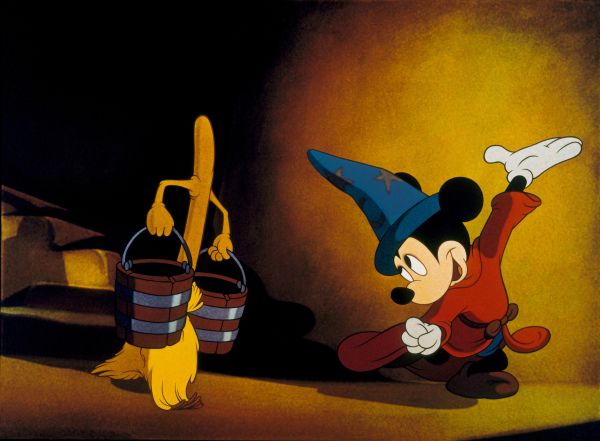
Fantasia is abstract art masquerading as mainstream entertainment. It seems almost unimaginable that that the film came out of Disney, and minus a few cute touches, an appearance of Mickey Mouse, and a few interludes that play like dull educational exercises the film really isn’t concerned with having mass appeal. It is a series of short animated segments set to classical orchestral music (one definition for "fantasia" according to Random House: “a composition in fanciful or irregular form or style”); the sequences are often devoid of narrative and feature almost no other sounds besides the music. This is pure cinema, a film concerned with overwhelming us with the force of its images and the essential power of cinema as a visual medium. What is some of this for, you may ask, and that would be the wrong question. It exists for its own sake. The segments that do feature narrative are underwhelming on a narrative level, but it is in the details, the fanciful and bizarre flourishes, that these scenes are imbued with that makes them so fascinating and enjoyable. Walt Disney was doing experimental and audacious things in 1940 with the film; he threw out the rulebook for what was expected of an animated film. Its animation is soft and radiant – something completely unheard of (and only just hinted at by Snow White and the Seven Dwarfs and Pinocchio). It pushed what animation was capable of, testing new techniques and styles, and it demanded that you not only take it seriously but animation in general. It succeeded beautifully.  

Grade: A

Tuesday, April 1, 2014

"Exotica" (1994)

Strip clubs are designed to seduce their clientele, to create spaces in which absent pleasures are vicariously provided. They fulfill a certain desire people have, but they really only serve to fill people’s wants not their needs. They imitate people’s desires but they’re a poor substitute for the real thing. Exotica focuses on the clients and workers at the titular strip club but it’s not really about a strip club. That’s merely a tantalizing hook, with the apparent promise of nudity, which allows writer-director Atom Egoyan to explore the void a place like a strip club, and the desires it fabricates, tries to fill. There’s certainly some sexy business, and Egoyan shows off some stripteases but he places them in the context of what they mean to different characters and what the emotional exchange being made is as much as the monetary one. But the true visual pleasure of Exotica is its sustained mood. Egoyan emphasizes how seedy and desperate this business is and the people who are part of this despairing place, but he also luxuriates in the alluring surfaces of it, the sexiness and sensuousness that hides such deep grief and melancholy underneath. The film unravels like a confounding mystery, but so much of the pleasure of the film, beyond Paul Sarossy's hauntingly sublime camerawork, is its enticing slow-burn; gradually piecing together what Egoyan intends so much of this to be for.

Grade: A-