Fantasia is abstract art masquerading as mainstream
entertainment. It seems almost unimaginable that that the film came out of
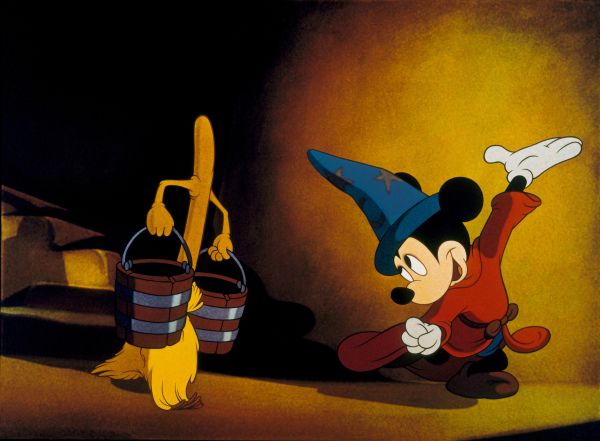
Disney, and minus a few cute touches, an appearance of Mickey Mouse, and a few
interludes that play like dull educational exercises the film really isn’t
concerned with having mass appeal. It is a series of short animated segments
set to classical orchestral music (one definition for "fantasia" according to
Random House: “a composition in fanciful or irregular form or style”); the
sequences are often devoid of narrative and feature almost no other sounds
besides the music. This is pure cinema, a film concerned with overwhelming us
with the force of its images and the essential power of cinema as a visual
medium. What is some of this for, you may ask, and that would be the wrong
question. It exists for its own sake. The segments that do feature narrative
are underwhelming on a narrative level, but it is in the details, the fanciful
and bizarre flourishes, that these scenes are imbued with that makes them so
fascinating and enjoyable. Walt Disney was doing experimental and audacious things
in 1940 with the film; he threw out the rulebook for what was expected of an
animated film. Its animation is soft and radiant – something completely unheard
of (and only just hinted at by Snow White and the Seven Dwarfs and Pinocchio).
It pushed what animation was capable of, testing new techniques and styles, and
it demanded that you not only take it seriously but animation in general. It
succeeded beautifully.
Grade: A

No comments:
Post a Comment