Thursday, March 13, 2014

"The Tenant" (1976)

It’s never entirely clear what is occurring in Roman Polanski’s uneven but arresting The Tenant, but it’s always clear why it’s happening. Polanski’s interested in getting at us on a level beyond intellectualism; it’s a purely emotional response built on inhabiting the mind of one person. Polanski plays Trelkovsky a mild-manner, nervous clerk who takes up residence in an apartment where strange things begin to take place. Whether these things are real or not doesn’t really matter, what does is that Trelkovsky does. Like Polanski’s Repulsion and Rosemary’s Baby, the film is about slowly unraveling the psyche of its protagonist and making us feel his distress and paranoia. We inhabit his headspace and we question along with him the peculiar behavior of his neighbors and the odd circumstances under which the previous resident died. By blurring fact and fiction Polanski heightens the story’s off-kilterness, and it slowly becomes impossible to tell what’s odd yet real and what’s just pure insanity at work. The Tenant takes the outward appearances of a thriller or mystery but it’s more of a character study. Polanski turns the apartment into an outward representation of Trelkovsky’s crumbling mind, utilizing the cramped space to make us feel trapped in his palpable anxiety and psychosis. 

Grade: B+

Wednesday, March 12, 2014

"The Thing from Another World" (1951)

The cold is almost another character in The Thing from Another World. Set at a cramped science station out at the North Pole, the film is constantly reminding you that damn is it ever cold this far north. The wind howls and the snow blows, and the chill seeps into our bones as much as the characters’. The other key factor that continues to make the film successful is its sense of space, or rather its lack of it. The characters are confined in small buildings, and they feel trapped in, which creates a sense of claustrophobia. When a UFO crash lands, a group of soldiers and scientists extract the frozen corpse of an alien, but the block of ice thaws and soon the creature is on the loose. How director Christian Nyby and cinematographer Russell Harlan choose to shoot the Thing (James Arness) adds to the effect of dread and discomfort. The film shoots the alien at a distance or in shadows, which, coupled with the makeup and special effects design, still serve to disturb. Minimizing the monster’s actual presence leads the film to nicely focus on the conflicting opinions and dynamics of those stuck at the station. Though Howard Hawks was only a producer on the film, his presence can be felt throughout the film. The film seems carefully attuned to Hawks’ directorial mantra: “Three great scenes, no bad ones”. It also features Hawks trademark sense of “macho heroics and succinct wit,” as Nathan Rabin described it. We may no longer be in the Atomic Age, but The Thing from Another World still works as efficient, well-crafted science fiction entertainment regardless of era. 

Grade: A-

"Suzhou River" (2000)

It’s impossible to think of Suzhou River without thinking of Alfred Hitchcock’s Vertigo. Writer-Director Lou Ye is clearly loosely borrowing the basic narrative and thematic predilections of Vertigo, as well as a handful from Hitchcock’s Rear Window. Low-level gangster Mardar (Jia Hongsheng) falls for Moudan (Zhou Xun), a woman he’s assigned to watch over but ends up falling in love with in the process.  However, things go sour in their relationship and Moudan jumps off a bridge, presumably to her death. But when her body is never found, Mardar presumes that Moudan is still alive and searches for her. When he meets MeiMei, a woman who looks uncannily like his former lover, Mardar assumes that she must be the same woman, or, at least, that he can convince her to adopt the same image. The story is told by MeiMei’s lover, a videographer who seems more infatuated by the images and idea of his girlfriend than the real thing. While Hitchcock’s interest was more in desire and obsession, which is still present here, Ye is more concerned with love. Why do we ask, demand even, so much from our relationships?  Why do we ask people to be something they aren’t?  Ye, like Hitchcock, is interested in surfaces: the ways images manipulate us and how we use appearances to mask our true selves and influence other.  In Suzhou River, love and obsession are a blur, feeding into volatility and passion. Ye forgoes the calculated exterior narrative of Hitchcock to focus on the untapped, raw emotional core interior. It’s ultimately messier but it glimmers with a the riveting force of its character's passions and cinematographer Wang Yu's alluring imagery. 

Grade: B

Tuesday, March 11, 2014

"The Scent of Green Papaya" (1994)


Notice the houses in The Scent of Green Papaya: huge, sprawling, and yet, deeply, almost uncomfortably, empty. There are people in the two houses where the majority of the film’s narrative occurs, but director Tran Anh Hung frames his actors so the space seems to overwhelm them. It’s constantly confining them. There isn’t a whole lot of plot to the film; it’s sustained more by tone and atmosphere, and it’s partially as compelling as it is due to how Hung shoots the film. But his stylistic choice makes sense: the film is about loss, isolation and muted passions. Set in 1950’s and 60’s Vietnam, the film is really two very different stories, a family drama and a love affair, connected by protagonist Mui, who becomes a servant in a fractured household at the age of ten. The first story dominates the narrative: Mui is not only a servant, and an observer of some tragic and overwhelming drama, but she’s a reminder of the family’s own loss of their daughter. She’s the age that their daughter would have been if she were still alive. This is one of many voids that need filling: the grandmother’s husband has long been dead (and she has an unrequited suitor who she refuses to let into her life), the eldest son is hardly ever around, and the father’s crippling gambling habits make him a flighty presence at best. The film flashes ahead ten years later: the family is still broken, perhaps irreparably, but they’re managing. Mui is hired by a bachelor, a friend of her former employer's eldest son, who’s nearly engaged to a woman, but he appears disinterested and disconnected. The second story turns Mui from an observer and to an agent of her own destiny. She and her employer slowly fall for one another. But this isn’t sordid; it’s flush with real emotion, and it’s the culmination of a lifetime of standing idly by watching the world crush spirits and dreams. 

Grade: B+

"Scandal vs. House of Cards"

Frustrated by consistently hearing people around me talk up House of Cards when it is a glossy but deeply hollow show, and equally frustrated that Scandal has not gotten enough of its fair due as one of the best television series currently airing, I wrote an article for my college's newspaper comparing the two shows. Hopefully I can convince you why one show is much better at telling its story, which are essentially the same story of a broken American political system.

"The Scarlet Empress" (1934)

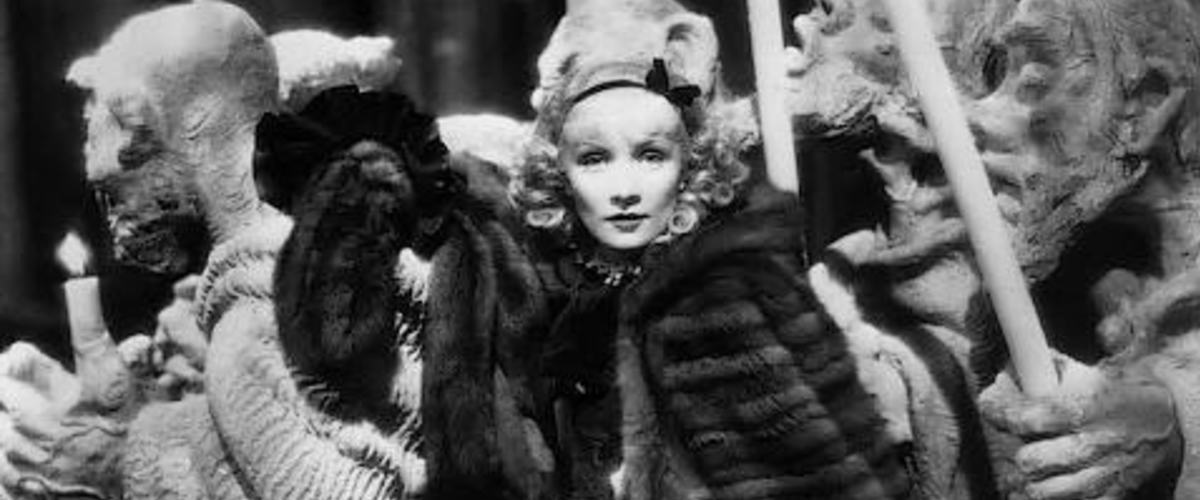
There’s a tendency to perceive Josef von Sternberg’s films as decadent or indulgent; his films looks exquisite and he likes focusing his lens on and packing his frames with lavish objects. But the graceful gaze of von Sternberg is ultimately deceptive. The Scarlet Empress is a film about the rise of Catherine the Great (von Sternberg’s frequent collaborator and muse Marlene Dietrich) to power, and it’s slightly unsettling just how little message or pointedness von Sternberg provides to the journey. He’s ambiguous, another consistent complaint. However, he’s less ambiguous than usually given credit. The film has its eyes set on the trappings of aristocratic life, but it also pauses to consider what the real price is to all of this decadence. This primarily comes in the form of dark power politics and fascinating gender politics. Catherine slowly discovers agency and a sense of self inside a system that sees her as either a pawn or ornamentation. The Russian tsarist system wants her around only for the sake of producing an heir, but when she grows dissatisfied, after discovering her arranged marriage is to the dimwitted and brutish Peter III (a delightfully bonkers Sam Jaffe), Catherine realizes that she can play the game to her advantage. All she has to do is produce heirs -- not necessarily by Peter's constitution -- and play nice around the right figures, but outside of her duties (which, it’s worth noting, are based on appearances) she can find satisfaction and power. She just has to play her cards right. Part of this comes from playing to her expected role as a female. Catherine is exploited here, but she’s also quick to realize how she can subvert gender roles. She’s not the only one. The ruling Empress before her, her mother-in law Empress Elizabeth (Louise Dressler), understands the realities for women in the 18th century but she never succumbs to them. The place where von Sternberg’s ambiguity can be troubling is in its treatment of Catherine’s character arc.* Catherine’s enters a naïve child and exits a ruthless monarch, and von Sternberg makes no judgment of it. The film ends its final moments as if they’re triumphant, but they’re also fairly disturbing. Catherine has gained so much, but at what cost? Well, it doesn't really matter when Dietrich is on screen and von Sternberg seems to forget he's supposed to be telling a story. He focuses on, really fetishizes, her, and in these moments von Sternberg's detractors might be right in letter but scarcely in spirit. I could watch those gorgeous surfaces all day.

Grade: A

*I'd just like to note I'm fine with its ambiguity and prefer it that way.  

Saturday, March 8, 2014

"Scanners" (1981)

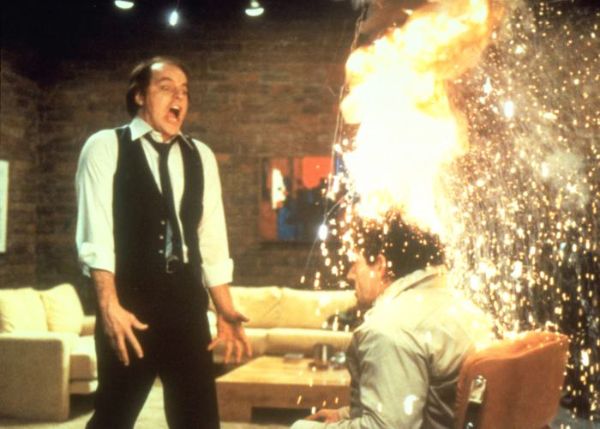
David Cronenberg has a knack for crafting images that are instantly and ghastly memorable, surreal and unsettling. He doesn’t use special effects to merely put you in awe but to get under your skin, to get at something more fundamental and hard to shake. In Scanners this moment comes early in the film in the film’s infamous exploding head scene. It’s disturbing but Cronenberg plays it beyond realism, emphasizing the excess and gruesomeness., which serves to make it even more macabre. Scanners is a film about identity, conformity and even mental health, but, above all, it’s a film about the body under stress. It is body horror, which is one of the more distressing and creepy forms of horror. This is largely due to the fact that the horror on display isn’t an outside force but an internal one and one that leads the body to go under contortions and damage no one really wants to witness. In the film, “scanners” are individuals with telekinetic powers who have become social outcasts and basket cases due to their abilities overwhelming them. ConSec is a corporation looking to turn these scanners into super soldiers, but they’re running into the problem of an underground scanner group attempting to dismantle the company and their research. Cameron Vale (Stephen Lack), a young, uninformed scanner, is sent to infiltrate this organization led by an exceedingly powerful rogue scanner (a delightfully committed Michael Ironside). Nothing quite lives up to the head-splosion moment, but really what could? It serves a purpose, getting us invested in the weird and wonderful world of Scanners where such perverse incidences are, gloriously and consistently, a natural occurrence. 

Grade: B