Tuesday, March 11, 2014

"The Scarlet Empress" (1934)

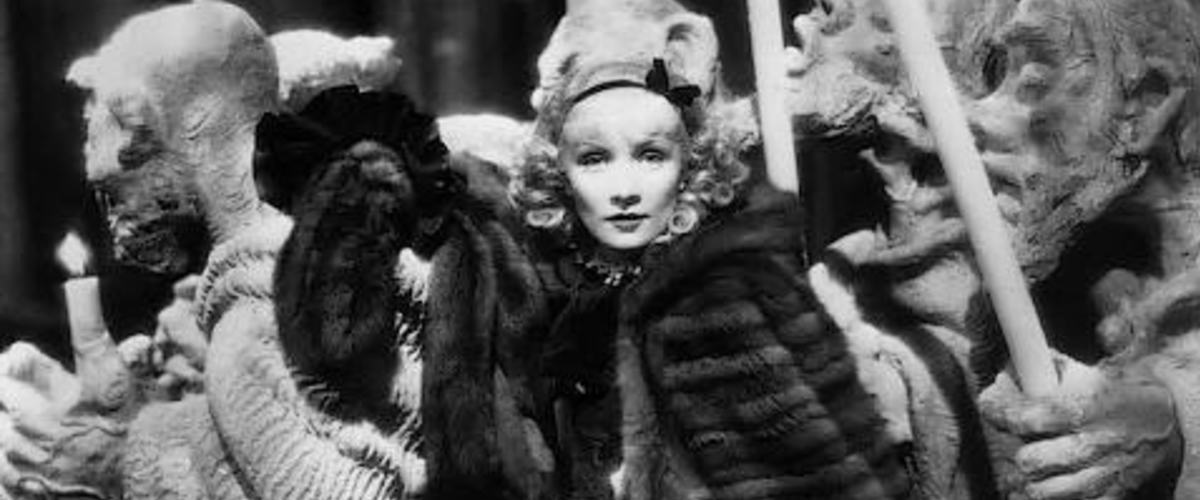
There’s a tendency to perceive Josef von Sternberg’s films as decadent or indulgent; his films looks exquisite and he likes focusing his lens on and packing his frames with lavish objects. But the graceful gaze of von Sternberg is ultimately deceptive. The Scarlet Empress is a film about the rise of Catherine the Great (von Sternberg’s frequent collaborator and muse Marlene Dietrich) to power, and it’s slightly unsettling just how little message or pointedness von Sternberg provides to the journey. He’s ambiguous, another consistent complaint. However, he’s less ambiguous than usually given credit. The film has its eyes set on the trappings of aristocratic life, but it also pauses to consider what the real price is to all of this decadence. This primarily comes in the form of dark power politics and fascinating gender politics. Catherine slowly discovers agency and a sense of self inside a system that sees her as either a pawn or ornamentation. The Russian tsarist system wants her around only for the sake of producing an heir, but when she grows dissatisfied, after discovering her arranged marriage is to the dimwitted and brutish Peter III (a delightfully bonkers Sam Jaffe), Catherine realizes that she can play the game to her advantage. All she has to do is produce heirs -- not necessarily by Peter's constitution -- and play nice around the right figures, but outside of her duties (which, it’s worth noting, are based on appearances) she can find satisfaction and power. She just has to play her cards right. Part of this comes from playing to her expected role as a female. Catherine is exploited here, but she’s also quick to realize how she can subvert gender roles. She’s not the only one. The ruling Empress before her, her mother-in law Empress Elizabeth (Louise Dressler), understands the realities for women in the 18th century but she never succumbs to them. The place where von Sternberg’s ambiguity can be troubling is in its treatment of Catherine’s character arc.* Catherine’s enters a naïve child and exits a ruthless monarch, and von Sternberg makes no judgment of it. The film ends its final moments as if they’re triumphant, but they’re also fairly disturbing. Catherine has gained so much, but at what cost? Well, it doesn't really matter when Dietrich is on screen and von Sternberg seems to forget he's supposed to be telling a story. He focuses on, really fetishizes, her, and in these moments von Sternberg's detractors might be right in letter but scarcely in spirit. I could watch those gorgeous surfaces all day.

Grade: A

*I'd just like to note I'm fine with its ambiguity and prefer it that way.  
Saturday, March 8, 2014

"Scanners" (1981)

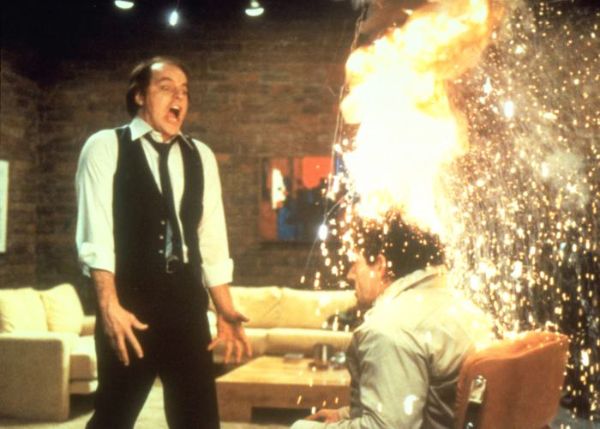
David Cronenberg has a knack for crafting images that are instantly and ghastly memorable, surreal and unsettling. He doesn’t use special effects to merely put you in awe but to get under your skin, to get at something more fundamental and hard to shake. In Scanners this moment comes early in the film in the film’s infamous exploding head scene. It’s disturbing but Cronenberg plays it beyond realism, emphasizing the excess and gruesomeness., which serves to make it even more macabre. Scanners is a film about identity, conformity and even mental health, but, above all, it’s a film about the body under stress. It is body horror, which is one of the more distressing and creepy forms of horror. This is largely due to the fact that the horror on display isn’t an outside force but an internal one and one that leads the body to go under contortions and damage no one really wants to witness. In the film, “scanners” are individuals with telekinetic powers who have become social outcasts and basket cases due to their abilities overwhelming them. ConSec is a corporation looking to turn these scanners into super soldiers, but they’re running into the problem of an underground scanner group attempting to dismantle the company and their research. Cameron Vale (Stephen Lack), a young, uninformed scanner, is sent to infiltrate this organization led by an exceedingly powerful rogue scanner (a delightfully committed Michael Ironside). Nothing quite lives up to the head-splosion moment, but really what could? It serves a purpose, getting us invested in the weird and wonderful world of Scanners where such perverse incidences are, gloriously and consistently, a natural occurrence. 

Grade: B

Friday, March 7, 2014

"Ashes and Diamonds" (1958)

“You can’t change things?” -Krystyna, Ashes and Diamonds

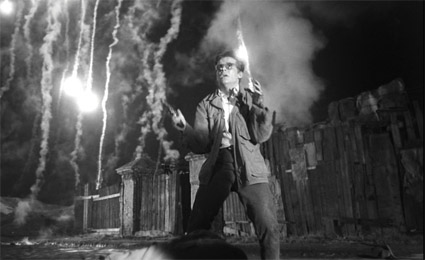
Forging a new nation requires compromises, and yet in the process of crafting a new national identity nations tell themselves, "This time things are going to be different: we’re not going to fall into the same traps as people did in the past". Ashes and Diamonds is about identity and compromise, nationally for Poland and personally for Home Army Soldier Maciek Chelmick (Zbigniew Cybulski), a resistance fighter who takes an assignment to assassinate a Russian official – representative of the new, growing communist threat from the Soviet Union. The film is set on the closing days of World War II in a small Polish town celebrating the end of the war with occupying Russian troops. Everyone in the film claims they are content with themselves, but we can tell they’re settling for second best. When the Maciek botches the assassination attempt, he hangs around the town in hopes of getting a second chance to eliminate his target. While killing time, his eye is drawn to the attractive and equally uncertain bartender Krystyna (Ewa Krzyzewska). Maciek falls for her, and not simply because he’s necessarily in love with her but because she represents for him a whole life he’s missing out on by being the gun for hire he is. Maciek contemplates getting out of the resistance life, realizing its futility, but if he doesn’t finish his assignment it will cost him his life. There’s no victory here for him. No matter what choice he makes he loses, and that’s the problem with the dawning of new eras: eventually they end, reality sets in, and everything is back to square one. Set against the gorgeous black and white cinematography of Jerzy Wójcik and marked by the coolness of Cybulski’s James Dean-aura, the fate of Maciek and his country is made all the more devastating and poignant. 

Grade: A-

Thursday, March 6, 2014

"Ernest and Celestine" (2013)

Ernest and Celestine is a film of pure joy for an hour and twenty minutes. There is simplicity to its storytelling and its imagery that belies a precision and exceptional craft. The film reminds me of the films of Charlie Chaplin, or, perhaps more appropriately, Jacques Tati: pure, beautiful, and utterly enchanting. Celestine is a mouse and Ernest is a bear, and they live in a Metropolis-like world of above ground and below ground cultures, divided by differences and reasons that have long faded into memory. The mice tell their children about the “big evil bear”, but Celestine, adventurous and precocious, doesn’t buy it. The film builds up a fully inhabited world, defined by its own logic and rules, and filled with memorable characters and locations. The mice steal the baby teeth from the bear world above to be used replacing their more delicate canines. They’ve built a culture around dentistry, but Celestine has aspirations to be an artist. Ernest, bumbling yet well-intentioned, is down on his luck and desperate to find some food. When he comes across Celestine he intends to eat her but soon becomes fast friends with her when she introduces him to the storage basement of a candy shop. The hand drawn animation is gorgeous: picturesque, delicate, and charming. Ernest and Celestine’s friendship makes sense to no one but themselves, and in that way it is, like all great friendships, a world onto itself. 

Grade: A-

Wednesday, March 5, 2014

"Born Yesterday" (1950)

Classism is sharply written into the plot and characters of Born Yesterday. But my favorite place it appears is in Judy Holiday’s wonderful, unconventional voice. Her voice is high yet soft, just a register off from shrill. It has working class written into its every syllable. But her voice also makes us almost immediately endeared to and interested in Emma "Billie" Dawn, a woman thanklessly engaged to crass businessman and con-man Harry Brock (Broderick Crawford). Harry has moved down to Washington D.C. in order to make some illicit deals with members of Congress, but Billie sticks out like a sore thumb in the polished, tasteful elitism of capitol culture. To remedy this Harry tries to pull a Pygmalion on Billie by hoisting her off on refined journalist Paul Verrall (William Holden) to be educated. Instead, Billie falls for the journalist and, through her studies, begins to realize Harry’s mistreatment of her. The drama and critique here are tame, reminiscent of Mr. Smith Goes to Washington. But it’s not really the point; the Capra-ian sincerity caters to a screwball sensibility, clashing Billie’s lack of formal learning with her crash course in culture. Throughout all of this, Holiday’s remains a thoroughly appealing presence. It’s easy to overlook what Holiday is doing here. She's playing a dumb blonde but the film doesn't pigeonhole her as only that persona. Notice the subtle changes in Holiday's voice. She's not only got great comedic timing, but she’s also doing small but significant vocal changes that not only win us over but also build an inner world, one that’s yelling, or, rather, squeaking, to be free. 

Grade: A-

Tuesday, March 4, 2014

"Gabbeh" (1997)

How much of Gabbeh is memory and dream? It’s hard to say; what is certain is that a young woman, named Gabbeh, is looking to marry a man who her father does not approve of. But it really isn’t about this because these events happened many years before, and Gabbeh, whose story is now woven into an old rug, suddenly appears and recounts this story to an elderly couple washing the carpet. This is a simple, what might be called magical realist, story but director Mohsen Makhmalbaf tells it in atypical ways. The film lacks really anything resembling a typical narrative structure. The old couple interacts with the people of the past, and they watch, almost as if watching a film or a theater performance, these memories, these parable-like stories, just off screen. Makhmalbaf will then intercut the story with digressions about life. And the film is ultimately about, nothing short of, life. The film tells its story in fragments, stops and stutters, and slowly accumulates meaning. Under what appears to be abstraction is a story of fable-like transparency. Memories do not flow out of us in nice, straight-forward packages but in shapeless, formless staccatos, and fables may resemble fairy tales but they are rooted in a much harsher reality. 

Grade: B+

"Glengarry Glen Ross" (1992)

Writer David Mamet’s dialogue has a distinctive cadence to it that makes it instantly recognizable. In Glengarry Glen Ross, Mamet’s foul mouthed, stylized dialogue is the showcase of the film. Wonderfully recited by Jack Lemmon, Al Pacino, Ed Harris, Alan Arkin, Kevin Spacey, and, in a scene stealing cameo, Alec Baldwin, the dialogue is fueled by an internal logic that creates a world onto itself. Glengarry Glen Ross is Death of a Salesman for a modern age. The film is about salesmen of worthless real estate property in a company that is long past being on its last leg. These men are informed that if they do not improve their sales they will be fired by the end of the month. They scramble to make sales to people desperate, foolish and dumb enough to buy into what borders on a scam. These salesmen should be slimy; they are often duping people, and they scheme and lie in order to get the sale done. Yet we never feel anything but sympathetic for these sad, sometimes awful, characters (and there is never a time where they don’t feel like larger than life presences that make them read more like characters than humans). Like Willy Loman, they’re oddly noble even when they’re pathetic. How much of this is due to Mamet’s dialogue? Mamet gives such interesting things for these people to say that we can’t help but listen, even when they’re selling bullshit even they wouldn’t buy. 

Grade: A-