Saturday, February 22, 2014

"The Stranger" (1946)

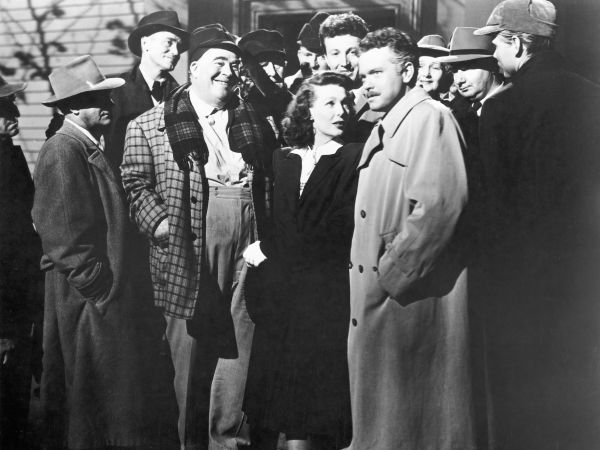
Orson Welles’ films wanted you to know you were watching a film. Welles was an ostentatious director, and he wanted his audience to marvel at his showmanship. Even not especially unconventional stories stand out when put under his flair for style. The Stranger is an exciting noir thriller about a government agent (Edward G. Robinson) tracking down an elusive Nazi Franz Kindler (Welles), hiding away under an assumed name in a small Connecticut town. The plot is fairly barebones, but within it Welles ratchets up the tension through atmosphere and deliberate pacing. As Kindler’s identity slowly becomes revealed, he tries to stay apace of the detective. His new wife (Loretta Young) becomes a pawn in the game of chess – or perhaps checkers would be more apt – between Kindler and the detective with Kindler feeding her convincing lies as the evidence mounts insurmountably against him and the walls close in on him, turning everything more claustrophobic. Welles contrasts the homey small town life against the deadly cat and mouse games, which only serves to turn everything all the more foreboding. He also gets a lot of mileage out of playing up the evils of Nazism, at the time still fresh in the public's mind. Welles may underplay just how terrible the actions of the Nazis were, but it’s all for an intended effect. Like its terrific Welles' noir counterpart Touch of Evil, The Stranger’s greatest trick is surrounding us in a moody ambience that suggests that there’s no good in this world, just varying shades of black and grey.   

Grade: A-

"Stella Dallas" (1937)

It’s become a cliché to say “It shouldn’t work, but it does”, but that description is surprisingly applicable to Stella Dallas. One of those weepie “women’s picture’s” from the 1930’s, the film features the expected near-histrionics plotting, but it’s anchored by a remarkable performance by Barbara Stanwyck, who makes this all more plausible and devastating than it sounds on paper. Stanwyck plays the titular Stella, a status obsessed working class woman who marries a down on his luck former millionaire playboy, foreseeing the potential wealth in store. That makes her sound heartless, but she’s more vain and self-deceiving than ruthless. Stella’s obsession with social climbing is complicated by her hard-nosed, scrappy upbringing. She can’t shake the habits or behaviors that mark her as an upstart. This leads her and her husband to grow distant and later become separated; taking turns to care for their daughter Laurel. Stella invests her whole life into her daughter, aspiring for her daughter the status and privilege that she herself is incapable of achieving. She vicariously lives through her daughter to an unhealthy fault, selflessly – for slightly selfish reasons – sacrificing herself and her happiness for the good of her daughter’s future. And Stanwyck sells all of this; the inflections in her voice, her posturing and mannerisms build a fully realized human being. Stella is deluded beyond all help, but her actions come from a troublingly recognizable place. 

Grade: B+

"The Letter" (1940)

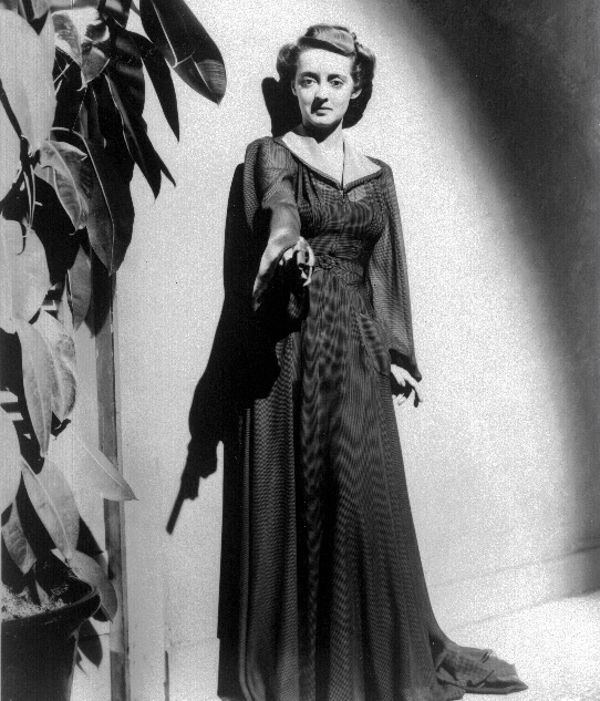
The Letter has a noir hard outer shell and a soft melodrama center. Tony Gaudio’s cinematography is languidly moody, dripping with the play of shadows that defined the noir. But the dialogue, the story and the performances are stylized in a manner more befitting the high emotions and ludicrous plots of the melodrama. Bette Davis’ Leslie Crosbie, the wife of a wealthy plantation owner in Malaya, is first seen killing a man. The look on her face demonstrates little remorse, and she fires off every single round in the revolver even as the man clearly lies dead on the ground. Leslie tells her husband, her lawyer, and the investigator a story about how a family friend attempted to rape her and how she killed him in self-defense. Director William Wyler makes it obvious from the get-go, however, that something is fishy here. This becomes corroborated when the lawyer’s assistant informs him that he’s come across a letter written by Leslie on the day of the murder inviting the deceased man over. Leslie is scheming at every turn but she never appears to fully think through her actions, scurrying to cover up one consequence after another. The Letter has some seriously outdated racial depictions regarding its Asian characters. The deceased man’s Asian wife is treated as a sinister figure almost entirely for her race and her nerve to be in an interracial marriage. Wyler’s direction suggests she’s a more deadly and less sympathetic figure than Leslie who is a manipulative, murderous adulterous. The Letter is elevated above its shortcomings through its performances and its atmosphere, and it still has the ability to strike a chord with the lubricious desire in all of us. 

Grade: B

"My Little Chickadee" (1940)

In every single movie Mae West was in she invariably played herself. The same was true for her My Little Chickadee co-star W.C. Fields. You could slap a character name onto them but no one was actually buying it. You went to see a Mae West film or a W.C. Fields film for their personalities. In hindsight, West and Fields were oddly well-suited. Each was liked for the delivery of their lines and the connotation of what they were saying. Their best dialogue functioned on double meanings and suggestion. West, with her swaggering, bawdy sex appeal, crooned out naughty lines about her extensive off-screen sexual conquests. Fields was a drunken buffoon as much off-screen as he was on, and his lines read like they were coming from someone trying convince you he was brilliant and put-together, when in reality nobody was really convinced. Fields spoke his lines in soft, muttering tones, trailing off into incomprehensibility. My Little Chickadee isn’t an especially good film, but it features these two distinctive performers and that redeems it. The film is a simple, almost redundant, western, with West as a woman whose purity is thrown into question when she has amorous relations with a masked bandit. She pretends to get married to the drunken conman Fields to set to rest any doubts about her maidenhood. Around this plot, the film allows for opportunities for West and Fields to play up their established personas. Much of the film separates them and switches back and forth between vignettes where they get in a few pithy pieces of dialogue. Besides the film’s ragged charm and humor, there is its sexual politics. Society questions West’s behavior but the film never does. West takes pride in her sexuality, and she simply shrugs off expectations and flirts with every guy around her. My Little Chickadee is often more advanced in its gender politics than many modern films: West remains single at film’s end and looks forward to more sexual adventures in her future. But really, who could contain Mae West?

Grade: B

Wednesday, February 19, 2014

"Letter From an Unknown Woman" (1948)

Unrequited love can be recovered from, but formerly requited love lingers with even the most hardened of individuals. Still yet, liking someone from afar, only to have your feelings confirmed and reciprocated, can breed an intensity of devotion and passion that can be unhealthy. Letter From an Unknown Woman by description sounds like a tawdry melodrama: a man, Stefan Brand (Louis Jourdan), receives a letter from a nameless, soon to be dead woman, Lisa (Joan Fontaine), recounting how she pined for him from afar, before having a glorious but brief affair that left her, unbeknownst to him, pregnant with his child. She kept the child secret because she didn’t want to ask anything of him – and probably because she thought it would temper the idyll of their time together. In the hands of director Max Ophuls though, the film rises above melodrama to become capital-d Drama. The film is aiming for high emotion, but Ophuls has deeper thematic interests about romance and love in mind, and he observes Lisa’s motivations and actions with sympathy while also understanding that they’re volatile and questionable. Ophuls treats the film like the opera music that plays a crucial role in the story, letting the camera glide along as if constantly set to an orchestral piece. Ophuls uses light and camera movement for expressive ends, emphasizing the progressively heightened emotions of Lisa. Notice the slow growth in high contrast of light and shadow; it’s subtle but crucial to our response. Lisa is a hopeless romantic who treats life with a corrosive dreaminess, all but predestined to blow up in her face. Even when Lisa gets exactly what she wants -- as she does on more than one occasion -- she finds excuses to induce things to fail because reality is never quite as satisfying as the unstable fantasy she’s built in her mind. 

Grade: A

Tuesday, February 18, 2014

"L’age D’or" (1930)

Luis Buñuel was fascinated by human nature. He was also quite cynical about it, and he thought of the human race as a depraved bunch, hiding behind a mask of politeness and civility. His second film L’age D’or caused something of a scandal for its candid depictions of and views on sex, and it was heavily censored for decades. The film begins with a seemingly non-sequitur scene describing the nature of scorpions, but Bunuel is really referring to humans, and he intends it, as almost everything he does, as a bizarre, derisive joke. The film’s main story is about a man and woman trying to have sex, but how social forces keep getting in the way of this. When they do get into the act, they look as if they’re in a parody of what sex is. They’re clumsy, and they all but ravage eachother. And that’s just the foreplay that never actually goes anywhere. Besides this central story though, the film is almost without plot, capturing moments of human weakness and selfishness with a twisted sense of humor. Bunuel fills the film with odd jokes that feel like they are there simply because they amuse him. The man attacks almost every living thing he comes in contact with, including a blind person wandering by. The man does it out of sexual frustration and self-entitlement, or may be for no reason at all. In one surreal moment, we discover that the woman has a pet cow, and see it lying in her bed. The film also features Bunuel’s indifference to religion and the Catholic church. In the film’s final moments, Bunuel ties up Christian iconography with sexual debauchery, and he does it for the sheer perversity of the joke. Today Bunuel's messages and ideas don't affect us like they did upon the film's release. In stead, what remains surprising is Bunuel's forcefulness in presenting his vision. No would mistake a Bunuel film for anything other than a Bunuel film; the audacity still shines through.

Grade: B+

Monday, February 17, 2014

"Lovely & Amazing" (2002)

Nicole Holofcener’s Lovely & Amazing is deceptively frivolous and lightweight. Holofcener isn’t concerned with traditional storytelling. There’s drama and there are moments played for laughs, but Holofcener often underplays a fair amount of what takes place. The low-key nature is in service of a story that feels true to life. The film looks at the lives of a family of four women, matriarch Jane (Brenda Blethyn), her two biological thirty-something daughters Michelle (Katherine Keener) and Elizabeth (Emily Mortimer), and her recently adopted eight year old African American daughter Annie. Michelle and Elizabeth deal with distant, inattentive partners. Elizabeth is an unsuccessful actress who lacks the confidence to make it big, while Michelle takes a job as a one hour photo job to get her husband off her back about her failing career/hobby as an artist. Meanwhile, Jane gets liposuction to take away what she sees as excess fat and tries hopelessly to flirt with her doctor, and Annie confronts issues of her racial identity and body image, complicated by Jane’s mixed messages about ethnic pride and self-image. Holofcener is interested in the lives of her women: their relationships, their work, their sense of self-worth. She isn’t afraid to have her characters come off as vicious, petty or lacking in self-awareness – or, by the same token, having too much self-awareness. The film is perceptive, observing the, often neurotic, behavior of these characters. In its best moments, especially its infamous, incisive nude scene, Holofcener places these women within the context of larger social and cultural forces. These women are as much products of gender norms as the screwed up family that’s, for better and for worse, bred them. 

Grade: B+