Jacques Demy's The Young Girls of Rochefort features all the sweetness and whimsey of the MGM musicals turned up to eleven. But rather than this becoming saccharine and excessive, it's infectious. The film is giddy and eye-popping and pure escapism. Yet Demy's guidance also never lets the affair turn mawkish. The film is tempered by an underlying sense of melancholy -- people keep missing opportunities or yearning for the past. But still, the music is playful, and the characters use music as an expressive way for livening up dreary and dour times. The elegiac emotional counterpointing of the pop-rock lightness creates a musical quite unlike any other (except perhaps for Demy's own exquisite The Umbrellas of Cherbourg). There's still room for unabashed romantic swooning, but it ultimately feels more earned due to a real sense of struggle and bitterness.
Grade: ★★★
Tuesday, December 31, 2013
"Melancholia" (2009)
Melancholia is possibly director Lars Von Triers most restrained film, and that may seem strange for a film where a planet named Melancholia threatens to crash into Earth and end life as we know it. The apocalyptic concern plays out in the background, ever creating a portent of doom and gloom over the proceedings. This feels right for a film largely about a character's struggle with depression -- something Von Trier personally dealt with. Melancholia is one of the most original and keenly observed films on the issue of depression. The film really gives a great sense of the struggles of someone burdened with the mental illness, but it even more strongly gets right the ways in which people around the afflicted individual confront this knowledge. Most precisely, the film understands how people fail to truly grasp what the person is going through, think it's an easy fix, and often make it about themselves. Mental illness is still something most of society doesn't quite fully comprehend, and the stigmas associated with it make it difficult for those who experience it to overcome it and relate to the people in their lives. Depression hangs over people like a giant planet just biding its time to crash.
Grade: ★★★
Grade: ★★★
"Anchorman 2: The Legend Continues" (2013)
The films created by actor-director duo Will Ferrell and Adam McKay (Stepbrothers, Taladega Nights) are puerile. They thrive on juvenile, silly, weird, hugely digressive jokes, and they live on the assumption you'll find Ferrell and his co-stars saying seemingly inappropriate, random or surreal non-sequiturs inherently funny. Enjoying a McKay film isn't a matter of being agreeable with its story but its anarchic disregard for politeness or logic. If you find Anchorman 2: The Legend Continues offensive or frivolous, you're right -- but that's the whole point!
The stories in these films are loopy, loosely strung together, and ramshackle enough that a light wind of critical analysis could upend it. The film picks up with drunken buffoon, seventies caricature, and news anchor Ron Burgundy (Ferrell) and his wife and co-anchor Veronica Corningstone (Christina Applegate), working at a New York news station. Veronica is offered the nightly news position and Ron is fired, which causes the manically selfish, and none too subtly prejudiced and sexist, Burgundy to spiral into his own meglomania. Ron walks out on his wife and young son. When offered a job at the new experimental twenty-four hour news channel, Ron reassembles the news team (Steve Carrell, Paul Rudd, David Koechner) in an effort to show up his wife.
It's the illusive, volatile flights-of-fancy between the actual plot where Anchorman 2 will either win your favor or leave you feeling meh. The film indulges free-wheeling, improvisatory moments here and there that more than occasionally don't feel entirely justifiable. For instance, a subplot involving the special needs Rick Tamland (Carrell) and an equally mentally challenged love interest (Kristen Wiig) is unbearably dull and unnecessary. It's not like its prequel was much better at this but it was leaner and more plot-oriented.
Still Anchorman 2 is funny. Too many moments fall flat, but there are some moments where the silliness is hard to resist. Some lines and jokes are surprisingly subtle and thrown out so causally and unobtrusively it's easy to miss the layers of meaning at work. In it's efforts to skewer the mega-corporation, twenty four-seven news cycle era, it never goes quite far enough. By moving from local to national news in its leap to sequel, Anchorman 2 similarly goes broader and loses some of the abundant charm in the process. Like a 24 hour news network, there's still charm -- you just have to be tuning in at the right moment.
Grade: ★★
Monday, December 30, 2013
"The Hobbit: The Desolation of Smaug" (2013)
Like its prequel An Unexpected Journey, The Hobbit: The Desolation of Smaug isn't simply an adaptation of a portion of J.R.R. Tolkien's novel, but an adaptation of multiple Tolkien works, including extratextual sources written by the author. By attempting to squeeze more into the film than just the the simple narrative of the book, the film consistently bites off more than it can chew.
The Hobbit is a simple adventure story and it's really the antithesis to The Lord of the Rings. Lord of the Rings is intended as a fantasy epic, while The Hobbit reads more like a folktale. As a follow up to the massive Lord of the Rings though, taking the novel on its own terms simply doesn't jive for attempting to up the ante. By trying to turn a small story into one that's gargantuan in scope, director Peter Jackson sacrifices a lot of the heart at the center of the story. In particular, Jackson completely loses perspective of his main character, modest homebody Bilbo Baggins (Martin Freeman), who has been swept up in a journey beyond his wildest imagination. Bilbo returns again with the Loony Toony band of dwarves looking to reclaim to their homeland and treasure. They go through many trials, notably facing the dragon Smaug (voiced by Benedict Cumberbatch) who guards their treasure.
But that is not the only story at play. Jackson adds subplot after subplot until the film seems incapable of doing justice to any single one of them. Gandalf (Ian Mackellan) seeks the returning threat of Sauron and his evil minions. A female elf (Evangeline Lily) unrequitedly pines for Legolas (Orlando Bloom), while also falling for one of the dwarfs -- surprisingly one of the sweetest and most affecting subplots. A smuggler (Luke Evans), at the base of the mountain where the treasure lies, desperately attempts to protect his town from the threat of the dragon.
As it is, the film never feels like all these elements are completely necessary. The barest bone concept for the film sounds entertaining enough: rapscallion misfits and their reluctant companion face trials and misfortunes as they try to reclaim lost treasure. That seems like the making of something pretty fun. In deed, when the film is just about a band of travelers on a single-minded quest, the film really clicks. A mid-film scene involving the dwarves and Bilbo escaping an elven prison by taking barrels down a river is far more crowd pleasing than it sounds on paper.
However, the film is draggy. There are too many false starts, and it ends both abruptly and in dreadfully bleak ways. Middle Earth is still an interesting world, and Jackson is still good at world-building, but there's simply far, far too much taking place and too often not enough reason is given to us in order to be invested.
Grade: ★★
"The Spectacular Now" (2013)
The interesting thing about The Spectacular Now is how, well, unspectacular it is. In one sense, it's just another one of countless films that tell coming of age stories -- a genre that is full of cliches and conventions. In another sense, the unspectacular nature is the honest mundanity of the story, and that's to the film's benefit. In the broadest strokes, The Spectacular Now is just another coming of age story, but in its more idiosyncratic story-beats and its attention to detail, the film rises above its conventions to become a deeply felt and sincere portrait of a specific time in young people's lives. It's youthful, hopeful, messy, intimate and sweeter than it has any business being.
Class clown Sutter's (Miles Teller) girlfriend just broke up with him, which, like most people, sends him into a spiral of depression. This is complicated by the fact that he's an alcoholic, although he can't fully admit this to himself. After a night of excessive binging, he wakes up on the front lawn of willowy nerd Aimee (Shailene Woodley). Miles initially seems to be using her to get over his ex (Brie Larson), but he also likes her for being so completely different than the crowd he's so used to surrounding himself with. Meanwhile, Aimee is so unfamiliar with relationships and romance that she's just happy to be noticed by someone -- anyone -- for once. An awkward, haphazard and sweet courtship between the two begins with neither quite sure what to make of it. They've both been insulated so long in their different cliques that they aren't quite sure what they've stumbled upon.
Everyone, including to an extent themselves, believes their relationship is all but doomed to fail. But somehow the very impossibility of it becomes its greatest boon as the two push eachother to get what they want out of life -- this might make it sound all too sappy but there's a certain naivete to this that makes it work. It's here where the story loses itself a bit, taking a detour into a subplot about Sutter trying to meet his absent father (Kyle Chandler, terrific as always). Outside of the relationship, the film stumbles, but inside the relationship it succeeds, forming a well-observed look at young love.
Sutter and Aimee remind me of more than a few people I knew from high school, and I mean that as a compliment. The characterizations of Scott Neustadter and Michael H. Weber's script are realistic and recognizable. The film is ably helped by its casting of its two leads. Teller and Woodley give two fantastically unaffected performances, and actually look like the age they're portraying. Woodley is especially adept at expressing the naivete of someone who has had so little experience with relationships that she's functioning off cultural expectations and fairy tales. But there's subtler things throughout the film -- such as costume choices: never made to look cool or hip but like what high schoolers might actually wear -- which add to the verisimilitude. The film, with such nuance and heart, captures the peculiar rhythms of high school romances.
While, especially in its final third, the film skirts dangerously close to maudlin and familiar, it's hard to resist its earnestness. If anything, the film overreaches with its course correction to teen romance depictions just before embracing some ill-advised excessive sentimentality. That it succeeds in avoiding this sentimentality for as long as it has is a testament to how well rendered the tender story has been.
Grade: ★★★
Friday, December 27, 2013
"The Wolf of Wall Street" (2013)
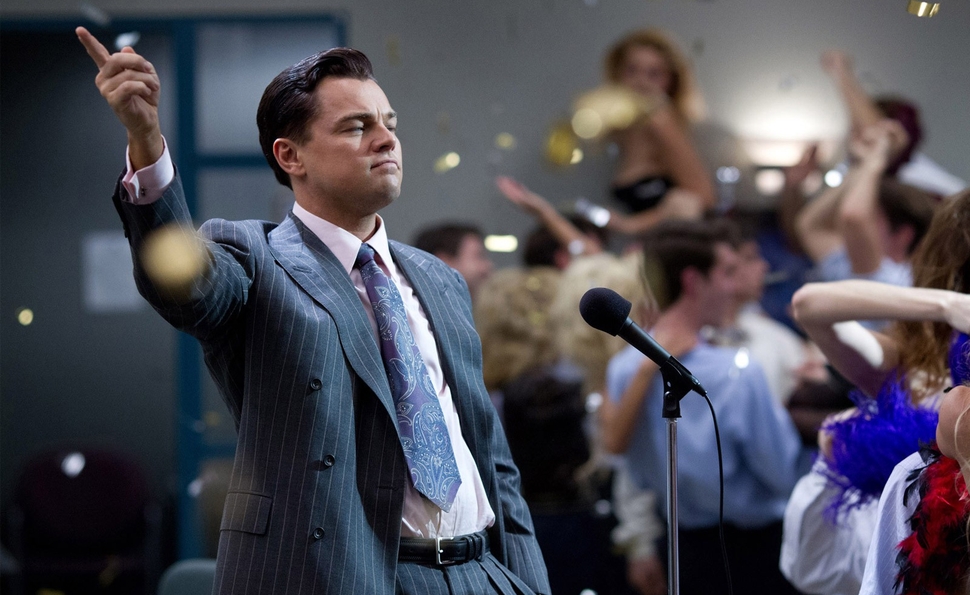
For Jordan Belfort life as a shark on Wall Street is an ever escalating series of quests for insatiable pleasure, and this is how director Martin Scorsese chooses to film his journey into ever increasing debauchery in The Wolf of Wall Street. Based on the memoirs of the real life story of Belfort, Scorsese uses the story of the ever-deluded and narcissistic climb towards wealth for its own sake as a searing, gob-smacked take down of capitalism. Terrence Winter's superbly constructed script utilizes Belfort's story as a bitingly satirical, highly hysterical window into the time period of the 1980's/1990's and the underbelly of the stock broker world, but, in truth, it's even more broadly aimed at America's dark side embraced by our disgusting economic appetites. Scorsese takes the energetic, virtuosic period crime drama storytelling of Goodfellas and sets his sights on putting us into the perspective of Belfort as the character enthusiastically guides us through his ludicrous story -- which he tells us in voiceover with a deranged pride in himself, his accomplishments, and his unhealthy behavior. Belfort here is Henry Hill if he were transplanted to Wall Street.
Belfort goes in fresh faced and naive into the late 80's stock market scene only to be blitzed by the mindset that bred Gordon Gecko -- introduced by a brief but pitch-perfect appearance by Matthew McConaughey as Belfort's first mentor. This simple-minded, straight edged all-American good boy is seen for a handful of minutes before transforming into a depraved, drug-addled, fraudulent man who is all too proud to call himself a "degenerate". It's a ferocious performance by Leonardo DiCaprio. He brings all his usual charimsa and charm to the role of a character who is by all rights monstrous. Yet Belfort is depicted as just selfish and deluded enough to fail to see past his limitations and the general idiocy of his misguided efforts.
Belfort is in Wall Street for a month before the 1987 stock mark crash causes him to be out of the job. He soon takes a job at a company working with penny stocks, where he cruelly screws over working class citizens who can barely afford stocks in the first place. Realizing the value of these worthless stocks being sold at a marked up value, Belfort creates his own company, Stratton Oakmont, that grows into, an all consuming broker giant. Even as he garners the attention of the SEC and FBI, Belfort carries on his illegal stock games and illicit personal habits.
Scorsese seems to want us to be swept up in the allure of this lifestyle. The delirium of his ever roving camera, pop and rock soundtrack, and the gameness of all actors involved gets us as addicted to the appeal of this little world as those actually popping pills and snorting coke. More importantly, Scorsese gets us caught up in this lifestyle before slowly stripping bare the atrociousness of these people, what they stand for, and everything they choose to be. There are some instantly memorable moments, particularly a sequence, we'll call it the "Quaalude Scene", which sees DiCaprio and his broker confidante and pal Donnie Azoff (Jonah Hill) in despicable, cringe-inducing, and very funny ways exposing how far their addictions and their belief in their own invincibility has gone.
In some ways the film feels like a dare to itself, introducing us to one deliriously shot, ludicrous situation after another. Though it clocks in at three hours, the film never feels long. Scorsese makes every moment as entertaining, surprising, and a piece-of-the-whole as the one that came before it. The incongruity between the way the characters perceive themselves, and the way we're meant to perceive them gives ample room for Scorsese to make us laugh at these awful human beings, who are sadly all too human -- Scorsese ultimately tries to get us to uncomfortably to see a potential version of ourselves in them -- despite how hyper and heightened the humor and style of the film is.
Grade: ★★★★
Thursday, December 26, 2013
"Fast Five" (2011)
In an age where blockbusters have gotten increasingly complex and convoluted to a fault, Fast Five stands out for the simplicity of its storytelling. That might make it seem hokey or corny or even dumb, whatever that means, but it also means the story never gets caught up its own ass. The clarity of its storytelling would put many films -- even more widely praised ones -- to shame. The film always has a exact sense of its characters, plotting, pacing and stakes -- things even the most simple-minded of films frequently fail to have, and therefore fail to properly engage us. Because the film has the audacity to be about some low-culture based things like high-octane car chases we label it as a stupid, disposable film, but Fast Five is a damn entertaining film. Some of recent action filmmaking's finest shot sequences are behind Justin Lin's carefully choreographed direction. The final action sequence, in particular, is beyond insane and implausible, but Lin always lets us spatially comprehend the craziness and that's crucial, and also adds to the thrills in subtle but vital ways. It's an adrenaline shot of action, but one that knows how to properly give the dosage.
Grade: ★★★
Grade: ★★★
Subscribe to:
Posts (Atom)