Monday, September 23, 2013

Breaking Bad: "Granite State"

The problem with judging an episode of a serialized television series is that some episodes only make sense or feel good in hindsight. After such breathless action, “Granite State” takes a big gulping breath to remind us of the consequences of what has unfolded while also bridging us to the end game for the show. In doing so it feels much more like its marking time, which makes it less notably memorable than some of the events of recent weeks. But you have to admit, few shows mark time like Breaking Bad.

Take the extended stretch of Walt out in New Hampshire. Not much happens, but it’s the way that happens that sets apart Breaking Bad from lesser series. Zach Handlen noted recently that what sets the show apart is how it turns its blatantly familiar serialized tv storytelling into one of its strongest assets. In the third season, we knew Walt and Jesse would partner back up but it was the way the show took seriously their divide and then carefully plotted out every little point leading to their reunion so that it felt totally earned that made it so much more than most serialized narratives. The show’s premise plays into the serialized model because we’re not watching a man stave off one consequence after another or turn from Mr. Chips to Scarface, as so often has been overused to describe the series, but rather we were watching Walter White slowly lose his soul. And watching every little thing that leads to that justifies the time spent so deliberately watching things unfold. 

This is why I point to the stretch in New Hampshire. It feels so very much like something we might have seen unfold in season two through four. Walt goes into hiding thinking that he’s going to plot revenge on the Nazis, and we slowly watch the little steps unfold where he barely has motivation to keep going – let alone plot this revenge. Note the little telling details that speak volumes to Walt’s state of being: His glasses prescription long having expired, asking the vacuum guy fixer to stay a few hours to keep him company, his wedding ring falling off his finger after large weight loss. Walt has given up on himself; there’s even a sense we’re given, for a time, that Walt could just live out his days in that isolated, idyllic New Hampshire cabin.  

This being an episode that takes its time (having extra episodic time to begin with) feels a little shaggier than our typical episode of Breaking Bad. It’s very loosely told and jumps around a lot. But there’s still a lot to like. Like how absolutely insane Todd is (Well, I guess “like” is the wrong word – more like love that you hate it). The only reason Jesse is still alive is so that Todd can try to please Lydia who he has a huge, creepy crush on (As far as justifications for keeping Jesse alive, it’s one I find to be great. It’s the kind of twisted, non-straightforward but intricate plotting the show has). Just look at the way he stares at Lydia, leaning over the back of his chair. He’s not experiencing love or infatuation – because who the hell knows if Todd is even capable of that – no, he’s experiencing obsession. And as if Todd weren’t atrocious enough he throws on a black ski mask and threatens the life of Skylar and baby Holly (!); this to protect his dearest Lydia. Somehow that’s still not the worst thing Todd does. No, that would be killing Andrea, but I'm getting ahead of myself. 

It’s hard to say who has it the worst out of the characters at the moment but at least Walt has choices. Jesse is as trapped as anyone can be. Imprisoned by the Nazis, he desperately makes an attempt to escape (MacGyvering his way out of his handcuffs with a paper clip – Jesse is far smarter than he’s often given credit). But alas he’s caught while climbing up the fence of the compound. He begs for them to just kill him already (and in that moment you’ve never wanted such mercy to be permitted upon a character). But nope: they’ve got to make him watch Andrea get shot in the back of the head. When she unlocked the door I was screaming out “No! Stay inside!” Now Brock is a poor orphan, a damnable piece of leverage to hold over Jesse. 

And then there’s what drives Walt to finally return to Albuquerque. Walt’s conversation with the fixer about whether he’d give the money to Walt’s family after he died made him realize he’s been a massive failure in the one regard he’s always at least claimed to be living up to. So he makes up a package of nearly a hundred thousand dollars and calls Walter Jr. (with a kindly bar patron pretending to be Aunt Marie in a phone call to the principal’s office). But Flynn has had enough of Walt’s crap. “I don’t want anything from you!” he yells. 

Walt has resigned himself to being caught, putting in a call to the DEA so they can locate him. He pours a drink and waits for the cops to arrive. When all of the sudden, the powers that be flicker the Charlie Rose talk program on the television featuring none other than his former Grey Matter partners who deny that Walt had any part in the creation of the company. “Virtually nothing,” they say. It stirs something deep down in Walt. This is the primordial pride that drove him to get into the meth business and refuse any and all handouts. He wanted to be acknowledged for his contributions. His money. His meth. His empire. His family. His name. Walt is super-possessive, and damn if he isn’t going to let things end on his terms. 

Stray Thoughts:

-I'm not sure the episode entirely justifies everything that occurred but it's a necessary bit of leg work to get us to the finale and so I'm willing to overlook it. If nothing else that last stretch with Walt's progression elevates the episode to a new level.
-Saul joins Walt in disappearing. The best moment here is Walt attempting to re-create his infamous “It’s over when I say it over” but coughs so badly midway through that he’s unable to. Saul can no longer be intimidated after a flub like that.
-Skylar barely hears any of the deposition; it sounds like screeching white noise. Similar to the funk Hank was in at the start of “Blood Money”.
-Walt was self-treating himself with the chemo while in New Hampshire. His inability to put the needle in himself before just nutting up and doing it is a wonderful little touch.
-Gretchen suggests one argument made about the show that the Walter that we saw at series start is long since gone and what remains is a shell of that man.
-The great character actor Robert Forster played the fixer Ed. Not sure I entirely understand or buy his continued relationship with Walt post-"witness protection", but a welcome presence none-the-less.
-Walt confirms that the things he said in his phone call to Skylar were, as some had argued, all intended to make her look blameless.
-Yea Todd, giving Jesse some Ben and Jerry's totally makes up for imprisoning him in a dungeon and turning him into your meth cook slave.
-Love that the show brings us way, way back to its roots by reminding us yet again of Grey Matter and tying that into Walt's decision to return home.

Grade: A-

"Sweet Smell of Success" (1957)

Sweet Smell of Success exists in that realm of films where people talk fast and think faster. It's a noir wrapped up in a more conventional drama about newspaper insiders. Everyone is trying to out think, out talk and out succeed the next guy, and few people seem above getting themselves a little dirty to get ahead. Journalist Sidney Falco believes himself to be too smart and too crafty to be stuck playing second fiddle to his boss columnist J.J. Hunsecker -- he writes a sensational, gossipy entertainment column that Falco wants to take over. Falco is Sweet Smell of Success's best creation; he's amoral and nearly without scruples but he's utterly compelling and charming in the hands of Tony Curtis. Its a performance that's matched at every turn by Burt Lancaster's cold, commanding Hunsecker. He's a man who's always in control and sends out Falco to go out and fix his every problem by any means necessary. Falco is fed up but he plans to turn his current task into sure-fired career advancement. He's been assigned to undoing J.J.'s kid sister's relationship with a small time jazz musician. Falco plays all the angles, attempts to force people into compromising and unpleasant situations, and sweet talks (occasionally slimily talks) his way in and out of every corner. He's not always as on top of things as he thinks but he's smart and ambitious and not afraid to do just about anything get what he wants -- even when it might not sit well with him as it slowly eventually does. The most memorable part of the film is the dialogue from Alexander Mackendrick (who also directed), Clifford Odets and Ernest Lehman's script; it's sharp, acidic and impeccably delivered by the cast.

Grade: A

This Week in Film (9/15/13 - 9/21/13)

A belated Master Post has arrived for last week's films. This week we have a lot of heartbreaking movies, a lot of movies about making movies, and simply a lot of good movies. Let's tally it up:

Blackmail (1929) - One of Alfred Hitchcock's earliest films and his first sound film. It's got nothing on his later classics but it still shows a lot of familiar Hitchcock trademarks: disdain for authority, links between sex and violence, and, of course, lots of suspense.

Breaking Bad: "Ozymandias" - If last week's Breaking Bad didn't make you just a little sick to your stomach than I'm not sure it succeeded but for all of the rest of us it continued the series brutal, scathing intensity that it has so expertly achieved in these last few episodes.

This Film is Not Yet Rated (2006) - Kirby Dick's insightful documentary about the shadowy, evasive and questionable Motion Picture Association of America takes tactics that undermine its message but its subject matter is so ripe for criticism that it's hard to get mad.

New Girl: "All In" - New Girl kicked off its third season with a premiere that proved that hadn't lost much steam coming off of its excellent second season, tackling the consequences of Nick and Jess becoming a couple and simply being as fun and endearing as ever. 

Who's Afraid of Virginia Woolf (1966) - Mike Nichol's domestic drama is difficult to get through and it's to the credit of Elizabeth Taylor and Richard Burton's powerhouse performances in the lead roles that it still has this effect.

Claire's Knee (1971) - Eric Rohmer's breezy, sumptuous small scale character study and examination of romance is like a nice little vacation away from reality filled with self-discovery, witty travel companions and beautiful French countryside locales.

Jason and the Argonauts (1963) - Come for the Greek mythos stay for special effects extraordinaire Ray Harryhausen's phenomenal pioneering stop motion effects.

The Cabin in the Woods (2012) -The Cabin in the Woods is part horror, part comedy, part meta-commentary, and all pretty damn fun. It's about why we watch horror movies and the ways in which they tell their stories, but it's also its own weird, idiosyncratic, wholly original work that deflates the genre even as its embraces it.

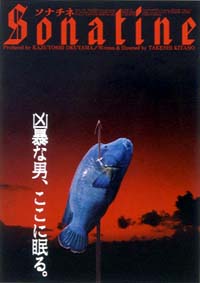
Sonatine (1993) - Takeshi Kitano's surprisingly affecting gangster drama shows gangsters as would-be machismos in way over their heads. It's a film that's rather funny even as its elegiac and sad. The gangsters get an unexpected break from their yakuza business and spend it goofing around, demonstrating their inner, care free selves but the reprieve is bittersweet as it is not long to last.

Sunday, September 22, 2013

"Sonatine" is as Playful as It is Heartbreaking

For a large portion of its run-time the gangster film Sonatine treats itself more like a sincerely goofy, playful comedy than a gangster drama. The simple task of negotiating a truce between small time criminal outfits goes awry and Murakawa (Takeshi Kitano -- who also wrote, directed and edited) and his surviving outfit are forced to go into hiding at a beach house. Here they play practical jokes, and care-freely mess around. And yet it's also a truly melancholy and sad film. Sonatine is interested in playing against gangster expectations; these aren't tough, masculine yakuza. They are just a bunch of guys who fell into this lifestyle, and the gangster life ultimately forces them to pay a price (Watch as people keep repeatedly discussing retiring, weary of the whole enterprise -- poignant even as it's ironic). Kitano underlines the film with a dry deadpan style (compositionally but not texturally, where it is often hauntingly beautiful). The big moments of action almost feel matter of fact and the characters treat them as business as usual (they can't afford to see it any other way). The time at the beach house is reprieve for them where they can be their true selves away from all the posturing and business, and that makes it all the more heartbreaking even as it is really funny.

Grade: A-

Saturday, September 21, 2013

"The Cabin in the Woods" is Smarter, Funner and More Rewarding Than the Average Horror Movie

If The Cabin in the Woods were merely its elements of horror, it would be a better-than-average but disposable addition to the genre. But you add in the other half of this film to the equation and the film almost ceases to be a horror film. It becomes, in part, a comedy, yes. But it also becomes a well-honed piece of postmodernism, deconstructing and playing off of our knowledge about how horror movies tell their narratives. To tell you how it does this though is to give away a great deal of the pleasure of watching the film. Like all good horror, it is built on surprises and expectations. It gives us the scares and the post-Saw bloody excesses we've come to expect, but it also wants to be so much more. It's smarter than the average horror movie and far more rewarding as well. It is about horror and why we watch it -- making it intellectually more satisfying than the typical studio fare -- but this also ignores the fact that it's a damn fun film, always trying out new things, affectionately riffing on and embracing the genre, and slipping in a Whedon-ism or two or twelve.

Grade: A-

Friday, September 20, 2013

"Jason and the Argonauts" Continues to Please with Ray Harryhausen's Top Notch Special Effects

Jason and the Argonauts is a quaintly dated epic about a Greek mythic hero's adventures. It is overly melodramatic, occasionally creaky, and very, very corny. However, what stands above all this is special effects pioneer Ray Harryhausen's fantastic special effects, using miniatures and stop motion animation to bring to life the mythical monsters and dangers Jason and his crew comes across. The story almost feels like an excuse for Harryhausen to dazzle us with skeleton warriors and giant bronze statues with a mind of their own, and that's totally okay because it's worth it just to get to the scenes where Harryhausen puts every ounce of imagination, skill and craft into building amazing action sequences, worlds and monsters.

Grade: B

Wednesday, September 18, 2013

"Claire's Knee" is a Smart, Witty Romance

It's to the credit of director Eric Rohmer that none of the behavior in Claire's Knee feels predatory, but rather romantic, sweet, delicate and aloof. When Jerome goes to sell his family's home, he ends spending the time playing out an odd experiment for old friend Aurora. Neighbor Laura, who's only 16, clearly has a crush on Jerome and Aurora wants Jerome to test how far Laura is willing to push her infatuation. Jerome finds it a bit silly but goes along with it; he says for the sake of Aurora but he's also sorting out some of his own feelings now that he's about to get married to a woman who he's had a tumultuous on-and-off-again relationship with for nearly six years. Jerome is the kind of person who claims he could never settle down and love one person, not fully at least. He's a lover of the world who's not satisfied with any one lover, but yet he ultimately finds himself cold towards everyone but his bride-to-be (who we never actually see, except once in a photo). He and Laura recklessly push forward with a game of chicken as to how far they're will to push their little affair but it ultimately doesn't amount to much (a simple kiss that never leads anywhere), and Jerome's eyes start falling upon Laura's recently arrived step-sister Claire who he finds himself mesmerized by even though he says he has no desire for her. The title refers to his fascination with her knee, which he claims holds the key to her psycho-sexual feelings, and imagines if he can just caress will alleviate any strong feeling he has for her.

There's a breezy, amiable, at times sensuous feel to the film marked by its gorgeous French countryside locales and meandering, casual dialogue. Rohmer pokes at the issues of romance, love, and fidelity from multiple different angles never suggesting to us that there's any one right away about them.

Grade: A