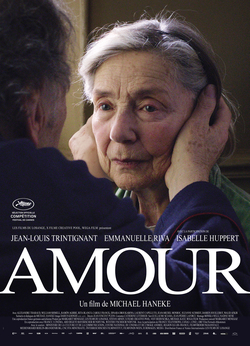
Amour is not an easy film to sit through, but it's not a film that's intended to be easy to swallow. It stares its subject matter straight down with brutal honesty and quiet dignity. It's an undeniably uncomfortable, deeply intimate and realistic portrait of an elderly couple's struggles when one suffers a stroke, her health slowly deteriorating.
When Anne (Emmanuelle Riva) suggests they just euthanize her and avoid the inevitable consequences of this, her husband Georges (Jean-Louis Trintignant) responds, "What would you do if you were in my shoes?" When wedding vows are spoken we sometimes take for granted that "for better or for worse" and "until death do us part" are commitments we are taking upon ourselves. And Amour shows its titular meaning of "love" throughout the film; depicting love in old age and in the face of health problems with nuance and earnestness. Love evolves with age and time spent with a significant other, and the film puts this love to the test and its breaking point. Georges begins looking at the woman he knows is his wife and she starts to become a shell of her former self, barely resembling the person he fell in love with.
At the heart of this is the fantastic performances of Riva and Trintignant who build a whole history of a relationship before our eyes. It's not devastating just because Anne grows steadily ill but because Georges stands so steadfastly by her side even as she barely recognizes his presence. And the film takes us step by step through the mental and physical regression that Anne goes through and the consequences this has on those around her.
There's a haunting beauty to the film. It's a dark, devastating film but also a highly humanistic one. It's lump in the throat, mature, and complex emotional examination of love in old age and the effects of a stroke is heart-wrenching.
Grade: A
Thursday, August 22, 2013
The Shakespearean Resplendence of "Ugetsu Monogatari"
When watching the Turner Classic Movie airing of Ugetsu Monogatari, Ben Mankiewicz described the film as Shakespearean. I'm reminded of what Joss Whedon recently said of Shakespeare: "Shakespeare is someone that I believe lived by a motto that I strive
for, which is 'subtlety is for little men.' There's tons of subtlety for
texture, but he's go big or go home." He might as well be describing director Kenji Mizoguchi. Mizoguchi is telling stories in the realm of fables with grand themes and big ideas. He puts his characters through endless tragedy and devastation and all in the name of making us feel on an emotional level as big as the scope of his story. But Mizoguchi has care for detail. The look and feel of the film is beautifully shot in black and white, playing with shadows and lightness versus darkness (particularly in a scenes that have one foot in fantasy).
Ugetsu is a tale about obsession and not knowing what you have until it's gone. But Mizoguchi wants to show us the slow, slippery slope where little by little characters lose a little of their soul and their frugal rationality (It's a film of deliberateness -- Mizoguchi seems to be interested in getting to the end where he can say, "See! That's what it all meant"). Characters overreach for goals that are arbitrary and self-serving, only for it to come back and bite them in the ass. And they do it due to some singular flaw, desire for money or fame.16th century poor Japanese farmers find that the sale of pottery wares proves successful and then become caught up in their fixation on making it big (one is concerned with buying armor and a spear in order to become a samurai which is played for laughs at times). It doesn't stop there though; the grandeur turns the story into increasingly loftier and heightened storytelling. The characters are caught up in the midst of warfare and the ethereal and otherworldly creeps in to help put a finer point on the film's themes.
There's a startling beauty to Ugetsu. Its simple tale, fluid camerawork, and exquisite cinematography transport us to a fable-like world that we know to be unreal and yet it still hits close to home.
Grade: A
"The Exterminating Angel" is as Thought Provoking as It is Twistedly Fun
The Exterminating Angel is Luis Bunuel's darkly comical, surreal and absurd deconstruction of bourgeoisie social expectations. After a party ends at a wealthy Spanish estate, the guests find themselves unable to leave the room. At first they just spend the night, but when it turns out no one can enter the premises, they start getting desperate and turning on one another. All bets are off as social proprieties are thrown out the window. Turns out they all hate each other and only feign liking one another due to social norms and social standing.
Why can't they leave? It doesn't really matter. An explanation is never given and who cares as it's all one big, bitingly funny allegorical snipe fest at the rich and their excessive, selfish lifestyles. In their desperation the film finds increasingly amusing ways for them to attempt survival. They break a hole into the wall to get water out of a pipe. They wreck furniture to start a fire and roast animals.
Throughout there's little details specific to Bunuel's cynical regard for human nature. A woman keeps a dead chicken in her purse. The owners of the house have a pet bear, and some sheep (a symbol for the people).
It's an absurd premise but everyone is so serious and committed to the idea that they can't leave the house that we begin to believe them. And as they throw off the act of social politeness and spar with one another, the film becomes far too entertaining to question the surrealness of all this.
Grade: A
Wednesday, August 21, 2013
"What Maisie Knew" Gives a Harrowing, Powerful Portrayal of a Custody Battle
My father is a divorce attorney. The way he describes his line of work has always been that it pays the bills but over time it's begun to wear on his soul. The fighting between couples is bad enough but once custody of children becomes part of the equation the cases nearly always become entrenched nightmares. Neither parent willing to yield ground or make compromises. The real issue though is that parents tend to forget about the children; their children become pawns in a selfish struggle to get one over on their soon to be former spouse. For about the first two-thirds of its run time What Maisie Knew is scarily spot-on in depicting the bitter and despairing fight for custody of a child and, more importantly, the effect this has on the children who don't have any say in it.
The film is seen entirely from the perspective of Maisie (played astoundingly well by six year old child actor Onata Aprile) -- intimately shot from low angles by handheld cameras with many close ups. Maisie is too young to fully comprehend the pull and tug she finds herself in the middle of. More disheartening is that both her parents (Julianne Moore, Steve Coogan) are pretty awful parents beyond their relentless and viscous desire to get one over on their ex. Moore is an aging rocker who's more interested with selling records and going on tour than taking care of her child, and Coogan is a self-important businessman who gallivants off to England and Italy whenever business demands. Coogan soon marries the formers caretaker of Maisie (Joanna Vanderham) and to keep up with the brinksmanship Moore quickly thereafter marries her boyfriend (Alexander SkarsgÄrd).
In the fittingly ironic nature of the film's world, the new spouses prove to be far better suited at taking care of Maisie than her actual parents and eventually bond over how terrible they're being treated by their new partners. In fact, Maisie grows more greatly attached to her new parents than her actual parents who are continually barely in the picture. This aspect of the film, that escalates as the film gets towards the end, gets the film into an area of melodrama that isn't nearly as interesting as the brutally realistic glimpse of the custody battle; but it also allows the film to finally give Maisie a fate where we don't have to worry that she's just going to be abandoned on a street corner (as she is at one point).
The film's intimate, searingly unromantic look at divorce and custody battles is heartbreaking, but it's the sort of film that you want to break your heart because it earns that heartbreak. Though it gets a little too heartwarming and sentimental by the end, the time it spend unflinchingly exploring Maisie's unjust situation is powerful.
Grade: A-
"Only God Forgives" is Beautiful to Behold But Boring and Brutal
There's no denying that director Nicholas Winding Refn can compose some hypnotic imagery. Only God Forgives is filled with bruising, neon sights that are quite tantalizing, but underneath this vision is a hyper-violent, hyper-masculine, hyper-sexualized film that has absolutely no clue what it wants to be. It looks pretty but like most films that go for style over substance, it's simply lacking.
Ryan Gosling's childlike Julian hunts for the man who killed his brother in Taiwan (why it's set in Taiwan and how poorly it utilizes its locale is only one of many baffling questions). The man who killed his brother did it after Julian's brother raped and murdered his daughter. He was pointed in the appropriate direction by a corrupt police captain (Vithaya Pansringarm) who likes using a katana as his weapon of choice (because: it looks cool, obviously). The cop serves as the film's villain, although there's not really "good" or "bad" guys; everyone is a little screwed up. This isn't even mentioning the twisted mother-son relationship between Julian and his mother Crystal (Kristen Scott Thomas) -- who pushes him forcefully to avenge his brother's death even as he's conflicted over it.
To match the film's heightened visuals are muted emotions. But a lot of this comes off as poorly conveyed motivations (The emotions are so understated that when emotions broil it's hard to comprehend why people are blowing up. It also leads to some awkward and terrible line readings). Refn likes tinkering with cool looking imagery but he can't really fathom good reasons to justify it.
Refn's previous effort, Drive, took a similar approach to storytelling, and also featured Gosling as the soft spoken, mysterious lead character. Drive, however, used its imagery as an outward expression of inner desires and feelings (it also had a much more straightforward and elegantly told premise). Here the imagery and the story it's in service of don't align and that leads to a lot of this feeling empty.
Grade: C-
The 1978 Re-Make of "Invasion of the Body Snatchers" Amps Up the Creepiness and Suspense From the Original
1978's Invasion of the Body Snatchers is a re-make of the 1956 classic science fiction-horror film of the same name. Where the original had the underlying metaphor of Cold War paranoia, the re-make ditches the subtext in favor of a more generally creepy and atmospheric vibe. Aliens are possessing the bodies of humans and walking around pretending to be the people they stole the bodies of, and, of course, in due time a handful of people catch on (played by a solid cast that includes Donald Sutherland, Brooke Adams, Jeff Goldblum and Leonard Nimoy). We're given far more of the why in this version of the story which allows for some opportunities for the special effects to really shine. This, in tandem with the jittery score by Denny Zeitlin (surprisingly the only score he ever composed) and the haunting mood provided by Michael Chapman's cinematography, lands some truly intense and unsettling moments. The film is dizzying slow descent into madness and unease, increasingly becoming claustrophobic and confining.
Grade: B+
Grade: B+
Tuesday, August 20, 2013
Breaking Bad: "Buried"
We’ve been here before haven’t we? Walt finds himself in
some impossible corner. Hank is within spitting distance of solving some
longstanding mystery. Jesse is broken down and paralyzed. Round and round the
plot wheels go … but like the roundabout we find Jesse lying on at episode’s
start, there’s seemingly no end to the circularity of this.
Of course that’s not entirely true. There’s much more
history the show is building off of to complicate the situations characters are
in. And the revelations characters are privy to could only possibly be
happening this late in the show’s run. But I keep coming back to that
roundabout, which we see at the start of the episode. This is the only time we
see Jesse until the very end of the episode and it gives us a visual
representation of where Jesse’s mind is so that when Hank stops into the
interrogation room, we know exactly where this is headed. Jesse has snapped;
his face is a painfully blank slate. He’s resorted to the inner childlike being
that he’s always been to some extent (it’s no coincidence he end up on a
playground).
The conflict has been set for the rest of the season: Hank
versus Walt. Both thinking alike turn to Skylar, but Hank gets to her first.
This fits with the direction the flash forwards have implied. Walt’s demise hath
cometh (tis only a matter of time). The titular “Buried” refers to Walt hiding
his money so the last shreds of evidence against him are gone (stunningly shot
as to be expected), but it also refers to how deeply the weight of everything that’s
happened is crushing every one of the characters. When Skylar says “I can’t
remember the last time I was happy,” she might as well be speaking for
everyone.
New members are being brought into the fold of this Club of
Misery. Hank in a desperate gambit tells Marie about the truth of Walt. His
initial efforts with Skylar get him nowhere. Skylar as always is too concerned
of what will become of her family if the truth goes public. The scene between
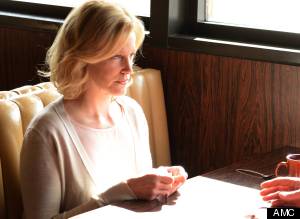
Hank and Skylar is the first of a number of fantastic scenes for Anna Gunn and
those opposite her. Betsy Brandt gets some of the meatiest material she’s
gotten throughout the entire series run and knocks it out. Skylar beginning to
speak but failing to find the words to say is some of the finest acting Gunn
has done, and Brandt’s horrified, disgusted, “Your sorry” is chilling. It would
be more chilling if it weren’t for the incredibly intense standoff after where
Marie attempts to leave with Skylar’s baby (for a moment I thought the baby
might die in the ensuing fight).
While it appears that Jesse is the key to Walt’s undoing,
there is still the other wildcard of Lydia (and Todd as well) who offs the
Phoenix distributors for failing to keep up a high quality of cook. Lydia wants
Walt back in the game and Walt, as Skylar notes, just needs to lay low for a
while. But whenever things get quiet on Breaking Bad, it’s never for a long
time. The plot demands forward momentum; the piling on of consequences and the
furthering of their reach.
“Buried” was as deliberately plotted out as the show has ever
been (picking up immediately after the events of last episode) but also had a simultaneously
viscerally intense drive. Who expected Hank to go to Skylar this soon? Who
expected Marie to learn this early? The show is keeping on track with its
timeline but it’s still thrilling and shocking (and lots of fun) to see the
series move with such confidence and pull it off with aplomb.
Stray Thoughts:
-The way Walt and Hank are shot after the garage door opens
is like an Old Western standoff.
-As great as Anna Gunn’s performance was this episode
otherwise, the line reading of “Am I under arrest?” felt a little flat.
-Huell and Kuby lying on the pile of money, contemplating
running away with it, is the show’s much needed black comic antidote it slips
into every single episode and it worked in spades.
-“Send him on a trip to Belize”
-“It was me” - Walt comes the closest he has yet to admitting
this is all his fault and accepting responsibility.
-The shell casings falling into the bunker was a nice little
touch.
-We get the return of the two cops that interrogated Jesse
in season four’s “Face Off”.
-I like how the show has Hank acknowledge that the moment
that he tells the police that Walt is Heisenberg that it’ll be the end of his
career. A well-played moment by Dean Doris in an episode that has plenty worthy
of being his Emmy submission.
-It feels appropriate that Jesse would have a hand in taking
down Walt. He deserves to get back at him after all that he’s been put through.
-Did anybody else cheer when Marie got in that slap? Perfect capper to that scene.
Grade: A
Subscribe to:
Posts (Atom)