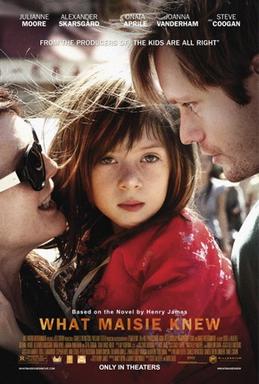
The film is seen entirely from the perspective of Maisie (played astoundingly well by six year old child actor Onata Aprile) -- intimately shot from low angles by handheld cameras with many close ups. Maisie is too young to fully comprehend the pull and tug she finds herself in the middle of. More disheartening is that both her parents (Julianne Moore, Steve Coogan) are pretty awful parents beyond their relentless and viscous desire to get one over on their ex. Moore is an aging rocker who's more interested with selling records and going on tour than taking care of her child, and Coogan is a self-important businessman who gallivants off to England and Italy whenever business demands. Coogan soon marries the formers caretaker of Maisie (Joanna Vanderham) and to keep up with the brinksmanship Moore quickly thereafter marries her boyfriend (Alexander Skarsgård).
In the fittingly ironic nature of the film's world, the new spouses prove to be far better suited at taking care of Maisie than her actual parents and eventually bond over how terrible they're being treated by their new partners. In fact, Maisie grows more greatly attached to her new parents than her actual parents who are continually barely in the picture. This aspect of the film, that escalates as the film gets towards the end, gets the film into an area of melodrama that isn't nearly as interesting as the brutally realistic glimpse of the custody battle; but it also allows the film to finally give Maisie a fate where we don't have to worry that she's just going to be abandoned on a street corner (as she is at one point).
The film's intimate, searingly unromantic look at divorce and custody battles is heartbreaking, but it's the sort of film that you want to break your heart because it earns that heartbreak. Though it gets a little too heartwarming and sentimental by the end, the time it spend unflinchingly exploring Maisie's unjust situation is powerful.
Grade: A-

No comments:
Post a Comment