*Spoilers Below*:
The nature of the beast of television requires that episode after episode after episode gets churned out. The end result is to have enough episodes to re-package for a syndication deal (the most profitable thing a television series can do, especially for the broadcast networks). In the mean time a show's job is to sell ad space. And this is in part the reason television has been looked down upon as a second rate cousin to film. Film's can tell neatly contained, well-wrapped up narratives. Television can reach highs but has to keep spewing out content even if its long ceased making sense from a quality perspective to keep a show on the air.
Serialization was something that was not really possible for the most part (outside of, say, a mini series). Some shows played with it, but attempting to draw in as many viewers as possible made that, for the most part, a toxic concept to the networks. Then The Sopranos became a sizable success, and though it wasn't a hugely serialized series, it had enough that that element was scooped up by shows born in its wake. Serialization is a a serpent eating its own head though. Yes, you can tell a long form story but the plot in turn becomes hugely important to how people perceive and enjoy the show. And when a finale or final season doesn't pay off fan's expectations or falls somewhat flat it recolors audiences' views of the show as a whole (as was the case with the divisive finales of Lost and Battlestar Galactica or even The Sopranos - which frustrated people less because it was bad and more because it was just weird).
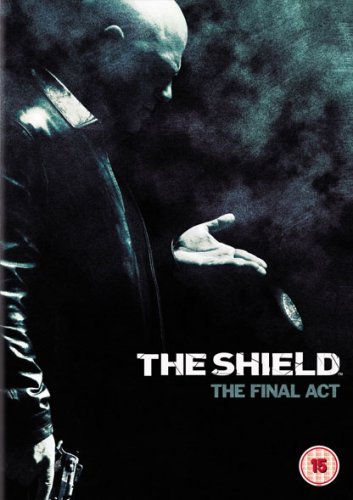
This a long-winded, roundabout way of saying that The Shield's final season has the massive burden of culminating in a satisfactory way because of how plot heavy it is. To end on a story note that was lackluster would make so much of the journey before feel just a tiny bit of a let down. The Shield had been a relentless plot machine for six seasons and that didn't end in its final season. The Shield was so consistently good though that expectations were weighing more heavily than with a show that's lost its way. The show's penultimate season is arguably its weakest season but its weak by standards of The Shield, which is to say it still damn good television. The sixth season acts like a giant bridge to the final season setting up storylines that payoff so well in the final season, however, that it almost feels worth it to spend that extra season getting to the last stretch.
Critic Alan Sepinwall once said that bad finales don't ruin a show but that good ones make a show. This has perhaps rarely been truer of The Shield. I don't want to overstate this, but simply put: the show ends about as perfectly as one could hope a show could end. This final season is so very, very good that it almost retroactively sweeps over whatever issues the show may have had (though to be fair, they were few).
I could discuss at length what happened over the course of the season but what makes the season as strong as it is is its culmination in the last few episodes. The season is almost more plot heavy in this last season then it was before, densely, intricately plotted, slowly building to a point of excruciating emotional devastation. And the payoff feels so thoroughly rewarding and plays off of so much of the history of the narrative and the characters that its equal parts gutwrenching and satisfying.
We knew the Strike Team would get their comeuppance at some point. The central conceit of the show had been about how the team barely survived one scrape after another. The question wasn't really if it would blow up in their faces but how. The direction the writers chose to go in was for maximum damage. The Strike Team's familial bonds implode and the members turn on eachother (after Shane believed he had no other choice but to murder Lem in a previous season). The conflict centers on Vic versus Shane, master versus protegee. As they attempt to outwit one another, they dig themselves further into a hole that becomes increasingly inescapable. Their myopia in trying to exact vengeance screws all of them (including Ronnie, the cleanest of the members. The character started out as a recurring character in early seasons before becoming a regular. The writers brilliantly built him up in later seasons, turning him into one of the most important characters -- the fate of Ronnie turns out to be every bit as a devastating as everyone else).
In the last few episodes, the plot slows down at times, something more intense and disturbing than the typical, pulp action. The show becomes quiet as if taking a breath after such unyielding plot machinations. Before revealing everything to gain immunity Vic pauses for forty seconds, a short amount of time but lengthy for television and it feels like forever. One of the final shots of the show is Vic sitting at his new desk job. He contemplates all he's done, the people he's screwed over in the process, the family he's lost due to it, and the fates he's resigned himself to. Waves of emotions slowly dawn on his face and Michael Chiklis makes his face crumple further and further inward to the point where you can't imagine there's another level of agonizing pain and weary self-realization that can be expressed, and yet there is. It's a beautiful piece of acting and it's a fantastic final shot (well, right before Vic grabs his gun and goes off into the night - where to? The right note of ambiguity to end on for a character who never could sit back and accept his fate).
The Strike Team's story is excellent but the stuff around the edges is often every bit as good. The continuing tension between former partners Claudette and Dutch (Claudette now as captain of the Barn) is just as much of an emotional payoff, exploring their relationship and its meaning to both of them. Claudette's new position as captain and her frustration in the face of an increasingly difficult medical condition cause her to take out her anger out on Dutch. Dutch, knowing her too well though, suffers through it because he respects and admires Claudette too much and knows she's the best person possible to run the police department.
Not every character and story feels as though it gets a conclusion worthy of its longstanding nature. Acevada is left to be the self-serving, selfish political opportunist he's always been (though that's arguably the whole point of why it ends that way). Julian's crisis of identity between his faith and his homosexual feelings he doesn't agree with seemed to be dropped. However, everything else is so strong and so well-handled and executed that it doesn't matter. The Shield's final season justified the seven seasons we spent with it. I wouldn't trade those seasons as they were some accomplished programming, but this final season made it all the more worth it.
Friday, July 26, 2013
"The Man Who Wasn't There" Slyly Skewers Film Noir
The Man Who Wasn't There is a darkly funny, subversive noir. Though it is a noir, its a film that doesn't quite read like a noir. The film looks like a noir, even at times talks like a noir, but it's a whole other beast. In the hands of the Coen brothers the film zigs where we expect it to zag. There are the twist and turns of a noir but the film seems to be mocking our very enthusiasm for so much of the tricks of the trade. There are plots that suddenly, abruptly end when they very well could have been the story for the entirety of the film's length.
But the film treats the twists, much like everything else, with a casual indifference. This is because we see the film from the perspective of Ed Crane (Billy Bob Thornton doing wonders being affectless), a bland man who can barely be motivated to speak three words at a time. He's in a loveless marriage with Doris (Francis McNormand). Through the marriage he's entered the family business of barbering, a trade that's described as being about as dull as Ed is.
The film is filtered through the extensive narration of Ed. We hear more from Ed in the narration than we do anywhere else. He's a quiet, matter of fact guy who feels like he stepped out of Albert Camus' The Stranger. He takes things as they come rarely conveying much emotion or sentiment. The great irony here being that everyone else is the world's biggest chatter box.
Terrible things occur throughout the film, but it moves past them with a shit happens sort of mentality. The film begins with Ed being won over by a fly-by-night con man (Jon Polito) claiming he needs an investment for a great new invention (dry cleaning!). Ed decides to get the money by blackmailing his wife's boss Big Dave (James Gandolfini), who he suspects is having an affair with Doris. And then things continue to maddeningly spiral out from there.
The cinematography for the film is gorgeous. It simultaneously captures the atmosphere from the noir films of the 30's and 40's and the drab, square 1950's American suburbia. Ed's world is as paint drying interesting as his personality and curt responses. His blandness is contrasted with just how interesting and exciting the plot ought to be. The Coen's refuse to give us total thrills, in stead providing us with something darker, funnier (fittingly, hilariously deadpan), more cynical, and probably far more interesting.
Grade: A-
Wednesday, July 24, 2013
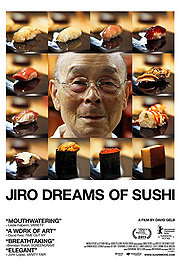
"Jiro Dreams of Sushi" Is a Contemplative, Elegant Character Study
Jiro Ono is the world's most famous sushi chef. He is 85, still running his three star Michelin rated restaurant in Tokyo. He lives, breathes, and, aptly enough, eats sushi. A stubborn perfectionist and dogged workaholic, Jiro has made sushi and the making of sushi his life.
Jiro takes the making of his sushi so seriously that it's almost become a form of art. In Jiro Dreams of Sushi, his process is described as a symphony or piece of music, and the stylistic form of the film is like a symphony. Classical music plays throughout and the film is shot with sheen-like, minimalistic elegance.
His restaurant is not a fancy place though. It's a tiny, tucked away place. But people must make reservations months in advance and one meal costs at minimal $300. Jiro has become a legend within the food industry and people go out of there way to eat his food and learn from him. He's a simple, serious man who loves his work and believes in doing it well.
Jiro is never satisfied, constantly seeking to improve his food and his technique; he's exceedingly hard on himself. He's also tough on his two sons who he insisted work for him rather than attending college. His sons resent him slightly (and they have a very strained bond with him, rarely seeing him when they were younger); it's never outright stated but they're frustrated with their father, who has continued working long past when anyone expected him to. Even a heart attack at the age of seventy has done little to setback his commitment to his work. His son now buys the fish but everything else is meticulously supervised by Jiro.
Jiro Dreams of Sushi functions as an fascinating character study and an intriguing glimpse into the sushi industry.
Grade: B+
Pixar's "A Bug's Life" Has Been Sadly Misaligned
Of all the Pixar films A Bug's Life feels a bit like the redheaded stepchild of the film studio. At least, that's the way everyone treats it; with disinterested apathy. Even more than the two Cars movies, people tend to treat it as a weird outlier by Pixar.
And for me, this perception never seemed to fit the film, which is just as exquisitely crafted as Toy Story (which was released three years earlier) or any of the films that came after it. But how we perceive the film is largely due to placement in Pixar's film canon. It's the second film produced by what was up to that point a scrappy little studio with only one hit on their hands. Toy Story had been a massive success both critically and commercially and this put a lot of pressure on Pixar to perform well again. If they put out something mediocre, well, we would just accept their first effort as a fluke.
Much of the discussion about A Bug's Life upon its release centered upon comparisons of it to Toy Story. The discourse inevitably shifted to saying, "Yea, it's good but not nearly as good as Toy Story". Agreed, A Bug's Life isn't as good as Toy Story but that's not entirely a fair or useful comparison. Taken on its own merits, A Bug's Life does what it's trying to achieve exceptionally well.
The animation is every bit as good as Toy Story. The characters are richly drawn and the story is told with such assurance and purpose. Pixar is as beloved as it is for these two reasons: its animation is excellent (and frequently boundary pushing) and its storytelling is thoughtful, engaging, and imaginative.
The opening sequence is brief but it quickly, entertainingly and confidently establishes everything we need to know. The character dynamics are laid out with an ease, complexity and breadth that would put many other films to shame. There's Flick, who's a bit of an oddball, misunderstood by the other ants. The queen ant is giving over duties to Princess Anna, who is nervous, and whom Flick has a crush on. Her little sis Dot looks up to Flick despite everyone else scoffing at her affection. The grasshoppers force the ants to collect a harvest for them, which goes awry when Flick's invention accidentally sabotages the collection. Flick decides to go out to find warriors to fight back the grasshoppers after they make the ants do the harvest all over again. The film drags a bit as it has to do another stretch of establishment for a group of circus performers who Flick will later mistake for fighters and ask to aid him. But once it gets past this, the film hums along and doesn't have to explain anything to us because we know who everyone is and where they stand.
Beyond its storytelling, the film is thematically rich. There's a great message in there about not judging people and the need for understanding people. This is a film that's often about misfits and wants us to root for them, whether it be Flick, the circus performers or Dot. Pixar films are frequently about outcasts, misfits and people who don't belong, and the films tend to argue about the need to be true to yourself.
Of course, the animation is every bit as inventive and well-crafted as we might now expect from a Pixar film. Take the use of water droplets as drinks and the head of a telescope; it's a little detail but its one that provides texture to the environment and demonstrates a certain level of affection for this universe. There's a very good sense of the anatomy and movement of insects and the way in which they interact with the world around them. There's a realism underlying the antics that shows time, effort and a concern for attention to detail put into the film production.
Mostly why I think we overlook and misjudge A Bug's Life is that its subject matter about anthropomorphic insects doesn't seem as crafty or original as some of the other concepts Pixar has cooked up. Toys comes to life when you're not around. The monsters living in your closet are real. A man straps balloons to his house and floats off like a hot air balloon. It's nothing nearly as overwrought as these concepts, but what makes A Bug's Life more than its simple, cute story is the specificity that Pixar lends the film; this isn't a film about insects but a film about a quirky, misunderstood ant named Flick and his journey. That may sound obvious but so many films fail to give us characters that we feel for and identify with. Pixar does it in every movie and makes it feel easy.
Give A Bug's Life a second chance. It's a sophomore effort that's not nearly as sophomoric as we've led ourselves to believe.
Tuesday, July 23, 2013
Theme of the Week: The 2000's and On
This is shaping up to be a week where I explore films released in the 2000's and onward (2000 - 2013 that is). This was always a sort of a plan in my mind but I intend to stick with it (and hopefully by officially stating it, it will force me to actually toe the line). I've been so intent upon schooling myself on some film history that I neglected the film present (Which is very, very rich despite what you may have heard).
The manner in which I choose the films I watch is a mercurial process (I tend to have a couple films in mind but it's not a dead to rights thing. There are lots of films I was sure I was going to watch on a given day/week and still have yet to get around to) so I can't outright say what I'll be watching (or if they will remain in this previously mentioned era). But I'm open to suggestions (Spirited Away was chosen at someone's recommendation) and might consider making more "themed weeks" in the future.
A running tally of films so far:
Spirited Away (2001)
Spring, Summer, Fall, Winter ... And Spring (2003)
Pacific Rim (2013) - Currently in theaters
25th Hour (2002)
Despicable Me 2 (2013) - I previously reviewed the film but revisited writing about it after a second viewing.
A Bug's Life (1998) - I bend the rules a bit in order to try to change your opinion on this second, consistently misjudged effort by Pixar.
Jiro Dreams of Sushi (2012) - Because it's only fair that at least one documentary get thrown into the mix.
The Man Who Wasn't There (2001)
The Shield's Seventh Season (2008) - The 2000's were a great time for television as well as exemplified by the great final season of this fantastic antihero police drama.
Life of Pi (2012)
Final Thoughts on This Week's Films
Odds 'n' Ends on "Despicable Me 2"
Re-watching Despicable Me 2, I found myself regretting my earlier opinions of it. No, it is not nearly as strong as the original Despicable Me, but it's also far more intelligent and deep than I initially gave it credit.
Amid a summer blockbuster landscape that has proven to be a bit of a wasteland, Despicable Me 2, even upon my first viewing of it, was refreshing for how colorful and uncynical it was. Now having seen a fair share of the summer movies (discluding indies and still having yet seen a handful of tentpole films), Despicable Me 2 ranks towards the top of the list. Too many films this summer have been abysmally bad (Man of Steel, Hangover 3, Grownups 2) that its a sight for sore eyes to see a film with a solid story that's often inventive and clever.
There's a consistently heartwarming story at the center of the second Despicable Me 2. While Gru is a more toothless character without his former villainy and one seemingly with little story left to explore, the parenting crash course that Gru is presented during the film is surprisingly earnest. Sub-plots I was previously dismissive of this time around I really took a shine to. Gru fretting over his teen daughter fawning over boys is not only very funny but spot-on in its accuracy.
There are elements here that don't work. The villain "El Macho" borders perilously close to offensive. He's also a much less compelling and nuanced villain than the original's Vector. And the film simply doesn't spend enough time with him (It also does a poor job with the middle child Edith). The mall setting likewise never gets developed or built up satisfactorily. I would have liked to have met more shop owners; instead we're limited to two, one a not-so-red herring.
The minions remain the best part of the film. They're scene stealers, but the film thankfully never overuses them and they never overstay their welcome. Their adorableness is matched only by Agnes, the youngest daughter, who is an animation feat in her own right for her considerable cuteness. The cuteness though is part of the film's aesthetic which is bursting with dazzling color and memorable visuals. Take the journey of a spy car turned submarine plunging into the depths of the ocean. It is an astounding, gorgeous piece of animation. The animation is matched by an equally great voice cast. The cast has some wonderful comedic timing and it's only fitting we find great comedians such as Steve Coogan and Kristen Wigg added to the roster this time around.
Despicable Me 2 is up there with Monsters University and Pacific Rim as the films of the summer that I've enjoyed the most. Monster University is another film I wish to revisit; I didn't give it enough credit the first time I saw it as well. It is another film brimming with a boisterous color palette and tons of fun ideas. Pacific Rim is also a film that's free of darkness. Perhaps what we need right now are films that don't try to be so serious or brooding or dark. We just need a fun time where we can laugh for an hour and a half, forgetting our worries. Despicable Me 2 does that without sacrificing creativity.
"25th Hour" Thoughtfully Takes on the Burden of Sin and Post-9/11 New York
The way a film carries itself is important. 25th Hour carries itself like a person whose seen and done too much and is simply weary of it all. Edward Norton's Monty Brogan looks like a dead man walking even before we learn what is weighing upon him. He gives off the appearance of man who wants to slouch and sag but has too much pride to let life completely crush him. We quickly discover that this is his last day before he has to go to prison for a drug charge.
25th Hour heavily carries itself like a film attempting to sort out some of the weight of living in New York after September 11th. There's a great monologue delivered by Norton early in the film where Monty stares into a bathroom mirror with "Fuck you!" scribbled in sharpy on the bottom left hand corner. He starts railing on everyone and everything: Fuck you he yells at various ethnic groups and demographics (show in a montage) that make New York City the rich and diverse place it is.
Eventually he lands on one final person to blame: himself. All he has to blame for the fate he's received is himself. He could have gotten out of selling drugs, gone into a more honest line of work like his childhood friends (Phillip Seymour Hoffman, Barry Pepper - though they're not entirely as straight and narrow as they seem or would like to believe), who he asks to send him off. He's grown apart from his two old friends, Jacob and Francis, having fallen into a less reputable crowd. Monty is a man sorting through some picadilos, confronting where life has led him and how culpable he is.
The one good act Monty believes he ever committed we witness pre-title sequence. Monty and his criminal partner Kostya (Tony Siragusa) stumble upon a severely wounded bulldog. Monty initially feels it deserves to be mercifully put down before changing his mind and rescuing the dog. The film cuts ahead five years later; the dog, Doyle, is all better but seems to be the only thing to have improved during the interval of time. There are a handful of flashbacks throughout the film, but the film primarily takes place over the course of the last day that remains for Monty and how he comes to terms with what he's done and the prison sentence that awaits him (There's only three options we learn: he runs, he kills himself or he accepts the seven year sentence. No matter how you slice it, it's not good).
There are subplots here but they're not nearly as interesting as the languorous dread that hangs over Monty's last day. Jacob, a teacher, has a crush on a seventeen year old student (Anna Paquin) who he runs into during the course of the farewell evening (It's very entertaining story played well by Hoffman and Paquin and provides a breath of air between the weightier material elsewhere).
Monty spends the day saying goodbye to his girlfriend Naturelle (Rosario Dawson), whom he fears ratted him out, his father (Brian Cox), who hopes to see him run away, Jacob, and Francis, who holds a grudge against Monty for getting into a criminal life. The discussion of issues that arose in the wake of September 11th never feel completely in synch with the rest of the film, but they also make sense for the first film that shot on location in New York after the attack. They also feel appropriate coming from director Spike Lee who has never shied away from such controversial subject matter and finds interesting ways for the weight of 9/11 to meld with the weight of Monty's incarceration.
Grade: A-
Subscribe to:
Posts (Atom)