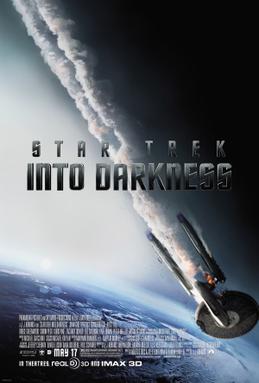
Much and more ink will be spelt over Star Trek: Into Darkness, so it almost feels besides the point writing anymore about the film which will be doubtless seen by plenty of people, and already has.
But having seen the film a second, as it is the summer, and as youngin' that's what I'm wont to do during this time of the year, I thought I'd share some additional thoughts.
Seeing the film a second time, I enjoyed it much more. The film is a fun, action-packed film. And while it doesn't reach the memorable heights of the first film, it does leave you entertained. I had expectations going into this film since its predecessor was such a wonderful reinvention of the franchise. Into Darkness doesn't expand the series further or reinvent it anymore, and that's a good place to start for considering why it doesn't come off as strongly as the original.
The film as is could shed the elements that make it uniquely "star trek-y" and it could still stand largely on its own as a solid big budget action, sci-fi adventure. That's partly a strike against it. It's nice to see a well put together summer blockbuster that's a fun distraction, but I'd rather, in the case of this film, that it be unique and specific to this franchise. While some of this is well-realized, including especially the relationship between Kirk and Spock, much elsewhere just doesn't give you that sense. I would love to see the affection for the old series shine through; to see people who geek out about the older series getting to play around in this sandbox. And that well-worn love doesn't always comes across as strongly as it did in the original.
Many of the characters feel incredibly poorly utilized. Pavel Chekhov has practically no screen time whatsoever. Uhura is stuck in a plot that is at times embarrassingly reductive, relating agency solely to her relationship to Spock. The conflict between the two characters also comes off as rather forced and is resolved much too easily.
This speaks to a larger problem that the film has with gender. It's not all bad; the undercutting of Kirk's masculinity, at turns, is a nice sight. But the female character are token at best and objectified at worst. This is particularly true of Carole Wallace. Carole often times seems to be in the movie for the purpose of looking good, and while I can dig a pretty face, this has male gaze written all over it.
However, the film is on the whole a very good time. There are very few sequences I would point to as being bad or distracting (although the fight on Chronos is kind of a mess and my least favorite). This is popcorn spectacle at its most refined, even if I think it could have been honed just a tiny bit more to raise it up to the tier of its predecessor.
Stray Thoughts:
-John Cho doesn't get as much to do this time around as Sulu, but that steely eyed speech to the Admiral is an excellent monologue and Cho revels in every second of it.
-Simon Pegg once again goes home MVP as he has an absolute blast playing Scotty. Also Scotty's sidekick is adorable and awesome.
-Khan crushing the Admiral's skull feels like it's from an absolutely different film. It's almost over the top for a film like this.
-Khan crashing the ship into enterprise headquarters at films end comes off as far too destructive for the conflict to feel truly victorious, like the film wants it too appear.
-I enjoyed the intro more the second time around, but having so much character development and plot take place off screen is just bad storytelling.
-The film could have done a better job explaining the situation with the Klingons for non-Trekkies.
-Kirk's death is very effective, although I think Spock saying the reverse-engineered version of the infamous line from Wrath of Khan feels a bit forced, even if it's kind of necessary for fan service.
Friday, May 24, 2013
"Texas Chainsaw" - Film Review
Texas Chainsaw is a by the book the horror film that defies the books it’s following and in the process becomes a convoluted mess.
Prior to this the film is mediocre but solidly crafted big
budget horror film. There are attractive but forgettable people heading to a destination
all but tailored to be their demise. There’s a general atmosphere of darkness. There
are little callbacks to the original franchise that are needless but nice.
There’s even a mid-portion to the film that’s genuinely rather scary and
thrilling. I wish the film had stuck with this tone and these thrills because they're well-staged and a lot of fun. If the film had gone this route, it might have redeemed itself.
But then the film goes for something so bizarre that it’s
simply baffling. It attempts to turn the villain into the protagonist, in part
by largely ignoring the fact he’s just killed a bunch of people. And I think it
worked, but I also think it may have been the stupidest and most confusing
decision a film could have done. It’s an incredibly offputting turn of events
that comes so out of left field and is given so little time to develop that it
makes very little sense. It also undermines what little momentum the film had
going for it and in turn its ability to scare us, as pseudo-villains take up
the role of killing our main characters (which adds further to the convolution of
this).
Texas Chainsaw has
its moments, but it descends into hackneyed, convoluted, uninteresting
storytelling.
Grade: D
Thursday, May 23, 2013
"Sex, Lies, and Videotape" - Film Review
Why are we so uncomfortable to talk about anything related
to sex? Americans get particularly squeamish when the subject matter is
broached. And we have unstatedly decided that violence is a-okay in films but
anything sexual is taboo. In fact, the more intimate the subject matter becomes,
the more likely me are to feel uncomfortable and unnerved.
Graham is coping with his troubled past and his impotence by filming woman while asking them about their sexuality and sexual history. Graham's greater openness leads to John, Ann, and Cynthia confronting their own troubled lives, secrets, and sexual frustration.
Writer-director Steven Soderbergh takes that feeling of
intimacy and makes it one of the key assets of sex, lies, and videotape. This is a story about four fucked up,
broken people and their intertwining lives. We find these characters in minimal
locations, talking and continually hurting one another. As the story unfolds,
the film digs deeper and goes more personal.
When John (Peter Gllagher)'s old friend Graham (James Spader), who he hasn’t seen for years, moves into
town, John invites him to dinner. Graham has a fucked up personal history, and he’s no
longer the same person who John was friends with nine years earlier. He’s a bit off,
unusual. John is sleeping with his wife’s sister Cynthia (Laura San Giacomo). This is in part due to his wife Ann(Andie MacDowell)'s lack of
desire for sex, and the two haven't had sex in a long time.
Graham is coping with his troubled past and his impotence by filming woman while asking them about their sexuality and sexual history. Graham's greater openness leads to John, Ann, and Cynthia confronting their own troubled lives, secrets, and sexual frustration.
As the film progresses the dark hidden truths behind these
people and their actions become revealed. In turn, these individuals become
able to admit what they really want and break from the baggage that’s dragging
them down.
The cast is all-around phenomenal, and the film does a wonderful job of fleshing out the characters. The script crafts some exceptional dialogue and asks some mature, thoughtful questions about sexuality, desire, and psychosis.
sex, lies, and
videotape is a great character study and a wonderful mood piece.
Grade: A-
Wednesday, May 22, 2013
"Dead Alive (Braindead)" - Film Review
Before he became known to a wider audience through The Lord of the Rings movies, Peter
Jackson directed a number of films that were all but destined to become cult
films. Dead Alive is a prime example
of this. For anyone who came into the movie solely based on their familiarity
with Jackson’s blockbuster works later in his career, they might be a bit
baffled.
Dead Alive is a
horror comedy. Well, actually, if we’re to be honest with ourselves, it’s
really just a comedy. The horror aspects are just an excuse to be gutbustingly
hilariously excessive. It’s a film that takes gleeful pleasure in trying to one
up every setpiece and gory showcase that it’s managed. There’s tremendous
pleasure to be taken from the buckets of blood and guts as they reach almost
transcendental heights of parodic, rhapsodic over-the-topness.
The film quickly dispenses with the explanations for the
Sumatran rat monkey whose vicious bite turns people into decaying zombies, and instead
gets right to its real purpose: blood galore! If this at all sounds crazy and
absurd, it’s because it’s meant to be, and it’s totally in line with the
sensibilities of the storytelling. As a friend described the film, it’s “glorious
schlock”; a film that’s self-aware of its trashy, low-budget, campy nature and
embraces it super hardcore.
There’s enough underlying, very basic storyline at it center
to prevent the film from completely going haywire as it gets involved in the
horror bloodfest. There’s a romantic plot between our protagonist Lionel Cosgrove (Timothy Balmy) and a comely
working class girl Paquita (Diana Penalver) who’s convinced of the supernatural. There’s also a mother-son
relationship that might just put Psycho’s
to shame. It’s this last element that has Lionel keeping those infected alive and
locked up in his basement. He just can’t let go of his mother, even if in this
state she’s not really his mother.
Dead Alive wants
to get a reaction out of us. It wants us to be shocked by its manic desire to
be insanely bloody and weird, and in its best moments it succeeds. It’s truly hysterical.
Grade: B+
Doctor Who - "The Name of the Doctor" - Review
Well, you certainly can’t fault Doctor Who in the Steve Moffat era for lack of ambition. That’s for
sure. In fact, I would say that the series’ greatest problem under Moffat has
been too much ambition. And while I really appreciate ambition, even ambition
that falls short of the mark, Moffat is simply trying to cram too many ideas
into any given episode, and this has become an increasingly bigger problem as
the time under his tenure has gone on. They’re frequently very wonderful ideas
but rarely are any of them given enough time to breathe.
“The Name of the Doctor” has a lot to like. But it feels
like an episode that’s trying to tell a story that ought to have parsed out
over a couple of episodes. For example, did we really even need the appearance
of River (whose appearance itself is a mystery related to her being trapped in
a database after “Forest of the Dead”)?
I like the explanation for Clara’s multiple lives. And somehow it’s both totally crazy and somehow kind of sound in that way that really only Moffat is capable of pulling off. But when the show tries to achieve these complex narratives with the pizazz and coolness so typical of Moffat occasionally the storytelling gets a little too convoluted.
Another problem is that we haven’t spent enough time with
Clara. While I really enjoy Jenna-Louise Coleman’s performance, we haven’t been
given enough time to really understand this character and her relationship to
the Doctor (her going into the time vortex without doubts doesn’t entirely add
up with what we know about the character even as it attempts to be a powerful
moment, which it is, but it also feels a tad forced).
The series has tried to cram a season long story into half a
season, and that came partially out of the need to service the story of Amy and
Rory. But I just don’t know if creating this over the top mystery for the show
to solve was the best path to enter as the show entered ostensibly a new chapter.
This becomes somewhat apparent in how the show never fully explains the problem
at hand, leaving the episode on an ellipsis with the reveal of another version
of the Doctor played by William Hurt. Another mystery.
I say all this because the mysteries have somewhat usurped
the narrative. And Doctor Who has never been about mysteries. There’s been
wibbly-wobbly-timey-wimey content here and there, but at its core it’s been
about a mad men with a box getting caught up in to situations where he tries to
help out and potentially save the day. Even his love for humanity was something
that grew, begrudgingly, over time.
Now let’s fanboy here for a moment because the above
probably comes off as totally despairing and cynical. The scenes of Clara
placed into stock footage are a real treat, even as they stretch the limits of
the budget to a point where they don’t totally work. The idea of the Doctor
facing up to his future death by heading to his tomb is emotionally rife and honestly
the episode doesn’t get enough time spent with the Doctor confronting this.
There’s plenty of the expected fun in “The Name of the
Doctor”, but it tries much too hard to get across what it wants to convey.
Grade: B
Mad Men - "The Crash" - Review
“The Crash” is a busy episode, and at times it’s a confusing
episode. But it’s an episode that’s meant to be busy and confusing. The moment
Don and the members of our now nameless ad agency take some doctor prescribed
drugs the whole episode goes into a bizarre overdrive. The episode has the
quality of a drug trip; it’s dream-like, fast paced, filled with unexplained
jumps forward in time, and many elements seem arbitrary but potentially loaded
with hidden meaning. But often, honestly, come off more arbitrary. Like what the heck is up with the creative team throwing
exacto-knifes at Stan beyond adding to the already abundant sense of chaos and
unproductiveness at the office?
After being dumped by Sylvie, Don becomes a wreck. He’s
scheming of ways to win her back, and standing outside her apartment door,
creepily hovering. The whole time Don has everyone convinced he’s working on
the ad campaign for Chevy, but instead it turns out he’s crafting the perfect
sales pitch to win back to Sylvie. If Don has been out of sorts before, he
rarely has stooped to such maddening lows. When he collapses towards episode
end, it feels like the only logical response to how much Don has been failing
to tackle reality and the many things in his personal life (it also feels like the only logical response to the absolute craziness of this episode). For so long this
season Don has been doing a terrible job at work and he’s been avoiding responsibility,
in his marriage, at work, and with his children.
There’s a general offness
to this episode (well, there's an understatement if there ever was one). Everyone is talking in a highly mannered and fastpaced way
that’s sometimes comical but mainly very strange and offputting. Even outside
the office, the Sally B-plot is totally weird. A strange black woman breaks
into the apartment and starts robbing the Drapers. Sally immediately recognizes
that something isn’t right but she’s put into a fix by her age, her lack of
knowledge of her father, and her general justifiable fear and confusion.
Sally has been a character that’s been overlooked this
season. After spending more and more time with her each season, it’s been disappointing
to not see more screentime from the always great Kiernan Shipka. Shipka continues
to nail the growing independence and rebelliousness of her character while
still managing to undercut this with a youthful uncertainty. But Sally's storyline is part and parcel of the larger peculiarity of this episode and also has less to say about her than Don.
For this is an episode all about Don. We get more flashbacks
to Don’s time living in a brothel, a formative experience. While these
flashbacks don’t interest me nearly as much as some of the flashbacks in the
past, they continue to fill out the backstory of Don and they set up the
wonderful (if very on the nose) closing scene of the episode where Don equates the agency with a
whorehouse (great resonance of “The Other Woman” here). We could have guessed
that the prostitute introduced in "Collaborators" would deflower Don and it comes to fruition here.
While the flashbacks aren’t the most interesting, they play off the episodes
theme stated by soothsayer and daughter of the late Frank Gleason, “Does
someone love me?” Don doesn’t want Sylvia; so much as he’s so damn lonely that he
doesn’t want to lose the one thing keeping his mind at ease.
“You have to let yourself feel it,” Peggy tells Stan in
regards to his cousin dying in Vietnam. Don isn’t letting himself feel things
though; he never has. He thinks he can just always reinvent himself and that
will keep him one step ahead of the pain of his past. “The Crash” might literally
refer to Ken’s car accident, forcing him to walk around with a cane. But it
figuratively refers to Don, who has been all but destined to collapse in some
form or another. It wouldn’t be all that surprising if the series ended with
Don having to own up to everything he’s been avoiding for five plus seasons,
and when he does it will be messy and self-destructive no doubt.
Our other "Don", Peggy, not be getting exactly what she wants (she clearly wants to hook up with Stan, and she even more obviously wants to sleep with Ted). But Peggy can control her urge; she, for now, is going to stay true to her boyfriend. As we know from our other “Don”, Pete, that it’s best to stay on the straight and narrow. No matter how good you are at assuming some part of the identity of Don Draper, it almost always comes at a cost.
Take Sally for instance. This episode wants to parallel
Sally and Don, to an extent. Sally is acting like she believes her father would
have and how she expects her father would have wanted her to. But this ultimately
leaves her doubtful. She apologizes for screwing up. But, of course, Sally
handled this as well as we’d hope a fourteen year old to. And more importantly
still, as Sally herself states, she doesn’t really know her father (but then
again: no one truly does). Don is still that child at the whorehouse and he's that way because he never got the affection of a real mother. Hence trying to hold onto Sylvia.
The themes of prostitution have been abundant this season.
And Don’s closing statement makes this blatant. Actual sex, in deed, takes
place in the office. The people that get hurt the most when things are run on
this sort of business model are people like kids (Don in the flashbacks or
Sally and Bobby in the present) or people who mean well (the kindly prostitute, Ken).
“The Crash” has a lot of ambition, and, while this ambition
doesn’t always succeed, I really appreciate its ambition. At times this season, Mad Men has felt like it’s retreading a
lot of territory we’ve seen so much of with not much new to say. It’s also felt
like it has so much it wants to get in that it’s not necessarily being as
substantive as it potentially could be. While this episode is often more style than substance, it's always nice to see the episodes of Mad Men that are structurally more adventurous, even if here it comes off as too frantic and hectic.
Grade: B+
Tuesday, May 21, 2013
"Star Trek: Into Darkness" - Film Review
There are a handful of reactions that you are pretty much guaranteed
to have when you go to see a summer blockbuster. The big three are pleasantly
surprised, mildly disappointed, and outright desiring your money back. There
are summer blockbusters that are a rip roaring good time, that earn their
spectacle through interesting situations and great characters. There are films
that amuse you but leave you slightly dissatisfied. And then there’s those
other ones you totally regret seeing it.
JJ Abram’s Star Trek
fell squarely into the pleasantly surprised category. It was not the summer
blockbuster that was most on my radar, but it was one that stuck with me
after I’d watched the film. The film took something familiar and elevated it above
the well-worn tropes that had made the series a cultural hallmark.
Star Trek: Into Darkness doesn’t stick with you the way its predecessor did. It’s what we might describe as mildly disappointing.
Into Darkness
reminds me of another recent summer blockbuster: Iron Man 3. Both are sequels to major successful franchises. Both
fail to live up to the merits of a sequel. There’s more spectacle at times, but
the spectacle never feels completely well-earned. The plotting is inelegant and
the stories try much too hard to provide a gravitas that simply just isn’t
there.
And this, mind you, is me talking about two films that I largely enjoyed.
Into Darkness has some moments that
are popcorn action at its most engrossing, but the plot is also frustratingly scattered.
So much so that the film is often a collection of mostly good scenes that are
somewhat disjointed. It takes a third of the movie to really get cooking, and
even then the film has suffered from an opening sequence that’s uninteresting
and perfunctory. There are also a number of twists piled on top of eachother
that start to become tedious.
There are many moments in the film that feel like they’re
in this movie merely because the studio expects it’s the type of stuff we want
in there. Scotty makes an off-handed quip. Kirk and Spock have disagreements
over commanding the ship. McCoy amusingly suggests an alternative action to
Kirk. Leonard Nimoy makes an appearance! But after a while a number of these
moments come off as if they don’t service the narrative but rather are in place
just to try to get a reaction out of the audience, to carelessly make us laugh
or thrill us. And too much of it is leaning on our affection for these
characters and this universe (granted, many of these previously mentioned expected moments really are a treat and arguably would have detracted from the film had they not been there). But as appealing as they may be, on their own a
solid film they do not make.
Don't get me wrong. The action of Into Darkness is wonderfully staged and addicting. This action is made all the more pleasurable by the tremendous performance of Benedict Cumberbatch in the role of the villain who vexes our heroes with his delightful scheming.
There’s a lot of fun to be found in the film, but it just
doesn’t step its game up the way a big budget sequel ought to.
Grade: B
Subscribe to:
Posts (Atom)