Sunday, April 28, 2013

The Office - "Paper Airplane" - Review

One of the greatest assets and also biggest weaknesses to television as a medium is longevity. Sometimes we wish a film had a few more hours to tell its stories. There might be some aspect we would have liked it to play up but it had to cut down on for time constraints or maybe we just want to inhabit that world for a little while longer. Television, on the other hand, has time to spare. But the downside of television having all this time to tell its story is that it sometimes overstayed its welcome. Films might under stay their welcome but they often don’t have enough time to feel as if they’ve expired countless hours earlier.

Everyone has a different point where The Office began to feel like a stale but comfortable show (it was starting it for me somewhere around the fifth or sixth season). You knew what you were getting and it was perhaps a safer bet to watch The Office than take up a new show that might get canceled or whose lack of familiarity made it difficult to get into. The series was clearly declining before that point but you got trapped in the series like a security blanket. Longevity does that. It builds up a connection between you and the show, and that’s one of the crucial aspects of television, but it also allows television to get lazy and stop trying as hard to be appealing. 

There’s nothing wrong about a show acting as comfort food. Some of the best television has been purely about creating a nice little space to kill a half-hour or so. But The Office has increasingly become a show without a rudder. There are a lot of the same characters and there’s a lot of the same style and outwardly it looks much the same as ever (minus a Michael Scott and a Kelly Kippur). But often times I’ll be watching and asking myself, “What am I watching?” This season and recent seasons have felt like Office-lite. It’s similar jokes and occasionally similar scenarios but they don’t make me laugh as often or consistently and sometimes the jokes and the plots have me raising an eyebrow and actively questioning my viewing experience. 

Final seasons have a harder time than almost any other season of a series (besides may be the first season). A good final season has to achieve closure. The finale in particular needs to do this but on the whole if a final season isn’t doing something where there’s a sense that you know what happened to these characters and this world beyond the series end point than the show has failed. And right now besides a very, very small number of characters, I’m incredibly nervous that The Office is oblivious as to what it’s seeking to do with these characters. What is the show doing with these characters? Angela and Dwight are … skirting coupling. I think; it’s honestly hard to tell if that’s just a plot point to kill time in this episode or if that will go somewhere down the road. Andy is getting into acting, which has no real end goal in sight other than to keep being used as a gag. Erin and Pete are dating and it’s mostly cute, but there’s nowhere for that to go if they just stay together or if it doesn’t take a step further, which is doubtful.  What else from this episode has any potential to go anywhere? Kevin sucks at making paper airplanes as only Kevin can. Nellie is oblivious and apparently likes refereeing events. Toby is generally awkward and gets his eye temporarily eye patched – None of these stories have the ability to grow into something where we might be pleased to see the show expand upon it and use it to tell some final story about the characters. 

Take what they’re doing with Andy. Now Andy is a character this season has dropped the ball on. A show doesn’t need to have real characters, but The Office has led us to believe that it exists in a world that’s mostly very close to our own (though it’s lost that sense in recent seasons). And yet I have no idea what is going on with Andy. Granted, sometimes Michael Scott’s antics were so goofy and outlandish that they could take you out of the moment, but for the most part they kept him likable and believable enough that you were willing to put up with his craziness. There’s a type of logic that many individuals abide by and I’m a strong supporter of it. It has many names but the common one is “Fridge Logic”. In essence, it’s the notion that if you didn’t question the logic or the plotting of something in the moment you were watching it, you can’t really have qualms with it. If a tv show or a film engrossed you enough to convince you that its logic and storytelling was sound, it doesn’t matter that that in hindsight there might be problems with the plot or logical inconsistencies. It succeeded. The Office lately hasn’t been winning in the Fridge Logic department. Andy is prime example where the show is failing at this. I can roll with the idea that Andy would want to get into acting (even if I think it’s a pretty useless storyline) but the way Andy treats his acting gig is so completely strange and so completely unreal that it was hard to buy the way Andy was behaving. 

Now I don’t really give a fuck about Andy anymore. I could probably list the handful of characters that interest me on this show and Andy isn’t one of them. Kevin occasionally makes me grin, mainly due to Brian Baumgartner’s commitment to the performance. Erin is a tall glass of whimsical cutesy and Ellie Kemper is admittedly delightful at times due to her abundant enthusiasm. Other bit players still make me chuckle here and there such as Stanley, Phyllis, Darryl, and Creed. But on the whole, I just don’t care what happens to these people. We had a vested interest in Michael Scott’s story and it paid off really well. Now the only story we still have a vested interest in is Jim and Pam.

Because we have a vested interest in this story and the writers recognize this fact, Jim and Pam’s story remains to be really, really good. When Pam runs to Jim and then Jim can’t even begin to find the words to express how sorry he is and simply hugs her, it’s spine tingling. 

It’s almost as if the series knows this is technically the only story it really needs to tell in full at this point and everything else is merely filler to fill up the edges of the rest of the half-hour. I perk up in my seat when I see Jim and Pam on screen, but I slouch down immediately after the story cuts to anyone else. The moment it pops in on any other character I know it will at best be mildly amusing and at worst disappointing. When a show goes on as long as The Office has, it reminds us of the downside of the television medium. Television has always been given flack for creating content that’s passable but not great because television’s real goal is to sell ad space and last as long as it possibly can to do that. Television was created with the mindset of appealing to the broadest base of individuals to sell ads and NBC will keep on a sizable hit like The Office on long after its expiration date if we’ll tune and drop out for a little while longer; even if we’re mostly only doing it out of a desire for completism and a vague hope of closure. 

Grade: C+

Saturday, April 27, 2013

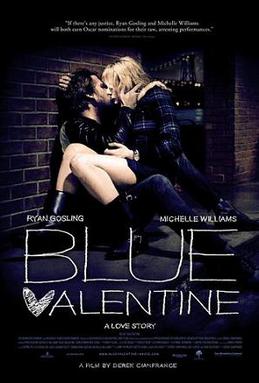
"Blue Valentine" - Film Review

There’s a soul aching pain that pervades Blue Valentine. The film contrasts the breakdown of a married couple’s relationship with their initial meeting and courtship. In the present, they have fallen out of love with each other and there’s a world weary, sad, and unnerving tone to the story. This is made all the bleaker by how sweet the flashbacks are. It’s observing two people unexpectedly being swept up in romantic spontaneity. But now they have a kid (who as it turns out isn’t the husbands, which complicates matters further) and they’ve become bitter and resentful.

The film owes much of its power to its cinema-verite style. The docu-realistic take on the subject matter leads to some truly chilling moments. There is an emotional intensity that it hard to sit through at times. The film has a shaggy quality, letting moments linger just a little longer than the typical film might which makes the impact of the scenes even stronger. This is particularly true in the more uncomfortable and claustrophobic moments in the film. 

This is notably the case in a number of sex scenes in the film. These scenes are some incredibly honest and intimate depictions of sex. They’re painful and awkward at times; one scene gets uncomfortably close towards being a rape scene. But they’re also, in a separate instance, tender and sweet (the sex scene when they’re younger is fun and hot, and yet completely advances the story of the characters and never feels like it’s there merely for the sake of having a sex scene). 

Much of the film’s realism stems from the improvisational, raw performances of Ryan Gosling and Michelle Williams. Watching the relationship unravel is as upsetting and affecting as it is due to Gosling and Williams. Not only do they have great chemistry, but, more importantly, they also make the jumps between the past and present carry the weight of change and time. The contrast between the past and present gives it all a terrible bittersweetness. Switching back and forth between the two times, it’s almost like seeing a different set of individuals, and the the youthful love affair is simultaneously all the more joyous and yet all the sadder due to this. 

It’s at once painful and sad, but also at times sweet and funny. Williams and Gosling create fully formed characters, which makes the relationship’s break down all the more disheartening and harrowing. The film’s intimate, personal portrait of a couple is powerful and poignant.  

Grade: A-

Thursday, April 25, 2013

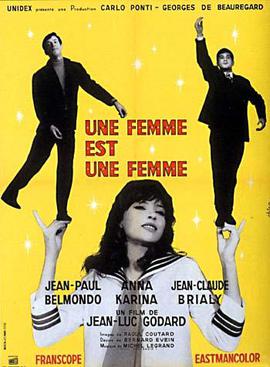
Patrick Vs. "A Woman Is A Woman" (Thoughts on "A Woman Is A Woman")


Patrick Versus A Woman Is A Woman 

In this week's episode: Patrick takes on one of the slighter efforts of director Jean-Luc Godard

I don't have time for a complete review so here are some random thoughts:

-Very colorful, light and fun. It would have been nice if it were more substantial but the film generally has enough charm that it doesn't matter.
-Slightly pretentious at times. Jean-Luc Godard at times seems really self-aware that he's being completely flippant and unconventional and that becomes distracting and frustrating at times.
-Though typically classified as a homage to American musicals, it has very little in the way of music. The sound is unnecessarily experimental at times. Music plays in synch with people's talking at times, and, in one instance, Anna Karina does actually sing, but the music is almost besides the point.
-Anna Karina is a lot of fun; she's young and vibrant and it's pleasant to watch her coo or play coy, but overall Angela is a less of a character and more of a delivery system for whatever Godard wants her to say. The same is true of most of the characters.
-Did Angela need to be a stripper? It almost seems pointless, and that sure is a tame strip club.
-Angela's desire to get pregnant is also totally unexplained. Although it does lead to a great ending.
-I guess the real problem is nobody's motivation for anything is clear and the plot doesn't have a strong enough sense of forward momentum to overcome this. (For instance, the love triangle almost seems to exist solely for the sake of existing rather than because these people actually have a genuine interest in one another)
-The scene where Angela and Emile use book titles to express themselves is really cute and funny.

Consensus: Overall it's all very light and the film jumps around a lot, uncertain as to what it wants to be. It's amusing but forgettable, and Godard produced better works.

Grade: B-

Tuesday, April 23, 2013

"The Red Balloon" - Film Review

You know when you feel really good; you’re all giddy and smiley and exuding a bubbliness. Well, that feeling is pretty comparable to The Red Balloon, which is a straight shot of pure unadulterated good to God happiness.  

It’s so fucking twee that you might think it’s exuberance of positiveness and colorfulness and general cuteness might be overwhelming and excessive. But it’s not. It’s charming and delightful from start to finish, and your soul has to be pretty black and empty not to smile.

A boy (Pascal Lamorisse) finds a balloon of the red persuasion and soon grows rather attached to the big shiny ball of helium. He begins taking it everywhere with him. 

What quickly becomes clear is that the balloon has a sort of consciousness to it. It moves by its own freewill as it damn well pleases. 

The boy tells the balloon to stay put but it just can’t help itself and follows the boy around. Some Looney Toons-esque classical music plays as the balloon sneaks behind the boys back and hides in doorways to avoid him looking back in time to see him. It’s adorable; actually correction: it’s the most adorable thing I’ve seen in a long, long time. 

The boy goes to school and he’s forced to leave the balloon outside. When the schoolmaster puts the boy into detention, the balloon follows the man outside of the school and taunts and harasses him to highly amusing effect. 

The red balloon sees a girl (Sabine Lamorisse) holding a blue balloon. Ah, it’s destiny! The two balloons attempt to escape their owner’s clutches to be together, but the kids are too young to get the heads up and keep moving along. 

A gang of kids keep chasing after the boy. They want the balloon, but the boy won’t let them get it. He outruns them for a while but inevitably they catch up. A rock hits the balloon and it deflates, collapsing to the ground. The boy is forced to euthanize his friend by stomping on it. And damn if it isn’t the most oddly moving thing you’ve ever seen put to celluloid. The balloon has become a character in its own right, if not the outright protagonist of the film. The film has just killed its main character!

Suddenly, in the film’s most effervescent moment yet, every balloon in the city, as if immediately aware of the balloon’s death, swarms to the boy and he finds himself lifted up by countless balloons. He’s flying high above the city. 

The film is at times like a silent film. It tells most of its story through eye catching and vivid visuals that are highly effective and leaves the sound to a minimum. This is actually a really great decision. The film doesn’t need much dialogue to impact us; it’s visuals are so wonderfully pleasing and simple that they do the job just fine on their own. 

This short film pops. The colors are bright and a whimsical, child-like wonder pervades it at every turn. Fun, charming, and utterly feel-good, it’s an absolute joy. 

Grade: B+    

Mad Men - "To Have and To Hold" - Review

One thing Mad Men does almost better than any other television series is letting its stories carefully unfold and trusting its audience to be patient enough to let the stories go where they may go. Many stories will feel as if nothing is happening and then suddenly everything will be happening all at once. The show is also great at having characters whose stories in a given episode were separate suddenly find their stories collide and, granted Mad Men isn’t explosive, but in those moments there’s a strange thrill to it all. The pleasures of Mad Men aren’t just the moments that cut across everything (that are hugely funny or deeply moving or unexpectedly powerful), but these moments when it needs to do them work incredibly well.  

A number of characters who typically don’t receive a lot of screen time in Mad Men are suddenly given a huge amount of story time in “To Have and To Hold”. Harry Crane every now and again will receive a plot, but perhaps even more unexpectedly is how Don’s secretary Dawn is given her first major story ever. Another thing Mad Men does so well is its ability to lean on supporting characters for large amounts of story time without it losing any of its storytelling capabilities. Harry isn’t the character we necessarily care the most about, but when he’s given his own plot it can be just as entertaining and interesting as anything we might see major players like Don or Pete or Peggy do.  

Which brings me back to my first point made in the opening paragraph, Harry’s story is less interesting for what it tells us about Harry (who has become a total useless asshole by this point in the series) and more for what it tells us about Joan (and it's in one of those "explosive" moments that this is really true, but more on that in a little bit). When Ken complains about his father-in-law, Harry comes up with an idea to help Ken soften his insufferable in-law. They help get Dow Chemical, Ken’s father-in-law’s company, ad space for a variety hour. But the best part of Harry’s story is the point where it starts to reveal its true motives in the moment it collides with Joan’s plot. Harry is so happy after the success of this sales pitch that when he returns to the office to find his secretary Scarlett fired by Joan he flips out. 

Joan has been in the background for the most part this season. There have been occasional reminders of what she did to gain her partnership (which comes up again in this episode as well) but she’s mainly been there as a reminder of her existence. And for a while it seems as if Joan isn’t going to have much to do in this episode once again. But suddenly she fires Harry’s secretary and her story really begins to pick up unexpectedly (but totally wonderfully). 

The third story of the episode intersects with these first two in interesting ways. Dawn doesn’t really enjoy her job at SCDP, but, as the animals in the Flintstones might say, it’s a living. Apparently she’s the maid of honor in a friend’s wedding, a task she’s neglecting due to her heavy work load. Dawn covers for Harry’s secretary (who I’m assuming has been there the whole time, but I couldn’t say for sure) by clocking in her time while she’s away. She’s reluctant to do it, but she doesn’t want to displease anyone. Now I really like the expansion of Dawn’s character, and it’s a surprising and bold choice that largely works. But my real problem is that the show doesn’t go far enough with this. The most interesting part of Dawn’s story and the one most underplayed is that fact that she’s African American and the only black worker at SCDP.  Mad Men has uneasily skirted around race, mainly giving it the good old college try, but never taking it to the level that it arguably should be for a show about 1960’s America. Granted, the show likes to show history through the experiences of characters rather than by blatantly shoving a historical event down our throat, but it still feels very surface level for a show that examines other things very well. 

So getting back to Joan (because this is her episode really in my eyes), the best scene of the episode comes after Joan and Harry have their confrontation (which is another excellent scene – that’s uncomfortable, sad, perfectly setup and equally well-executed). Harry looks in on the partners meeting, envying the position that Joan is in and wishing he were there (although as Roger and Bert note later in the episode, there’s no way in hell spineless Harry Crane is ever going to be a partner). He storms in and argues that he’s done more for the company than Joan (which really isn’t at all true, and this is all further shaded by the fact that Joan proved herself to better at Harry’s job in television back in season three before getting cut out due to being a woman). Then he goes one step too far and reminds everyone of how the company prostituted Joan out to Jaguar (they all sit in awkward silence and the camera lingers for just the right amount of time). It’s a sickening, sad, pathetic moment spurred by a desperate, narcissistic man who thinks he deserves more merely because he’s a man. 

This is capped by a great but slightly on the nose moment (Mad Men does this more times than you’d think); Joan is talking with her friend Kate who is in the city on a visit. They’ve just had a carefree, drunken night where they hooked up with random strangers. Her friend wants to do it just to try out the experience, but she says she couldn’t live this life Joan does. “I’m not you, aren’t I?” “Why would you want to be,” Joan replies, “I’ve been working there for fifteen years and they still treat me like I’m a secretary”.  To Harry, Joan has it all, but she sadly still doesn't.

Meanwhile, Don leaves a pitch to Heinz to find his protégée ready to make a sales pitch. He listens in and he’s simultaneously frustrated and pleased. Peggy has learned well, even stealing mantras that Don provided her such as “If you don’t like what they’re saying, change the conversation”. Metaphorically Peggy is cheating on Don by attempting to steal away this client. (A point made all the more explicit by the fact that SCDP paid for use of the hotel room - But then again Don is doing a very similar thing to Raymond of Heinz Beans that Peggy is doing to him).

Don is none too pleased to learn that Meghan’s career is advancing, especially when she’s been written into an affair storyline in her soap opera. Don watches as the scene is filmed and sees his wife pretending to have an affair, all the while knowing he’s having an affair for real, and he hates himself all the more. The only time Meghan would dare consider “having an affair” is all an act for a television show.   

No one gets what they think they deserve. Harry isn’t made a partner. Dawn isn’t fired but is put in charge of the keys for the time cards and supply closet. Joan isn’t given the respect she deserves. Meghan doesn’t get the support of her husband. And, well, Don still doesn’t get his piece of mind he so longs for.

Stray Observations:
-Are the Vietnam War and pot smoking references too on the nose?
-Meghan’s bosses Mel and Arlene are swingers. Not sure why this happens, but it’s really funny.
-The way Joan is shot in the scenes with Kate show how totally disconnected she is from all that’s going on.
-“I was different from you in every way Mr. Crane” – How awesome is Bert Cooper?
-Stan flipping Peggy off in a wonderful, nicely paid off moment.
-They’re really playing up the prostitution theme this season.
-Lisa Cardellini is a great actress but Sylvia can’t help but feel like she’s a plot device. -Ginsberg and the spy joke just didn’t work for me. Felt like it tried too hard and was too out of place

Grade: B+

Monday, April 22, 2013

Game of Thrones - "And Now His Watch Is Ended" - Review

When Game of Thrones is excelling, it’s mesmerizing. The series is addictive and when it’s firing on all cylinders, the show propels forward with such intensity that it becomes incredibly thrilling. And I wish I had more insightful or thoughtful words to give you, but all I can say is hot damn that was awesome! There are arguably better shows than Game of Thrones but there are few that have such a huge momentum to them where every story picks up at exactly the same time and the holy shit moments are pulled out in such large numbers that all you can do is stare in awe at how exciting, intense, and fun it all is.

It helps that this episode actually has some thematic unity. “I resolved to live,” Varys tells Tyrion early in the episode, and it’s something that we find to be true of almost every character’s story. Now this is a theme that’s arguably inherent in every episode, but it’s particularly true in “And Now His Watch Is Ended”. 

The first character we see is Jaimie, a character who has lost all the will to live. With his swordfighting hand cut off he knows that the one valuable asset he had is gone. Besides his wealth, he’s pretty useless now. Jaimie has become a hot mess; Nikolaj Coster-Waldau is fantastic in these scenes. He’s so completely dour that it’s easy to almost instantly forget that this character a short while ago was tossing a ten year old out of a tower. He’s come a long way, and he’s lost his center entirely. If it weren’t for how he has unintentionally sparked a new resolve for life in his companion, who recognizes how much she currently owes him for saving her own life (she likely would have fought to the death for her chastity if Jaimie hadn’t lied about her family’s supposed wealth) Jaimie would remain wallowing in self-pity and resigning himself to die. 

Resolving to live means staying alive, and when someone’s desperate enough to live, they’ll do just about anything. Take our beleaguered Night’s Watch members for example. “If we’re going to live, we’re going to have to look out for ourselves,” one crow says. Crastor continues to strive for the award of Worst Person in Westeros, and eventually it leads to a breaking point. The members of the Watch are underfed, freezing, and scared for their lives. Commander Mormont can only do so much to hold back their thinly veiled rage.  “All Hell breaks loose,” I wrote in my notes and it’s an apt description of the scene (and yet oddly enough this isn’t even the most explosive moment of the episode – more on that later). Everyone starts killing left and right and Mormont is stabbed in the back. Sam recognizes that shit is going down and resolves that he’s not going to die. More importantly he’s going to save his beloved Gilly and her son. 

However, resolving to live often means much more than just merely choosing to live. Tyrion barely survived the Battle of the Blackwater and yet he can’t be content with this fact. He has to immediately try to discover proof that Cersei is behind the gruesome assassination attempt on him. He wants revenge but has no power to achieve this. Tyrion has little reason to live if he finds himself useless (he was given a taste of power after being looked down upon his whole life and seeing his whole life as a joke). However, as Varys explains to Tyrion, gaining “influence” takes time and Varys only managed to accumulate power after years and years of hard work. Most people in the world of Game of Thrones don’t desire to live solely for the sake of living; they always have some angle. Usually it’s to vie for power or position. 

Cersei tries to convince her father to take her seriously. In Cersei’s eyes she’s Tywin’s perfect child. But Tywin doesn’t lack respect for her due to her sex but because Cersei isn’t as smart as she thinks she is. Tywin, on the other hands, has power; his reason for living is to rule the kingdom and keep power in the hands of his family (a task undermined by his children who keep screwing up constantly at every turn). 

Margaery is almost a cracked mirror image of Cersei. She’s a beautiful girl with an eye for the political maneuvering in King’s Landing. But she’s also an astute manipulator; she has Joffrey wrapped around her finger, and she puts on the visage of a giggly teeny bopper for the sake of Sansa. Cersei lets her emotions get in the way; she’s too maternal towards Joffrey and too jealous of Margaery to effectively make any power plays at the moment. 

Which leads us to that conclusion; Dany starts the series as a meek, subordinate individual. She had loss all will to take action for herself. And now, she’s sacking cities like it’s no big deal. Did anyone really think Dany would give up one of her dragons? Of course not! Dany is already playing the “game of thrones” despite being a continent away from King’s Landing. The whole scene where she gives over Drogon, we can see the gears shifting in her mind; she’s calculating whether the risk she’s taken is working. And HOLY SHIT did it ever! Dany resolved to live back in the Khalasar; she decided she wasn’t going to live for her brother. She resolved to live in the Red Desert. She has strived to keep going through constant setbacks (and less than great storylines). When you resolve to live and then you resolve how you’re going to live, and you succeed at both: well, you can walk away with an 8,000 man army and three dragons.

"Storm of Swords" (the book being adapted) when it hits it stride is a book that is near impossible to put down, and the show, similarly, when it's doing what it does best feels like something you can't stop watching. This episode captures that feeling. It's like being a junkie needing the next fix. And when we get such well-earned, wonderful moments as Dany's sack of Astapor or the breakdown of order at Craster's, nothing else really matters. The show pulls off these moments better than almost any other series and they're so cool, intense, and engrossing that little else matters. Next Sunday can not come soon enough.   

Stray Observations:
-Some excellent Varys scenes in this episode. Conleth Hill has been underutilized prior to this episode, but he gets a number of wonderful moments. The best of these is possibly the monologue where Varys describes just how he became the eunuch he is and how the incident led him to the particular life he’s chosen. It’s a powerful scene that fills in so much information about this character. Just as telling is Varys talk with Lady Olenna. When he describes Littlefinger as the “Most dangerous man” in all of Westeros; Varys reminds us just how aware he is of the political machinations taking place and where he stands in the midst of it.   
-Jaimie is forced to wear his rotting hand around his neck (as if his circumstances weren’t bad enough). This opening scene is deeply painful. Watching Jaimie sink down in the mud and flail with his nonfighting hand is  sad and pathetic. If you’re not sympathetic about Jaimie by this point (I am), than Brienne’s opinion is certainly changing. This pairing = too good for words.
-Bran has another effectively creepy dream vision in which Catelynn (in her only appearance in the episode – Robb makes no appearance) pushes him off the top of a tree while yelling “No climbing!” in a call back to the very first episode. Bran's story is one of the less interesting stories, but it's been better handled this season than in the past.
-Ros continues to get much more screen time and it’s intriguing how the character is being used. She’s playing off both Varys and Littlefinger and it’s hard to say where she stands in all of this. However, she picks up Littlefinger’s eye towards Sansa where Varys doesn’t.
-Joffrey’s small talk: dragon’s killing people.
-“Sometimes severity is the price we pay for greatness” – Margaery, your way with words is awesome! Natalie Dormer gets some other choice lines but this one resonated with me (especially for how it works on multiple levels).
-Theon’s supposed helper returns him back to the torture chamber he left in the first place and claims that Theon killed the men that he was responsible for murdering. Theon's story is probably taking up more story time than it needs to.
-Alfie Allen is given a great monologue where he acknowledges his failures and how he screwed over his actual kin, the Starks. I know we should hate Theon, but in that moment, Theon is so vulnerable and Allen plays it so well, that it’s hard not to be slightly sympathetic (especially after what comes next).
-“Porridge Plague”? Sansa, you really are clueless. 
-Margaery suggests that Sansa be betrothed to Loras (at the behest of Olenna who is scheming with Varys)
-Arya’s story is left on a cliffhanger: The Hound is sentenced to trial by combat by Beric Dondarrion (Eric Dormer).  Because apparently there were just too many awesome moments for one episode as is.
-Maisie Williams’ delivery of “You murdered Micah” was just all kinds of awesome.
-I set aside the power rankings model from last week but I may return to it in the future. 

Grade: A

Sunday, April 21, 2013

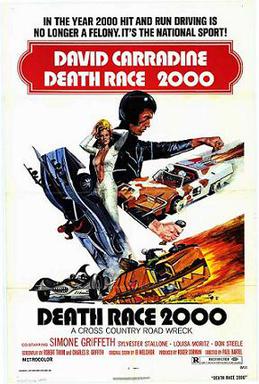
"Death Race 2000" - Film Review


Death Race 2000 (if it wasn’t clear from the title) is not a film that is meant to be taken seriously. Its premise is absurd and the film doesn’t try to take itself seriously.

It’s a campy, absurd romp with all the best elements of an exploitative low budget film. There are explosions, bloody violence, and nudity. 

The film never tries to be anything more than it is and that’s one of the joys of watching it. It’s not trying to be something that plays off your intellect but just revels in how cool and outlandish its premise is. Leather clad individuals in super powered cars driving at top speeds in a race with the goal to kill people for points. It’s a delightfully fun premise and the film takes a lot of pleasure in playing up its absurdity. News crews analyze every aspect of the race in detail, groupies obsessed with the "sport" try to sleep with the racers, and rebel forces attempt to dismantle this world’s dystopic dictatorship by tossing roadblocks in the paths of the racers.

The racers themselves are all so cartoonishly bizarre. The most amusing of these are a pair of neo-Nazis who bear swastikas and mock fellow racers whose shtick is being old timey cow boys. The protagonist is the mysterious Frankenstein (David Carradine), a racer who’s been in so many racing accidents that most of his body parts are less than original. He appears to love racing but he’s also oddly altruistic, doing things for the greater good based on his dark self-serving moral code. One of the more interesting parts of the film is the fact that a young Sylvester Stalone plays the villainous "Machine-Gun" Joe Viterbo, a bratty, selfish dude who will win at any and all costs. 

The race is at the heart of the new world order, numbing the viewers at home with endless violence so they forget about the fact they’re being ruled by a corrupt government with a secret police force. The commentary on society really is never taken far enough for it to matter and largely seems tacked on. The film doesn’t really get into the specifics of the functioning of the world or the race. Instead it leaps right into the race and gets in as many propulsive action sequences in as it can. The action is sometimes incredibly over the top but that’s ultimately part of its charm. The film as a whole, in deed, is over the top.

One of the most entertaining things about the film is how funny it is. The film plays up the blood and explosions to a point of dark, absurd comedic effect. There’s also some satire that though mostly mild and middling is occasionally really funny.

There's even a romantic plot thrown in because, of course, this film isn't trying to rise above its cliches. Frankenstein and his "navigator" (essentially a co-pilot) Annie Smith (Simone Griffeth), who as it turns out is working for the resistance, slowly fall for eachother despite constantly being at eachother's throats. Those crazy kids better figure it out in time to stop the dictator Mr. President! 

There's a fair amount that's clumsily handled. Dialogue is at times awfully written and even more poorly delivered. But it's not exactly the type of film that's concerned with having a precise ear for the way people speak or even having an actual basis in reality.

The cult classic hasn’t exactly aged well but its low budget thrills remain surprisingly fun.

Grade: B-