Wednesday, April 3, 2013

Doctor Who - "The Bells of St. John" - Review


Steven Moffat sure does love intricate mysteries. Even with a more adventurous nature to “The Bells of St. John” and the Christmas special, the episodes (and this one in particular) couldn’t help but feel like Moffat was re-treading territory he’s mined for far too long.

Much of the Moffat era of Doctor Who has been good, but increasingly after the fifth season (my personal favorite) things seemed to get a little jumbled. The serialized plotting for the big mysteries revolving around River and Amy were a bit of a letdown as well as a mixed bag in how they were handled. 

Moffat is frequently better at beginnings, at making something seem like it will be really exciting and cool than actually paying it off down the line. This seems to be the case with Sherlock as well, which declined in quality in its second season when its ambitions couldn’t align with its execution. Moffat has a ton of wonderful ideas floating around that pretty head of his, but he doesn’t always know quite how to use them or when he’s put far too many into a given episode.  

I’m fond of Jenna-Louise Coleman’s performance as Clara. She has the right level of fun, cheeky enthusiasm to fit this series well. I also enjoy her chemistry with Matt Smith and how Clara matches the Doctor tit for tat in a way that it doesn't feel like a companion has in a long time. But I wish she were just another companion; someone who the Doctor saw something in, took along for the ride, and eventually demonstrated their full potential to. Not some mystery that will simmer and unravel for the remainder of this season. 

I don’t mind a long arc hinted at throughout a season, and I’ve liked a number of them in seasons past. But this doesn’t feel like territory the series wants to head down again. 

Otherwise this was a typical Doctor Who adventure. I was amused by the commentary on the Internet and technology’s hold over us (A CCTV critique in a series that’s technically a family show? Didn’t see that one coming), even if this wasn’t the best baddie of the week the show has produced. Of course there were a number of charming, cool little moments that this show nails like few shows do: The Twitter jokes, the bike going up the side of the building, Clara calling for tech support and unwittingly telephoning the TARDIS, the misdirect where we think the Doctor has directly confronted Miss Kizlet and it turns out it's actually one of the spoonhead robots. 

The episode also felt much less overstuffed than the Christmas special, which was a very good episode but one that had too much going on at any given moment. Though the business with the Doctor being a monk in exile is likely one plot strand too many, it’s nice to simply return to the universe of this show. 

Doctor Who, when it comes down to it, is for the most part merely a procedural. But it’s never a series that’s obsessed with just the investigation to discover the answer to the week’s problem. It’s a show that unlike CSI and Law and Order isn’t forced to use its procedural to one particular design. It can use its procedural to pay homage to a genre or take us to a historical event or whatever weird thing it has in mind for us any given week.  

Doctor Who is also a very "television-y" show that’s often indebted to a lot of tropes but it usually has plenty of fun using the fact it’s a television show to its advantage. We know that odds are the Doctor will save the day and it will be with the help of his companion. Though on occasion it goes very dark, there’s always this sense that they’ll fight another day! Which is a very clichéd notion, but one the show consistently earns. It earns this through very good characterization, a strong mythology that is a more often a boon then a crutch, and an unabashed love for humanity and the worlds it explores. 

Though I might have hoped for more from the return of the show, I can’t help but simply be happy it’s returned. There may be better shows than Doctor Who, but there are few that come as close to being as inexplicably addicting. 

Grade: B

The Walking Dead - "Welcome to the Tombs" - Review


Well, that was a letdown.

I should probably get into the meat of the episode and really dig into the specifics, the intricacies (or rather lack thereof) that brought down this episode, an episode that isn’t just a bad finale but just an altogether middling episode. But the real big sticking point is that there was simply very little action, and what action that did exist was some of the least interesting, exciting and most poorly executed action the series has attempted to date. 

Now I’m not some crazy action junkie who needs constant action to enjoy something.  But the one thing that might actually be meritable about The Walking Dead (a series that has so very many flaws) is how surprisingly good its action frequently is, even at times in the midst of episodes that are incredibly inconsistent or just flat out bad elsewhere. 

When a show doesn’t have great thematic aims or shoddy characterizations or premises that essentially lead them to have no real purpose or no foreseeable end, said show has to be managing something worthwhile of some kind to make up for it. A show that I turn to time and again for this point is It’s Always Sunny in Philadelphia. The characters of It’s Always Sunny never act like real people and they’re written in such a way that they only exist to be put into crazy scenarios and do terrible things. But what allows It’s Always Sunny to get away with this is that it’s in many instances very funny. It’s often making you laugh so much that it can sometimes make you forget and forgive the questionableness of certain things you’re watching. 
   
The Walking Dead had one element that covered up for many of its flaws and that was its action. Its action is usually well-staged, well-choreographed, inventive and filled with the most zombie kills you’re going to see this side of cable. I keep returning to the first eight episodes of this season because I think they exemplify the things this series does best. They’re not the best episodes of television (or even this season - that honor would be "Clear", the rare example of a truly good episode in this back half of the season), but they have something going for them that lots of other series either don’t have or aren’t particularly good at, and that is above all else action. They’re not completely action-packed. Actually there are at times long stretches of (and I say this knowing it’s awfully uncritical sounding) boring followed by exciting action sequences that make you slightly forgiving of the shortcomings of the show.  

That is to say: [*in my most “bro” voice*] dude, where’s the action?

Oh, sure, there’s action in the episode but it’s not really the action the show does well. There’s no tension to many of these scenes. So the whole season the show has been building towards a conflict. Now, it wasn’t the most interesting or well-crafted conflict, but it was practically the sole purpose of the show during this season. The show had even shown parallels between the two groups at odds; they weren’t strong or fascinating ones, but they were better drawn than much of the conflict the show had done prior. And then it’s as if the writers had this moment of self-actualization where they realized that a direct conflict between our protagonists and the Governor and his redshirts couldn’t logically end in any other way but with a lot of major characters dead. But it comes off as if the writers couldn’t think of an interesting reason to justify most of the characters living to fight another day and so a number of hugely contrived things take place. 

First is a twist that really isn’t a twist. The characters leave the prison and the writers want to convince us that these people have finally wised up and done what I’ve been suggesting all season: get as far away from the prison as possible. Soon after the Governor and those extras who have been hanging around Woodbury show up, grenade launchers at the ready. And wouldn’t you know they’re searching an empty prison. 

PSYCH! 

Turns out those crazy kids set up some traps, sicked some zombies on their enemies, and bottle necked a number of them into a crossfire. 

So that was our long awaited conflict. Man, how explosive… 

The staging of this is just so poorly done. You can understand all the intentionality of it, but it doesn’t work. They want to misdirect us so we truly believe Rick and co. have left, before having this twist triumphant moment. However, we know that the writers are going to feature some form of the battle between these two groups of people. How do we know this? Well, for starters, The Walking Dead isn’t exactly what you’d call a clever or smart series. Secondly, leaving the prison comes out of absolutely nowhere. This isn’t a show consistent with its characters, but it’s not going to drop a major plot change for the entirety of its major players without establishing it a little (at least, I hope not). 

So we’re waiting for the inevitable and it saps all the tension from the experience. May be the conflict doesn't happen right there and then, but we know it's going to happen at some point. And for a time it actually appears the Governor is searching an empty prison and that the show is weirdly lingering on the search. On top of this, the actual execution of the eventual action is really cluttered and even at times hard to follow. And, not only that, it’s the only action sequence. 

Well, there’s that whole business with Andrea but the show stretches what should have happened really quickly over a period of time that it just doesn’t warrant. 

The other action-filled scene barely qualifies as action. The Governor has gone into full-on crazy mode. It’s not the form of villain that creates dynamic conflicts but it does get some absurd, stupid, occasionally memorable twists, and at least the show finally settled upon just how awful and evil and crazy this character is. In awful, evil, weird form the Governor mows down all the survivors from the prison attack, and it’s really upsetting and frustrating. It’s the pointless death of people; yea, granted it’s people we don’t know at all, but where the fuck does this character decision come from. I can understand it a little bit I suppose. I can finagle my way towards some half-assed understanding that the Governor has gone fully over the cuckoo’s nest. But there’s no point A to point B of character transition. And how the hell can this character still be alive? Does the show really want a wildcard like that wandering around on its fringes? Well, I’m guessing they’re going to figure some way to get him back into the picture like they did with Merle. 

In terms of using the medium of television to its advantage that’s an interesting choice that could payoff well down the line (the decision to keep Merle still alive was a good idea in theory at least). In terms of making this season feel like a cohesive whole though, it fails to take this season’s conflict to a logical and interesting conclusion. 

There’s more to unpack in this episode, but what’s the point really? Some people died. We didn’t really care about them so the deaths had no impact. The one that on paper should have been meaningful, Andrea’s, is all well-staged. Everyone shows up too late to save her, and she and Michonne share one final farewell before the camera pulls back to outside the room and we hear the gun go off. And I’m not a heartless bastard, but it just doesn’t have the impact a major death ought to. It’s not even that I don’t like Andrea as a character; I disliked Lori and her death was surprisingly moving. It just feels as if the show thinks that because it’s the finale some major character has to die and so the monkeys in TWD’s writer office threw a dart and it landed on Andrea, and the writers said, “That sounds good to me!”

Besides the poorly handled, obligatory deaths and the poorly handled, obligatory action, what else is there here to unpack? The poorly handled, obligatory exposition? We could discuss Carl’s sudden descent into psychopathy and how it comes out of nowhere and how it isn’t done well. But, hey, do you really care? No? Neither do I. I want to. I really want to. But the more I analyze this show, the more cynical I become about it. It’s a show that’s scared of its own shadow. It’s a show that gets just shy of being something really good, and then runs wildly far away from it the moment it gets even remotely close.  And in spite of its improvements (which I'm underselling, and have been a leap forward from last season), it still remains mostly frustrating to watch.

I mean, if you’re into unintentional anticlimax than may be you’ll love the hell out of this episode. But otherwise this episode fails at all the things the show does remotely well. 

Stray Observations:

-The intro scene: Milton inexplicably is now getting the shit kicked out of him by the Governor. The show doesn’t really understand the idea of shorthand.
-Admittedly Milton’s impossible choice given to him to kill Andrea was legitimately exciting.
-Milton's death succeeded far better than Andrea's. Partly due to how much more interesting the circumstances of his death were and partly due to Dallas Roberts' performance.
-The Governor gives the bizarre, cheesy life lessons no one was asking for: “In this life you die or you kill. Or you die and you kill”
-Michonne thanks Rick for bringing her into the group. A scene that should have worked if it weren’t for the damn fact the show was trying to pull that terrible twist on us.
-Yea, leave them a Bible passage. Make the religious themes more overt!
-And by psychopathy I mean Carl killed a random guy in cold blood. So, yea, that happened.
-Tyrese and a bunch of random survivors from Woodbury join our merry band at the prison. So that also happened.

Grade: C+  

Tuesday, April 2, 2013

Game of Thrones - "Valar Dohaeris" - Review


Season two of Game of Thrones was based on one of the more unfocused books in George RR Martin’s book series A Song of Fire and Ice. A Clash of Kings in many ways acts as bridge to bigger events that take place in A Storm of Swords, the book that season three is based on. If season two felt more like a hodgepodge of good (sometimes great parts) that didn’t feel like they added to a cohesive whole like the first season did, part of the blame comes down to the book it was translating to the screen. Clash of Kings has some great elements, many of which played out in a beautiful fashion in the show, but it isn’t as streamlined as the first book. The book that follows it, A Storm of Swords, on the other hand is seen as less messy (though just as digressive and expansive), more ambitious, and is widely regarded by fans (and I’m among them) as the best book of the series. However, these reviews intend to review Game of Thrones as a television series and not as an adaptation (though I may in passing mention my feelings about how the show handled particular aspects from the book).

If there is one element that carries over from the book, it’s how much more brooding and operatic this premiere feels. Largely nothing major happens (although I’d argue in one location in particular, beyond the Wall, was the exception that proves the rule) and yet everywhere we go there is a moodiness that pervades everything. Not to spoil anything but A Storm of Swords is a decidedly darker book in a series that is decidedly dark to begin with and so it fits the material being adapted. To move away from these vague references to the book I’ve sworn to not mention, it’s apparent in the production design which appears to be emphasizing darker colors (though things do lighten up a bit when we head over to Dany’s story towards episode's end). Sam and John, in particular, look more weary and battered than ever before, fittingly appropriate for their recent trials and tribulations. 

There’s plenty going on in the episode but the show aptly picks up slightly after the cliffhanger we were left on in season two. That cliffhanger was problematic for me. Its treatment of the white walkers showed a bit too much of the series’ hand; the whites probably ought to have remained a larger enigma for a little longer. But the series handles the response to the cliffhanger in a way that, though likely disappointing to many, I was relieved about. This is a television show and there’s largely no way the show (even on its comparatively large budget) could have pulled off the battle that took place between the whites and the Nights Watch. Instead it maintains much of the awe surrounding the whites (they clearly fucked shit up) and it provides an excellent starting note for the season. 

This isn’t any more members of the Watch then we’ve seen before and yet we immediately are given the sense with a handful of visual cues and lines that the battle was disastrous. There are so few who survived and those who did are drenched in blood and notably exhausted. The way the sequence is shot is great. The episode misdirects us into thinking we’ve picked up right where season two ended, Sam rushes, breathing heavy, through a hazy snow fall on a desolate, endless snowscape.  We’re led to assume he’s running away from the whites; it turns out he is, but the battle's long since over. He’s attacked by a straggling white after witnessing a decapitated watch member; John's dire-wolf leaps out and saves him, and the white is quickly set ablaze. It’s an incredibly exciting sequence and it’s the most action-packed part of the episode, and with very little information it lets us know all we need to know about what's happened and where things are heading. 

Lord Commander Mormont asks if Sam sent out the ravens to which he replies he didn’t. Exacerbated, tired, desperate Mormont tells them what they already know: they need to get back to the Wall. The ragtag crew that is the last defense against imminent doom is underfunded and undermanned, and Mormont is trying to salvage what little sense of duty they still have after the attack. The music rises in the background as he makes a speech and it culminates on that perfect coda: “If you don’t, everyone you know will be dead!” Overblown, sure, but when ice monsters are hot on your tail, it’s a justifiably overblown moment. 

After once again putting everything in perspective (the series constantly likes to remind us how the political maneuvering south of the Wall is petty and pointless), the show proceeds to reintroduce us to most of the characters. There are number of major characters missing (Theon, Arya, Bran, Brienne, Jaimie) and there are number of new players, but, for the most part, the premiere attempts to remind us where every character is at this point in time. One of the great joys and the biggest problems for Game of Thrones is how many characters and locations it is dealing with. Don’t like Jon Snow’s escapades with the wildlings, here’s Tyrion making quips at Cersei or Sansa gazing longingly with Shae at the ships in the harbor. But that means the show often feels crammed to the brim as it attempts to fit everything in. Season two’s “Blackwater” proved it can do something more focused where everything seems to add up to one cohesive whole rather than a lot of good scenes that feel totally disconnected from one another. 

In some respects season three (based on just this first episode) has gotten better at handling this problem, it knows when too much is too much and leaves some characters out (though the fanboy in me is disappointed at the absence of some, though more on that in the “Stray Observations”), and the characters it does stop in on have stories that don’t waste time getting straight to the point. In some instances, that’s a problem for the stories which could have used more breathing time or a scene or two extra (Dany’s feels this way, although, to be fair, her scenes are very good and an improvement upon last season). But the episode is much less cluttered than a number of season two episodes were (notably the season two finale which tried to jam everything into the episode it possibly could with problematic results). 

The show jumps around a lot less. Many of the characters have their story get told and then their plots are sidelined for future episodes. Jon’s storyline is quickly done away with early on. He joins the wildlings, he attempts to win over Mance Rayder (Ciaran Hinds), and he seems to have done the trick (though it's uncertain to what extent). And then we never hear from him again, or anyone else from beyond the Wall for that matter.

Part of this comes from what seems to be the writers trusting us more. There’s less establishment of scenes and more of a desire to dig right in. Sometimes this level of trusting the audience (or more likely a lack of episodic time to tell the story – seriously Storm of Swords is a massive book and the show has mostly made some wise choices on what to synthesize and what to cut down) just isn’t effective though. Take the Robb-Catelynn storyline for example. At Harrenhal, numerous members of the Northmen’s army have been killed or are dying. It’s not explicitly outright stated who did it and through some guesswork you can probably figure out that the Lannister’s hands were involved in this, but it’s so poorly dealt with and the exposition is so brief and passing that it barely reflects the seriousness of the event or the importance of its occurrence. Characters are also very abruptly introduced into this story. Suddenly new individuals, close counselors to the Starks, appear. To those of us familiar with the story we have an inkling it’s Roose Bolton (Michael McElhatton) who will soon play a significant role in the season but for any newbies out there, this poorly handled introduction is probably confusing. There’s also a badly wounded maester known as Qyburn (Anton Lesser), and we figure he’s probably going to play a major role in events to come and so we can overlook the fact that he’s suddenly introduced and then that we never hear about him or any of the other new characters again.

Of course, the show has so, so, so much story that it has to tell and it wants to let every story get a moment to shine and these new characters simply aren’t doing anything relevant currently. Wouldn’t you rather stop in on Tyrion and Davos (the two stories that play over the longest extended period of time in the episode) and their ongoing struggles we know a good deal about rather than dealing with learning about yet another figure in an already very, very expansive cast (one that’s already so large that a number of characters couldn’t even make a brief appearance)? On a critical level it’s handled poorly, but, on a fanboy level, part of me just doesn’t mind much that these characters are left undeveloped.   

However, to be contrarian, the show does establishment of characters fine elsewhere. Margaery Tyrell is given much more storyline than we’ve previously seen from her. Apparently she has a charitable side (at least a politically motivated one for appearance sake) and stops to win over some children in a poorer section of King’s Landing. It’s an action that clearly rankles Cersei, who holds immediate disdain for anyone trying to steal away the attention of her dear Joffrey. 

When Game of Thrones starts up its theme and dashes me from location to location we’ll soon find ourselves at, I find myself excited in a way few shows manage. Did I have problems with this episode? Sure. But Game of Thrones has a world that is always nice to inhabit even for just a little while. Its world runs deep and its characters are richly drawn. This is one of the best casted series on television and continues to cast every new character with an expert eye. Some characters I have trouble imagining anyone else playing them. When Game of Thrones is throwing tons of different things in the air and the plot wheels occasionally get in the way of stuff like thematic unity, or unity of any sort for that matter, there are enough very good things taking place that it’s easy to forget the problems. Sometimes I’d like more from Game of Thrones, but it’s never a series where I say to myself, “That was terrible. Give me less”. This is a high quality production carried by one of television’s best dramatic ensembles. 

Stray Observations:

-NO ARYA! I’m just going to be upfront; Arya is my favorite character and I’m amazed by how good Maisie Williams is as a performer. A little bit of Arya goes a long way and her absence didn’t go unnoticed.
-Sophie Turner’s age is starting to get to a point where it’s going to become increasingly hard to believe the youthful naiveté of Sansa’s character. Littlefinger has Sansa convinced he can get her out of King’s Landing. The best part of this exchange, for what it reveals about the character, was Sansa’s enthusiasm upon hearing about Arya. She’s come a long way since her spoiled season one days.
-Tywin was not pleased to learn about Shae and forbids her presence in King’s Landing. Tyrion’s visit with his father makes Cersei nervous; she fears the true lineage of her children might come to bear upon her poorly. Tyrion has bigger concerns though, such as his claim to Casterly Rock, which his father does not take kindly to even the mere suggestion of. Peter Dinklage and Charlies Dance's acting during this scene was superb. Tyrion has fallen far from his station of season two days.
-Dany and Jorah are now no longer in Qarth (THANK THE LORD!), but their sudden appearance on a ship is somewhat awkwardly explained as is their sudden interest in getting an army of fearless eunuchs called the Unsullied. However, this story is altogether far, far more interesting than anything Qarth produced and so you take what you can get. The Dany story doesn’t crop up until the last twenty or so minutes of episode, at which point I went, “Oh, right, we haven’t even gotten to Dany yet”.
-The Dany plot also brings about the return of Ser Barristan Selmy, who has tracked down Dany after being disgracefully removed from the lifetime duty of Commander of the Kingsguard by Joffrey (back in season one). It’s the ending of the episode. Was there a potentially better ending? Possibly. But for those unfamiliar with the book, I’m assuming this reveal still was surprising enough to justifiably end the episode. Though I don't know if the moment takes place too quickly and therefore lacks the gravitas it should have.
-Jon discovers that the wildlings have giants at their disposal. So that's cool.
-Jon’s explanation for his “desertion” was Mormont’s failure to act upon Craster’s sacrifices of baby sons to the whites. This is a much less compelling reason than the one in the book (being a bastard left him outcasted by the Starks), but it does make much of the somewhat garbled nature of the Craster plot seem more important in hindsight.
-Jon kneels to a man who is not the King-Beyond-the-Wall, which gives him two strikes: wildlings aren’t “kneelers” and he got down on one knee for the wrong dude.
-Bronn is reintroduced in what looks like it’s going to be “sexposition” but is quickly undone by Poderick Payne requesting Bronn at Tyrion’s behest. Bronn is now a knight for his efforts in the Battle of the Blackwater, a fact that puts him at odds with some Kingsgaurd members (part of me wishes it could have come to blows but it makes sense that it didn't).
-The reintroduction of Davos could have been established better but worked due to the bedraggled look of Davos. The makeup department did a wonderful job.
-Davos plans to kill Melisandre who has taken an even greater hold over Stannis who, at her request, is burning nonbelievers. His assassination plot, however, fails and he’s thrown in the dungeons.
-The opening theme has always been excellent, but this episode's was particularly good for featuring a ruined, smoking Winterfell. It's the little things. 

Grade: B+

What did everyone else think?

Monday, April 1, 2013

The Vampire Diaries - "American Gothic" - Review

There’s a lot to talk about in tonight’s episodes, but before we go any further, can I just say ELIJAH!!!! 

“American Gothic” was a good episode prior to Daniel Gillies arrival, but the moment he appeared as Elijah everything began clicking even more. Part of this stems from the fact that Gillies is awesome as Elijah; he seems to relish every scene he does and he also seems to bring out the best in the other performers in the scenes he’s in. Whether it be Nina Dobrev as Elena in an awesome (a word that tends to get thrown around frequently when Vampire Diaries is on its A-game) new mode of emotionless outlook or a much welcome return from the always delightfully devious Katherine or Claire Holt as a wonderfully vulnerable Rebekah, Gillies sucks you into every single one of these scenes. He has an unmistakable presence and it shows. 

Elijah is back in the picture because of another character’s lovely return, Katherine. Katherine has the cure and intends to use it to bargain for her freedom from the ruthless Klaus who has been hunting her for nearly 200 years. Of course, Katherine can’t make the deal directly and so has struck up a relationship with Elijah. This leads to one of the funniest scenes of the episode. “He can’t have much of an impeccable taste if he’s friends with you,” Steffen quips. “When I say friend. I mean friends,” Katherine informs. Cue disgusted reactions from everyone. Priceless. 

Elijah’s smarter than this though, right? “She’s playing you,” Elena is quick to inform him. Elijah still holds hope that “Katerina is behind this Katherine façade”.  In yet another excellent scene, he draws parallels between his inability to escape his feelings for Katherine to Damon and Steffen’s endless pining for her and their ceaseless desire to turn her back into human Elena. Well, Elena is fed up with Damon and Steffen trying to “fix” her. 

The proof is the pudding by episode’s end. Damon and Steffen try to give her another of the clichéd, repetitive talks to convince her she’s lost her senses, and, well, Elena’s tired of this shit. She snaps the neck of the waitress and admonishes that her death is on them: “Like I said: consequences”. 

As if this new version of Elena weren’t fantastic enough, Katherine and newly devil-may-care Elena get to spend some quality time sniping at eachother, and wouldn’t you know it, Elena and Katherine have excellent chemistry (it’s almost as if they’re played by the same actress).  

But there were so many pairings of characters that worked so well this episode, including Damon and Steffen, who get some much overdue brotherly bonding time. Steffen is fed up with Elena altogether; he intends to get out of dodge the moment she’s cured. Meanwhile, Damon has a “lapse of judgment” and purposefully allows Rebekah to take what appears to be the cure. He immediately regrets it. Damon has changed to the point where there’s no satisfaction to be gained from being with this new version of Elena. The old Elena challenged him in a way that made being with her ws an exciting possibility. Now she’s just a drain on him. 

Putting together three of the best chess pieces the series has had throughout its run on the board (Katherine, emotionless Elena, and Elijah) turned “American Gothic” into one of the funnest episodes of the series in a long time. Seriously, this was the type of pure fun The Vampire Diaries was pulling off at its peak when it was phenomenal and peerless. And yet this was simultaneously one of its best episodes at delving into these characters, and processing where they’re at this point in the show. In combination that made for one of the best episodes in a long, long time. 

Stray Observations:
-In the subplot, Silas tricks Klaus into believing he’s Caroline. Candice Accola proves to be far more adept at shifting into this role than David Alpay seemed to be. This is another very entertaining piece of business, and it demonstrates the direction the series is taking Silas in, which has oddly enough been in the background of much of the season in recent episodes. Silas is a scary mother fucker, needless to say. He tricks Klaus into thinking he has the white oak stake stuck in his back, and due to this he was in endless agony.
-Katherine compelled the whole sleepy town to do her bidding. Clever girl.
-A perfect piece of music playing when we first enter the diner: Forget Me Not by The Civil Wars
-Rebekah’s jabs at Katherine were great: “Not quite slutty enough”; “Just the right amount of contempt and hidden insecurity”
-Just the way Nina Dobrev carries herself you can detect a difference between Elena and Katherine. The meet up between them could have very quickly felt like writer’s wish-fulfillment, but Dobrev nails those scenes, and there’s a noticeable, inexplicable difference between the two characters even when they’re acting incredibly similar.
-Katherine has a point. Suddenly becoming mortal isn’t going to fix all the massive baggage Rebekah has.     
-Elijah immediately picks up on the change in Elena being emotionless because Elijah is a badass.
-Vervaned fish tank. Pretty sweet.
-Katherine snapping Elena’s neck, actually took me by surprise. Not because it was unexpected but because of where the conversation was with Elijah and Elena. The twists really worked this episode in a way they haven’t been a lot this season.
-Rebekah and Elijah’s scene was really touching. Whenever Claire Holt is asked to show the more sensitive side to Rebekah, she captures that tragic, child-like quality to Rebekah and it’s really incredibly sad and well-acted.

Grade: A

Friday, March 29, 2013

"Would You Rather" - Film Review


I watch a lot of bad movies. Sometimes I watch these bad movies by choice with the intention of making fun of them. And sometimes a film is so bad that there’s no room to make fun of it but to sit there displeased at the failures of the films. Would You Rather isn’t the worst movie ever, but it’s frequently pretty odious.

It’s a film with a thinly conceived excuse for torture porn horror excesses. I can take violence and gore and blood spatters galore, and a number of my favorite films and tv series use violence to great effect. But Would You Rather fails to understand the point of violence and especially of violence to excess in a film. 

It establishes a scenario (desperately in need of money, people choose between two awful, violent actions to win said money and stay alive) in which people are forced to do awful things; awfully violent things. At first it’s tolerable and then the justifications and the nominal thoughtfulness fade away and what remains is a film doing terrible, terrible things to its characters for seemingly no other reason than because it can. The film takes a weird, semi-fetishistic pleasure in forcing its characters do despicable things to themselves and eachothers in order to survive and to make money, as well as to fuck over other people. 

And what all this eventually leads to is you feeling like total, absolute shit. I felt lousy and a little unclean after watching Would You Rather.

There are familiar faces in the film, notably Jefferey Combs hamming it up endearingly as the sadistic host Shepard Lambrick, but also Sasha Grey as the peggable winner (she’s not there to make friends!) and an underutilized John Heard. Obligatory blonde Iris (Brittany Snow), the protagonist, is provided a thin prologue backstory to make us sympathize with her, a pat, generic story involving a sick brother in need. But we end up caring about really none of the character because they’re so underdeveloped and none of their motivations make real sense (even often from a primal stand point). 

It's not a totally unentertaining film, but it never earns the excessive bloodiness or the scenarios they take place in.

Grade: D

"Flight" - Film Review


There are those films that come straight out of the gate. They’re fully formed right from the very first scene. This doesn’t mean they’re necessarily good. But films that have identity crises, that can’t settle on what they want to be, are often too problematic to fully work and be enjoyable. Flight is an example of this latter type of film.

It’s all over the place. There’s entertaining things happening on occasion but for what purpose, it’s frequently tough to tell.

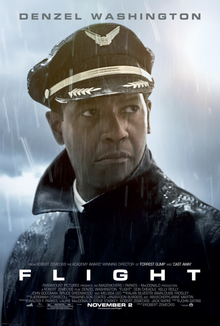
Denzel Washington was nominated for an Oscar for his work as in Flight, and though I don’t know if the nomination was justified, Washington is one of the better aspects of the film. Whip Whitaker is an airline pilot with major addictions, largely to alcohol. He shows up to work drunk and high on cocaine, and when the plane malfunctions, going into a nosedive, he flips the plane upside down to level it out in order to make an emergency landing in a field. The plane crash sequence is genuinely exciting and one of the film’s highlights, but afterwards the film becomes something far more brooding. 

It chooses to delve into the self-destructive tendencies inherent in Whip. Whip initially decides to go cold turkey after discovering the flight attendant he was having a fling with died in the flight (saving a child no less). He quickly returns to his old ways, however, when he learns that the toxicology report has him pegged for manslaughter for the six people who died on the flight. A fact that’s complicated by the fact that the real cause of the crash seems to lie in the plane’s mechanical failures and Whip appears to have pulled off a feat that no one else could have.

For awkwardly developed, slightly contrived reasons, Whip befriends Nicole (Kelly Reilly) a recovering heroin addict he first meets at the hospital. She tentatively tells him where she lives, and in a drunken haze, after failing to rekindle relations with his estranged son and ex-wife, he saves her from the deadbeat she owes drug money to. With his help, she kicks her drug habit (eventually joining AA – he goes along for one meeting, but quickly leaves, turned off by the whole idea), but has to watch as Whip continues to destroy himself slowly, guilt stricken by the crash and consuming increasingly excessive amounts of liquor. 

This has all happened within the first hour of a film that’s over two hours long. And it isn’t that it’s not entertaining or not well-acted or poorly directed, in fact, Flight is entertaining, well-acted, and well-directed by Robert Zemeckis (though it has some major pacing and structural problems). The individual moments and scenes work well in of themselves, but holistically it’s kind of a mess. The film early on is bouncing between Whip’s relationship with Nicole and his preparation for the trial. These two aspects are interesting but they’re often at odds with one another, having little to do with eachother and clashing tonally. 

At times, it’s cheesy or clichéd but Washington and a really great cast that also includes Don Cheadle as the lawyer Hugh Lang assigned to him for the case, who’s simultaneously disgusted and in awe of Whip, and John Goodman as his druggie best friend Harling Mays (who’s incredibly underdeveloped and who’s introduction is terribly handled). However, the ending undercuts much of the moral complexity the film had established and shoves a far, far too simplistic message down our throats.

Flight is an entertaining film, but the its initially interesting premise gets lost in the shuffle of a grab bag of ideas that work with varying degrees of success. 

Grade: B-

Thursday, March 28, 2013

"Paranormal Acitivity 4" - Film Review


Why do we like the found footage genre?

I’ve always found it to be due to our desire for being immersed into something that appears, at least on the surface, real. In the first Paranormal Activity film (the best of the series), there isn’t a big budget and there aren’t any large scares (besides a conclusive moment). Nothing really happens. In the first film this works because there’s a sense of verisimilitude: this could happen in real life.

By the fourth film, what’s the appeal of watching people be occasionally, abruptly be freaked out by demonic beings (beings which they can’t even see in the first place)? If the story were to immerse us into this world, and have us buy into the notion that there’s a legitimate threat to the people we’re watching than perhaps we might care. Or perhaps if these were fully realized, well-developed characters worth liking and worrying about. 

Instead we’re made to watch unrealistic, one-dimensional people … and mostly they’re not even being haunted. They’re going about their daily lives and every now and again we’re reminded that oh, right there’s demonic foul play afoot!
 
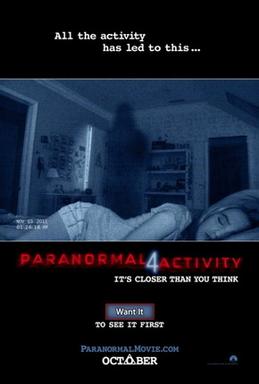
Paranormal Activity 4 features long stretches of voyeuristically witnessing the day to day lives of a family. There’s dialogue that’s repetitive, uninteresting, and doesn’t advance the plot. And every once in a while the film remembers that it’s supposed to be a horror movie and has some moment that has us jump.

The would-be protagonist teenager Alex (Kathryn Newton) suspects something is up when the neighbor’s son Robbie (Brady Allen) creepily keeps appearing at their house. He’s forced to stay with them when his mother takes ill (the mother being the demonically possessed woman from the first film, but that’s almost beside the point). He’s helping the demon try to take possession of the family’s son Ben (Matt Shively) and in the meantime the demon dicks around and messes with this family in some supposedly, but not really, scary moments.      

Not only is Paranormal Activity 4 not very scary, it’s also very illogical. It’s necessary to accept the found footage concept to buy into the premise, but the film doesn’t even do a nice job establishing the basis of this found footage. Why is the daughter filming all the damn time? Does she have an interest in filming? Does she like documenting stuff? Why is she recording stuff with computers all the time? Why do they have so many damn computers?

A boring film that fails to achieve the one thing it’s supposed to (ya’ know: be scary), and that’s frustratingly, distractingly fallacious.  

D