Friday, March 15, 2013

The Office - "The Farm" - Review

“The Farm” is a very odd episode of television. Initially intended as a backdoor pilot for a series of the same name as the episode, NBC scrapped the show after shooting the pilot. The Office in turn had to rework the rest of the season to smooth over the change in direction. And so “The Farm” is a salvage mission; it’s an episode that tries to integrate the footage of “The Farm” and make it work as just another episode of The Office.

It’s not a terrible episode; this season has had far worse ones. However, it’s an episode that feels halfbaked. The material about Dwight on the farm never is given enough footing to truly take off. Thus it’s a lot of ideas that actually aren’t that bad but never amount to much.

When Dwight’s aunt dies, he attends her funeral, where he’s reunited with never before seen siblings. Setting aside how weird it is that we’ve never even heard in passing about his brother or sister, I’d be willing to accept their existence if it weren’t for the fact that I doubt we’ll ever see them again. Much of this episode is very “pilot-y”. It’s setting up ideas that would potentially have paid of down the line in the spin-off. But since there’s no longer a spin-off, the siblings are just types, and they don’t seem to have at least a cursory similarity to Dwight. His brother is a tad off, but he’s a hipster loser. His sister is a single mom who lives in the city and loathes rural life. There’s the suggestion of history between them (the brothers playfully fight the moment they see eachother), but we know nothing of these other characters beyond the fact they’re related to Dwight. But what does this do to service Dwight’s story arc? (wait, for that matter: what is Dwight’s story arc this season?)

There’s a B-plot that’s tacked on about Todd Packer pretending to be a part of AA and trying to apologize for his past mistakes. I’ve never been a fan of Todd Packer. It’s a character that if the series had used him any more than they did, he would have become frustrating and annoying. The storyline is incredibly unnecessary but it was interesting to watch Packer be kind of backhandedly nice for a change. And the reactions were all appropriately in character. However, the storyline is made problematic when it turns out Packer laced the cupcakes he gave to the office with drugs. At which point an unnecessary but not grating storyline took the series back into the realm of surrealness it’s ineffectually been dancing around with in recent seasons. 

The Packer story is treated like an afterthought, and the Dwight storyline is a series of amorphous but never fully formed ideas. Part of the problem is derived from trying to make the best of the fact there’s no longer a spin-of and the show does an amiable effort. I’m a sap and so I probably would have checked out the first few episodes no matter how little I care about The Office at this point.  But even the best salvaging efforts sometimes can’t completely save the wreckage. 

Grade: B- for effort, C+ as an episode of The Office.

"A Fistful of Dollars" - Film Review

A Fistful of Dollars is one of those rare remakes that’s quite possibly as good if not better than the original. When it comes down to it, Sergio Leone’s spaghetti western is a reworking of Akira Kurasawa’s Yojimbo; the setting is now Mexico rather than Japan, and it’s gunslingers rather than samurais, but the simple but great premise about a loner who wanders into a town fought over by rival gangs remains. In many ways, Dollars is the superior of the films. It streamlines the narrative and cuts away some of the fat, which leads to more action and a more crackling, sensational vibe.

Dollars is the first in Leone’s "Man with No Name" trilogy. Most people remember him best for the third of the films, The Good, the Bad, and the Ugly. I’m a contrarian who finds the film to be more problematic than Dollars. It’s too overlong, too digressive, and too unfocused. Here in Dollars is all the best aspects of Leone. It feels a lot less rambly and sprawling than Ugly. It focuses on a small Mexican town in the 19th century just across the border from the U.S. The Man with No Name (Clint Eastwood) comes across the town, learns of the infighting, and decides to clear the town of evil and make a profit in the process. 

There’s Leone’s undeniable style; it’s a film that’s often so cool that it makes you shut off your brain at times and forget to be critical of it. From the opening animated title cards to that wonderfully well-executed final standoff, it’s a film that’s massively energetic and fun, even surprisingly thoughtful, but definitely by no stretch of the imagination boring. This is perhaps best exemplified by Ennio Morricone unforgettable score. And while it’s certainly not a perfect film, it’s an incredibly entertaining movie with some memorable action scenes and characters, particularly Eastwood in the lead role. 

But more than anything is the feel the film gives off. It’s darker and more stylish than just about anything that came before it. There’s a reason Eastwood’s character remains iconic even for those who haven’t seen any of Leone’s films. With his signature poncho, the nameless badass who’s quick on the trigger but even quicker with his wits is an archetypical hero with outrageous amounts of charm and swagger. The film has style to spare, especially from its protagonist, but it also has some incredibly effective plotting and some nice character work even from supporting characters, all the more impressive considering much of the dialogue is dubbed. 

All of the action isn’t just for the hell of it; it all grows organically from the plot necessitating it, and then once Leone has justified the action, he goes out of his way to craft  some of the most electrifying and exciting scenes in film history. It’s not the brainiest of films but it's a damn good time.

Grade: A-    

Thursday, March 14, 2013

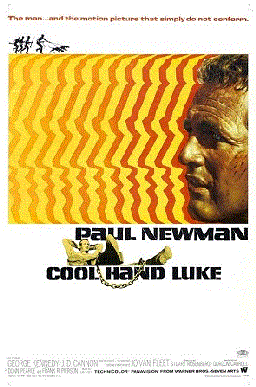
"Cool Hand Luke" - Film Review

“What we have here is a failure to communicate,” the prison warden tells the inmates a little over halfway through Cool Hand Luke. It’s a great line and the scene from the film most people remember when they think of the film. It’s a line that’s become part of colloquial expression and pop culture consciousness. But it also marks a change in the tone of the film.

Up to that point, Cool Hand Luke is about as feel good as a movie about prisoners can be. Luke (played wonderfully by Paul Newman) gets sent in on some petty crime for taking off the heads of parking meter while drunk. His rebellious, jovial, aloof, devil-may-care attitude initially puts him at odds with the inmates, but he slowly wins them over. He’s willing to do anything to stop the boredom and tedium of working a prison chain gang. He makes absurd bets in a poker game; he has them rush the tarring of a road; he eats fifty eggs in an hour.

But soon it’s not enough. He learns his mother Arletta (Jo Van Fleet) has died and he can’t stand the prison any longer. He plans an escape with the help of the other inmates but doesn’t make it very far before he’s sent back. He breaks free again and it seems like it might work, but Luke is apparently shit out of luck. The warden isn’t going to put up with this anymore; he decides he’s going to break Luke and puts him through hell. He’s sent to solitary confinement every night; he’s beaten relentlessly at work; and he’s given needlessly difficult and pointless work assignments. The wily smiles and jokes soon fade to reveal the sadness hiding behind Luke’s carefree persona.

The film is inhabited with a rich world of characters. There are a number of great bit roles. This is especially true of the prisoners particularly George Kennedy who won an Oscar for his role as Dagget, the de facto leader of the prisoners. Strother Martin is also fantastic as the prison warden, the Captain.

Stuart Rosenberg's direction is frequently clumsy and awkward. Cool Hand Luke’s tonal shifts don’t always work and this is largely due to some unfocused plotting and some scenes with great writing but a peculiar presentation. However, overall the film is funny, compassionate and moving.

Grade: B+

Tuesday, March 12, 2013

"Repulsion" - Film Review

Carole Ledoux (Catherine Deneuve) seems like a nice girl. She’s perhaps a bit shy, nervous and quiet but she’s not dangerous.

Something’s not quite right about Carole though. She’s spacey, distant, obsessive. Repulsion takes its time peeling back the layers of her damaged psyche. She’s not well and possibly has some disease like schizophrenia. It’s clearly never been diagnosed though. 

The only people that have any interest in her overlook what’s wrong with her. She lives with her sister Hellen (Yvonne Furneaux) who cares for her but sees her as a burden. The guy, Colin (John Fraser), that’s interested in her just wants to be in a relationship and doesn't stop to think there might be something wrong with her.

Carole mostly keeps to herself. Stuck in her mind where everything is in a constant state of hyper-reality. Every sound stands out stronger and louder; the lighting and the space of the tiny apartment start to make everything feel increasingly claustrophobic and confining.

Eventually she’s left in the apartment for several days and the time alone takes a toll on her. She begins seeing things that aren’t there and disappear at a moment’s notice. She leaves food out to rot and gather flies. She bars the door and cuts the telephone line. When people begin inquiring she freaks out and attacks them.

On display for most of this is Catherine Deneuve who’s incredibly convincing while speaking next to no dialogue, even in her scenes with other actors. Deneuve has this ability to subtly shift her eyes and provide all the necessary information you need to know. It’s not all that surprising that director Roman Polanski uses the eye as a reoccurring motif throughout the film.      
     
The film takes its time desconstructing Carol’s life demonstrating to us the limiting and frustrating nature of her life, and how desperately overlooked and disregarded she is. It has a wonderfully well-executed build up and it leads to some riveting and intense climatic scenes. 

Repulsion is a penetrating character study and a great psychological horror movie with creepy, evocative atmospheric visuals and Deneuve’s great performance. 

Grade: B+

Monday, March 11, 2013

The Walking Dead - “Arrow on the Doorpost” - Review

The Walking Dead is a severely uneven. Its characters’ actions are often inconsistent and its plotting is just as haphazard. I don’t expect every series to be as perfectly plotted as a season of The Wire. I’m willing to suspend my disbelief and be taken along for the ride to wherever a show might want to bring me, no matter how occasionally uneven, if it feels like I’m ultimately being rewarded. Plenty of great series were uneven. Many series often stumble in their later seasons. Friday Night Lights after its first season was uneven but still very good. Breaking Bad’s fifth season thus far has been doing things that are really pushing that show to a point where it’s questionable. Arrested Development’s third season was becoming much more hit or miss.

But unlike these much better series, The Walking Dead has almost always been inconsistent. The series has this odd tendency to go from very good to borderline bad, and often within the same episode. After “Clear”, last week’s excellent episode and a season high, “Arrow on the Doorpost” was likely not going to live up entirely. Much of the literary quality of “Clear” is gone, which isn’t a bad thing; no one ever said a show had to be literary to be good (Archer, Cougar Town, Parks and Rec, Bob’s Burgers are all examples of series that I would likely never describe as literary but are some of the best shows on television). However, instead though we’re back to the odds and ends hemming and hawing that’s been an irregular death trap for the series. 

It’s not all bad. Darryl and Martinez’s conversation, as well as Hershel and Milton’s are both nicely observed. Maggie and Glen finally talking through their issues was well played by Steven Yeun and Lauren Cohen; even if this happens a bit too fast, the two actors have too much chemistry to not buy it. I appreciated Glenn standing up to Merle, especially as it calls back to his recent character development.  Rick’s hesitation about handing over Michonne also fits well into the plot movements from last week’s episode. 

Its moments like these (and some of you might disagree or choose other ones) that the series occasionally pulls off in the midst of fragmented episodes (which is to say most episodes). But as for the moments that should really count, it somehow never seems to stick these; the real biggie here being the Governor and Rick finally meeting for the first time. 

Part of the problem is shorthand. Television does this often; it sometimes doesn’t tell us everything and has us fill in the gaps ourselves. This isn’t always a problem but it is on a series like The Walking Dead which rests upon constant pressing human (or at least zombie) conflict. In media res isn’t a bad plot decision but it doesn’t make sense for this episode. It hasn’t been established that Rick and the Governor were going to negotiate.  Sure it was hinted at that Andrea would try to set something up, but immediately jumping to this huge plot moment without having built up to it means that what should be an intense and exciting moment has to be spread out for far longer than it can sustain itself. Andrew Lincoln and David Morrissey are pretty good actors and so they cover for some unsatisfying, repetitious dialogue. Thus I wasn’t feeling anything during their sitdown, the most important part of the episode. 

The shorthand on a much larger scale is even more disconcerting. To me, the whole “war” between Woodbury and the prison doesn’t make any sense whatsoever. The Governor is crazy and so it’s reasonable that he’d want to be further crazy and destroy our merry band. But Rick and co. have no logical reason to fight this war. They may have a stockpile of guns now, but they’re still outnumbered and the prison isn’t as defensible as they keep convincing themselves it is. Some may have vendettas against the Governor, but in a world with zombies, shouldn’t your first priority above all else be to survive. Zombie stories are partly interesting because the main thrust is that the only true meaning in life anymore is to survive for the sake of surviving. Not only that but with their ad hoc family formed, these people have more meaning to their lives than a lot of people still alive must.  When Hershel said that some people wanted to leave, I yelled out, “THANK YOU!” None of them have been acting like real people on this count; they’re being irrational, paranoid, and gung ho with no extensive, well founded basis for it. 

I’d say this is better than the first three episode of the mid-season return, but it’s a step down from last week’s episode which showed so much of the promise this series has. Its untapped potential is truly depressing. The first eight episodes saw improvement and it’s still a better season overall compared to both season one and two, but it’s still a series that continues to take the easy way out. Now we’re on track for another showdown and the uncertainty surrounding the protagonist, particularly Michonne, is a direction that has some serious potential, but then again I never enter an episode of TWD with high hopes. I’m usually amused but it just doesn’t enthrall me like I wish it would.   

Saturday, March 9, 2013

Community - "Cooperative Escapism in Familial Relations" - Review

The more television I watch, the more it seems to me that what makes a series work is its ability to form a foundation that it can always fall back upon. In the case of comedies, the comedies that are the most likely to leave you satisfied and that don’t retread themselves terribly in later seasons are the ones with emotional and character cores. These character and emotional underpinnings establish series as not just vehicles for being funny but explorations of whatever is on the writers’ minds. This allows a show to make jokes without the series getting its head too lost in the clouds and losing all purpose.

This may not sound revelatory but it’s a huge distinction that sets apart shows that are bad and mediocre from those that are good. For example, It’s Always Sunny in Philadelphia, especially in its earlier seasons, is a funny series. However, it also is a series that has its characters do inexplicably terrible things in the name of being funny. Sometimes it goes too far and the characters feel like unrepentant cartoon characters out of something like Drawn Together. These characters are amusing but they frequently have to no basis to any actual human being or reality whatsoever. Take a totally different example, Modern Family. Modern Family, starting in its second season, and increasingly so afterwards, lost the whole premise of tension and emotion underlying it. The characters on Modern Family early in the series had to fight and finagle their way to understanding and appreciation of one another. The characters didn’t always immediately forgive and forget; they didn’t always just return to status quo of “We’re family = We love eachother unquestioningly”. 

Community was able to get away with its many homages, spoofs, and parodies because it would ultimately use these crazy antics in the service of telling something meaningful about the characters (as well as breaking down just why it is we love the particular pop culture genres we do). In the season four premiere with The Hunger Games parody, there was no real reason to do it other than to try to provoke laughs out of us; to essentially shock us into some guffaws. It wasn’t a cleverly designed means of exploring these characters and their relationships and therefore it felt very, very empty. The Inspector Space Time Convention was an even more extreme case of this phenomenon. 

"Cooperative Escapism in Familial Relations", on the other hand, feels like early Community in how it utilizes homage and ties it back to the characters. The jokes aren’t just for the sake of jokes. They’re funny, yes, but more importantly the jokes are used with the intention of saying something about the characters. The prison break/Shawshank Redemption spoof is amusing; however, the ability to ground that in how it pertains to Troy, Abed, Annie, and Pierce’s relationship to Shirley elevates it. Similarly, Jeff meeting his dad for the first time is an interesting examination of Jeff’s character, and it brings up an aspect that’s been hinted out constantly throughout the series run. In turn, the way this plot manages to touch upon Britta and Jeff’s relationship is another great use of joke telling and storytelling in order to look at that pairing and why it matters.

This is a step up from the previous episodes of the fourth season, and I really hope they keep it up.

Grade: B+

Friday, March 8, 2013

"Laura" - Film Review

A hardboiled detective. A femme fatale. Shadowy lighting. Moral ambiguity.  Yep, it’s a noir film alright.

Laura was one of the earliest films from the noir genre, and its footprint can be felt in countless noir stories. 

The Detective Mark McPherson (Dana Andrews) is investigating the murder of a woman named Laura (Gene Tierney). There’s a number of suspects at hand; the two most likely responsible are her fiancĂ©, meek, shy Shelby Caprenter (Vincent Price), and an ex-lover, Waldo Lydecker (Cliffton Webb), who is an eccentric critic who appears to be an open book. And each one, and others as well, is taken seriously as a potential suspect. At one point or another, you’re going to believe it was one of them, even the detective starts to seem peculiar as he becomes obsessed with Laura, even impossibly falling in love with her just from the sight of her portrait and the taste in her music. 

The more we get to know about Laura, the more we’re forced to ask “who was this person?” Everyone keeps saying “She was so sweet”; but was this the truth or was there perhaps a more sinister side to Laura? She seems to have played both Waldo and Shelby like a fiddle, stringing them along. Or this merely the sense we're given since we only ever see her from the perspective of men lusting after her?

The greatness of Laura lies in its constant twists and turns. Just when you think you’ve got it all figured out, it tosses a curve ball and has you questioning everything all over again. It’s gripping and engrossing, and builds to an incredibly suspenseful and taut climax that’s as pulse pounding as anything made today in Hollywood.  

Great acting and wonderful build-up make Laura a first-rate mystery.

Grade: A-