Thursday, March 7, 2013

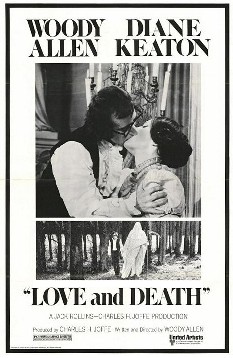
"Love and Death" - Film Review

 Love and Death is a vehicle, like many Woody Allen movies, for Woody Allen to tell whatever jokes or observations are on his mind. The film is essentially a historical satire (and to differing extents a satire on Russian literature and contemporary European cinema), but it’s very broad in how it tells this satire. The film is more concerned at poking fun at anything and everything that in Allen’s eyes is weird, questionable, or absurd.

Set in Russia during the Napoleonic Wars; the film tells the story of Boris (played by Allen, who for all intents and purposes is practically playing himself). There are two plots at the heart of the film. The first is about how Boris finds himself in love with his cousin (Diane Keaton), but unfortunately she has no interest in him. The second involves him being drafted into the war effort against France despite his total disagreement with the war. 

Love and Death doesn’t lean on any particular type of joke. It’s the sort of comedy that throws everything at its disposal at you in order to provoke a laugh. When it’s effective, it’s incredibly effective and Allen makes you laugh like no one else. But when the film fails to be funny or becomes self-indulgent, it noticeably falls flat. However, credit has to be given to Allen for incorporating everything from slap stick to more subtle literary references. There’s humor targeting existentialism, stereotypes, racism, death, love, war, and everything in between.      

Allen’s trademarks are all here. There’s a flare for the absurd and surreal at turns. A white cloaked visage of death keeps popping up and having amusing conversations with Boris. The man that proposed to Sonja dies the moment she announces the engagement. Boris is shot out of canon and lands in the enemy’s officer tent thus ending the battle. It also features Allen’s trademark fourth wall breaking; he continually looks right at the camera and makes a summarily thematic speech or quip.  

The film reminds me most of all though of Mel Brooks. Brooks became less and less interested with plot over the course of his career and increasingly tossed too many jokes to count at his audience. This method didn’t always work but you could always appreciate the effort, especially because the films were often too entertaining to care otherwise. This film has a similar sensibility of humor to Brooks, perhaps not surprising considering they were Jewish comedians producing films around the same time.

Love and Death is uneven (and it’s best not to read into the plot too much), but that’s mostly made up for by how funny it often is.

Grade: B+

Wednesday, March 6, 2013

"Paths of Glory" - Film Review

Heading into World War I, everyone involved expected an easy, quick conflict. For years Europe had devoted themselves to the notion of “progress” that technology and war would advance society for the better. Those attitudes still prevailed early on in the war before it had really started to take its toll. WWI was in many ways the first war that made people realize that may be war was bad and perhaps it should be avoided.

The military mission given to the French troops (although played by no one French and with no French spoken throughout)  in Paths of Glory is impossible, even foolhardy. They’re to take a fairly useless strategic position, a hill labeled the “Anthill”. In the process, the loss of more than half the troops is expexted, and once they’ve taken the hill they’re to hold it for several hours until backup arrives. It’s a pointless military assignment that doesn’t serve to advance the war effort and all-in-all is meant to look good for the politicians and press back home. 

Paths of Glory is an “antiwar” movie. Its message is didactic and it’s filled with archetypes and lofty themes about the cost of war. There’s not exactly real people to get attached to, but rather people who stand in for different ideological systems or who become constrained by those ideological systems. There’s the general, Major General Georges Broulard (Adolphe Menjou), who has no real sense of the cost of war and still enthralled by the so-called chivalry of war. He keeps insisting they take the position even as it becomes increasingly unfeasible and dangerous. There’s the solider, Colonel Dax (Kirk Douglas), who chooses to oppose him. Idealistic and concerned for his troops’ lives, he questions the purpose of the mission from the word go.

When the mission stalls, the troops are unable to make it more than halfway through no man’s land (some don’t even leave the trenches because their commanding officer died before they were given an order to exit), the general court marshals all the surviving troops, who are few and far between considering most died in the foolish forward march. The colonel won’t stand for this and defends them in their military trial, a loaded court case overseen by top military officials who intend to make an example of three soldiers chosen as stand-ins for their companies. They, not unexpectedly, lose the trial and are sentenced to death by firing squad.  Nobody learns anything, other than the colonel, and the war continues on. 

The film is directed by the inimitable director Stanley Kubrick in one of his earliest feature films. Kubrick would become increasingly abstracted and thoughtful about the nature of the medium of film. This is arguably his most accessible film; fans of his film will know that his later films would find him exploring the medium’s possibilities with exceedingly strange but brilliant results. Kubrick was best remembered as a calculating perfectionist. Much of his immaculate framing and impeccable sense of detail are present in the film. Kubrick had a tendency to put his audience at arm’s length from the action taking place. We can see this in the forward movement out of the trenches. It’s one long tracking shot, occasionally spliced with a less extreme wide shot of Douglas. It’s not overly stylish; it’s not gruesome. People are frequently being mowed down by bullets and the lines noticeably thin, but there’s no sense that Kubrick is trying to get us engrossed in the action or deeply involve us in this moment. We’re at a distance, watching this tragedy unfold. There’s no honor or glory here, just death.

It’s not all that thought provoking or original of a message, but it’s an incredibly assured and well-crafted film and Kirk Douglas gives a great performance. 

Grade: A-

Tuesday, March 5, 2013

Girls - "It's Back" - Review

Lets face it, relationships are sometimes awful. We’re often so desperate for intimacy and connection that we’ll put up with people’s shit even when it’s a massive burden. It’s a question that series often are forced to ask themselves: why do these people spend time together? Often times we date someone or we’re friends with someone out of complacency. May be things aren’t the same between us, the sparks dwindled, but the familiarity is comforting even as we’re being dragged through the muck.

Todd VanDerWerff at the AV Club said something back during the first season of Girls that has continued to strike me. He described Charlie and Marnie’s relationship: 
“A long-term relationship has its own kind of inertia. Once you get past the year mark, your life becomes harder and harder to picture without the person you’re dating, and it becomes easier and easier to see the rest of your life stretching on with them in it, heading off into the future. Even if the person you’re with does something really awful, you might find yourself fighting to get them back simply because having to reimagine your future without them in it can be so terrifying. It eventually becomes less about how much you love them and more about how much your life makes sense with them in it, never mind the fact that it only makes sense with them in it because you’ve reordered your cosmos to include them. Love is a part of it, yeah, and there will be times when you really, really love them. But the real success of a long-term relationship comes from constructing the most comfortable habitat for it, like a really impressive animal cage in a zoo.”
He was talking about Charlie and Marnie, but he might as well be discussing any of the relationships on this series. Even though Marnie and Hannah are supposedly at odds with one another, they continue to be incredibly attached to one another at a level of unhealthy codependency. At her dinner party in "It's a Shame About Ray", Hannah defends Marnie when Charlie badmouths her, despite the fact she’s still pissed off by her. In “Boys”, both characters keep dancing around their need for one another and lying to one another in the process. This is friendship isn’t good for either; inevitably it just ends up bringing out the worst in both. But after a certain amount of time relationships trap you inside their weird internal logics. 

Marnie isn’t the only one with a strained relationship to Hannah. Adam returns in his own plot where we see him at an AA meeting rant about his frustration over Hannah. The scene really elaborates just why Adam feels so strongly about Hannah, something that never made total sense from a character stand point. Here at the meeting an older woman is so intrigued by his speech asks him to call her daughter, Natalia, on his date. Adam is nervous but he wants a distraction and so calls her up. Turns out she’s gorgeous and down-to-earth, and just as cynical about her mother’s blind date suggestion.

If Adam is starting to get over Hannah, well Hannah is unfortunately ignorant of this fact. She’s so paranoid about Adam stalking her that it’s kicked in her OCD, which hasn’t been triggered since high school. I didn’t even consider that Hannah might have OCD, but once this character detail is presented to you, it totally makes sense. Hannah always thinks she’s right, she always thinks she knows better, and she’s often oblivious to things around her when she sets her mind on something. While this feels like it comes out of left field, it's not entirely implausible and after the immediate reveal the show handles it surprisingly well. Her getting frantically unnerved and freaking out as her OCD returns is made all the more amusing due to her parents being in town on a visit. This of course leads to another occasion of disappointment for Hannah’s parents as they're cofrced to take her to a pediatrician whose office is open weirdly late. 

Marnie is also unable to shake a person still lingering over her mind. She discovers Charlie has invented an app, started a company, and become a bit successful. I’m not sure Marnie even wants Charlie anymore so much as the sense of security and ease of that coupling. Charlie is familiar; reestablishing their relationship, however, is probably not going to happen again and it would probably be a terrible decision anyway.  

Meanwhile in the only semi-cogent relationship of the bunch, Shoshanna and Ray still have yet to work out the apparent problems in their coupling. Ray likes Shoshanna but he doesn’t know if he sees this as meaningful or lasting. Shoshanna has had her fairytale, Disney romantic notions undercut by the lack of togetherness (and the age difference) of Ray. And due to the lack of communication on both their parts, Shoshanna finally crosses over into that territory that girls so frequently takes its characters: “NO WHY WOULD YOU DO THAT?!” Territory. Shosh is trying to gab to a friend,Radhika (a charatcer that comes out of nowhere) she hasn’t seen in a long time at a party, but the girl is so thoroughly disinterested (and no offense, I’m kind of siding with her on this one) that Shosh gets fed up and leaves the party. Before she can leave though, she’s won over by the charms of a rakish doorman and is hooking up in a coat closet. 

Relationships are tough. They require work, investment and deep consideration and sympathy on the parts of all people involved. Over time these relationships can be our undoing though. We build them up and they begin to confine and trap us. When we know they’re no good for us, we can still keep being drawn back to them. When we want to get out but find ourselves incapable, it can bring out the worst in us. 

Stray Observations:
-“Where is she. What is she wearing? Is it linen?”
-Part of the nicely observed absurdity inherent to the series: there’s White Castle being served at the party.
-“She’s the richest Hindi I know”
-“You learned another life lesson. How adorable”
-“You can’t dress like a magician’s assistant much longer”
-“You’re not anorexic. I’ve seen you in a bathing suit”

Grade: B+

"The Navigator" - Film Review

Buster Keaton’s Rollo Treadway is, like many Buster Keaton characters, placed in the most unlikely of situations. He finds himself taking a trip on a ship mistaken for one owned by a nation the country is at war with. This leads to Rollo being in the wrong place, at the wrong time, when the ship is sent off to sea by international spies. One crazy happenstance after another has Rollo scrambling, scared and witless. But through it all is Keaton’s signature stoic, deadpan expressions as he quietly suffers through one situation after another.

Unlike Charlie Chaplin, the other most ubiquitous silent film comedian, Keaton was never one for emoting. The other actors around him certainly do, including Kathryn McGuire as the luckless female companion who accidentally ends up on the titular Navigator. But Keaton has since garnered attention for how understated his performances are. Zany things are frequently happening around him and yet he grins and bears it. Part of the film's charm comes from how reserved Keaton is at every turn. Also unlike Chaplin, Keaton’s movies frequently have a dry sense of humor. There’s subtle wit and sarcasm throughout The Navigator. After his engagement proposal is rejected, he refuses to get chauffeured around; instead claiming he plans to take a long walk to clear his mind. Cue him walking right back across the street to his house.  

The film is filled with some incredible setpieces, including notably the ship itself which was an actual passenger liner purchased by Keaton, and some impressive stunts by Keaton (who did all his own stunt work). Though it's not Keaton's best work, it's still has some great slapstick and surprisingly intense action, especially in the film's climax.

Grade: B+

The Walking Dead - "Clear" - Review

The Walking Dead is not a show known for taking time out from its narrative to tell more isolated, self-contained stories. It’s a series that at best is propulsive, action-packed and filled with a few great horror setpieces. It does this well and it’s mostly entertaining but these sequences tend to come in the middle of uneven patches either within individual episodes themselves or between longer stretches of episodes that just plain don’t work. However, it’s never been a series all that good at anything but breakneck action and zombies splattering. While this is fun, it’s hard to service a series entirely in just the name of zombie kills, especially in this particular medium.  

The Walking Dead never seems to reach that level that the best television dramas achieve. Everything about the series merely seems to be a pretext for zombies and zombie kills and this has been at the expense of everything else, particularly the characters. Even occasionally uneven series such as Lost and Homeland have such great characters that the actors cover for a lot of the plotting’s sins. The Walking Dead, on the other hand, has the complete opposite problem; its plot often covers for the lack of nuance in its characters. The best portion of the series thus far had been the first half of this season, which ramped up the pace, killed off several characters, and spearheaded its way through a surprising amount of plot. The weaker episodes have been its more low-key episodes that often find characters running in circles and bickering. The three episodes after the return from the mid-season hiatus have been the most disappointing of the third season. With the pace tuned down, it was easy to be reminded why the second season was frequently frustrating. These characters aren’t well-developed enough to care about them and their problems. When last week Andrea stood over the Governor, switchblade drawn, I felt nothing. There wasn’t anything to be felt; Andrea is practically a non-entity who’s schizophrenic in her decision making.    

So if you told me a character focused episode would be arguably the best episode the series has produced this season, I’d probably just have laughed really hard. And yet “Clear” shows a lot of daring I wish the show would take more often. Cutting out all but three of the main characters and telling a story that focuses on just Rick, Carl, and Michonne, along with the welcome return of Morgan (played excellently by Lennie James). It sounds like a recipe for disaster, but rather unexpectedly it uses its more tightly honed story to zero in on these three characters and explore them. 

After complaining for so long about Michonne being underdeveloped, we finally see glimpses (no matter how small) that Michonne is not just a badass with a sword but a talking, walking, breathing human being. When she reassures Rick that him seeing visions of dead people is fine, noting how she used to talk to her dead boyfriend, it’s a moment that's just enough to give Michonne a more well-roundedness she has been oh-so lacking. We also spend some more time with Carl, a character who has also felt pointless beyond being Rick’s son. He’s kind of disturbingly become efficient with a gun, but he’s also a boy who misses his mom and who’s scared for his sister; a kid forced to grow up too fast. The unlikely pairing between them brings out some interesting sides to their characters and it’s a much needed exposition upon these two even as it manages to find ways to integrate horror, zombies, and blood galore.

Rick has the heft of the story and the most gripping of the two plots as he returns to his home town where he last left a man, Morgan, and his son behind with a radio. He told them to contact him on the radio he provided them. But of course Rick lost track of the radio once he found Laurie and Carl (not to mention nutjob Shane). When Rick finds the radio lying amongst the crate of guns only to then see sprawled in graffiti, “Duane has turned”, tell me your heart didn’t give out just a little bit. It’s these little details that I wish the show placed in more often to form atmosphere and create emotion. This detail carries out all over the episode, from the bookended scenes of a would-be hitchhiker (or eventually of what remains of a hitchhiker) to the burned pile of victims and the Mad Max-like barricades to trap walkers, the show establishes with these background details nicely observed elements that make the world feel lived in and also remind us just how far into the zombie apocalypse we are by this point. Much of the episode demonstrates just how far Rick, Carl and Michonne have come. They’re almost automated. The walkers don’t phase them; sure they fear them but they’re not surprised by them; it’s business as usual. 

Morgan’s son has since died (at the hands of his zombie mother no less), and in the aftermath, Morgan has, not surprisingly, gone a little crazy. After making him realize who he is, Rick tries to convince him to join Rick’s merry band, but Morgan’s no fool. He immediately notes Rick stockpiling guns and calls him on the fact that someone must want the prison. “Yea, but we’ll win though,” Rick says with feverish enthusiasm that borders on obsession. Morgan has already lost too much to get sucked into this disaster in the making. May be Morgan has got it figured out. Rick has lost plenty and his craziness has descended him into a maddening conflict with an almost equally fanatical man, the Governor.   

But what’s best of all about this episode is that it feels like a short story. The episode doesn’t feel like anything lacks purpose or is just there to kill time, and this is all the more impressive and surprising for the fact that much of the episode is heavy on taking its time, as if it’s a “breather episode”. Much like the Game of Thrones’ episode “Blackwater”, I kept asking myself, “Okay, when are they going to cut back to the prison?”, and then it became increasingly apparent that that wasn’t going to happen. That made me incredibly happy and I was quickly on the bandwagon. This is the type of storytelling I’d like to see from the series more. “Home” had some slower character driven plot in it but it failed to be as engaging an episode because firstly it was a hodgepodge of elements, secondly because the action sequences were often completely out of place and didn’t fit with the direction of the plot, and finally because it failed to be honest in its observation of its characters. It was an episode asking us to follow it as it explored these characters without ever actually exploring them; rather just skimming the surface and pretending the pond scum was the mud at the bottom of the lake. Instead, “Clear” by honing in is able to do some nice, believable character work without sacrificing action or plot. It even finds a way to advance a bigger story arc by having Rick, vicariously through Carl, accept Michonne as a member of the group. 

The confidence to set aside characters for an episode and to tell a story about just a handful of characters and still pull off the show’s great horror setpieces (without it being at the expense of the story) make “Clear” a standout episode in a flawed but mostly entertaining season of television. 

Grade: A
Monday, March 4, 2013

"Wild Strawberries" - Film Review

The arthouse masterpiece Wild Strawberries is one of writer-director Ingmar Bergman’s best films. With its evocative, intimate story of an old man haunted by memories, troubled past and missed opportunities; the film is a moving portrait of aging.

Plagued by shadowy dreams that he can’t quite shake, the elderly professor Isak Borg (played wonderfully by Victor Sjöström) takes the lengthy journey to receive an honorary degree for his long academic career. If his work has been satisfying and pleasing, his life elsewhere has been filled with countless rough patches. His first love cheated on him and spurned him for his cousin. His love life didn’t fare much better after that; his wife was constantly having affairs and yet he couldn’t stop loving her in spite of this. If that wasn’t enough, his overbearing, cold as ice mother still lingers at ninety-six to complain about how none of her progeny ever visits her anymore except to borrow money. The noticeable parallel of loneliness between Isak and his mother is unmistakable.

Long stretches of the film go spelunking around the psyche of our protagonist. Large portions of the film are literally spent inside Isak’s dark, sad, sometimes foreboding dreams. When he revisits an old summer home, his mind returns to the day his first love, Sara (played by Bibi Andersson, who also plays the affectionate hitchhiker of the same name whose attention her two male friends vie for) was unfaithful. The dreams keep adding up to one thing in his mind: that he’s already dead and only just playing at living. He’s clearly a troubled man, barely coping with the many unfortunate, occasionally tragic moments from his past. He’s getting older and death feels like it’s just around the corner. Indeed, in his first, and most surreal, dream he witnesses a hearse dumping a coffin onto the street only to discover the man lying inside is himself.      

It’s not surprising then that for most of the film’s journey, he spends it with young people in the prime of their life to juxtapose and heighten matters. When two young hitchhikers (Folke Sundquist and Björn Bjelfvenstam) he’s taken on as passengers start arguing about whether there’s a God or not, it feels like empty, youthful arguing that ultimately amounts to nothing. At worst it’s certainly not putting his weary mind at ease. His daughter-in-law Marianne (Ingrid Thulin) is also troubled, and he sees in her an opportunity for the future. She fears she and her husband will end up like all the older people in her life so bitter and jaded about life. She’s pregnant with a child and she’s decides that the buck stops here: she’s going to raise this kid right without all the fear and anxiety and loneliness.

Thought provoking, warm, humanistic and emotionally resonate, Wild Strawberries is a beautifully rendered story of facing death and growing old. 

Grade: A

Sunday, March 3, 2013

"Last Tango in Paris" - Film Review

Last Tango in Paris was considered shocking upon its release for how provocative its sex scenes are (including a now infamous one involving a stick of butter). But what those who upheld the film at the time saw and what still remains to be true of the film is how it uses these eroticized elements to neither turn us on nor disgust us but to tell a highly intriguing story of two disaffected people.

Two nameless individuals meet to fuck and fuck and fuck in spare apartment. He’s (Marlon Brando) a 45-year old American living in Paris. His wife committed suicide and he’s at a loss of what to do with his life. She’s (Maria Schneider) an attractive 20 year-old Parisian and engaged to be married to a lame filmmaker she doesn’t love. As their passionate inexplicable love affair goes on they explore their sexual appetites to increasingly destructive ends. Neither can seem to escape it though; they say that the outside world has no place inside the apartment when they’re together, but they’re increasingly drawn to eachother. 

The film is surprisingly subdued for a film with such overtly sexual content. Cinematographer Vittorio Storaro  glazed the film with an orange tint that’s sleepy and dreamlike. 

Last Tango in Paris is a flawed film; its parts are much greater than its whole. It’s an occasionally (sometimes unintentionally so) funny, deeply dark, twisted descent into the minds of its two protagonists. The scenes between the two of them are the most interesting parts of the film and much of the rest of the film seems beside the point. Writer-director Bernardo Bertolucci gives the narrative a grandeur (in the arthouse vein and typical of Bertolucci’s style) that doesn’t always fit with the low-keyness of the story. However, Schneider and Brando give some great performances and the erotic content is as striking as it was upon its release.       

Grade: B