Saturday, March 2, 2013

"The Last Picture Show" - Film Review

In a small Texas town, Anarene, teens are about to graduate from the local high school. The adults keep pestering kids for losing the big football game, but they’re too busy meeting the guy or gal they’re going steady with at the local movie theater.  It all seems so quaint, so perfect; a picturesque postcard of 1950’s America. In deed, The Last Picture Show is designed to perfectly evoke 1950's America and the films released then.

But something’s not right for the citizens of the town. All the adults keep yearning for a time long since gone by, and the youths don’t know just how good it is to be young. Under the surface of The Last Picture Show is a poignant, bittersweet ode to growing old, loss, and isolation. The dusty, one horse town has an inimitable sadness hanging over it at every turn captured in wide angle shots where people seem so small upon the landscape. Before they know it, the kids have graduated and they’ve turned into the adults they always told themselves they’d never end up like. Before the year has passed friendships are tested, sexualities explored, and the local theater will hold its last picture show. 

It sounds like a simple tale, but writer-director Peter Bogdanovich tackles the subject matter with a level of sincerity and frankness that give the film a world weary realness. Bodanonvich has a particularly keen eye for depicting social and sexual mores with a surprising level of honesty. The amount of nudity and sexual authenticity is rare for its time. 

The beautiful cinematography by Robert L. Surtees with an incredible use of black and white photography is matched only by the slew of great performances from countless actors. In particular, Timothy Bottoms, Jeff Bridges, and Cybil Shepherd (in her debut role) in some of their earliest work are fantastic as the young adults of the film. But there’s so many countless memorable supporting roles by Cloris Leachman, Ben Johnson, Ellen Burstyn, and Eileen Brennan. 

Gorgeously shot and filled with wonderful performances, The Last Picture Show is one of the best coming of age stories.  

Grade: A

Friday, March 1, 2013

"I Am Cuba" - Film Review

On the surface I Am Cuba is just a propaganda piece, and, to an extent, it totally is just that. The film was produced jointly between Cuban and Soviet film studios, and the overlying story is essentially “Hurrah Communism!” However, what remains striking today about the film is how visually stylish and energetic the film is. It's some of the best black and white filmmaking I've ever seen.

Sergei Urusevsky’s cinematography creates some beautiful imagery that’s filled with great use of low-key lighting. The visual imagery is incredibly expressive and evocative, particularly early on in the film. The accompanying music by Carlos Fariñas is vibrant and dizzying, ranging from utter exuberance to total mourning. 

The film doesn’t have a singular storyline. Instead it feels like a series of loosely connected short stories. The real character on display here is Cuba, who even is personified and provided a female voice who continually repeats the titular refrain, “I am Cuba”. 

These stories, however, have a connective tissue between them, telling the story of why Cuba turned to communism and why that was ultimately the right decision. It starts with dance halls and prostitutes taken advantage of by inconsiderate Americans and ends with guerilla fighters taking back their country. The political idealism is a bit quaint and simplistic in hindsight, but it's not really the point of seeing the film anymore. Though it loses some of its immediacy and urgency as it increasingly leans more clearly on the prophandistic elements, there’s consistently some wonderful scenes throughout. The long take that starts on top of a building, inexplicably floats down three stories, and goes into a pool represents one of the many memorable examples that demonstrate the film’s keen level of craftsmanship.  

The stories are nicely self-contained, humanistic, though dated, pieces, and the visuals are utterly stunning.

Grade: B

Community - "Alternative History of the German Invasion" - Review

The study group has never really branched out beyond their little niche. It’s not entirely unexpected; people frequently get caught up in their own lives at college. The study group is constantly having one crazy adventure after another and, also on top of that, is deeply, deeply codependent and tightknit. However, there’s a much wider world at Greendale. One which the show has slipped in every now and again with some hilarious supporting characters, but due to the fact that we only ever meet these individuals through the perspective of the study group, we never truly see these people as anything except oddballs. But they must have lives beyond their brief, fleeting interactions with the study group. Garrett takes classes; Fat Neil is pursuing Becky; the gang treated Todd like absolute shit.

It's the kernel of good and it's something the series has only touched upon this in passing every now and again; pointing to how the antics of the study group are isolated in a bigger world that gets shut out, but the series never taken it on so directly. It’s an interesting note to play and it’s one the show couldn’t have managed in earlier seasons, but it's also one that the show doesn't necessarily want to play. The group’s reaction to it comes off as slightly hollow. Not that they’d be totally taken by surprised and upset with themselves, nor that they’d do something to fix matters (or “give reparations” as Jeff describes it) , but rather the PSA style cleanup they perform which just doesn’t ring true to these characters. However, the initial thematic and narrative beat reads better than anything the fourth season has done up until now, even if it comes completely out of nowhere. The flashbacks demonstrating how the silliness of the study group that we’ve come to love has been problematic and detrimental to other members of the campus were amusing, if poorly chosen (particularly the one to“Advanced Dungeons and Dragons”), and I’d have liked to have seen them go further with it. 

Malcolm MacDowell was a welcome (if underused) sight as a no-nonsense history professor whose recently been fired from Oxford. His utter straightness worked well in contrast to the rest of the character’s increasingly broad sensibilities. His presence was particularly great for a scene where the study group assumes the Occupy Wallstreet style protest by students angry at them was all a ruse staged to teach them a lesson (as if this were some feel good 90’s sitcom such as Boy Meets World). The way it undercuts this moment after the seven of them talk themselves into this absurd notion is hilarious and the cast bounces off eachother so well in this scene.        

I was surprised to find Chang wasn't the aspect I found most problematic. Chang was always a character the show had problems with especially as it increasingly contrived reasons to keep him around even though the study group wasn’t being taught a class by him. Some of his worse character traits are suppressed (due to what appears to be amnesia or “Changnesia” as that awful reoccurring gag put it) which makes the Dean-Chang scenes slightly bearable. Ken Jeong is good in small doses and this was the right amount of usage of this character. Chang in many ways represents the worse aspects of the show: he’s self-involved; he’s far too broad; he’s far too weird; and when he’s utilized poorly he’s grating and annoying and frustrating and difficult to stomach. That may be an overstatement in terms of parallel to the series, but Chang is the worst handled character and I simply don’t find his character funny. Plus there’s never been enough emotional backing to justify the character beyond his shtick, thus if you don’t find him funny than you’re not going to see any point to his presence. Not to mention him returning at this point stretches all logic, all sense of credulity, all plausibility; they might as well have had him not return. 

The Germans are at times even more frustrating than Chang. It wasn’t like any of us were asking for the series to return to the well and draw out the German caricatures from "Foosball and Nocturnal Vigilantism". Not only that but we don’t get the original actors but a new trio. This is a shame because Nick Kroll totally sold that group of characters and made them palatable. Here there’s not that underlying level of sincerity to make them rise above stereotypes (which there are plenty of in this episode to mixed results). 

The spoof (Hogan’s Heroes) is way too understated for a show like Community (then again I don't know much about Hogan's Heroes - However, having Jeff outright state the homage that they were attempting was way too on the nose) but if the Hunger Games’ spoof from the premiere is proof, overstating a high concept this far into the show’s run may just not be a good decision.

This is a grab bag of ideas, some of which I thought were really good at least on paper, but most of them didn't work in of themselves or were jarring when put together with everything that came before it.

Stray Observations:

-Jim Rash’s acting when he reacts to Chang’s return is priceless.
-“Hear us out … they offered us money”
- “Damn them and their perfectly crafted time pieces”
-There’s a Little Munich near Greendale. They sell non-FDA approved sausage.
-Displays of nationality and racial and ethnic pride are apparently illegal at Greendale.
-That closing gag just didn't work. "We have a thing," even in the hands of Donald Glover just isn't funny and make the whole segment feel incredibly pointless.

Grade: C+

Thursday, February 28, 2013

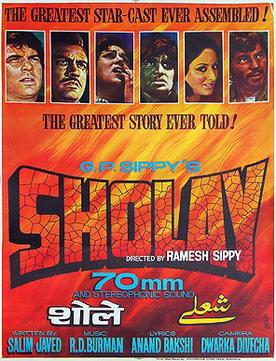
"Sholay" - Film Review

Sholay is a Western; it’s part of a subgenere of films known as “Curry Westerns”. Much like how Spaghetti Westerns provided an Italian take on the Western, the Curry Western is an Indian form of the Western. Anyone with a semblance of knowledge of Indian cinema will recognize some of the Indian cinematic tells: the sweeping musical numbers; the broad humor; the typical romance plot.

Sholay has a lot to offer. It may be a Western, but it features elements from a number of different genres, including comedy, romance, drama, and action movies (even occasionally, if I'm not misreading it, a smidgen of kung fu). These various elements don’t always mesh well, but there’s never a scene where something isn’t trying to at least entertain you.

However, the mismatched sequences are a large part of what hinders the film. Much of the narrative feels very stop and start. There are also some majorly jarring tonal shifts, particularly when the film chooses to transition from musical numbers to action sequences (or vice versa). 

That’s not to knock the film; though holistically this is a patchworking of various components, many of these individual parts taken by themselves are really good. The action sequences are beautifully staged, and incredibly exciting and enthralling, while the musical numbers are equally well choreographed and fun. Composer A.D. Burman's music is one of the film's highlights.

The film is far too overlong though (with a screentime just shy of three and a half hours). There are things that are just unnecessary and too out of place. The musical numbers are to be expected from a Bollywood movie, but the various sight gags, slapstick, and satirical moments (including a bizarre sideplot about a prison warden who looks like Hitler) are far too frequent. It has an unfortunate tendency to get sidetracked and lose focus of the very interesting narrative of a village harassed by a bandit (played with wonderful gusto and swagger by Amjad Khan) and the two petty crooks (Amitabh Bachchan and Dharmendra) hired out to save the town by a former police officer (Sanjeev Kumar). 

Though its length becomes a burden and it’s a melting pot of genre elements, it’s fairly entertaining. It's Western and action-adventure elements are massively enjoyable and engrossing (and in some instances surprisingly very dark). The film was one of the highest grossing Indian films of all time and is widely regarded as one of the best examples of classic Indian cinema, it's gone on to have massive influence on the Indian film industry.

Grade: B

Wednesday, February 27, 2013

New Girl - "TinFinity" - Review

The best ensemble comedies can take any of their characters, stick them together, and watch as they bounce off eachother. Once characters have become well defined, writers can pair any combination of characters and get different jokes and stakes for a situation.

This is where a show like The Walking Dead constantly fails. So many of the characters have been and continue to be underdeveloped and thus when certain characters are given air time we have no real reason to care about them. Too many of the character don’t have a defined set of character traits that can be reliably returned to and that determine how they’ll act in any given situation. 

Besides the occasionally erratic Winston (who, to be fair, they've gotten better about), the five main characters of New Girl are well-realized. When a character makes a joke, I know it’s a Jess joke or a Nick joke or a Schmidt joke and it speaks to that character and thus the joke is ultimately funnier for being a well-observed character moment rather than just something designed to create a reaction.  

This is the beginnings of a comedy that’s amusing but it’s the shows that go one step further that are really brilliant. The next step is to play these characters off one another to explore different dynamics and examine relationships. New Girl continues to do this incredibly well. 

It’s present in the A-plot which revolves around Schmidt throwing a 10 year anniversary for him and Nick being roommates. There’s laughs to be had at they’re odd couple bickering over the party’s details, but the scene that truly sells this episode’s pairing of them is the scene towards episode’s end where Nick comforts a heartbroken Schmidt (who has just witnessed Cece getting proposed to by Shivrang). 

It also exists in the ongoing awkwardness between Nick and Jess as they dance around suppressed feelings and general uncomfortableness. The show has handled the fallout from the kiss really well (more than I could have ever imagined). It’s landed every beat of this story, and the aftermath remains to find new ways to express the tension between these two characters that don't feel repetitive. 

It’s even there in the Jess-Winston plot where they fight for the attention of a footballer named Jax McTavish. This story may not go far enough, but it’s still a nice look at Winston and Jess that reminds us why their friends. There’s a competitiveness here that speaks not just to vied affection but the type of rivalry that could only arise between two longstanding friends. 

It’s this consideration to character that makes the show work so well. This is especially true when the plots aren’t particularly very good. The whole B-plot about Jax the football play isn’t new or interesting, nor is him revealing a more feminine side, but the plot doesn’t feel pointless or needless because it remains squarely about Jess and Winston and what this situation means to them. New Girl can get away with plots that I might find less than stellar because its character work is too good not to elevate some occasionally second rate material. Which isn't to say this episode is all second rate material, the Schmidt material in general is great and it's a really good exploration of his relationship with Nick. Plus this continues to deal with the longstanding plots of the relationships between Cece and Schmidt, and Nick and Jess in a way that still resonates.

Stray Observations:

-Jess’s continued inability to articulate sexual desires remains hilarious: “I need a different mouth on my mouth” “I want to French you”
-Schmidt is not above writing a strongly worded email to his florist.
-“Now that our mom’s approve, you want to do this thing?”
-“Take your football back to Europe”
-Nick is proud about his decision to buy a portapotty: “I’m a small business owner”
-Nick to Jess on convincing people to use his terrible portapotty: “Really sell it”
-Jess on the ongoing problems between her and Nick: “You think this is about a portapotty?”
-Max Greenfield’s acting when Schmidt sees Cece get proposed to is excellent and so damn heartbreaking.
-Jax proves to be a real problem: “I found my third wife”
-Apparently hot air balloons need propane to work. Go figure. 

Grade: B+

"My Dinner with Andre" - Film Review

Films are often obsessed with getting somewhere; to propulsively lead us to the final scene. But when a film plots itself in such a way that it’s all build up to that one moment, the journey itself feels a little less meaningful. The films, and many films that don’t quite understand the value of a plotting, often stage themselves to tell a story and hit all the necessary narrative beats we’ve come to expect from a film. But these beats, in turns, can appear artificial or superficial. The question of “what does it all mean?” remains unanswered. A really well-wrought, tightly constructed story can work incredibly effectively, but usually those films also have some extra umph setting them apart.

My Dinner with Andre doesn’t contain your typical plot. There’s one set, a New York City restaurant, that the film primarily stays in and we stay there for almost the entirety of screentime besides a brief beginning and ending voiced over montage. For the majority of the film’s story it’s not entirely clear where the movie is going. If this were an average, ordinary film, the scene at the restaurant would be brief, minimalized, infantilized, reduced to the point of short hand and of abstraction. Perhaps it would be the catalyst to snap Wallace Shawn (playing himself) out of his stupor and cause him to realize the wonders of life or some other formaldehyded, stock cliché.

Andre is a story about a man whose been avoiding a friend he’s since lost contact with (Andre Gregory playing himself) and rediscovering why he was friends with the guy in the first place. Wallace is hesitant about the dinner; he believes he’s gonna want to get in and out, but then Andre starts recounting his worldly adventures, an odd theater shop in Poland, an intriguing trip to Tibet, a bizarre time in the Saharan Desert. As he realizes the rumors he’s heard about Andre have misguided his perceptions, he’s slowly won over by Andre’s peculiar charm and abundant storytelling capabilities (muchof the first half of the film is just Wallace listening to Andre talk at length). Soon Wallace starts opening up, revealing a side of himself he’s often nervous to show. They get to talking about the problems of modern living and theater, trading worldviews and enjoying good, meaningful conversation. Before either knows it the rest of the restaurant is empty and they’ve talked the night away.

The film works so well because it’s unpredictable. It isn’t really worried about getting from point A to point B to point C. Rather, it’s content just to observe these two interesting people and the experience they share.  

My Dinner with Andre is an unconventional but wonderful character piece carried by strong performances from its two leads. 

Grade:B+

Tuesday, February 26, 2013

How I Met Your Mother - "Weekend At Barney's" - Review

Part of a show’s success is suspension of disbelief. Our ability to tune into a show and a slip away into its world. How I Met Your Mother doesn’t really succeed at this anymore.

There’s some funny lines and gags here, but I’m at the point where I just don’t care. 

Lily is an art consultant. But what is the point of her and Marshall visiting an art exhibit? In what way does it advance the plot of Lily’s career or her relationship with Marshall? If it were just a story about 30-soemthings growing up and it felt true to real life, than it might be passable, but that’s a different story, and a type of plot the series has shied away from lately. 

Ted breaks up with Jeanette, but what’s the point of watching Barney coach him (terribly) using the Playbook. There’s some amusing failed attempts to use the schemes, always ending with Ted offering to show his penis. However, we know Ted’s not going to end up with any of these people and it doesn’t service a forward direction towards meeting the mother. Jeanette had already broken up with Ted, and her return felt needless. The end where Ted’s stuff lies in ruins from Jeanette going crazy was a cop out. It (unsurprisingly) didn’t add up with how explosive and big the show suggested it would be. 

Robin is missing for most of the episode (enough so that I was starting to question the decision), but it pays off in one of the better scenes from the episode. After discovering that Barney hasn't actually destroyed the Playbook, Robin storms out. Barney’s reminder that their relationship is built on lies made me consider temporarily why these two are together; when you think about it, it’s fairly unstable foundation, one only upheld by Barney's love for Robin, and it’s a fact the show should play around with more. Of course, Neil Patrick Harris plays this all too sincerely and charmingly not to be won over just as much as Robin is.

The Robin-Barney scene was the only scene where I was drawn in, sucked in to the point where I forget "Oh yea, I'm watching a tv show". It's a great moment, but elsewhere this episode just doesn't have the heart or the feeling of purpose that earlier seasons had in abundance 

Stray Observations:

“Thank God. There’s no concert”
-“We don’t want to miss what their one big song was”
-Jeanette returns Ted’s grandmother’s ring: “She was buried wearing this”
-Two great smash cuts to Barney and robin’s reactions to Ted breaking up/getting back together with Jeanette.
-“Wow, even his scarf is up and coming”
-Lily describing her many “nip slips” was both a nice character beat and very funny.
-After all the references to the 80's flick throughout the series's run, it was only a matter of time before we got a Weekend at Bernie's spoof. 

Grade: B-