Saturday, February 23, 2013

"My Neighbor Totoro" - Film Review

My Neighbor Totoro looks like a lovely painting. There’s a watercolor, impressionistic quality to the film that lend it a richness that is missing in many other animated films. And what the film often lacks in the way of plot, it makes up for with gorgeous, naturalistic animation that’s color palette is warm, soft, and inviting, and whose imagery is often impressively intricate and detailed. The film is filled with depictions of wildlife and nature that have painstaking anatomical accuracy.

Totoro is also great for being a film about kids that doesn’t feel childish or pandering. There are no talking, anthropomorphic animals and a lot of the darker elements never get fully resolved. 

This isn’t to say the film is completely dark; in fact, the film is carried by a childlike whimsy and a sense of wonder. However, it’s a commendable how the film slips in subtle, darker elements into the film, notably an ailing mother with (what appears to be) a terminal disease. 

Part of the film’s charm comes from grounding the more imaginative, marvelous facets amongst a world that feels incredibly realistic. It’s like finding the wondrous amongst the mundane. Indeed, the film‘s plot centers around a father and his two daughters moving to an old house out in the countryside; a story that in of itself holds nothing special until the story peels back layers to reveal forest spirits and soot sprites hiding in the rafters. 

Much of the film early on has little interest with establishing a plot (surprising for a film that clocks in at under a hour and a half). Rather it meanders and builds up a world worth exploring and draws us in through its beautiful imagery. The film seems more concerned with creating a particular tone, and allowing us to appreciate the artistry at hand.

Outstanding animation and a fantastic visions all its own make My Neighbor Totoro a great animated film and one of the best from writer-director Hayao Miyazaki.

Grade: B+

Friday, February 22, 2013

The Vampire Diaries - "Stand by Me" - Review

The Vampire Diaries has proven itself capable of handling death very well. When Jenna and Alaric died, "The Sun Also Rises" and "Do Not Go Gentle" provided incredibly well the emotional heft these particular moments deserved. For both these episodes, the series set aside large amounts of time just to have people mourn for the loss of the people they loved and cared about.

“Stand by Me”, however, is an episode about a dead person that doesn’t feel like it’s about that death, and that’s a bit disconcerting at times. 

Part of the problem is that other plot wheels keep turning in the background, such as the rise of Silas and Damon’s search for Bonnie. Other problems arise from how Elena deals with this situation. So though it’s an episode about the death of Jeremy, it becomes an episode primarily about Elena. 

This isn’t entirely unreasonable. She did just lose her brother and in turn her last human connection. Some of her reaction in theory is interesting and plausible, but the writers keep driving it further and further to a point where it feels overstated.

Not only that, but I’m not sure this is a direction that the show necessarily wants to take the character in. We end with Damon using the sirebond to shut off her humanity and Elena burning down her house to cover up Jeremy’s death. 

Now I liked the idea of Elena becoming a vampire; it felt bold and decisive and suggested exciting potential directions for the future of the series. Indeed, the season three finale is one of the show’s brightest moments, and yet nothing has ever been as well-realized as that momentous plot decision seemed to point towards. 

To an extent it’s brought out interesting aspects of her character that I really like, but it’s largely been poorly handled. First with the sirebond misstep, and then with the cure, both of which undermined the very premises of the series at large and the plots advanced up to that point.

But Elena as a vampire and Elena with no humanity are two polar opposite character decisions. Her becoming a vampire almost feels inevitable now, but her losing her humanity feels wrong even as it remains shocking and unexpected. Elena has always been defined by her humanity; her need to help and care for others is a defining trait; what happens now that that’s gone? 

Don’t get me wrong; perhaps it’ll end up being an absolutely ingenious decision. But for now I’m not sure the show can surefootedly deal with such a huge changeup (It really hasn’t seriously been capable of such a major shakeup since the third season). 

Mourning elsewhere isn’t entirely off. Matt gets some great moments where he confronts Jeremy’s death. Bonnie’s reaction to the news is also nice and believable, even though it’s undermined by how batshit crazy Bonnie is starting to become. 

But everywhere else it’s nonexistent. Damon and Rebekah are off in their own stories, too busy to consider or care about the matter. Stefan makes one passing comment about feeling sad but never really shows any outward emotions towards the death. Caroline is still too concerned about Tyler to even really notice the death.  

And thus the death passes without the weight it deserves. Elena would be the one to react the most and the hardest to this, but it’s played up to the point where I stopped buying it.  

May be this comes down to intention versus execution. I can understand what the writers intended (in fact, I find what they intended to do to be brilliant), but in execution, it just doesn't work as gracefully as it feels like it could. 

Stray Observations:

-Don't get me wrong, this is a very good episode that moves forward with clarity and efficiency, but I couldn't stop shaking how forced it felt in places. 
-Silas can take up the appearance of other people (in this case Shane) and is manipulating Bonnie to do his bidding.
-Caroline is uncertain about what to do and suggests “make a casserole” amongst her list of how to help.
-“That’s Damon Logic: you’re mean to the ones you love.”
-The use of the music to drown out everything else while Bonnie talks and the camera closes in on Elena is wonderful. It’s very atypical music for this series. I got a very Breaking Bad vibe. 

Grade: B+

Community - "Conventions of Space and Time" - Review

There are two major aspects to shows and movies that make them what they are: form and content. Form is structure; it’s the types of shots and lighting and editing that frame everything we see. Then there’s content; content boils down to plots and characters. It’s who we’re watching, and what they’re doing.

Form wise Community is much, much less snappier. Its pacing is slower, and the cuts are a bit more lackadaisical. 

Content wise the show is ostensibly the same … and yet it’s not.

The whole idea of an Inspector Spacetime Convention doesn’t actually sound all that interesting in the first place. This was a one-off joke that became overused and grating. It worked as background piece of set dressing but beyond that we didn’t need any more elaboration on how it fit into the show’s universe. 

So the initial idea for the content of this episode doesn’t hold water. Fine. There’s been plenty of Community ideas I can say the same thing for, and they still worked better than I’d expect… This, however, is not one of them. 

The problems begin to crop up with the fact that the writers don’t seem to have any clue what to do with the characters beyond Abed and Troy. None of them, besides Britta who is now Troy’s paramour, would ever have any reasonable interest in the convention. The reasons the show then proceeds to contrive to get the rest of the cast in the picture utilize them poorly or implausibly, or both (not to mention there’s no Dean and no Chang – Although I could do without Chang so that’s fine by me).   

The most obvious here is Alison Brie’s Annie. Not only do I not believe Annie would fake being married to Jeff and then have the rest of the hotel staff play along with it, but, more importantly, it begs the question what is the point of this? It’s a storyline that detracts from the nuance we’ve seen built up in this character. She’s no longer that doe-eyed naïve girl we knew way back in season one and this is a step back for her character. Brie does the best with the material but it’s simply not very funny and doesn’t add up with what we know about the character. She’s off by herself for far too long for no foreseeable reason. 

Britta’s also largely poorly utilized. The fact is that the show hasn’t elaborated enough on the Troy-Britta relationship to justify it or even to define what it is. But Britta exists as nothing more than a roadblock in this episode whose sole purpose is to keep Troy from Abed while Abed deals with the cuckoo #1 Inspector Spacetime Fan.   

Shirley and Pierce’s storyline isn’t half-bad actually (and nicely humorously meta), and it’s practically the only real reason that makes sense for their appearance whatsoever. But they’re disconnected from the rest of the plot for too long, and it all feels massively, massively contrived.  

This wasn’t very funny, and altogether very formless. It was even a little heartless, like a succubus masquerading as Community and ripping out what remained of its heart entirely. 

Grade: C+

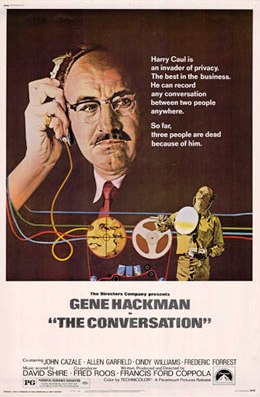
"The Conversation" - Film Review

For more than two-thirds of its existence, film has been a medium of sounds. Yes, films are a visual medium and part of their artistry and impact comes through the visual design. But it also largely comes from a film’s sound design. Films create visual landscapes, but they also form “soundscapes”, whole worlds of sound that describe the particular world the film is set in and cue us in on what’s taking place.

The Conversation is a film about wiretapping and surveillance, and in that vein it’s a film whose sound design is carefully calculated and matched or disassociated with the images we’re witnessing. Take the opening scene for example. We have super wide shot of a public plaza, but the sound we are hearing doesn’t match with what we’re seeing. We’ll soon discover it’s part of a recording for a surveillance operation. But before that, we’re not entirely sure where we’re supposed to be looking at in this crowded space. 

The film is also a story of voyeurism. Harry Caul (Gene Hackman) is an introvert who’s barely socially functional; he can barely hold conversations not on his work in everyday life. So it’s fitting that his personality should lead him into a line of work where he doesn’t have to interact with people; he can just observe other people without having to get involved. 

Harry is also massively paranoid. He’s jittery about even using his own home phone, using a payphone or outside line to make calls. His paranoia in turn leads to obsession. He’s obsessed with his most recent job, a recording of a conversation between a man and woman. He’s certain he has the scenario figured out, and the more he begins analyzing the tapes, the more positive he becomes that the two individuals might get murdered. 

Harry wants to give the tapes to the company that hired him, be done with the job, and clean his hands of the whole mess, but his fragile moral compass keeps leading him to what he believes is true north. He’s obsessing over the case, and increasingly becoming fearful for his own life. Apparently he did a case out in New York years ago that led to the killing of three people, and he still feels guilty and haunted by it. It’s the reason he moved out to San Francisco in the first place. 

Despite knowing he ought to get out while he can and throw his blinders on, he finds himself unable to stop getting involved and interfering. The more he pushes back, the shakier the ground he walks on becomes. The light, jazzy piano score starts to ramp up into more industrial and electronic as the stakes get higher, the cuts of shuts become quicker, and Harry’s paranoid state more frequently starts to seep through the screen. 

Writer-Director Francis Ford Coppola is primarily remembered for making The Godfather films, which are absolute masterpieces. But while Godfather Part I and II and Apocalypse Now are recognized as unequivocally brilliant works, The Conversation often get short shrifted. This is a shame because it’s a masterful, surefooted, engrossing thriller. The film features much of what made Coppola’s other movies great: impeccable writing and technical craft, unparalleled character work, and a hard to peg down feeling of texture and richness.   

Grade: A-

Thursday, February 21, 2013

"La Strada" - Film Review

La Strada exists in that feverish place between reality and surrealism. It’s an Italian Neorealist film by writer-director Federico Fellini, but, though it tells a very grounded, very realistic story, there’s a level of lyricism to it that makes it almost poetic at times.

“La Strada” translates from Italian to “The Road”, the location we spend the majority of the film on. The story takes us to one town, seashore, and circus after another, and observes the lives of the two protagonists, brute Zampano (Anthony Quinn) and good hearted Gelsomina (Giulietta Masina), and the people they come in contact with.  

Desperate and impoverished, Gelsomina’s mother sells her into the employ of Zampano. Zampano is a strongman who goes around performing feats of strength for people he meets along the way. 

Gelsomina cares for Zampano, may be even loves him, but Zampano is no good for anyone. He’s a drunken lout who hits on other women and ignores Gelsomina’s kindness. 

Even after raping and beating her, Gelsomina can’t shake her affection for him. “If I don’t stay with him, who will?” she asks herself. 

We want her to escape this terrible situation she’s in, but every time she’s given an out, she just won’t take it. And it’s heartbreaking. 

Gelsomina, in the hands of Masina, is adorably wide-eyed and sincere. When she first leaves home, she’s just happy that she’s going to finally get to see other parts of the world. 

When that unequaled, exuberant smile begins to fade… well, a little bit of hope starts to dissipate from the world with it.

Nino Rota’s score is wistful yet melancholy. The tune feels like carnival theme, which is oddly fitting, both for the film’s ties to the circus as well as Gelsomina’s childlike nature.  

The film lends a level of compassion and sympathy in its portrayal of the people that inhabit it. Even Zampano is allowed to be more than a one note character, eventually finding redemption.

Beautifully shot, the simple tale is filled with vignettes that are funny, moving, and sad.

This is one of Federico Fellini's best early works that looks forward to his more fantastical later films; it's also a great example of Italian Neorealism.  

Grade: A-

Wednesday, February 20, 2013

New Girl - "Parking Spot" - Review

New Girl is a show that works as well as it does because its characters are always consistent. The writers have these characters down to a peg, and every line and interaction feels true to what these characters would actually do and say.

It’s this attention to character detail that turns characters from joke delivery machines to individuals we want to follow on a weekly basis. 

The chase to get to the parking spot is a funny scene, but it works as well as it does because it plays off what we already know about these characters. Jess stopping to pick up trash is an amusing moment, but it’s also totally in character, and those little character beats elevate New Girl from just another show about twenty-somethings to one of television’s best ensemble comedies. 

The interactions between Nick, Schmidt, and Jess as they confront the situation of who gets the great, open parking space (and eventually the kiss-shaped elephant in the room, or “rum” as Schmidt would pronounce it) is filled with nicely observed character moments that are at once very funny and yet all the funnier for how specific the jokes are to these characters. 

Take the parking spot sit-in scene for example. Schmidt pees himself, Jess brings hard candy, and Nick essentially eats garbage. Those three actions in of themselves aren’t funny; in fact, if you told me that some show was doing these things to get laughs, I probably wouldn’t watch it. But in the context of these characters, it works and it’s funny. 

The integration of the ongoing tension between Nick and Jess into the main storyline also works really well. Rather than turning this into its own plot that would probably start to get predictable and distracting, the writers find ways for it to play off of the current antics. Jess “flirting” with Nick by wearing his hoodie and talking for what passes as sexy for Jess advances both storylines while remaining hilarious and in-character.

This cast features some great performers and the writers utilize them well to tell meaningful, endearing, entertaining stories where I never question a character's actions or decisions but look forward to seeing what those might be.

Stray Observations:

-The opening toothbrushing scene also worked really well. I particularly liked the way both Nick and Jess kept saying “Sucked face”.
-Schmidt was scrubbing out the backside of a dumpster when he discovered the parking spot.
-Schmidt asks Nick rhetorically what the Constitution says to do: “Don’t share stuff”
-The roommates play their particular trump card. Jess: female. Winston: race. Nick: lazy drunk. Schmidt: found the spot first.
-“Justice may be a lady, but Victory has a dick”
-Coach gets mentioned when Schmidt discusses the “Nail Oath”.
-Winston doesn’t have money on him and really wants to get laid: “I am in desperate need of condom,” he yells to the store’s other customers.
-“What do you think, mono is just some sort of joke?”
-“If I had kissed Winston, you’d be the first person I told”
-Jess tries to purple nurple Schmidt and can’t find his nipples … Alrighty then?
-Winston in his desperate search for a condom goes to Cece, who is the middle of trying to fix her relationship with the Indian “chemical engineer” Shivrang (Satya Bhabha) her mom's set her up with.
- “Did you just pee inside yourself?”
-“Know what drives men? Sex and competition. It’s why the U.N. was created. It’s why women aren’t allowed on pirate ships”
-“You nailed my mouth. And you nailed it good”
-Schmidt kisses Jess to defuse tensions … and it so does not work. They left this whole story a little too unfinished. It needed about a minute or two more to resolve itself before Winston barged in.  
-“You are literally sitting in a pile of your own piss”
-“Is everyone having sex but me?” - Mainly for Lamorne Morris' delivery

Grade: A

What's in a Grade?: On the Difficulty of Assigning Grades and My Process

I’ve actually found the back-half of the 8th season of How I Met Your Mother to be much better than the first half of the season. But everywhere I’ve turned I’ve seen people tearing to shreds episodes that I may not have found to be the show’s finest work, but also didn’t perceive as the worst offenders either.

Perhaps I should grade the series more harshly, but since HIMYM has already so significantly disappointed in the past, I go light with the critical heat when the series may be middling but isn’t glaringly awful. 

A show has to go severely off course and lose all sense of self in order for me to actively despise it, which is why The Office is privy to my most damning reviews, whereas HIMYM gets off more easily.

But then again, the grades I assign are essentially arbitrary. I’m sitting on a cloud of judgment handing down qualitative markers that, when it comes down to it, don’t mean crap. 

I’ve never felt comfortable assigning grades, even when I was doing it early on (and perhaps more so then because I had a worse grip on it). It comes down to a gut feeling and my opinion is wont to change. Plus grades are just so completely loaded in the first place.  

I choose to give out grades to challenge myself and to add another facet to the review to make it more interesting. I could do it in a non-letter grade format, but the letter grade format ultimately feels like it’s the most challenging method to dole out grades with, and hence why I chose it. With numbers and stars you can split hairs more easily. 

My general approach to grades is this: If it’s anything below a B- it’s probably pretty bad. If it’s a C+, it may not be the worst thing in the world, but the film/episode has significant enough problems that any of its noteworthy qualities (if any) are mostly overshadowed. Anything below a C- is highly unseemly and deeply disappointing. It doesn’t have to be poorly made; it can be a high quality production that’s purposefully mediocre. And, well, hopefully I never watch anything in my free time that gets the dreaded F.  

A’s are exceptional and should be given out sparingly. I know I’ve given a Pandora’s Box’s worth of A’s out lately to the films I’ve watched, but that’s because I’m purposefully watching films I know to be/have heard to be good. Even for these films though I’ve been tough on a couple of them that others would say I judged too harshly or didn’t understand (I’m thinking: Eraserhead, Re-Animator, Last Year in Marianbad. All of which I actually softened the blow of my review for.)

Generally speaking, a work should aim to land somewhere between an A and a B+. The B+ is often times more niche, more curio, more cultish, and/or falls short here or there, but is still usually brilliant. B+’s for me tend to be movies I deeply enjoyed but aren’t as artistically significant or holistically masterful as A’s and A-‘s. 

The line between grade to grade is string thin. While a work may be obviously in the A-range or B-range or C-range, the distinction between one grade and another is just what feels right. 

I’m talking about art, and art is subjective.