Monday, March 31, 2014

How I Met Your Mother: "Last Forever"

 Spoilers Below:

“Last Forever” was a bumpy episode. Though filled with some touching character moments, it was ultimately hindered by a choppy overall narrative, which attempted to squeeze a ton of plot in (leapfrogging around to a number of future events post-wedding) for a final setup that will likely frustrate and divide fans. 

We may have gotten the answer to this series’ title but it did feel like a little bit of a cheat. We do see that moment and the life Ted built with her, and Cristen Milioti’s palpable chemistry with Josh Radnor makes this ending feel slightly disappointing, as well as the fact that whatever feelings we may have had towards Robin and Ted as a couple are way, way back in the rearview mirror.

Had the series ended sooner, and had it had fewer seasons, this reveal, that the mother is dead in 2030 and that Ted is telling the story to find out if his kids don't mind if he asks Robin out (hinted at a few episodes back) might have felt rewarding and like a neat twist. It stays true to the narrative's heavy focus on the relationship of Ted with Robin. But too much character change regarding Ted, Robin and Barney over the series’ run doesn’t allow it the same oomph it might have had. 

The fact that the show focused so heavily on Barney and Robin’s wedding only for that marriage to dissolve only served to make this final season feel a little bit like a waste. 

And yet this finale was not devoid of goodness. 

What surprised me was how thoroughly the show embraced the deep pool of melancholy and disappointment it had accrued. Ted’s increasingly desperate efforts have made him a somewhat tragic figure. He’s a romantic Charlie Brown who had practically stopped trying even to kick the football from Lucy (Forgive the lousy metaphor). Here we see how that change from romantic idealism to something more grounded, even fatal, has made him who he is. He almost doesn’t go over to talk to the mother on the train platform, doubting his faith in destiny. 

More saddening still was Barney’s regression into his old ways after failing with the one woman he could see himself building a life with. Barney in this episode became the dark, pathetic core at the center of his womanizing throughout the series, and it was a strange direction that almost felt like a meta commentary on the character. 

That bitterness of life not working out exactly as the characters had planned gives the episode a few really touching and moving moments. Robin confronting Lily about the sorry state of the “gang”. Barney looking at his newly born child. Ted talking to the mother under that yellow umbrella. 

The series long-con didn’t work, but I also don’t feel let down. I’ve abandoned series before, but I stuck with How I Met Your Mother because its characters and its perspective and its humor, when firing on all cylinders, could create something really great. So few shows last nine seasons, and so few are any good when nine seasons deep. I don’t hold it against the show or Carter and Bays that it wasn’t what it was at its peak. It was a sitcom, and occasionally one that was quite funny and quite poignant. May be its longterm narrative was a mistake as it began to consume the show’s aims whole, but, hey, the world is still spinning and we have four really excellent seasons and lots of highlights besides after.

"Johnny Guitar" (1954)

The titular character of Johnny Guitar (Sterling Hyaden) is not the protagonist. He is a supporting figure in this Western, a genre notorious for being masculine and macho. But then Johnny Guitar relegates all of its male characters to the sidelines. The figures who take charge and drive the action, who dominate and manipulate are all women; men are, at best, their all too willing pawns. The protagonist is Vienna (Joan Crawford), a saloon owner who is easily the most commanding and strong presence in the film. She squares off against Emma (Mercedes McCambridge) the leader of a town mob who thinks Vienna is behind a recent train heist. Vienna calls in Johnny, a former lover, to use his gun-slinging to protect her, but he has turned pacifist and plays a guitar. He speaks like a beatnik in cowboy gear. Emma is so vehement in her hounding of Vienna because Vienna holds the attention of the Dancin’ Kid (Scott Brady), who actually led the heist, and who Emma jealously pines for. Vienna and Emma play the men around them like fiddles. Both the Kid and Johnny want Vienna to love them but they let her define the terms of their relationship. The greatest sparks of fiery passion take place between Vienna and Emma. Under the surface the film suggests some surprisingly kinky sexual things. Ask yourself where the real romance of the story is. Emma’s mob mirrors the witch-hunt of the House Un-American Activities (the film was ghost written by the blacklisted writer Ben Maddow); Emma ferociously demands people be implicated no matter the evidence. Johnny Guitar sells itself as delicious camp (it’s almost self-consciously, low-budgetly artificial and obsessed with a lascivious but buried psycho-sexual drama), but Nicholas Ray is sneaking ridiculously subversive messages throughout this bizarre, wonderful film. 

Grade: A-

"Red River" (1948)

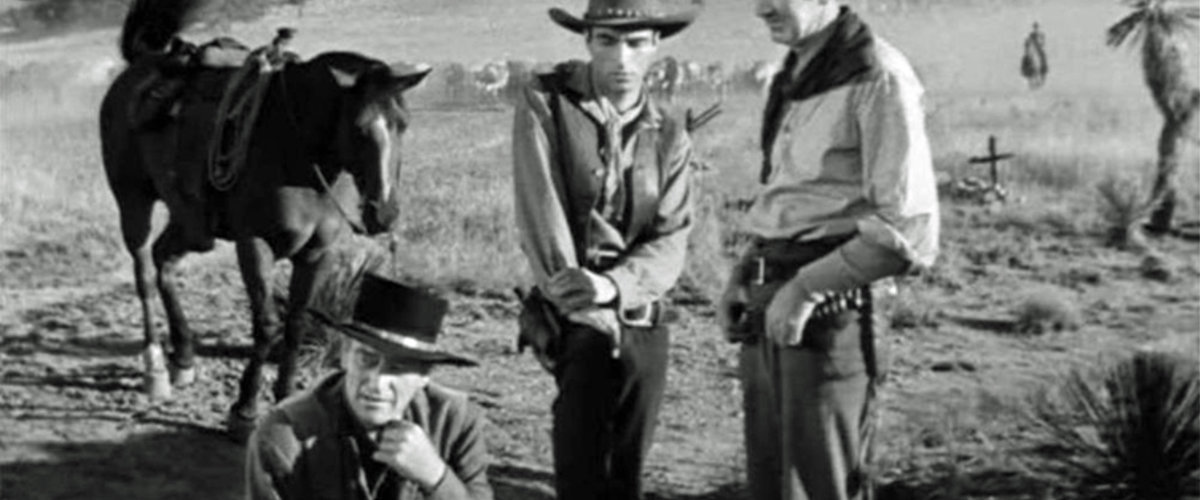
In Red River there are only two named female characters and one of them dies within the first few minutes, but this makes sense for the film’s story. The world of Red River is a man’s world, defined by strong, stoic men suffering the harshness of the untamed West. This is a deeply masculine film based around male friendship and bonding, roughing it, and keeping and codifying an honor code. At its center it is a film about father-son relationships that buries the hatchet of its two main characters Tom Dunson (John Wayne) and his surrogate son Matthew Garth (Montgomery Clift, in his first role) through a bruising fistfight. But in an environment only just witnessing the advancement of civilization, Red River argues that this aggressive testosterone can-do spirit is necessary to survive and tame the land. Dunson buys a piece of land and raises some cattle over more than a decade, but when the value of his livestock begins to diminish he sets out to sell them. The film’s story pivots around a long, exhausting cattle drive, the first drive along the Chisholm Trail. As Dunson and his hired hands become mired in setbacks, including a cattle stampede that kills one of their own, Dunston starts losing his head and his demand for total control threatens to tear apart the drive. Howard Hawks' direction and Russell Harlan’s cinematography take advantage of beautiful, sweeping vistas and continually reminds us of how daunted by the natural environment the men are. As the environment thwarts them at every possible opportunity, Matt and Dunson’s differing views on how the journey should be handled helps unravel their long simmering relationship. Wayne gives in one of his best performances. There's a subtle transformation at work where Dunson's wounded pride and years of hardship gradually, ruthlessly harden and wreck him. 

Grade: A-

Saturday, March 29, 2014

"Cat on a Hot Tin Roof" (1958)

To watch Cat on a Hot Tin Roof is to watch two of the most insanely attractive stars of early Hollywood verbally spar it out. Elizabeth Taylor and Paul Newman were ridiculously good looking, a fact that does not go uncommented upon in the film, but they were also commensurately talented, and they are easily the most interesting part of this uneven but often searing film, besides Burt Ives’ excellent turn as Big Daddy. Taylor and Newman’s Southern good looks are worth pointing out because the film is deeply concerned with the rottenness underneath the decadent surfaces of a Southern aristocratic family. Brick (Newman) and Maggie (Taylor) look like the perfect couple but a gaping rift has formed between them. Brick, a former football star whose best days are behind him, has taken up drinking incessantly; he quietly shuts out the world and gazes into the distance as if barely aware of the presence of other humans. Maggie, who on some level married Brick to marry into money, is partly responsible for Brick’s funk, seducing his close friend Skipper, who guilt-strickenly killed himself in response. But Brick’s problems run deeper and extend further back to his upbringing in a family so obsessed with money and status that they failed to actually build any meaningful, affectionate connections. At its center is Burt Ives as the patriarch, a lumbering man unaware that he’s soon to be dead from a cancer that might as well symbolize the barely veiled decay of the family. The film writes much of Tennessee Williams’ Southern languor into the tone and mood of the film; the cinematography and direction give the sense of a long summer day that just won’t seem to end; sweat accumulating and clinging to every fabric until it matches the heated passions of the characters it sticks to. While the film is unnecessarily sluggish and wooden (it handles transitions between scenes pretty horrendously), Taylor, Newman and Ives are still electrifying. 

Grade: B

Thursday, March 27, 2014

"Le Corbeau" (1943)

Le Corbeau was made in France during the occupation by Nazi Germany, and it is a film heavily informed by the historical context in which it was produced. Set in a small provincial French town, the film deals with a series of mysterious “poison-pen letters”, venomous pieces of gossip and slander making claims about various members of the town and turning the town into a deadly rumor mill. The author of these letters signs off simply as “Le Corbeau”, or the Raven, and the anonymity of the claims causes the town to start looking around at one another for the person responsible. The film exudes a palpable sense of paranoia as everyone starts suspiciously eyeing their fellow townspeople and turning on their neighbors. As Doctor Remy Germain (Pierre Fresnay), who specializes in pregnancies, is accused by the letters of being an abortionist he starts losing clients. He also finds himself pegged as an adulterer due to his close but platonic relationship with Laura (Micheline Francey), the much younger wife of a psychiatrist friend (Pierre Larquey). Note the name of the main character; Germain is just a letter short of German, and Germain is an outsider who recently settled in the town. But Germain is not the villain of the film. Rather, it is the French people who start selling out one another out of a desire for self-preservation and status. They give themselves over to greater irrational forces beyond them rather than sticking to their beliefs and communal bonds. They begin ratting out one another, and every time a new potential suspect arises mob-mentality sinks in and they’re sucked into a vortex of hatred and pettiness. Henri-Georges Clouzot tells the story like it’s a mystery, keeping us guessing who is responsible. But who the “Raven” is doesn’t really matter (It’s significant that it could be anyone because it suggests everyone is complicit). Like the best mysteries, it’s not about the answers provided but how those answers are arrived at.  

Grade: B+

Wednesday, March 26, 2014

"L’Enfant" (2006)

In L’Enfant, Bruno (Jeremie Renier) has no allegiances to anyone but himself. He would, and does, sell his own child if it served his own ends. Bruno has the looks and the charm to have been a big shot in high school but has amounted to little since. Barely scraping by off petty thievery, Bruno is looking to do anything to make some cash and has few scruples as to how that cash is attained. His girlfriend Sonia (Deobrah Francois), who recently gave birth to his son, is a study in contrast: shy, kind and meek. She must have been swept up by Bruno’s brash rebellious charisma when she was too young (and she is still very young) to realize the reckless amoral pit underneath. The film’s centerpiece involves Bruno selling his own son Jimmy to thugs who claim they’re going to find people to adopt him. What little measure of conscience Bruno has shows itself when it dawns on him what giving up the child means for the little bit of stability and contentment in his life. Sonia reacts as well as we might expect, passing out from shock and disowning Bruno upon the delivery of the news. Bruno, panicked both because he doesn’t want to lose Sonia and because she draws the attention of the police, attempts to retrieve his son back. The film’s title, which translates to “the child”, doubles for Bruno’s son as well as Bruno’s apparent arrested development. Directors Jean-Pierre and Luc Dardenne tell the story with a sense of kitchen sink realism; the film is interested in the struggles and tiny details of working class life. While Bruno’s eventual actions are troubling and dark, the film doesn’t entirely lapse into somberness. The film, in its final stretch, is painfully thrilling as Bruno’s criminal activities finally catch up to him. Early on the film observes Bruno and Sonia’s relationship and it is warm and tender. These are two people who are in love, or, at least, think they, and that makes Bruno’s actions all the more despairing. 

Grade: A

Monday, March 24, 2014

How I Met Your Mother: “End of the Aisle”

Regardless of your feelings towards how How I Met Your Mother has treated the relationship between Ted and Robin over the course of the series run, particularly in more recent seasons and with Ted’s lingering feelings towards Robin, “End of the Aisle”’s treatment of where the writers had taken that relationship felt right. It felt true to the developments and character arcs of both of these characters and it put a necessary and touching button on the relationship. So much of the show’s run had sapped the vitality out of this relationship and Ted’s undying feelings only served to make it all the more unbearable, but this is what we got and it was tremendously satisfying. 

Of course Robin would see through Ted’s gambit, and, in that moment, sticking with this direction for these two characters over the show’s run paid off. The scene between them played off the show's history with the kind of emotional honesty I cherished from this show at its peak. This episode is filled with plenty of call-backs and a few too many feel like call-backs for their own sakes, but that worked here, in this instance, and it worked because it wasn’t mere fan service but where this story needed to go. 

As Older Ted tells us that he’s heard what he has long died to hear, that Robin loves him, and that hearing it for real snaps him to attention, it was the culmination of the story this show has been telling about Ted and Robin. You may not have liked the turns it took, and I certainly got fed up with it, but in this moment I could almost forgive the series for its shortcomings. 

This was far from a perfect episode. The answer of the strangely orchestrated mystery of why Robin asked for Ted to come and see her on her wedding day was built up far too much prior to this episode for the payoff here to really work. And too much time here is spent marking time until the finale when the real answers were looking for, regarding Ted and the mother, are dealt with (including the potential that the mother is dead in the future – which I dislike as an narrative possibility, especially if Robin is the kid’s step-mother, as it feels like slight cheat) and the episode feels a bit flabby, with jokes and moments stretching out longer than they ought to, particularly with Marshall and Lily and the wedding vow gags. 

But as a penultimate episode of a series that has been on for nine years, this worked very well. It released tensions between Ted and Robin, and Robin and Barney that were necessary, and it did it in very acute, relieving and pleasing ways. 

HIMYM may have had it rough for a while, not least of which during this final season, but when it has its sights on its characters and what they need going forward versus what we as an audience supposedly want (which Carter and Bays seem to have lost a grip on at some point, and that was coupled with typical sitcom aging), well, it can still hit a sweet spot.