Thursday, February 27, 2014

"Rock ‘n’ Roll High School" (1979)

Rock ‘n’ Roll High School is a musical built around The Ramones, but the musical aspects aren’t really what make the film so entertaining. If you enjoy the music of The Ramones it will be enjoyable, but, though the musical moments are well-shot, The Ramones are an uncharismatic screen presence. Instead, what makes the film work is the simple fact that anyone can get behind the film for its embracement of the punk ethos The Ramones represented (and the band could easily be swapped out for any other late 70’s punk band and this would still work). Like Freaks, the film that inspired one of The Ramones’ best songs, the film has an abiding affection for weirdos and misfits, and it gives them, led by the band’s self-proclaimed biggest fan (PJ Soles), an opportunity to fight for control of their school, through music and an anarchic spirit, against the dictatorial control of the new principal (Mary Woronov). For most of its runtime though, the film is simply a very self-aware teen film. Rock ‘n’ Roll High School functions off of a lovable cartoon logic. There’s a Looney Toons appeal to the film, which functions less on plot than on a grab bag of high jinks and tomfoolery. This is a film where one of the best running gags involves taking a joke about a lab experiment on mice to its logical conclusion, having the mice become human sized; no one bats an eye at this. But it makes sense within the rationale of the film’s world: anything goes, as long as you’re not keeping anyone down.

Grade: B+

Wednesday, February 26, 2014

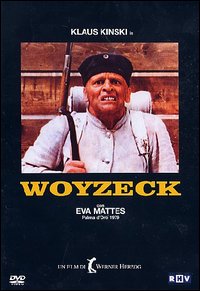
"Woyzeck" (1979)

Until the 19th century the treatment of those with mental illness was horrendous, and even the reforms from that century were inadequate. At present, we still have a long way to go but there are now opportunities to help those who need it. But if you lived at any time before the last century: you were fucked. You’d be looked down upon at best, but you were even more likely to be taken advantage of or seen as a problem. Werner Herzog’s Woyzeck is about a German soldier Johann Franz Woyzeck (Klaus Kinski) who is very clearly a ticking time bomb. He is paranoid and hears voices. This is exacerbated by everyone around him, who only see how pathetic and nervous he is. Kinski was an intense method actor and director Werner Herzog brought out some of his best performances by bringing out the ferocious intensity Kinski could convey like few others. Kinski allows his face to sink in further and further as he suffers indignity upon indignity and his madness sets in. At any given point, Kinski’s posture is rigid but his eyes constantly suggest the depths of his emotional turmoil. Woyzeck is in a loveless marriage with Marie (Eva Mattes), who’s bored and looking to have affairs. Woyzeck seeks the help of doctor and the doctor begins using Woyzeck as a subject of experiment. The doctor makes him eat only peas for a year, which only serves to worsen Woyzeck’s instability. The doctor takes the madness as a joke and laughs about Woyzeck as if he were an amusing oddity. Herzog plays this all out with a sense of forgone conclusion; madness is inevitable once it sets in. 

Grade: B+

Tuesday, February 25, 2014

"There’s Always Tomorrow" (1956)

“There’s always tomorrow,” is the type of phrase loaded with double meaning. It can be accepted as a statement of youth, where possibility and time feel endless. But it can also act as something sour and bitter, referring to missed opportunities and faded dreams, as it does in Douglas Sirks’ film There’s Always Tomorrow. Sirks made melodramas about how Eisenhower era conformity was, as James Dean might say, tearing everyone apart. "There's always tomorrow" is the kind of deceptively hyper-optimistic phrase we might expect from a time of Leave It to Beaver deluded hopefulness and self-conception. On the surface, Sirks was dealing with stories of heart-stringingly intense emotion, but underneath Sirks examines people trapped and overwhelmed by doing what society expected of them. There’s Always Tomorrow could be taken as a fascinating study of constricted masculinity; Fred MacMurray’s Clifford Groves is a man who’s tired of the daily grind of his job as the owner of a toy company and he feels as if his family doesn’t appreciate him. When old friend Norma (Barbara Stanwyck) returns into his life, old memories and feelings are stirred up; reminding him of how much life has gotten away from him. His children believe their father is having an affair with this old friend, which they’re mostly wrong about. Clifford deep down knows he’s only fooling himself and that his stodgy old life is going to keep consuming him, no matter how overwhelming his sense of ennui might be. Sometimes there’s no tomorrow, just a lousy today. 

Grade: A-

"Ziegfeld Follies" (1946)

Broadway producer Florenz Ziegfeld Jr. was famous for his extravagant theater performances known as the “Ziegfeld Follies”. The Ziegfeld Follies rolled out the red carpet for every big name performer the producer could rope in for the show. They featured dancing, singing, comedy and everything in between. Ziegfeld Follies attempts to recapture the “let’s put on a show”-spectacle of the producer’s shows, touting itself on the DVD cover as the “Greatest Production Since the Birth of Motion Pictures”. It’s exactly the sort of hyper-overstatement you’d expect from something overflowing with this many top-billable performers, including Fred Astaire, Lucille Ball, Gene Kelly, and Judy Garland. Though Ziegfeld Follies has certainly dated, it’s more for lack of cultural relevance than for lack of entertainment value. There’s an admirable go-for-broke quality to the film that creates a not entirely unexpected lack of consistency; some sketches or bits are still really fun, but others feel more like filler than well-thought out acts. It doesn’t help that some of these performances aren’t the most memorable work by the players that are doing them. Ziegfeld Follies is more of a cultural artifact of its time, a time capsule from when an excessive Broadway revue could easily draw in a crowd. 

Grade: B-

Monday, February 24, 2014

"Abbott and Costello Meet Frankenstein" (1948)

There seems like few things quite as antithetical as the comedy routines of Budd Abbott and Lou Costello and the frights of the Universal horror monsters. The value of both of these film properties Universal had its hands on were fading, and in a desperate effort they threw them together. The result in Abbott and Costello Meet Frankenstein was something that benefited from the mismatched elements of horror and comedy. The funny business is far funnier because it feels bizarrely out of place and yet uncannily appropriate. The Universal monsters, Frankenstein’s Monster (Glenn Strange), Dracula (Bela Lugosi) and the Wolfman (Lon Chaney Jr.), were always a little campy and recognizing that exaggerated nature and placing it against the cartoonish charms of the comic duo makes it appropriately amusing. Yet director Charles Barton doesn’t sacrifice scares in the name of comedy; some good moments of horror are provided for all the monsters and this became a fitting swan song for them. 

Grade: B+

"A Story of Floating Weeds" (1934)

Yasujiro Ozu’s sound films have the quality of a silent film. They rely on the strength of their imagery and the depths of emotions Ozu plumbs from them. Ozu told simple stories, typically family dramas, with increasingly radical compositions (in most of his films he breaks the 180 degree rule). A Story of Floating Weeds, one of Ozu’s earliest films, is a silent film about the leader of a traveling theater company who returns to visit a former lover and his grown-up illegitimate son, unaware of their biological relationship. The man’s mistress, another member of the troupe, discovers the identity of the son, and grows jealous. She asks a friend to seduce the son, as a way of getting back at her lover and in hopes of breaking apart the family. This becomes further complicated as the woman actually falls for the son as she courts him. The genius of Ozu though is how all of this grows out of recognizable human emotions, and the ways he keeps layering the story with situations that deepen this emotion. Ozu displays what might be called a “formal objectivity”; though it doesn’t have the same rigor of formal discontinuity and distance of his later works, Floating Weeds allows feeling to arise from our observations of these characters and their story. Ozu’s sense of distance only serves to increase our empathy, as we feel more deeply because the film chooses to avoid directing our emotional response.     

Grade: A-

Sunday, February 23, 2014

"Kind Hearts and Coronets" (1949)

Kind Hearts and Coronets postures itself like an English gentleman, literate and dry, but with a lacerating, understated wit. The film was one of Ealing Studio’s famous droll comedies, and it tells its story with an ironic sense of detachment, contrasting its dark story with how matter-of-factly it’s recounted. Louis Mazzini (Dennis Price) has recently become the duke of the a’Asocyne family and he recounts his story in voiceover from prison, where he will be soon be hung to death. Mazzini’s mother married beneath her social standing to an Italian tenor, was disowned by the family, and instilled hatred into her son for the aristocrats who’ve taken away everything from them. When his mother dies, Mazzini plots the murders of his family members standing in line to his ascendency to the dukedom. All eight of these heirs are played by Alec Guinness, but you never notice that he’s playing all these roles. Make up, costuming, and choices in posturing and voice transform all these characters into wholly original figures. Mazzini might be a remorseless psychopath, but much like the film he’s in, he’s a sophisticated and well-spoken one, and ultimately that’s all that really matters. 

Grade: A