On New Year's Day 2009, a twenty-two year old black man named Oscar Grant was shot and killed by police at the Fruitvale Train Station in San Francisco. The incident was recorded by on lookers and stirred up a national controversy. Fruitvale Station dramatizes the last day of Grant's life leading to up to his death. The film plays itself like a Greek tragedy in the making, hanging the inevitability of Oscar's fate over everything that occurs. While sometimes this plays out a little too neatly with people saying things steeped in dramatic irony or Steve Coogan's script painting Oscar as an almost too exceptionally nice and decent person, it plays mostly fair with who Oscar Grant was, given the nature of the film. Coogan doesn't leave out some of the more problematic elements of who Oscar was: he sold drugs, was formally convicted, cheated on his girlfriend, and occasionally lost his temper. But Coogan's ultimate task is to humanize a man who could so easily just have been a symbol or a statistic. Even in its most unbelievable of moments, such as when Oscar goes out of his way to help give a woman he's never met before his grandma's fish fry recipe or comforts a dying dog in a foreshadowing heavy moment, Michael B. Jordan's charismatic performance carries the day. Due to Jordan's performance, even at his most reproachable Grant is never less than sympathetic. He's a man trapped in by circumstances; he's a man cut down by larger systems beyond his control that make it difficult for black individuals to improve their lot in life. We know we're being pushed to feel deeply upset about the events at hand, but it's often easy enough to forgive the film because it's just brimming with humanity. Fruitvale Station's primary goal is to show the humanity underlying not just Grant but everyone around him, including major supporting characters like his girlfriend (Melonie Davis), and his mother (Octavia Spencer), but even passing characters as well. There's a beautiful moment towards the end of the film where one of the police officers realizes how out of hand things had gotten and demonstrates his total agonized regret. It would be so easy to depict the police as merely a force of evil, but Coogan in stead reminds us that they're just people, as much victims of the system, in their own way, as Oscar. While race is a major thematic interest at hand (as well as class), it's never the end all be all. This is about celebrating one man's brief life as much as it's about mourning why that life was so short.
Grade: ★★★
Wednesday, January 29, 2014
"Lore" (2013)
I've always found it fascinating that some of the most damning examinations of Germany's actions in World War II put to film are so often in German films, but then again often people are their own harshest critics. Lore isn't entirely about the atrocities committed by Germany but it's a major lingering theme, especially during the mid-third of the film. We typically think of the conclusion of WWII as this glorious thing where all the evils of the war were suddenly put to bed, but as most lore passed down through the ages this sugar coats the fact that post-war environments are nightmares, as much carry overs of the wartime hostility, confusion and indvidual struggle as recovering peacetime reprieves. Lore (Saskia Rosendahl) must traverse the fraught post-war landscape with her siblings to find safety with relatives in Hamburg. Her parents were part of the Nazi party and therefore are taken away. As Germans have become suspect by the Allies since occupation, making it to their destination involves taking indirect and problematic paths towards salvation. In the wake of the war's conclusion, a power vacuum forms with everyone taking advantage of the semi-lawlessness on the fringes. Lore and her family encounter weirdos, rapists, thieves and opportunists of every variety. The most significant indvidual they come across is a man named Thomas (Kai Malina) who appears to be a Jew but chooses to aid them in spite of this, using his papers to make it more easily past soldiers. The film's finest material derives from the interplay between the Thomas and Lore. She's torn between her anti-Semitic feelings ingrained into her and the remarkable kindness the man demonstrates. There's not entirely simple kindness from the man however; a fair amount of weird, complicated sexual tension builds between the two -- much of it foisted on her begrudgingly and against her will. While the obvious suggestion over the loss of innocence during war is present (never more bluntly than towards the end of the film), the film is really more about the generally hellish nature of war. Cinematographer Adam Arkapaw gives the film a lovely bluish-greenish hue (reminiscent of Saving Private Ryan), which gives it the requisite period piece vibe, but the film's look, especially when setting its eye on the ambiance of the ravaged and natural landscape, is more often like a sleepy, feverish dream, almost unreal. This is fitting as so much of what takes place, amplified by being witnessed by children and individuals just on the cusp of adulthood, is unfathomable and disturbing.
★★★
★★★
Monday, January 27, 2014
"The Past" (2013)
It's something of a small miracle to see a film where not a single character is in the wrong. Typically we're led to root against somebody, or at least identify primarily with one character. To watch a film with a large ensemble that asks us to understand all of its characters perspectives is rare (Perhaps because it is much more difficult than it sounds to appropriately and believably craft this kind of drama). Writer-director Asghar Farhadi's breakthrough A Separation did just this. It told a story of people stuck inside their opinions and point of views, and hurting one another due to their limitations and short sightedness. A Separation is a consistently engrossing family drama that edges on melodrama but earns its sense of high emotions through careful plotting and pacing. No one intends for anyone to get hurt but then human nature gets in the way and basic facts of life make it impossible for a neat outcome. Farhadi's follow up, The Past, raises the stakes of the drama while losing none of the emotional acuity and deft plotting. At the center of A Separation was a story that in the wrong hands could have felt like it was playing with our emotions: a soon to be divorced couple paired with the accidental miscarriage of their new housekeeper's baby leads to a series of devastating misunderstandings. The Past keeps the expiring marriage but puts a comatose woman into the picture almost as an ante-raising move. It also moves the setting from Iran to France, but keeps the film trained on the experience of Iraqis by keying in on Iranian immigrants. While The Past lacks some of the immediacy and groundedness of A Separation, it's every bit its companion piece. Ahmad (Ali Mosaffa) left France and his estranged wife Marie (Berenice Bejo) four years ago, but returns from his stay in Iraq when she asks for him to finalize a long in the making divorce. Ahmad has conveniently dropped back in the middle of a complicated time. The Past thrives off of what people say and what they do not say. What people don't say is for well intended reasons but ends up causing more harm than good. Some of these unspoken things turn into some stirring yet completely plausible twists. Marie has hidden the information of a new boyfriend, Samir (Tahar Rahim), from her soon to be ex, and her boyfriend, among many other complications, has a wife clinging to life in coma after an attempted to suicide. Marie also has two daughters from another marriage (one of three she has had). The oldest of these, Lucie (Pauline Burlet), is troubled by her mom's new relationship, for reasons that, like all the tension, are revealed in time, and are heartbreaking but also completely make sense. "There's always room for doubt in these situations," a doctor tells Samir late in the film, and he might as well be describing Farhadi's films. We're never entirely sure who is right in any of the many fights and arguments in the film, and the characters wonder whether they should have revealed the secrets they long kept buried, or whether things would be any better off if they hadn't. We also never learn everything about the past of these characters where so much of the film's issues and conflicts derive from. Ahmad attempts to reveal one more piece of information about the past to Marie towards film's end, and she outright refuses to hear; she's had enough unloading -- and so have we.
Grade: ★★★★
Grade: ★★★★
"Blue is the Warmest Color" (2013)
Controversy has been both a blessing and a curse for Blue is the Warmest Color, keeping the film in the public spot light but also distracting from the film's real strengths. Did director Abdellatif Kechiche push his two leads too far? Is the film's infamous ten minute sex scene too explicit? These are interesting questions but they're not nearly as important as some have made them out to be. Blue is the Warmest Color is primarily interested in the intense, fiery passions of first love and the bitter embers of love faded away, and Keniche gets Adele Exarchopoulos and Lea Seydoux to commit to the film's riveting sense of intimacy and ecstasy. Furthermore, I wonder if we would even be having these conversations if these two character, Adele and Emma, were a man and a woman rather than two females. Yes, this is a film about lesbian lovers but much of what occurs could happen to any sexual and gender variation, and that's exactly the point. The story is specific to to these two unique, interesting individuals and non-hetero romance, but it's also universally true in the themes it explores and questions it poses. The sex scene has been called pornographic, which is false; it's explicit, but frankly, those who have used "pornographic" as a descriptor have either never seen porn or are uncomfortable with seeing such honest and raw homosexual sexual experiences. Keniche's camera trains itself to never blink at anything it puts its eye towards observing. In its observations, Keniche captures the rhythms of various environments (schools, bars), events (rallies, parties) and relationships. Adele (Earchopoulos) starts out as a senior in high school, and Keniche explores her interests and her boredom, her desire to escape. The beats of school life are accurate, especially the gossip and the awkward romances. Keniche gets right the sliding scale of bi-sexuality. Adele is stuck in expected heternormativity, and is interested in men but finds herself drawn more to woman. She spots Emma (Seydoux) from afar and is immediately drawn to her. She's confused about her real feelings, and she knows her infatuation from afar is somewhat strange. But then her infatuation is reciprocated: Emma is endeared to it. They tentatively get to know one another, and falls into the throes of passion of love at first sight. Their relationship is beautiful because it feels real, and Keniche proceeds past the early bliss of the relationship to discover the fading passions of a relationship that no longer has the immediacy of initial love. When Keniche points out the differences between Adele and Emma that make them incompatible as much as what binds them makes them right for eachother, it's painful but earnest. Ultimately though, this is Adele's story (the original French title was The Life of Adele), and most of the film is close ups of Exarchopoulos' face. Exarchopoulos has an wonderful face. It's normal and plain yet interesting and unique. It's a face that earns the right to be looked at for nearly the majority of the three hour run time, as Exarchopoulos makes us care about everything that takes place, no matter how seemingly trivial. It is Adele's story though in ways beyond the romance. We see her come into her own, and grow into an adult. We witness her start up a career as a teacher and move out on her own. Her time with Emma is simply the first of many lessons about the harsh realities of life and adulthood.
Grade: ★★★★
Grade: ★★★★
Saturday, January 25, 2014
"The Purge" (2013)
The Purge has an underlying metaphor so obvious that the film seems to increasingly become self-aware that its whole premise is in service of that metaphor: class warfare. There's an unnecessary literalness to the film that would make it all feel redundant if all that thinly veiled, and not very deep, social commentary weren't in service of a souped-up home invasion horror-thriller. Thankfully the film makes the most out of its premise to create something with a constant sense of anxiety, and it has enough gear shifts in storytelling that it never feels like its spinning its wheels. It's slight but it's also consistently intense and fleet.
Grade: ★★
Grade: ★★
"In the House" (2013)
Though it's infrequently discussed, there's an certain ethical nature to writing. What you can and cannot write about, and, more importantly, how you should or should not write about something. Strictly speaking, nothing is off limits for telling a story, but some stories or how those stories are crafted can be questionable or objectionable. In the House is interested in testing where that line of objectionableness lies. As an English teacher comes across a student with a budding gift for writing, he encourages the student to keep writing while the real life events the students draws his material from make everything more than a little inappropriate. But the teacher sees such promise in the student that he overlooks any potentially sticky ethical concerns. The student has befriended a classmate in order to go over to his nice house repeatedly, and then once in there he snoops on the family secrets and ingratiates himself to the mother who he's attracted to. Meanwhile, the teacher reads the various installments of the story to his wife, uncertain of the means by which they're obtained -- or if some of this is being fabricated -- and gives lessons to the student in how to better write his stories. When the teacher treats the writing as simply just "fiction" in his writing sessions, his methods continually feel purposely designed to side-step the realities of meddling in other people's lives. While the student seems to have fictionalized some elements, the core of the story is based in reality. The teacher tells the student to deepen the characterizations of his characters but that sounds grossly ironic and condescending. The more he pushes the student, the more his personal life is drawn into the story until he realizes that it isn't merely just a story but people's real lives he's messing around with. Early on, In the House treats much of this for thrilling and humorous effect, but as the film progresses it acknowledges the misconduct at hand and doesn't let its characters off the hook for their ethical breaches.
★★★
★★★
"Dallas Buyers Club" (2013)
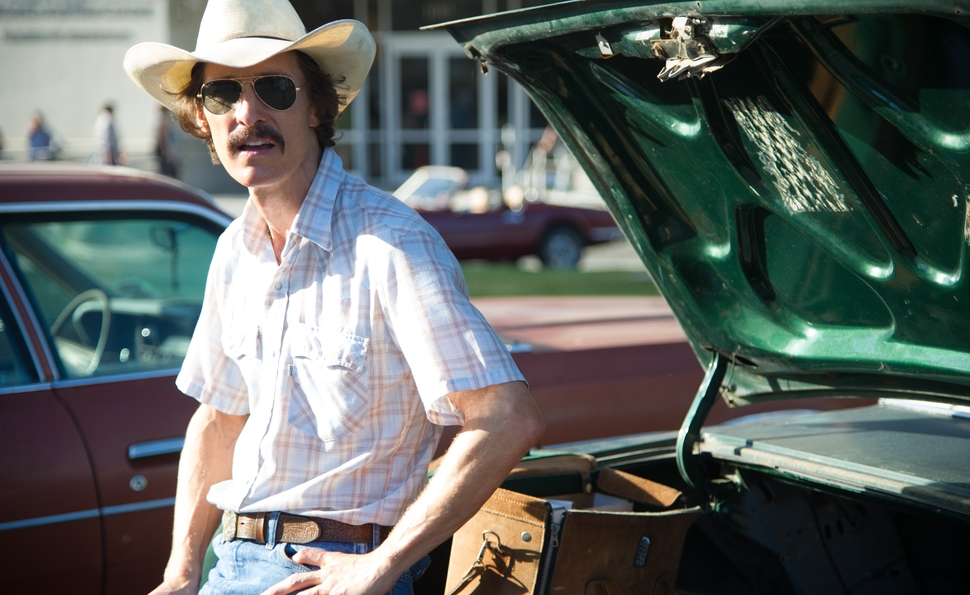
Since the late 80's and early 90's, the cause for people with HIV and AIDs has advanced tremendously. Though a stigma still remains surrounding people who have the disease, most have come to accept those who have it and regret how not so long ago we were ignorant and foolish regarding its existence and those who suffered from it. We're familiar with it, and we're familiar with the stories about it, and familiarity in a story means it makes it difficult to create a story that seems like we haven't heard it before. Based on a true story, Dallas Buyers Club is about homophobic Texan Ron Woodroof (Matthew McConaughey) who eventually changes the tune of his drum as he contracts HIV, and later full-blown AIDS, and sells unapproved drugs to a largely homosexual and transgendered clientele. What begins as a cash grab quickly transforms the man. While its sympathy for both those afflicted with the disease and the gay community is nice to see, Buyers Club feels far too calculated in its eagerness to get an emotional response from us. The film treats its subject as a sentimental, weepy melodrama, glossing over some of the darker elements at work in the narrative. Dallas Buyers Club could take a cue from its lead: McConaunghey's emotional nakedness stands in sharp relief to the material he's working with, elevating an unremarkable film.
Grade: ★★★
Grade: ★★★
Subscribe to:
Posts (Atom)